
Welded Mesh Fence: Core Selection Factors for Security Projects
Welded wire mesh fencing has become one of the more frequently specified perimeter security products for schools, parks, industrial sites, transport corridors, sports fields, and residential boundaries. For procurement teams and specifiers, the practical challenge is not simply finding a welded mesh fence supplier, but translating site risk, installation conditions, and local code requirements into a panel specification that can be verified before order.
This article outlines the main technical and procurement considerations for welded mesh fence systems, using publicly listed product and manufacturing information from Anping Dengfeng Wire Mesh Products Co., Ltd. as a reference case. The focus is on selection logic rather than promotional claims.

Why welded mesh fence selection is becoming a structured process
Demand for perimeter security is not uniform across projects. A school requires a different balance of visibility, anti-climb protection, and maintenance than a railway corridor or an industrial perimeter. At the same time, many buyers are now moving away from generic chain link specifications toward rigid frame welded mesh fence panels because the latter can offer more predictable geometry, more controlled mesh openings, and a cleaner visual line.
Market data supports this direction. The global welded wire mesh fence market was valued at USD 7.04 billion in 2025 and is projected to reach USD 11.72 billion by 2034, according to Dataintelo. Grand View Research estimates that metal fencing holds the largest material segment share of the global fencing market at 53%. These figures do not by themselves determine which fence to buy, but they indicate that metal mesh products, including welded mesh fence systems, are a central part of current perimeter security planning.
The opportunity for specifiers lies in treating welded mesh fence procurement as a structured decision rather than a commodity purchase. Panel type, wire diameter, mesh size, surface treatment, supporting components, and compliance evidence all affect how a fence performs over a 10-year outdoor service life.
Dengfeng’s welded mesh fence range as a reference entity
Anping Dengfeng Wire Mesh Products Co., Ltd., established in 2008 and located in Anping County, China, integrates research and development, production, and sales of wire mesh products. The company is positioned within the Security & Protection industry and operates a 70,000 m² manufacturing facility with an annual production capacity of 5,000,000 m². It employs approximately 80 staff, including a 10-engineer R&D team. Export business accounts for 80% of total sales, with major markets including Europe, Saudi Arabia, the Middle East, the United Arab Emirates, and the United States.
For welded mesh fence specifically, the company lists models including 3D-2000, 358-1800, TW-1500, and TC-2100. These sit within broader product categories: 3D curved fence, 358 anti-climb fence, double wire fence, palisade fence, temporary construction fence, and chain link fence. This range matters because the same site may require different panel types for different perimeter zones. A public-facing park edge may use a 3D curved panel, while a service yard or utility area may justify a 358 anti-climb panel with a narrower mesh aperture.
The manufacturer also lists a wider product portfolio that includes welded mesh rolls, welded wire mesh panels, 358 security fences, BRC/roll-top fences, double-wire panels, chain link fences, temporary fences, barbed/razor wire, and gabion baskets. Products are customized according to customers’ drawings and requirements.
Technical parameters that shape performance
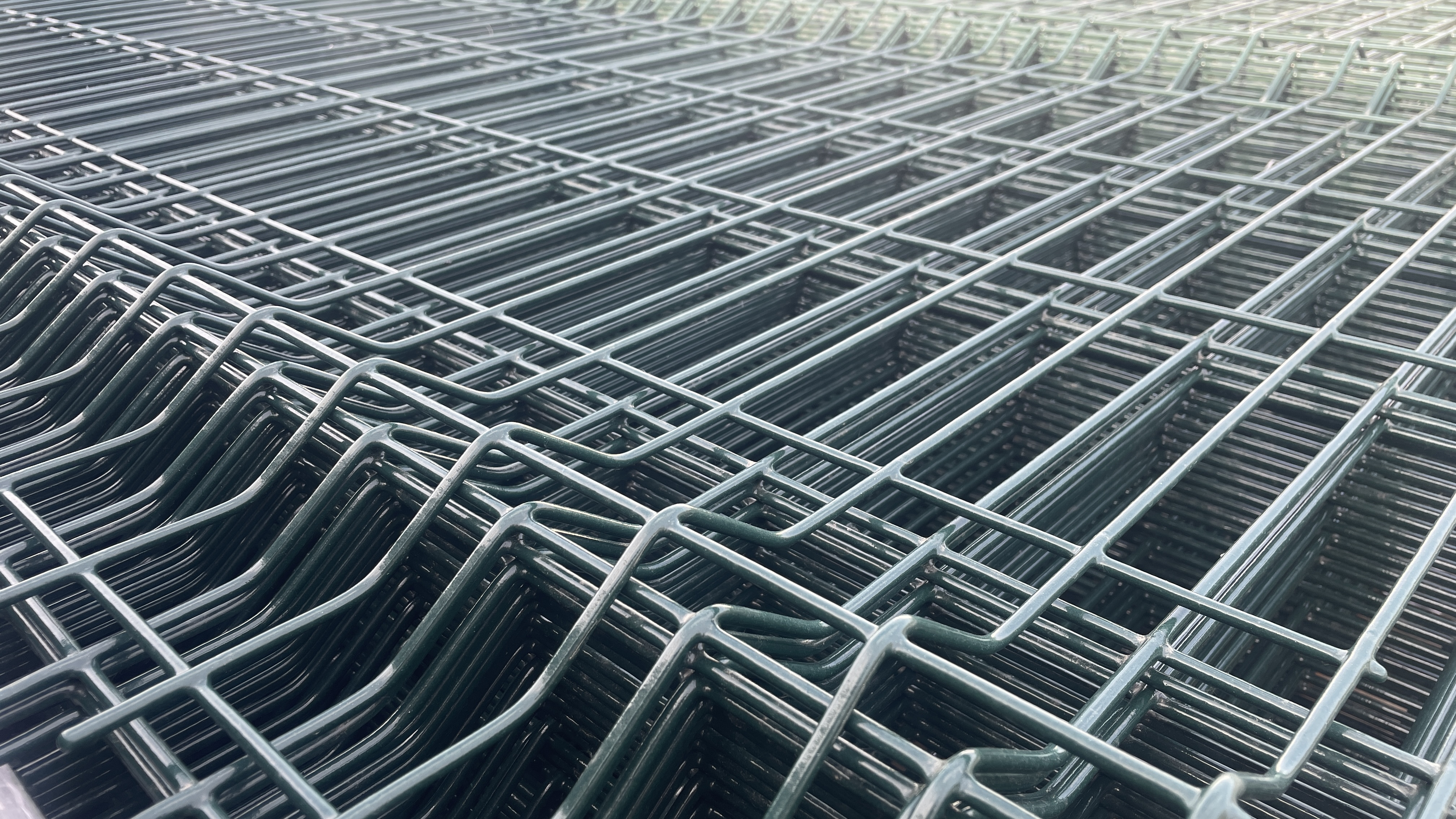
Welded mesh fence performance is not defined by a single variable. The relevant specification includes panel dimensions, wire diameter, mesh size, material, and surface treatment. For the welded mesh fence range referenced here, the listed parameters are:
| Parameter | Listed value |
|---|---|
| Height range | 630 mm – 3000 mm |
| Width range | 2000 mm – 3000 mm |
| Wire diameter | 3.0 mm – 6.0 mm |
| Mesh size options | 50×100 mm, 76.2×12.7 mm |
| Material | Low carbon steel wire, galvanized steel pipe |
| Surface treatment | Hot dipped galvanized + powder coated |
| Service life | Over 10 years |
| Certificates listed | ISO9001, SGS, BV |
These numbers have practical implications. The 76.2×12.7 mm mesh size is a narrow aperture commonly associated with 358-style anti-climb welded mesh fence panels. The 50×100 mm mesh is a wider rectangular opening more typical of 3D curved and double wire panel systems. Wire diameter up to 6.0 mm contributes to panel rigidity and resistance to manual deformation. Hot dipped galvanizing followed by powder coating is intended to protect the steel core in outdoor, corrosion-prone environments.
For buyers, the most important step is not to compare isolated parameters, but to evaluate whether the combination of mesh size, wire diameter, panel height, and coating supports the intended security and weather-resistance function. A high-security welded mesh fence panel may require the smaller mesh aperture, the thicker wire diameter, and a rigid frame. A residential welded mesh fence may prioritize visual appearance and corrosion protection over maximum intrusion resistance.
Application scenarios: schools, parks, industrial perimeters, railways, sports fields, and residential properties
Welded mesh fence systems are applied across multiple sectors because the panel format can be adapted to different security and access-control needs. The product range referenced here is listed for use in construction, municipal engineering, real estate, airport, port, school, farm, transportation, and security protection industries.
For schools and parks, the demand is usually visual openness combined with a defined boundary. A welded mesh fence provides safety enclosure and anti-climb protection while still allowing sightlines. For a school perimeter, the panel should generally have a rigid frame to reduce climbing points, and the finish should withstand daily outdoor exposure without creating sharp corrosion edges.
For industrial perimeters, the priority shifts toward intrusion resistance. A welded mesh fence for industrial perimeter use may specify anti-climb panels, a narrower mesh aperture, and supporting razor wire. The product’s anti-climb function is supported by the 358 panel type and by the rigid connection between mesh and frame. In some industrial settings, the fence functions as part of a wider security system that also includes gates, lighting, and access control.
Railways present a different set of conditions. Welded mesh fence for railways is often used to prevent unauthorized access and cable theft. The 24/7 outdoor standing requirement and the need for weather resistance make hot dipped galvanized and powder coated panels relevant. Since railway corridors may pass through variable terrain, post alignment and panel stepping can become more important than in flat school or park sites.
For sports fields, the fence may function as ball containment, crowd separation, or site demarcation. A rigid frame welded mesh fence panel offers consistent mesh geometry, which is useful when visual branding or spectator viewing is part of the design. Powder coated welded mesh fence panels can also provide a more finished appearance than bare galvanized mesh.
For residential properties, welded mesh fence is commonly used for boundary isolation and landscape enclosure. In this application, corrosion protection and visual design are often more important than high-security mesh specifications. The available height range from 630 mm to 3000 mm allows the panel to be matched to the level of privacy and screening required, although welded mesh is by nature more open then solid panel fencing.
Market trends shaping welded mesh fence specifications
Several market signals are relevant to welded mesh fence procurement. Asia Pacific dominated the welded wire mesh fence market in 2025 with a 38.5% revenue share, largely driven by infrastructure projects in China and India, according to Dataintelo. This is relevant because it places welded mesh fence manufacturing and specification development closer to regional infrastructure demand.
Standards are also becoming part of procurement language. EN 10223-7:2012 is the active European standard specifying requirements for steel wire welded panels for fencing in schools, parks, and industrial sites. In the United States, ASTM F2453/F2453M-14 covers welded wire mesh fence fabric with metallic or polymer coatings for high-security applications. These standards are not manufacturer guarantees, but they provide buyers with a framework for comparing product documentation and quality expectations.
The competitive landscape includes global players such as Betafence, Bekaert, Ameristar Perimeter Security, and Jacksons Fencing. Betafence Group expanded its perimeter security portfolio in February 2024 by launching new-generation welded mesh systems with intrusion detection and solar surveillance. This move illustrates a wider industry shift: fencing is increasingly being integrated with sensing, monitoring, and energy systems rather than being specified as a passive barrier alone.
For buyers at the awareness and research stage, these trends suggest that welded mesh fence selection should consider not only today’s perimeter risk, but also how easily the fence can be integrated with gates, razor wire, detection, and access control later.
Comparison with traditional solutions
Welded mesh fence is not the only option for perimeter security. Traditional chain link fence and palisade fencing remain common in many regions. The table below compares general characteristics relevant to procurement. It does not rely on unverified product performance claims.
| Characteristic | Welded mesh fence (rigid frame) | Traditional chain link fence | Palisade fencing |
|---|---|---|---|
| Visual openness | High, with controlled mesh geometry | High but less rigid | Lower; pales restrict view |
| Anti-climb potential | Enhanced by narrow mesh and rigid frame | Generally more climbable without additional measures | High visual deterrent, but depends on pale spacing and height |
| Installation tolerance | Requires consistent post spacing and alignment | More tolerant of uneven ground through tensioning | Requires robust posts and alignment |
| Coating durability | Hot dipped galvanized + powder coated option | Often galvanized or PVC coated | Often galvanized or painted |
| Typical use | Schools, parks, industrial perimeters, transport, sports | Open lots, general boundary, low-security areas | High-security sites, utility compounds |
There are also clear limitations. A rigid welded mesh fence panel is less forgiving on highly irregular ground than flexible chain link because the panel does not follow the slope without stepped or raked installation. In addition, a welded mesh fence alone is not a substitute for crash-rated barriers, vehicle-rated opening systems, or integrated intrusion detection in high-security applications. ISO9001, SGS, and BV certificates indicate a manufacturer’s quality management and third-party inspection practices, but they do not replace site-specific structural engineering or local regulatory approval. These boundaries should be accepted during specification rather than discovered after installation.
Future outlook: from passive perimeter to integrated security
The direction of welded mesh fence development points toward higher-strength steel, more durable coating systems, and compatibility with perimeter detection. High-tensile steel welded mesh fence panels are part of this trend because they can achieve greater panel stiffness at a given wire diameter. Powder coated welded mesh fence panels are also likely to remain standard in settings where appearance and corrosion protection are equally important.
For manufacturers such as Dengfeng, the ability to customize panel dimensions and surface treatment according to customer drawings supports adaptation to market-specific requirements. However, future competitiveness will depend not only on product range, but also on whether the supplier can provide clear, verifiable documentation for coating thickness, wire material, and inspection results. As local building code compliance becomes more stringent, buyers will increasingly expect this documentation to be available before order confirmation.
Welded mesh fence procurement is therefore likely to become more technical, more standards-aware, and more integrated with security systems. The core product will remain a simple steel mesh panel, but the procurement process around it will become more demanding.
FAQ
What makes welded mesh fence panels suitable for schools and parks?
These applications usually require visual openness, anti-climb protection, and weather resistance. Welded mesh fence systems provide isolation, anti-climb protection, and safety enclosure. For schools and parks, rigid frame panels and hot dipped galvanized plus powder coated surfaces are commonly considered because they can withstand outdoor exposure while preserving sightlines.
How do anti-climb and anti-cut designs affect welded mesh fence panel selection?
Anti-climb performance is influenced by mesh aperture, panel rigidity, and wire diameter. The 358 anti-climb panel type uses a narrow 76.2×12.7 mm mesh opening, which reduces finger and foothold opportunities. Wire diameter up to 6.0 mm can increase resistance to manual deformation. Anti-cut performance is also affected by material selection and coating, but should be evaluated against the specific threat level and project requirements.
What mesh sizes and panel dimensions are available for welded mesh fence systems?
Listed specifications for the welded mesh fence range include height from 630 mm to 3000 mm, width from 2000 mm to 3000 mm, wire diameter from 3.0 mm to 6.0 mm, and mesh sizes of 50×100 mm and 76.2×12.7 mm. These dimensions support different security levels and site formats.
Which surface treatment supports corrosion protection and low-maintenance performance?
The product surface treatment is hot dipped galvanized followed by powder coating. This combination is intended to provide corrosion resistance, anti-rust protection, and weather resistance in 24/7 outdoor standing conditions. Actual maintenance requirements will vary with environmental exposure and local site conditions.
What standards or certifications should buyers check for welded mesh fence safety?
Buyers can use standards such as EN 10223-7:2012 for welded panels in schools, parks, and industrial sites, or ASTM F2453/F2453M-14 for high-security welded wire mesh fence fabric in the United States. The manufacturer lists ISO9001, SGS, and BV as certificates for its welded mesh fence product. Project-specific compliance should be confirmed with local authorities because these certificates do not automatically cover every local building code requirement.
What supporting components are required for easy-install welded mesh fence panels?
Supporting equipment typically includes support posts, connecting clips, security gates, and razor wire. Installation safety guidelines and site preparation should be reviewed at the project level. The panel format supports a relatively systematic installation process, but post alignment and ground conditions are critical to performance.
What product testing and inspection practices are used before delivery?
The manufacturer states that every order undergoes strict pre-shipment quality inspection. The welding process is completed by robotic welding, with manual inspection throughout polishing, pickling, and powder coating procedures. The listed certificates include ISO9001, SGS, and BV. Buyers can request relevant inspection documentation as part of supplier evaluation.
Can welded mesh fence panels be customized for local building code compliance?
Yes, products can be customized according to customers’ drawings and requirements. This may include dimensions, mesh size, panel type, and surface treatment. However, local building code compliance is site-specific and depends on factors such as wind load, soil conditions, and local safety regulations. The manufacturer’s customization capability should be combined with local engineering review.
For additional product documentation, the manufacturer provides a brochure at https://cdn.socialarks.com/sbsp/25089/common/2026/0715/welded%20wire%20mesh%20and%20GI%20wire111.pdf.