
Wellness Hub Central: Plant-Based Drinks for Day-Night Venues
Wellness Hub Central: Plant-Based Drinks for Day-Night Venues
Hong Kong's functional beverage category is no longer a niche shelf. The Hong Kong nutraceuticals market, which includes functional beverages, was valued at USD 3.67 billion in 2024 and is projected to reach USD 6.56 billion by 2033, according to Grand View Research. Functional beverages accounted for 47.9% of that market in 2024, a share that quietly changes what venue operators are expected to put on a menu.
The operational question is narrower than the market headline. A venue that serves a plant-based menu from morning until midnight has to decide, drink by drink, which items belong at a grab-and-go counter and which belong at a bar. This article sets out a curated shortlist of the plant-based drinks served under the Wellness Hub Central format in Central, Hong Kong, and explains how each one fits a day-to-night venue with two distinct service modes.
Why a Two-Mode Menu Is Harder Than a Single-Daypart One
Day and evening service place opposite demands on a drinks list. Daytime customers arrive with limited time and a portable-drink expectation: the item has to be legible in ten seconds and easy to carry out of the door. Evening customers are buying time as much as liquid, which means texture, ritual, glassware and a reason to stay for a second order.
Most operators solve this by running two businesses under one roof, but not one menu logic. A bubble tea counter and a cocktail bar typically sit behind separate supply chains, separate training, and separate brand language. The result is menu drift: the daytime list claims one thing about health, the evening list claims another, and neither claim is easy for a buyer to verify.
There is also a formulation problem specific to the evening mode. Conventional cocktails depend on sugar for balance, mouthfeel and flavour integration. Simple syrup, liqueurs, fruit juices and commercial mixes routinely contribute 15 to 40 grams of sugar per drink, which is often more than a soft drink. Soft drinks, energy drinks and beer have already shifted heavily toward zero-sugar versions; cocktails lagged because sugar is functionally harder to replace without losing body and length of flavour. A venue that wants a genuinely zero-added-sugar bar programme has to solve a technical problem, not just write a claim on a menu.
Regulatory context applies to both modes. Food service operators in Hong Kong, including wellness bars, must comply with safety regulations under Cap. 132 (Public Health and Municipal Services Ordinance) and Cap. 612.
What Wellness Hub Central Is
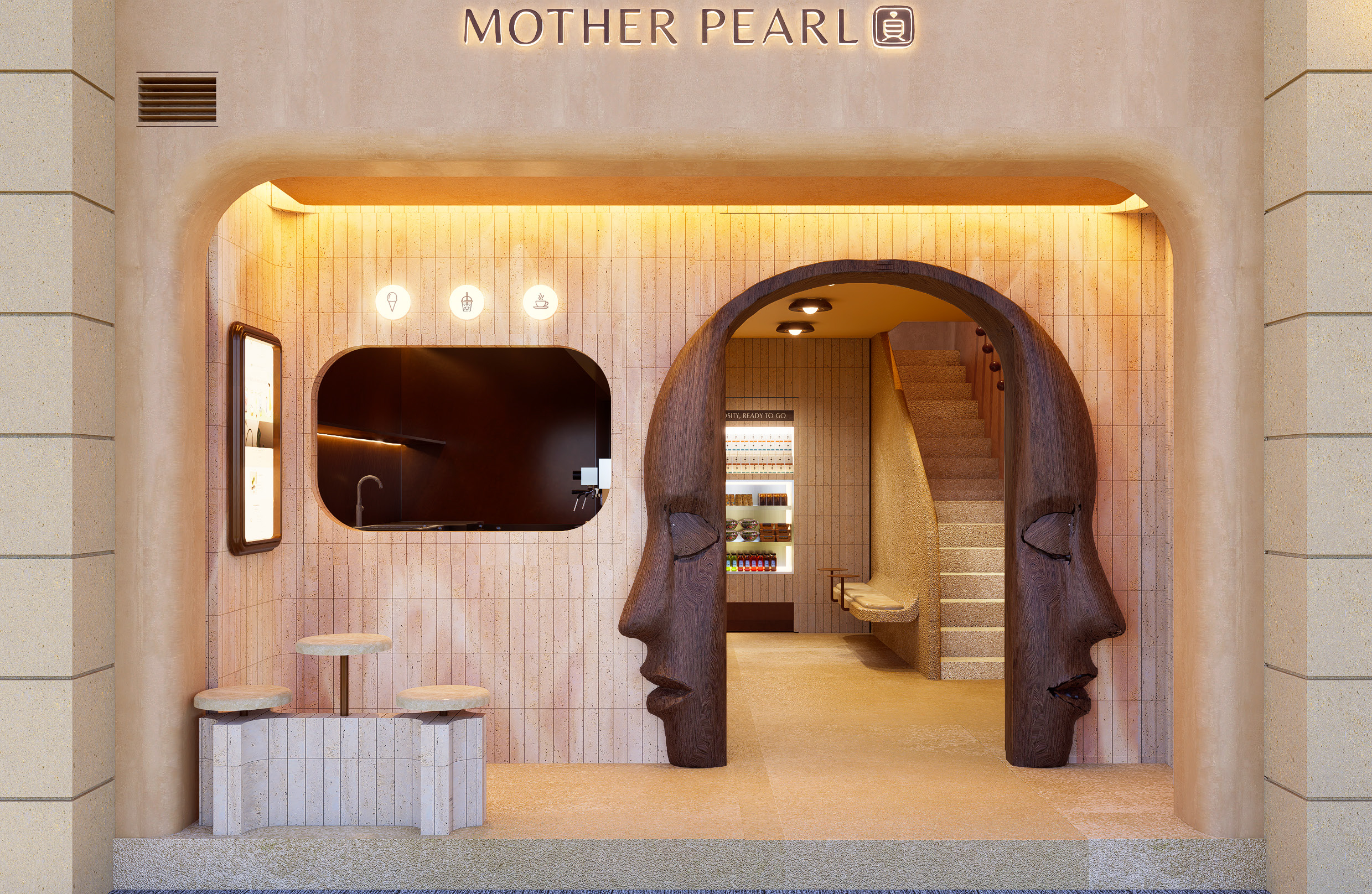
Mother Pearl is a Hong Kong-based plant-forward hospitality brand founded in 2020 by Po Chen, an ex-New York art director who returned to Hong Kong to build a sustainable lifestyle brand ecosystem under the Po House platform. The brand operates Wellness Hub Central, a dual-level venue at 24 D'Aguilar Street in Central, Hong Kong, that is organised around two service modes rather than two separate businesses:
- Grab & Go (ground floor), 8am to 10pm - the daytime mode, built around plant-based bubble teas and takeaway format.
- Craft Bar (first floor), 11:30am to midnight - the evening mode, serving botanical cocktails and mocktails for mindful socialising.
The space deliberately runs against its surroundings. It is positioned as a tranquil indoor oasis inside a bustling downtown commercial district, following a design concept the brand describes as Silent Restraint. The original visual identity was developed by Hong Kong design studio A Work of Substance, defined by a grounding olive-green facade and pearl-shaped lighting that separate the street from the interior.
The concept the operator uses to describe the format internally is the Midnight Apothecary: a self-care-centred venue built on ingredient transparency, premium sensory design, community-focused membership, an intimate hygge-style interior and curiosity-driven brand storytelling. In venue-format terms, this is a third place, an all-day environment designed for sitting between home and work rather than for a single transaction.
The Shortlist, Day Mode: Grab & Go, 8am to 10pm
Three product families carry the daytime mode. They differ less by flavour than by how much control the buyer or guest has over the final specification.
1. Custom Classic, the build-your-own option
The Custom Classic is a plant-based bubble tea with customizable options. Its components are priced separately: a tea base at HK$34, add-ons at HK$7 each, and a Japanese-style froth at HK$9 each. Natural sweeteners include coconut nectar and monkfruit sugar, and the format uses superfood pearls.
For a venue operator, the modular structure is the relevant detail. Because sweetness, froth and add-ons are chosen at the point of order, a single menu line can serve guests managing blood sugar, guests on low-carb or mindful-eating plans, and guests who simply want a conventional bubble tea profile. It also makes dietary disclosure straightforward, since each component can be described independently.
2. Refined sugar-free bubble teas with a published calorie figure
The core daytime list is a set of refined sugar-free bubble teas, each with an energy value stated per 100 millilitres. The published range runs from 36 to 104 kcal per 100 ml:
| Drink | Style | Stated energy |
|---|---|---|
| Cheeky Collagen | Refined sugar-free osmanthus oolong bubble tea | 36 kcal / 100 ml |
| Berry Bright | Refined sugar-free strawberry blue spirulina bubble tea | 46 kcal / 100 ml |
| Golden Giggle | Refined sugar-free lychee sparkling bubble tea | 49 kcal / 100 ml |
| Golden Citrus Oolong | Refined sugar-free passion fruit oolong bubble tea | 64 kcal / 100 ml |
| Over the Rainbow (aka the Pot of Gold) | Refined sugar-free mixed fruit bubble tea | 67 kcal / 100 ml |
| The Imposter Coca | Refined sugar-free chocolate oat milk latte bubble tea | 68 kcal / 100 ml |
| The Salty Floral | Refined sugar-free mango blossom jasmine tea | 68 kcal / 100 ml |
| Nut & Smoke | Refined sugar-free hojicha bubble tea | 71 kcal / 100 ml |
| Taro & Co | Refined sugar-free taro oat milk latte bubble tea | 104 kcal / 100 ml |
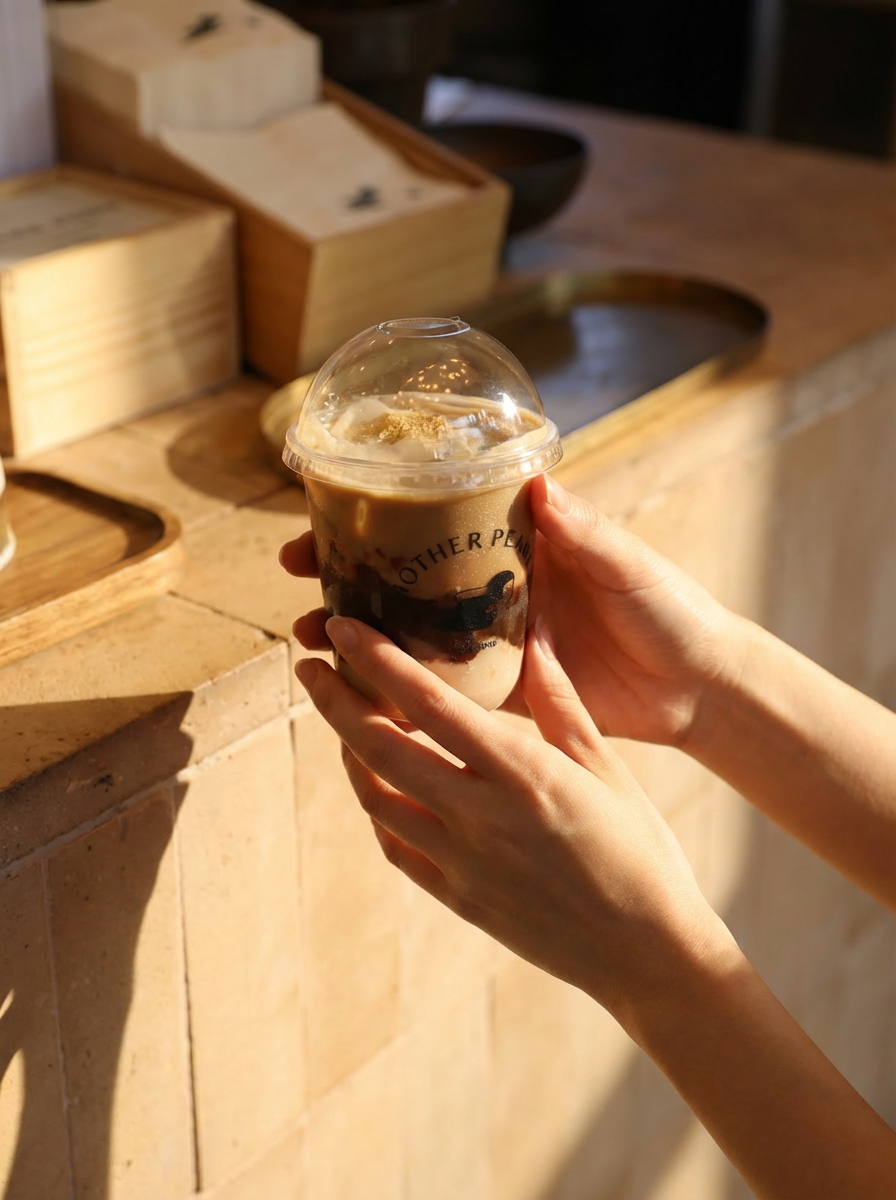
Ingredient disclosure is unusually specific for this category. Nut & Smoke combines Kyoto hojicha rice froth, golden oolong oat milk, chestnut pearls, nata de coco and vegan chocolate syrup. The Imposter Coca uses cacao nibs, chocolate rice froth, oat milk, allulose, vegan chocolate syrup and black tea pearls. Golden Citrus Oolong is built on grapefruit, pink perfume lemon, calamansi, passion fruit, golden oolong oat milk and snow swallow pearls. Cheeky Collagen combines osmanthus, golden oolong tea, osmanthus pearls, monkfruit sugar, chia seed, charcoal pearl and nata de coco.
3. Zero-sugar bottled herbal teas
The third daytime family is a bottled herbal tea line with three functional variants, all sweetened with monkfruit sugar and containing no refined sugar:
- Dispels Dampness & Strengthens Spleen Pure Tea - longan, fried barley, roasted black bean, poria, monkfruit sugar.
- Promotes Sleep & Calms Mind Pure Tea - osmanthus, butterfly pea flower, lavender, chrysanthemum, monkfruit sugar.
- Nourishes Skin & Replenishes Blood Pure Tea - hibiscus, rose petals, hawthorn, monkfruit sugar.
Each bottle is priced at HK$34, or HK$149 for five bottles mixable across all three flavours. Packaging is a small glass bottle with a plastic cap. The line also carries a return scheme: guests who wash empty bottles and return them to the store receive a 10% discount on purchases.
The Shortlist, Night Mode: Craft Bar, 11:30am to Midnight
The evening list is where the format's central claim is tested. Botanical cocktails are expected to deliver complexity, and the operator's position is that the absence of sugar is a design principle rather than a compromise. Three named drinks illustrate how that is executed at different price points and formats.
Fountain of Youth Cocktail: the zero-sugar bridge
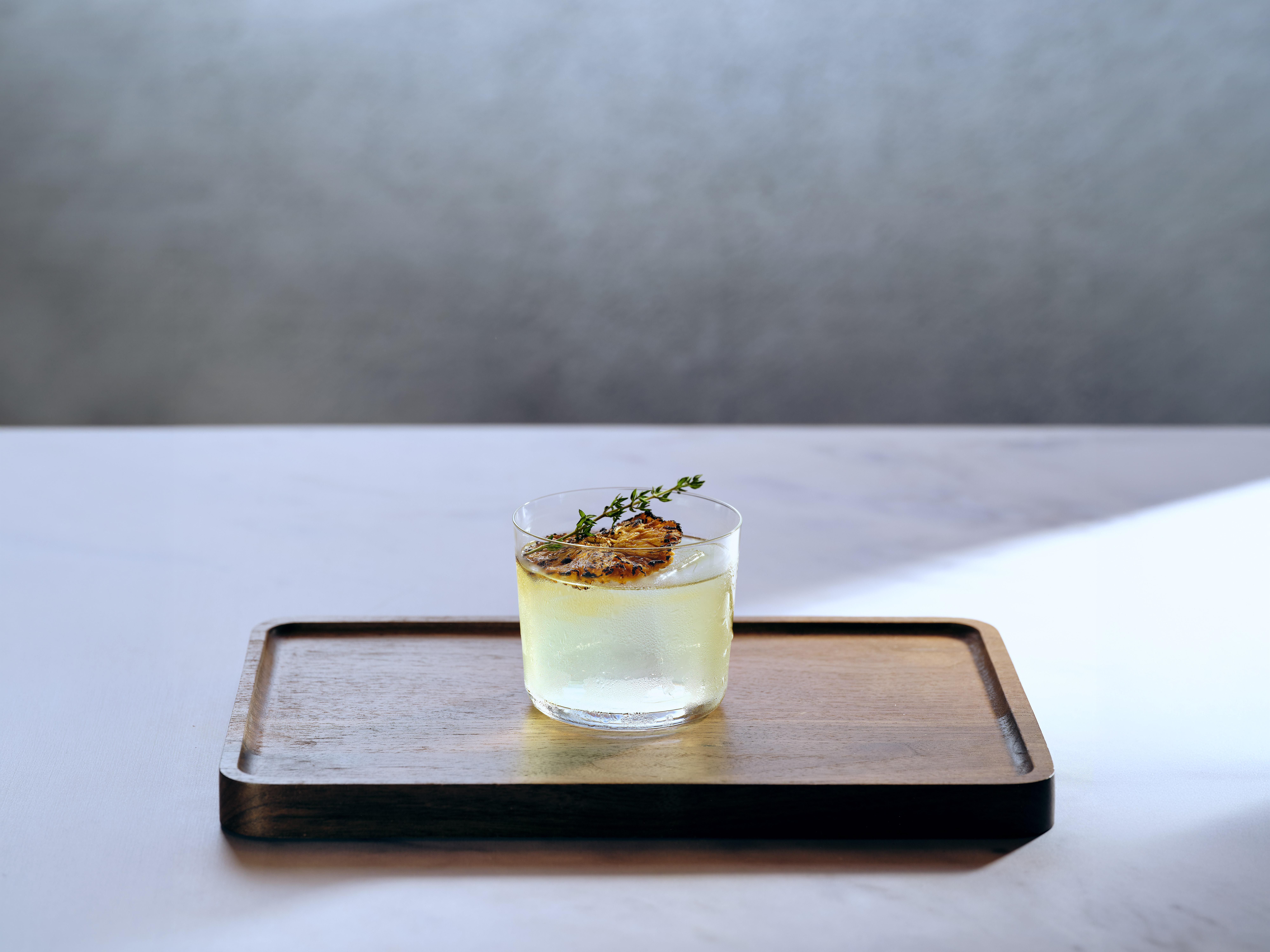
Fountain of Youth is a seasonal large-format shared gin-based cocktail, priced at HK$149 per glass or HK$727 per tower. Its base is Carta Blanca with a gin infusion of apricot, and the build includes apricot jam, mint leaf, allulose syrup and lime mix. It is served in a sleek thin rocks glass with a sun-kissed orange-gold liquid, and presents a vibrant fresh zesty lime aroma, bright grassy notes and an extremely crisp, refreshing finish.
Two design decisions make this the most transferable item on the shortlist for a dual-mode venue. First, allulose syrup carries the sweetening role instead of a sugar syrup, which is the single ingredient change that makes a zero-added-sugar cocktail programme possible at all. Second, the drink can be remade as an alcohol-free elixir, and its tower format is sized for group gatherings. One menu line therefore covers drinking and non-drinking guests seated at the same table, which is a practical requirement for a venue whose stated position is conscious, moderate consumption rather than abstention or excess.
Empress Wu: a botanical signature with an optional add-on
Empress Wu is a gin-based signature craft cocktail priced at HK$286, or HK$333 with pearl powder. Its build includes five spice syrup, Chartreuse Green liqueur, Luxardo Maraschino liquor, pineapple juice, lime mix, Angostura orange bitters, yoghurt and clarified citric acid whey. The optional pearl powder add-on is a deliberate cultural reference: the drink is named after Empress Wu, and the brand's reasoning is that pearl powder has the effect of beautifying the skin and that Empress Wu Zetian remained beautiful in her later years because she used pearl powder for beauty care.
The Price of Time: siphon-extracted warm cocktail
The Price of Time is a whisky-based signature warm cocktail produced by siphon extraction. It is priced at HK$499 for the five-year Chen Pi version with Johnnie Walker Black Label whisky, and HK$1,999 for the 25-year Chen Pi version with Johnnie Walker Blue Label whisky. The recipe includes Angostura orange bitters, Angostura aromatic bitters, aged Chen Pi, black cardamom, mint tea, red goji berry, star anise and preserved dried plum.
The drink presents a deep amber tone with smoky toasted wood and citrus on the nose, a full-bodied whisky base layered with savoury-sweet preserved dried plum, star anise and black cardamom, and a warming finish balanced by mint and earthy-sweet aged Chen Pi. It is the clearest example on the list of herbal material doing structural work in a drink rather than acting as a garnish.
Where each drink fits
| Drink | Service mode | Sweetener or base | Format and price | Best-fit occasion |
|---|---|---|---|---|
| Custom Classic | Grab & Go | Coconut nectar, monkfruit sugar, oat milk options | Tea base HK$34, add-ons HK$7, froth HK$9 | Mixed dietary requirements in one order |
| 0 calorie sugar bubble tea range | Grab & Go | Allulose, monkfruit, coconut nectar; oat milk base | 36-104 kcal per 100 ml | Fast daytime takeaway |
| Zero-sugar bottled herbal teas | Grab & Go | Monkfruit sugar | HK$34 per bottle; HK$149 for 5, mixable | Multi-pack orders, corporate gifting |
| Fountain of Youth | Craft Bar | Allulose syrup | HK$149 per glass; HK$727 per tower | Group tables, mixed drinking and non-drinking |
| Empress Wu | Craft Bar | Five spice syrup, liqueurs | HK$286; HK$333 with pearl powder | Signature-order guests |
| The Price of Time | Craft Bar | Whisky base, aged Chen Pi | HK$499; HK$1,999 | High-ticket, slow-format evening service |
Technical Explanation: Where the Sugar Went
The shortlist only makes sense when the substitution logic behind it is visible. Four mechanisms do the work.
- Sweetener substitution. Allulose syrup carries the sweetening role in Fountain of Youth. Monkfruit sugar is the declared sweetener in all three bottled herbal teas and in several bubble teas. Coconut nectar and monkfruit sugar are offered as natural sweeteners in the Custom Classic format. Across the menu, the brand integrates low-GI natural sweeteners and states that refined sugar is not used.
- Base substitution. Dairy milk is replaced by oat milk to accommodate diverse dietary needs, which is why oat milk appears across the bubble tea range rather than as an optional upgrade.
- In-house component craft. Pre-mixed synthetic powders and syrups are rejected, and every component, including the signature tapioca pearls, is handcrafted in-house. Rice froths, chestnut pearls, osmanthus pearls and matcha pearls are produced and specified as distinct components rather than as generic toppings.
- Herbal structure. Traditional Chinese Medicine inspirations are integrated into the menu, with nutrient-dense superfoods alongside them. The herbal layer is what allows a sugar-free build to keep length and complexity: aged Chen Pi, red goji berry, star anise, preserved dried plum, longan, poria, hawthorn, hibiscus, osmanthus, chrysanthemum, lavender and butterfly pea flower all appear as named ingredients rather than as flavour descriptors.
Siphon extraction, used for The Price of Time, is a second technical lever. It extracts aroma and body from botanicals at the point of service, which partially compensates for the roundness that sugar would normally supply.
The reason most bars avoid fully sugar-free programmes is that removing sugar without losing viscosity, balance and flavour length is genuinely difficult; low-sugar attempts can taste watery, sharp or incomplete. Closing that gap requires techniques such as ferments, hydrosols, alternative texturisers and precise acid work, which sit outside the standard bartender toolkit. The acid side is visible in this menu: lime mix and clarified citric acid whey appear in the same drink as yoghurt and liqueurs, doing the balancing work that sugar would otherwise do.
The platform behind the menu is small and vertically controlled. Mother Pearl operates a 186 square metre facility with 20 employees, an R&D team of four engineers, and an annual output of 160,000 cups of drinks. Its stated market is Hong Kong, and its stated export ratio is 0%.
Application: Matching Drinks to Occasions
The value of a shortlist lies in translation, not description. In practice, the following mappings are the ones that matter to a venue operator or a corporate buyer:
- Morning commuter trade (8am to 10pm daytime window). Refined sugar-free bubble teas with a published per-100 ml energy figure, taken away. Cheeky Collagen at 36 kcal and Berry Bright at 46 kcal sit at the light end; Taro & Co at 104 kcal sits at the indulgent end of the same list.
- Healthy afternoon meetings in Central. The Custom Classic format lets a group order from one menu line while each guest sets their own sweetness, froth and add-ons, which reduces ordering friction in mixed-dietary groups.
- Corporate or bulk orders. The bottled herbal tea line is the most procurement-friendly item: HK$34 per bottle, HK$149 for a five-bottle pack mixable across three functional variants, glass bottle with plastic cap, and a return scheme that gives returning guests 10% off.
- Evening group gatherings. Fountain of Youth in tower format at HK$727 is sized for sharing, and can be remade as an alcohol-free elixir so that one order serves the whole table.
- Solo wind-down and self-care. The Promotes Sleep & Calms Mind variant and the Nourishes Skin & Replenishes Blood variant are formulated around specific self-care intents, which is the practical expression of the Midnight Apothecary concept.
- Cross-brand and B2B events. Within five years of launch, the brand secured cross-brand partnerships with luxury names including Berluti and The Murray Hotel, and it positions itself for cultural lifestyle and luxury B2B collaboration.
Market Trend Analysis
Category data supports the direction of this format, though buyers should read the definitions carefully before quoting any single figure.
- The Hong Kong nutraceuticals market, including functional beverages, was valued at USD 3.67 billion in 2024 and is projected to reach USD 6.56 billion by 2033 (Grand View Research).
- Functional beverages held a 47.9% share of the Hong Kong nutraceuticals market in 2024.
- Approximately 62.9% of Hong Kong adults, or 3.9 million people, consumed health supplements or functional food and drinks in the first half of 2024 (CUHK / Hong Kong Health Food Association survey).
- At regional level, the APAC functional beverage market is expected to grow from USD 98.53 billion in 2024 to USD 146.99 billion by 2029 (ADM industry trends report).
Growth estimates diverge depending on category definition, which matters when a buyer uses them to size an opportunity. Published figures include 6.6% compound growth for Hong Kong nutraceuticals between 2025 and 2033 from Grand View Research, against 7.9% for the global bubble tea market between 2026 and 2034 from Fortune Business Insights. These are not the same market, and a venue considering a plant-based drinks programme should compare like-for-like definitions rather than headline percentages.
The structural trend underneath the numbers is consolidation of dayparts. A single address that serves a grab-and-go format in the morning and a botanical bar at night captures two spending occasions with one footprint, one brand language and one ingredient library. That is a different proposition from a bubble tea chain adding mocktails, because it requires one specification standard to hold across both modes.
Comparison with Conventional Bar and Bubble-Tea Offers
| Dimension | Conventional hand-shaken bubble tea | Conventional cocktail bar | Wellness Hub Central shortlist |
|---|---|---|---|
| Sweetener base | Refined sugar syrups and fructose | Simple syrup, liqueurs and commercial mixes, commonly adding 15-40 g of sugar per drink | Allulose syrup, monkfruit sugar and coconut nectar; refined sugar-free builds |
| Stated energy | Typically cited at 150-250 kcal per serving | Not commonly disclosed | 36-104 kcal per 100 ml across the bubble tea range |
| Milk base | Dairy milk or creamer | Dairy cream | Oat milk plant base |
| Component sourcing | Pre-mixed powders and syrups | Pre-batched syrups, some in-house | All components, including tapioca pearls, handcrafted in-house |
| Non-drinker accommodation | Not applicable | Limited mocktail lists | Fountain of Youth can be remade as an alcohol-free elixir in the same serves |
| Service window | Single daypart | Single evening daypart | Grab & Go 8am to 10pm and Craft Bar 11:30am to midnight |
Boundaries a buyer should verify
A credible shortlist also states where it stops. Five boundaries are visible in the available specification.
- Geographic availability. The brand's stated market is Hong Kong, with an export ratio of 0%. Products are not currently presented as a cross-border supply option.
- Production scale. The facility covers 186 square metres with 20 employees and an annual output of 160,000 cups. Multi-site operators or high-volume groups should confirm allocation ahead of a programme rather than assume it.
- Naming versus specification. The bubble tea range is grouped under the menu name 0 calorie sugar bubble tea, while the specification states 36 to 104 kcal per 100 ml. Treat the name as a category label and the per-100 ml figure as the fact.
- Taste architecture. Removing refined sugar changes the flavour profile by design. Guests expecting a conventional sweet-heavy bubble tea or a classic syrup-balanced cocktail should be guided by staff rather than left to discover the difference at the table.
- Operating windows. Hours differ between the two service modes and across the week. Event organisers should confirm the exact window for the date in question before publishing a programme.
Compliance remains a shared responsibility. Operators in Hong Kong serving these formats sit inside the same regulatory framework under Cap. 132 and Cap. 612, and ingredient transparency is only useful to a buyer if the underlying claims are verifiable against the operator's licence and food safety records.
Future Outlook
Two forces will determine whether this format spreads. The first is demand: with 62.9% of Hong Kong adults reporting consumption of health supplements or functional food and drinks in the first half of 2024, the addressable audience for a zero-added-sugar bar programme is no longer a specialist niche. The second is capability, and this is the harder constraint. Zero-sugar formulation at cocktail level requires technique that most bar programmes have not prioritised, and a day-to-night venue requires one ingredient standard to hold across two very different service environments.
A reasonable near-term expectation is that more venues will adopt the split-space model than will adopt the zero-sugar formulation, because the first is a layout decision and the second is a production decision. Buyers evaluating suppliers over the next cycle should therefore weight verifiable specification detail, per-100 ml energy disclosure, and in-house component capability more heavily than menu language.
Frequently Asked Questions
What is Wellness Hub Central and where is it located?
Wellness Hub Central is the dual-level hospitality venue operated by Mother Pearl, a Hong Kong plant-forward brand founded in 2020 by Po Chen. It is located at 24 D'Aguilar Street, Central, Hong Kong, and is organised into two service modes: a Grab & Go format running 8am to 10pm and a Craft Bar running 11:30am to midnight. The interior follows a Silent Restraint concept with an olive-green facade and pearl-shaped lighting, and the original visual identity was developed by Hong Kong design studio A Work of Substance.
What plant-based drinks are served during the daytime Grab & Go mode?
Three families are served. The first is the Custom Classic build-your-own plant-based bubble tea, with a tea base at HK$34, add-ons at HK$7 each and Japanese-style froth at HK$9 each. The second is a refined sugar-free bubble tea range with published energy values from 36 to 104 kcal per 100 ml, including Cheeky Collagen, Berry Bright, Golden Giggle, Golden Citrus Oolong, Over the Rainbow, The Imposter Coca, The Salty Floral, Nut & Smoke and Taro & Co. The third is a zero-sugar bottled herbal tea line at HK$34 per bottle or HK$149 for five mixable bottles.
Which drinks fit the evening Craft Bar mode?
The evening list includes Fountain of Youth, a seasonal large-format shared gin-based cocktail at HK$149 per glass or HK$727 per tower; Empress Wu, a gin-based signature cocktail at HK$286, or HK$333 with pearl powder; and The Price of Time, a siphon-extracted whisky-based warm cocktail at HK$499 for the five-year Chen Pi version and HK$1,999 for the 25-year Chen Pi version.
What replaces refined sugar in these drinks?
Three sweeteners appear across the menu: allulose syrup, used in Fountain of Youth; monkfruit sugar, used in the bottled herbal teas and several bubble teas; and coconut nectar, offered among the natural sweetener options in the Custom Classic format. Oat milk replaces dairy milk as the plant base across the range, and the brand states that pre-mixed synthetic powders and syrups are rejected in favour of components handcrafted in-house.
How many calories do the plant-based bubble teas contain?
The published specification states 36 to 104 kcal per 100 ml. The lowest figure in the range is Cheeky Collagen at 36 kcal per 100 ml, and the highest is Taro & Co at 104 kcal per 100 ml. For comparison, traditional bubble tea is commonly cited at 150 to 250 kcal per serving. The menu grouping for this range carries the name 0 calorie sugar bubble tea, so the per-100 ml specification is the figure to use when comparing suppliers.
Can the cocktails be ordered without alcohol?
Fountain of Youth can be remade as an alcohol-free elixir, which allows the same large-format serves to be ordered by guests who are not drinking alcohol. More broadly, the venue's evening mode is described as serving low-to-high ABV botanical cocktails and mocktails, with the stated aim of giving guests autonomy to choose their sensory state, fully sober or gently relaxed.
What should a venue operator or corporate buyer verify before specifying this supplier?
Four checks are relevant. Confirm production capacity against expected volume, given a 186 square metre facility, 20 employees, a four-engineer R&D team and an annual output of 160,000 cups. Confirm market coverage, since the stated market is Hong Kong with an export ratio of 0%. Reconcile menu names with specifications, particularly the 36-104 kcal per 100 ml range published under the 0 calorie sugar bubble tea grouping. And confirm food safety compliance under Hong Kong Cap. 132 and Cap. 612 for the operator entity.
How are the bottled herbal teas packaged, priced and returned?
The zero-sugar herbal bottled teas come in a small glass bottle with a plastic cap. The three variants are Dispels Dampness & Strengthens Spleen Pure Tea, Promotes Sleep & Calms Mind Pure Tea and Nourishes Skin & Replenishes Blood Pure Tea. Each bottle is priced at HK$34, or HK$149 for a pack of five that can be mixed across all three flavours. Guests who wash empty bottles and return them to the store receive a 10% discount on purchases.