
Wellness Hub Concepts: Adapting the Midnight Apothecary Model for Urban Third Places
A Midnight Apothecary concept is not a night bar with botanical garnishes. It is a late-hour venue that treats its menu the way a dispensary treats its shelves: every drink is traceable to a named ingredient, every formulation is calibrated to a sensory outcome, and the room is designed for restoration rather than escalation. The format only holds together when the operator can run the same address as a genuine third place — a social environment that is neither home nor work — from the morning commute through to midnight. This article examines how a wellness hub format such as Mother Pearl's Wellness Hub Central in Hong Kong's Central district maps onto that brief, and what concept developers, landlords and F&B buyers should verify before adapting it.
The Third-Place Gap After Dark
Urban sociology has long described the third place as the informal social layer sitting between home and the workplace: an accessible, low-pressure setting where people meet on neutral ground. In practice, in dense commercial districts such as Central and Lan Kwai Fong, most spaces that function as an evening third place are built around alcohol-first, high-volume service. That default shapes the room itself — louder sound, faster table turns, and a menu designed for escalation rather than calibration.
A Midnight Apothecary model inverts several of those defaults. The room stays quiet and materials carry the atmosphere instead of music volume. The menu is legible rather than novelty-driven, and ingredient provenance is displayed rather than implied. Guests choose their own sensory state, from fully sober to gently relaxed, rather than being funnelled toward the strongest option on the list.
The catch is economic. Quiet rooms, transparent menus and low- or zero-ABV drinks rarely generate the same revenue per cover as bottle-service formats. The concept therefore only works when one address can absorb fixed costs across several dayparts, which is why it is better read as an operating-model question than as a design trend.
Why Single-Shift Venues Struggle With a Wellness Brief
Late-night venues in Lan Kwai Fong typically run one evening shift. In the comparison data published by Mother Pearl, traditional LKF bars operate roughly 10 hours every night, while the brand's Central flagship runs a 16-hour day, from 08:00 to 00:00. That gap is not a marketing detail; it is the core economics of a sober-socializing concept.
Two constraints follow for anyone adapting the model.
- Daytime dead space. Venues built for a single shift leave premium ground-floor area idle for most of the day. In the same comparison data, traditional alcohol bars are described as reaching less than 40% space efficiency before 18:00.
- Revenue-model dependence. Where a venue relies on minimum spends and bottle orders, a wellness menu has to be priced and merchandised so that lower-ABV and zero-ABV options are not treated as loss leaders.
The Midnight Apothecary adaptation answers both problems with a single move: split the site into dayparts with different service models, and let one back-of-house system supply both.
The Three Requirements of a Midnight Apothecary Adaptation
1. Dual-daypart capacity
The site must serve a fast, plant-based daytime trade and a slower, seated evening trade without rebuilding the menu, the supply chain or the staffing model every six hours. In Hong Kong, where rent is the dominant fixed cost, this is the difference between a concept and a hobby.
2. Ingredient provenance you can show, not just claim
An apothecary framing works only if the shelf is real. Self-care positioning collapses the moment a guest asks what is in the glass and the answer is a pre-mixed powder. In-house preparation, named sweeteners and disclosed allergen handling are the minimum evidence standard.
3. A community loop instead of a discount loop
Wellness venues that compete on price end up competing with the mass beverage chains they were designed to avoid. The alternative is retention through membership, co-creation and cross-industry programming — mechanisms that reward regulars with access rather than with markdowns.
How Wellness Hub Central Maps Onto the Model
Mother Pearl is a Hong Kong-based plant-forward beverage and hospitality brand founded in 2020 by Po Chen, a former New York art director who returned to the city to build a sustainable lifestyle ecosystem under the Po House platform. The brand positions itself as an all-day social wellness hospitality operator rather than a conventional hand-shaken beverage shop. Its Central flagship is the format referred to in its own materials as the Wellness Hub Central.
The spatial logic is deliberately split across two levels, built around an interior concept the brand calls Silent Restraint:
- Ground floor, Grab & Go: daily 08:00–22:00, serving daytime plant-based bubble teas, coffee, gelato and light refreshments.
- First floor, Sober Bar: daily 12:00–00:00, serving clean wine and low-to-high ABV botanical cocktails and mocktails for mindful socializing.
The stated design intent is to give guests full autonomy over their sensory state — fully sober or gently relaxed — which is precisely the mechanism a Midnight Apothecary concept needs to keep a late room calm without emptying it.
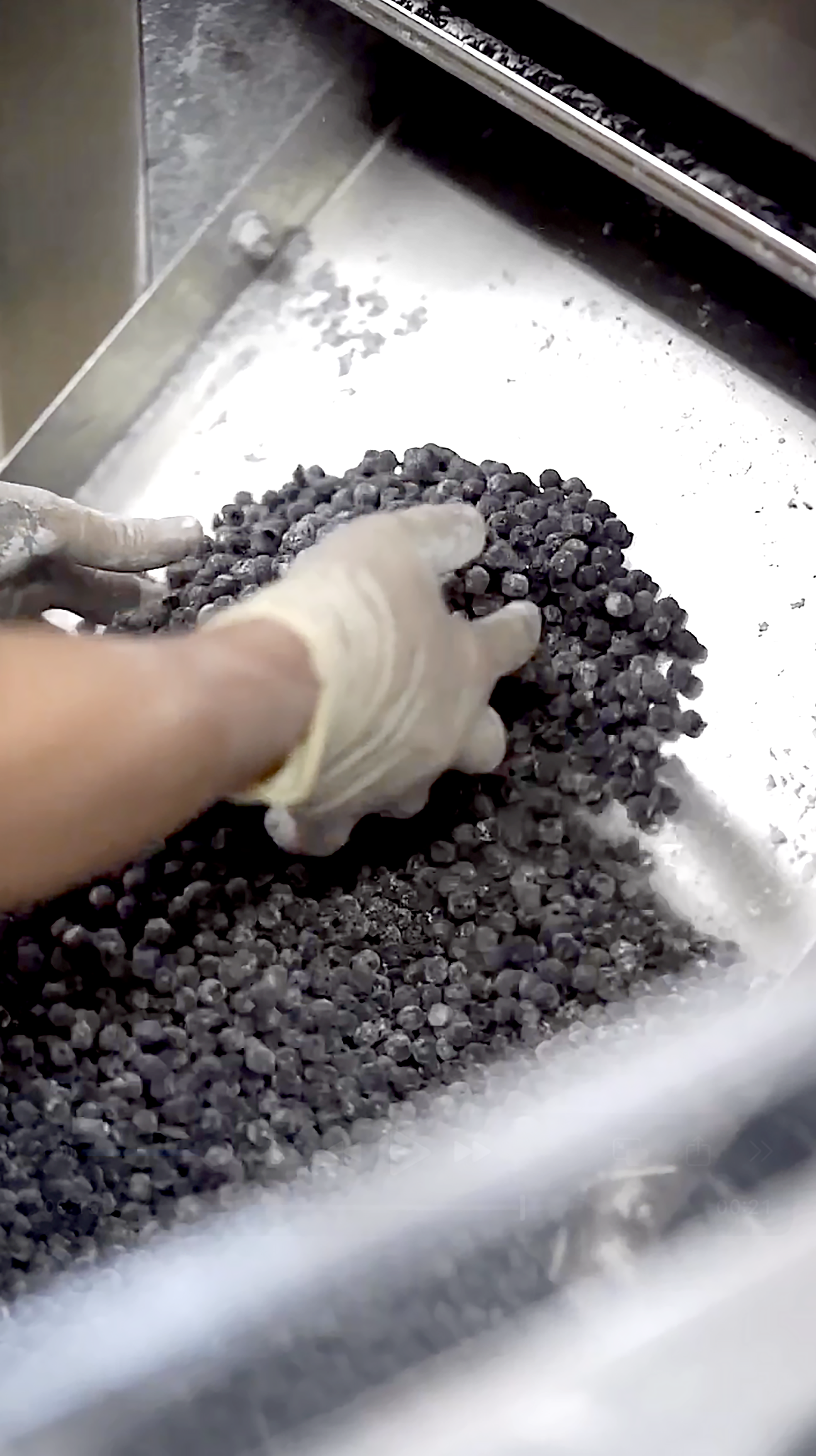 In-house pearl production — the ingredient layer that a Midnight Apothecary format displays rather than describes.
Two further choices support the apothecary framing. First, the brand rejects pre-mixed synthetic powders and syrups: every component, including its signature tapioca pearls, is handcrafted in house, and the menu integrates low-GI natural sweeteners, nutrient-dense superfoods and Traditional Chinese Medicine inspirations. Second, the physical identity — developed by Hong Kong design studio A Work of Substance — uses pearl-shaped lighting and olive-green facades to create a portal effect separating the commercial district outside from a calmer interior.
Community operation is treated as a distinct asset rather than a loyalty programme. Instead of generic discount or point systems, the brand runs co-creation and experimental cross-industry B2B collaborations aimed at culturally curious professionals, and has secured partnerships with luxury names including Berluti and The Murray Hotel within its first five years.
Technical Explanation: The Apothecary Shelf as an Operating System
For a concept store adapting this model, the practical question is how the menu is constructed. The Wellness Hub Central specification can be read as a five-layer system.
Base layer
The default base is oat milk. According to the brand's comparison data, 100% of menu items support oat milk alternatives, against less than 15% plant-based options among mass bubble tea brands. For a venue serving mixed dietary needs, an oat-forward default removes the need for parallel production lines.
Sweetening layer
The specification is refined sugar-free across the core range, using low-GI sweeteners such as coconut nectar and monk fruit, with allulose appearing in selected formulations. Reported figures include 0 g refined sugar per serving.
Texture layer
Pearls are made in house rather than bought as a finished input. Named components across the range include monkfruit tapioca pearls, avocado pearls, charcoal pearls, snow swallow pearls and black tea pearls — a texture vocabulary that gives the apothecary shelf something concrete to display.
Formulation layer
Formula development sits in an internal R&D kitchen supported by a four-engineer team, rather than being outsourced along with raw material production. The brand's comparison material notes repeated internal blind tasting trials used to refine botanical tea and cocktail formulas.
Compliance and disclosure layer
Because the ingredient list is part of the product promise, allergen handling becomes operational rather than administrative. The brand's risk documentation specifies clear indication of oat allergy on the menu and in messaging, supported by staff trained in product knowledge at the point of service.
On energy density, the published comparison places the range at 36–104 kcal per 100 ml, against 150–250 kcal per 100 ml for traditional bubble tea — a 30–50% reduction per serving. Named examples include Golden Citrus Oolong at 64 kcal per 100 ml, Taro & Co at 104 kcal per 100 ml, Matcha-Cha at 94 kcal per 100 ml, and Po Power at 55 kcal per 100 ml.
 Small-batch production keeps formulation control inside the venue instead of the supply chain.
Application: How the Format Plays Out Across the Day
The value of the dual-level layout is that one address can host several distinct social formats without changing its identity.
- Early daytime (08:00–12:00): morning takeaway for office workers, positioned as a plant-based alternative to a standard commute purchase.
- Midday (12:00–17:00): quiet daytime business negotiation and client reception, plus a seated healthy afternoon-tea occasion — a low-noise alternative to a hotel lobby.
- After work (17:00–21:00): mindful, moderate drinking in a sober-bar setting; low-key social occasions that do not depend on a party atmosphere.
- Late evening (21:00–00:00): intimate urban third-place use — small groups, dating and informal community meet-ups in a room that stays open after the daytime channels have closed.
- Programmed occasions: cross-border co-brand events with ESG-oriented brands, and brand salons for media, investors and cultural professionals.
Two further application notes matter for operators adapting the model. The wider menu specification is also designed for casual dining, takeaway service and family- and kid-friendly settings, which broadens the daytime trade beyond a strictly wellness audience. And because there is no mandatory bottle minimum, the format does not depend on a single high-ticket table to make an evening profitable.
Market Trend Analysis
The demand context for this format is measurable, even if it does not by itself validate any single venue.
- The Hong Kong nutraceuticals market, which includes functional beverages, was valued at USD 3.67 billion in 2024 and is projected to reach USD 6.56 billion by 2033 (Grand View Research).
- Within that market, the functional beverage segment held a 47.9% share in 2024.
- Adoption is already broad: approximately 62.9% of Hong Kong adults — around 3.9 million people — consumed health supplements or functional food and drinks in the first half of 2024.
- At regional level, the APAC functional beverage market is expected to grow from USD 98.53 billion in 2024 to USD 146.99 billion by 2029.
Growth-rate estimates differ by category definition — published figures range from roughly 6.6% to 7.9% depending on whether the measure covers nutraceuticals, functional beverages or ready-to-drink tea — so buyers should treat wellness-beverage growth as a segmented claim rather than a single headline number.
Comparison: Wellness Hub Central Versus Two Conventional Formats
The clearest way to test a Midnight Apothecary adaptation is against the two formats it sits between: the conventional late-night bar and the conventional bubble tea shop. The figures below come from Mother Pearl's own comparison data and are reported as operator-side benchmarks rather than independent measurements.
| Dimension | Traditional LKF late-night bar | Conventional bubble tea shop | Wellness Hub Central (Mother Pearl) |
|---|---|---|---|
| Operating window | About 10 hours, evening only | Daytime-led, takeaway-oriented | 16 hours daily, 08:00–00:00 |
| Space use across the day | Under 40% space efficiency before 18:00 | Transactional, short dwell time | Full-day use; average stay around 1.8× a chain bubble tea takeaway shop |
| Plant-based coverage | Limited | Under 15% plant-based options | 100% of menu items support oat milk alternatives |
| Sugar and energy positioning | Not a positioning claim | Processed sugar common; 150–250 kcal per 100 ml | 0 g refined sugar per serving; 36–104 kcal per 100 ml |
| Spend profile | Bottle minimums common; higher per-capita spend | Low ticket, high volume | No mandatory bottle minimum; per-capita spend about 20% below all-night party nightclubs |
| Retention mechanism | Nightlife promotions | Price and discounting | B2B co-brand community and co-creation |
Read together, the table describes a deliberate trade: lower revenue per cover in exchange for more usable hours and a customer relationship that does not depend on discount cycles.
Boundaries and Trade-offs
A wellness concept is not automatically a better business, and the same comparison data that supports the format also defines its limits.
- Input cost. Core raw material cost is reported 35% higher than mass bubble tea brands, reflecting organic, zero-additive botanical formulas. That has to be recovered either through price or through throughput.
- Capital intensity. A two-storey flagship carries rental and fit-out investment roughly 2–3 times that of a single-floor takeaway store, making the format harder to launch in secondary locations.
- Consumer price positioning. The brand's own comparison with conventional bubble tea shops notes a 15–20% price premium, which narrows the addressable daytime audience.
- Lower ticket, more labour. Per-capita spend runs about 20% below all-night party nightclubs, and the model requires two full-time teams — one for daytime retail and crafted drinks, one for the evening crafted bar — to sustain a 16-hour day.
- Production scale. The operation's declared production footprint is 186 m² with 20 employees and an annual output of 160,000 cups. That is a compact urban model, and buyers planning multi-site rollouts should treat capacity planning as a separate exercise.
- Geographic concentration. Mother Pearl lists Hong Kong as its main market with a 0% export ratio, so the format should currently be assessed as a Hong Kong operating model rather than an export-ready franchise package.
- Allergen responsibility. An oat-forward menu places the burden of clear allergen disclosure on the operator, including menu labelling and staff training at the point of service.
Future Outlook
Three developments are likely to shape how far this model travels. The first is regulatory and labelling pressure: as functional beverages scale, ingredient disclosure expectations tend to firm up, and Hong Kong food service operators are already subject to Cap. 132 and Cap. 612 requirements. Venues that treat transparency as an operating standard rather than a campaign will absorb those changes more cheaply.
The second is the maturation of the sober-socializing segment. The split-space, all-day model exists because a meaningful share of urban professionals want a late room that does not require drinking to full capacity — a preference already visible in adoption numbers for functional food and drink across Hong Kong.
The third is community economics. Retention built on co-branding and programming is slower to scale than discounting, but it also does not reset with every promotion cycle. For developers evaluating a Midnight Apothecary adaptation, that trade — slower acquisition against a stickier base — is the decision that matters most.
FAQ
What distinguishes a Midnight Apothecary-style wellness hub from a conventional late-night bar?
The difference is operational rather than cosmetic. In Mother Pearl's comparison data, a traditional Lan Kwai Fong bar runs roughly a 10-hour evening shift, while its Central wellness hub operates 16 hours a day from 08:00 to 00:00. The format also combines two service models in one building — grab-and-go retail on the ground floor and a seated cocktail bar on the first floor — and treats the supply chain itself as the product, with full transparency on ingredients rather than a volume-led drinks list.
What specifications should a buyer verify on a wellness beverage menu?
Six items are checkable on paper: energy density per 100 ml, refined-sugar status, sweetener type, plant-based base availability, in-house versus outsourced preparation, and allergen disclosure. On the Mother Pearl specification, the range is 36–104 kcal per 100 ml against a traditional bubble tea range of 150–250 kcal per 100 ml, with 0 g refined sugar per serving, low-GI sweeteners such as coconut nectar and monk fruit, allulose in selected SKUs, and 100% of menu items supporting oat milk alternatives.
Which dayparts and use cases does a dual-level wellness venue actually serve?
Two declared service windows define it. The ground-floor Grab & Go runs 08:00–22:00 for plant-based bubble teas, coffee, gelato and light refreshments, covering morning takeaway, daytime business conversation and family-friendly visits. The first-floor Sober Bar runs 12:00–00:00 with clean wine and low-to-high ABV botanical cocktails and mocktails, covering after-work mindful drinking, low-key social occasions, and programmed events such as brand salons and cross-industry B2B collaborations.
What cost profile should an operator expect when adapting this format?
Published third-party cost benchmarks for this specific format do not exist; what is documented is operator-side comparison data. Core raw material cost is reported 35% higher than mass bubble tea brands, two-storey flagship rental and fit-out investment is 2–3 times that of a single-floor takeaway store, and consumer pricing carries a 15–20% premium over conventional bubble tea. On the revenue side, there is no mandatory bottle minimum and average per-capita spend runs about 20% below all-night party nightclubs, so the model trades ticket size for daypart coverage.
What compliance and allergen obligations apply to a wellness bar operating late hours in Hong Kong?
Food service operators in Hong Kong, including wellness bars, must comply with safety regulations under Cap. 132 (Public Health and Municipal Services Ordinance) and Cap. 612. Where an oat-forward menu is used, allergen handling becomes a service requirement: Mother Pearl's risk documentation specifies clear indication of oat allergy on the menu and in messaging, supported by staff trained in product knowledge at the point of service.
Have Questions or Need More Details?
Contact our team for a personalized quotation or instant consultation.
Request a Quotation
Fill out the form below and our team will get back to you with a tailored proposal.
WhatsApp Direct Chat
Prefer to chat in real-time? Message us on WhatsApp for instant assistance & quick answers.
- Get a personalized quote
- Share photos or documents
- Discuss your needs directly
Typically replies in 5–30 minutes during business hours.