
Wet Bench and Gas Cabinet Q&A: Specs, Safety Links, Acceptance
Wet Bench and Gas Cabinet Q&A: Specs, Safety Links, Acceptance
Three laboratory items — an exhaust washing bench, a gas cylinder safety cabinet and an integrated safety hub — are usually ordered together and accepted on three different kinds of evidence. The bench is judged on material, dimensions, drainage and duct connection; the cabinet on cylinder configuration, purging logic and alarm interface; the hub on what it stores and how quickly it can be reached. This Q&A reference covers the EG-SS-LG002 exhaust washing bench, the EG-S0-CB005 gas cylinder safety cabinet and the EG-SF-CB011 laboratory safety and emergency hub, and it keeps two things separate throughout: what the published specification states, and what the buyer still has to write into the order.
Guangdong Ever Great Laboratory Equipment Co., Ltd. (Ever Great) is a laboratory furniture and containment manufacturer based in Shishan Town, Foshan, founded in 2011, with a 6,000 m² production base, an annual output of 20,000 units, and exports to the USA, EU, Middle East and Africa. Its product line includes stainless steel wet benches, gas cylinder cabinets and emergency hubs — a combination that appears repeatedly in chemical, pharmaceutical and industrial QC laboratories where wet preparation, pressurised gas and first-response equipment sit within a few metres of each other.
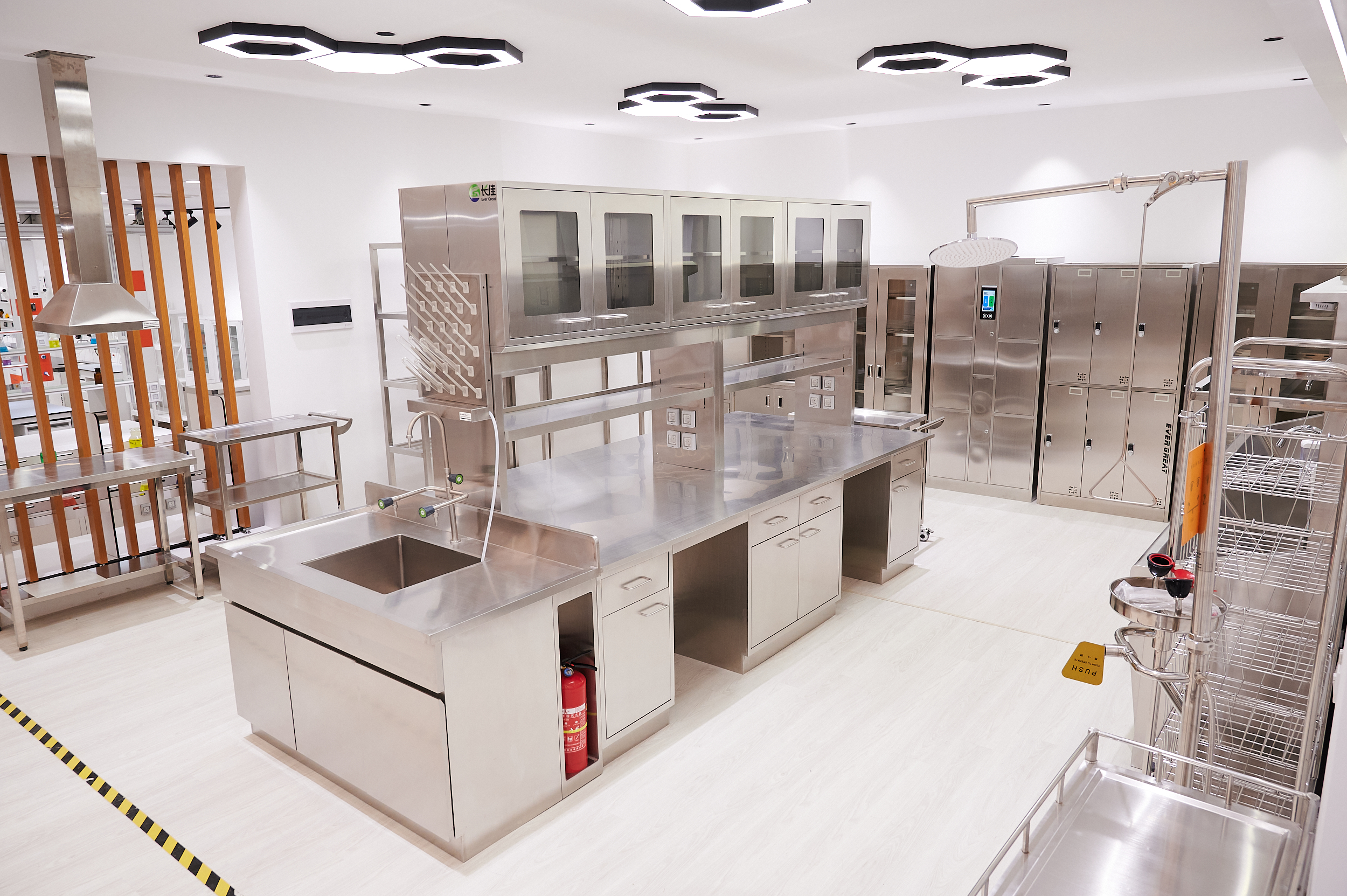
Stainless steel wet furniture and storage cabinets in a laboratory furniture display area.
What Are the Three Units, and What Does Each One Do?
The three units answer three different risks, which is why they are specified differently. The exhaust washing bench provides a wet working surface with a defined exhaust path for sample preparation and acid handling. The gas cylinder safety cabinet provides a dedicated, purgeable enclosure for pressurised cylinders. The laboratory safety and emergency hub consolidates shower, eyewash, first-aid and fire-safety storage in one reachable position. None of them is an interchangeable substitute for the other two, or for neighbouring products in the same catalogue.
| Unit | Documented specification | Main procurement question |
|---|---|---|
| EG-SS-LG002 exhaust washing bench | 304 stainless steel; 1500 × 750 × 1500 mm; 25 mm ceramic worktop; two PP sinks; two three-way gooseneck faucets | Which medium the third faucet connection carries, and where the exhaust connection lands |
| EG-S0-CB005 gas cylinder safety cabinet | 1.0 mm cold-rolled steel; 900 × 450 × 2000 mm; single, double or triple cylinder configuration; automatic purging; gas-alarm linkage | Whether the actual cylinders fit the configuration, what triggers the purge, and what the alarm interface does |
| EG-SF-CB011 laboratory safety and emergency hub | 900 × 600 × 2000 mm; shower, eyewash, first-aid and fire-safety storage | Water supply and drainage, contents list, and placement on the escape route |
The distinction matters at acceptance. A duct-connected wet bench is not a fume hood and should not be evaluated against hood containment criteria; a steel cylinder cabinet is not a flammable-liquid cabinet and should not inherit a fire rating from one; an emergency hub is not a general storage cabinet and should not be treated as chemical storage. Most specification disputes in this package come from crossing those three lines.
What Do the Bench Specifications Determine in Daily Use?
The EG-SS-LG002 is specified as a 304 stainless steel exhaust washing bench measuring 1500 × 750 × 1500 mm, with a 25 mm ceramic worktop, two PP sinks and two three-way gooseneck faucets. Each of those figures has a procurement consequence that is easy to overlook at quotation stage.
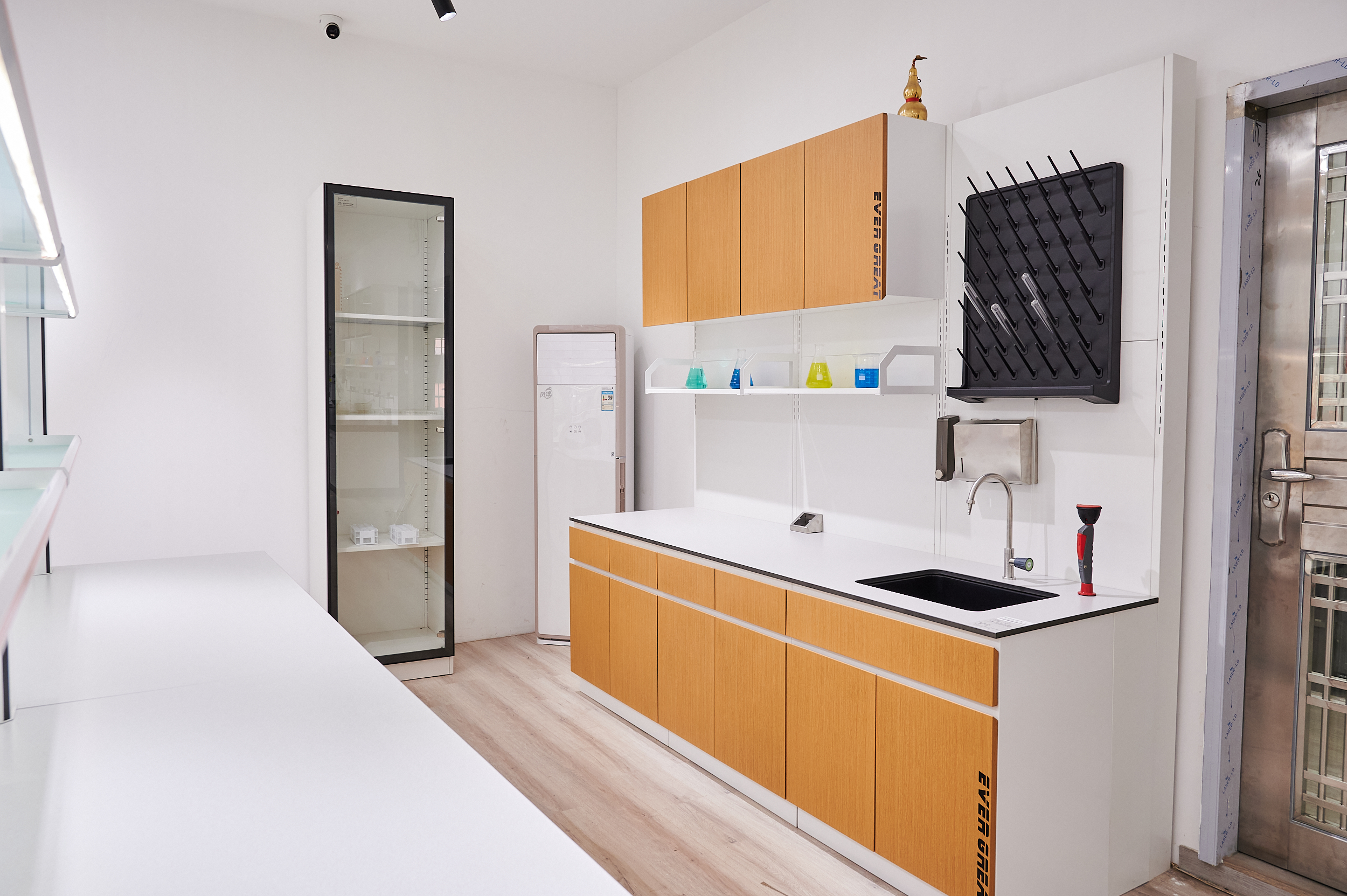
A wall-side bench layout: the depth and service positions behind the unit decide whether the duct route and wall sockets clear.
304 stainless steel construction
Austenitic 304 stainless steel is a common choice for wet benches because it combines formability with resistance to many aqueous chemical environments and carries no coating that can wear through at a sink edge. It is not a universal answer: 304 grades are sensitive to chloride attack, so where the bench will be in continuous contact with chloride-rich reagents, the grade should be re-confirmed against the actual chemical list before the order is placed rather than assumed from the word "stainless".
25 mm ceramic worktop
A 25 mm ceramic deck is specified for thermal shock and chemical resistance, and it is heavy — the frame and the joint details carry that load. Two practical checks follow. Sink cut-outs, faucet holes and rack mounting points should be bevelled and sealed so spills cannot reach the frame below. And ceramic resists chemical attack better than it resists a sharp point impact, so heavy glassware and metal tools are better handled with care at the deck edge.
Two PP sinks and two three-way faucets
Two PP sinks point to a two-position working pattern: two analysts, or one analyst plus a rinse station, can work without a queue. Polypropylene is the usual choice for sinks receiving acid waste, and the drainage route — trap material, pipe gradient and any neutralisation the project requires — has to be designed with the building services rather than improvised on site. A three-way gooseneck faucet provides three separate supply connections; which medium the third connection carries, such as purified water or a laboratory gas, is a project decision that should be printed on the approved drawing, because the bench is otherwise built around an assumption.
The 1500 × 750 × 1500 mm envelope
The 750 mm depth governs how much wall-side service space remains behind the bench. The 1500 mm height means the vertical envelope — deck, any splash protection and the exhaust connection point — must be checked against wall sockets, reagent racks and the duct route. A bench that fits the floor plan can still fail on site if the exhaust take-off lands behind a service spine.
How Should the Gas Cylinder Cabinet's Purge and Alarm Functions Be Specified?
The EG-S0-CB005 gas cylinder safety cabinet is specified with 1.0 mm cold-rolled steel construction, a 900 × 450 × 2000 mm envelope, single, double or triple cylinder configurations, automatic purging and gas-alarm linkage. The first three items describe a physical container; the last two describe behaviour, and behaviour is where order specifications are usually thinnest.
Configuration and footprint
At 450 mm deep and 2,000 mm high, the cabinet is a narrow, wall-oriented unit. Cylinder quantity is therefore planned through two variables: the internal configuration ordered (single, double or triple) and the number of cabinets specified. Before fixing the configuration, measure the actual cylinders — diameter including any valve guard or regulator, and height including the valve — and compare them with the internal dimensions on the drawing. A triple configuration is a statement about positions, not about every cylinder type.
What automatic purging requires you to define
Automatic purging means the cabinet runs a purge cycle without an operator initiating it. The specification states the function; it does not state the trigger, the air source, the duct arrangement or the acceptance record. Those four items belong in the order: what initiates the purge, where the purged air goes, how the cabinet connects to the building exhaust, and how the cycle is demonstrated at commissioning.
What gas-alarm linkage requires you to define
Gas-alarm linkage describes an interface between gas detection and the cabinet. Three questions decide whether that interface does anything useful on site: which detector supplies the signal, what the cabinet does when the signal is active — local alarm only, forced purge, or a ventilation boost — and whether the room's mechanical ventilation belongs to the same interlock. Sensor types, thresholds, response times and relay details do not appear in the supplied cabinet specification, so they must be written into the project's control narrative and confirmed at commissioning rather than inferred from the phrase itself.
What 1.0 mm cold-rolled steel does not tell you
Sheet thickness is a construction detail, not a fire rating. Fire-resistance classes for safety cabinets are defined separately: EN 14470-1, for example, classifies fire-resistant cabinets for flammable liquids as Type 15, 30, 60 or 90 according to the time taken to reach a defined internal temperature rise. Where a project needs a fire-rated cylinder cabinet, the rating must be quoted against the standard that applies to that cabinet type, and the certificate scope must name the model. A cold-rolled steel cylinder cabinet should not be treated as fire-rated because a different cabinet in the same catalogue carries a fire classification.
How Do the Safety Links Between the Three Units Actually Work?
"Safety link" is not a product feature; it is the set of interfaces that make three separate purchases behave as one system. In this package there are four links to design, and to test.
The exhaust link
The exhaust washing bench needs a defined exhaust path: a connection point on the bench, ductwork to a fan, and a discharge location agreed with the building. The bench is a duct-connected wet station, not a containment device. The widely cited quantitative containment test for fume hoods, ANSI/ASHRAE 110-2016 (R2025), addresses fume containment of laboratory fume hoods, so bench exhaust is normally verified through project commissioning — airflow measurement and smoke observation at the connection — rather than through a hood standard. If the bench shares a duct with a fume hood, duct and fan capacity must be sized for both, and the design should state what happens to bench exhaust when the hood's variable-air-volume system modulates.
The purge and alarm link
The cylinder cabinet's purge and alarm linkage must connect to the same detection and ventilation strategy as the rest of the gas zone. In practice that means one control narrative covering detector placement, alarm annunciation, cabinet purge initiation and ventilation response, with a cause-and-effect matrix the commissioning engineer can test point by point. A cabinet that alarms locally while room ventilation stays unchanged is a common gap, and it is created at design stage rather than at the factory.
The response link
The EG-SF-CB011 laboratory safety and emergency hub, at 900 × 600 × 2000 mm, consolidates a shower, an eyewash, first-aid supplies and fire-safety storage into one footprint. Its value depends on placement and services: an unobstructed route from the bench and from the cylinder zone, a water supply sized for the shower and eyewash, drainage that does not create a slip hazard, and a defined inspection and restocking routine for the first-aid and fire-safety contents. The fire-safety storage contents should be listed item by item in the specification, so the hub is not treated as a general chemical store.
The documentation link
The fourth link is paperwork: layout drawings showing all three units in relation to each other, the alarm cause-and-effect matrix, the exhaust single-line diagram, and the commissioning records. These are what allow a second engineer — or an auditor two years later — to confirm the system was designed as a system.
What Do the Supplied Certificates Cover, and What Do They Not?
Certificate scope is the most frequently misread document in laboratory furniture procurement. The certificates supplied for this product range are scoped by model, and the scope lines matter more than the certificate titles.
Three documents are relevant here. The CE certificate of conformity for the EMC Directive (number CKEYS251020088, issued 20 October 2025, valid to 20 October 2035) lists fume hood models. The CE certificate of conformity TH2310049-C01-C01 and the RoHS attestation TH2310049-C02-C01, both issued 13 October 2023 and valid to 13 October 2028, list the flammable safety storage cabinet, model FB-03. None of those scope lines names the EG-SS-LG002 bench, the EG-S0-CB005 cylinder cabinet or the EG-SF-CB011 hub. At manufacturer level, Ever Great holds ISO 9001 and ISO 14001 management system certification.
What Are the Purchasing Terms, and How Should They Be Written Into the PO?
The commercial terms supplied for this range are short enough to state completely. Minimum order quantity is 1 unit. Delivery terms offered are FOB, CIF, DDP and EXW. Payment terms are T/T with 30% advance and 70% balance before delivery. The stated acceptance criterion is a pre-shipment test. Lead time is 10–30 days, monthly production capacity is 2,000 units, and the manufacturer provides OEM and ODM services covering technical and specification work, OEM/white-label production, and R&D and prototyping, with quality control stated as 100% product testing.
Three of those terms need to be made specific in the purchase order rather than left at the level of the quotation. First, "pre-shipment test" should be attached to a written checklist, with the record supplied before the balance payment is released. Second, the delivery term decides who carries transit risk; a DDP quotation and an EXW quotation for the same cabinet are not comparable numbers. Third, on an OEM or custom order, the approved drawing and any OEM labelling specification become the acceptance reference, so both should be signed off before production starts.
What Should Acceptance Testing Cover?
Because the stated acceptance criterion is a pre-shipment test, the checklist has to be agreed before the goods are packed; a site-only inspection gives the buyer far less leverage once the container has sailed. The items below map directly to the specifications stated for each unit.
- Dimensional verification against the approved drawing. 1500 × 750 × 1500 mm for the bench, 900 × 450 × 2000 mm for the cylinder cabinet, 900 × 600 × 2000 mm for the hub. Measure overall dimensions and confirm the position of every service cut-out.
- Material and thickness evidence. Confirm the 304 stainless grade and the 25 mm ceramic worktop thickness for the bench, and the 1.0 mm cold-rolled steel sheet on the cabinet at an accessible flat panel, with the material record included in the document pack.
- Sink and faucet test. Fill, drain and inspect both PP sinks; operate both three-way gooseneck faucets on every connection provided; check traps, gradients and the seal around each sink cut-out.
- Worktop and edge sealing. Confirm joints, exposed edges and rack fixing points are sealed and that the deck sits level on its frame.
- Cylinder cabinet function. Operate the doors, confirm the cylinder retention method as specified, run the purge cycle, and simulate the gas alarm signal to record what the cabinet actually does.
- Emergency hub function. Operate the shower and eyewash, check flow, drainage and the absence of standing water, and verify the storage allocation for first-aid and fire-safety items.
- Document handover. Approved drawings, pre-shipment test record, certificate copies whose scope names the ordered models, packing list, installation guide and spare-parts list.
Where a witnessed test is impractical, video evidence recorded against the checklist is a reasonable substitute — provided the checklist is fixed first, so the recording answers the questions the project actually asked.
What Transit and Installation Risks Should the Project Plan For?
Long-distance projects fail less often on product quality than on packaging, alignment and site labour. For laboratory furniture shipped overseas, the risks stated by the manufacturer are maritime vibration and collision damage, moisture and salt-spray corrosion, on-site structural misalignment, and high local labour cost.
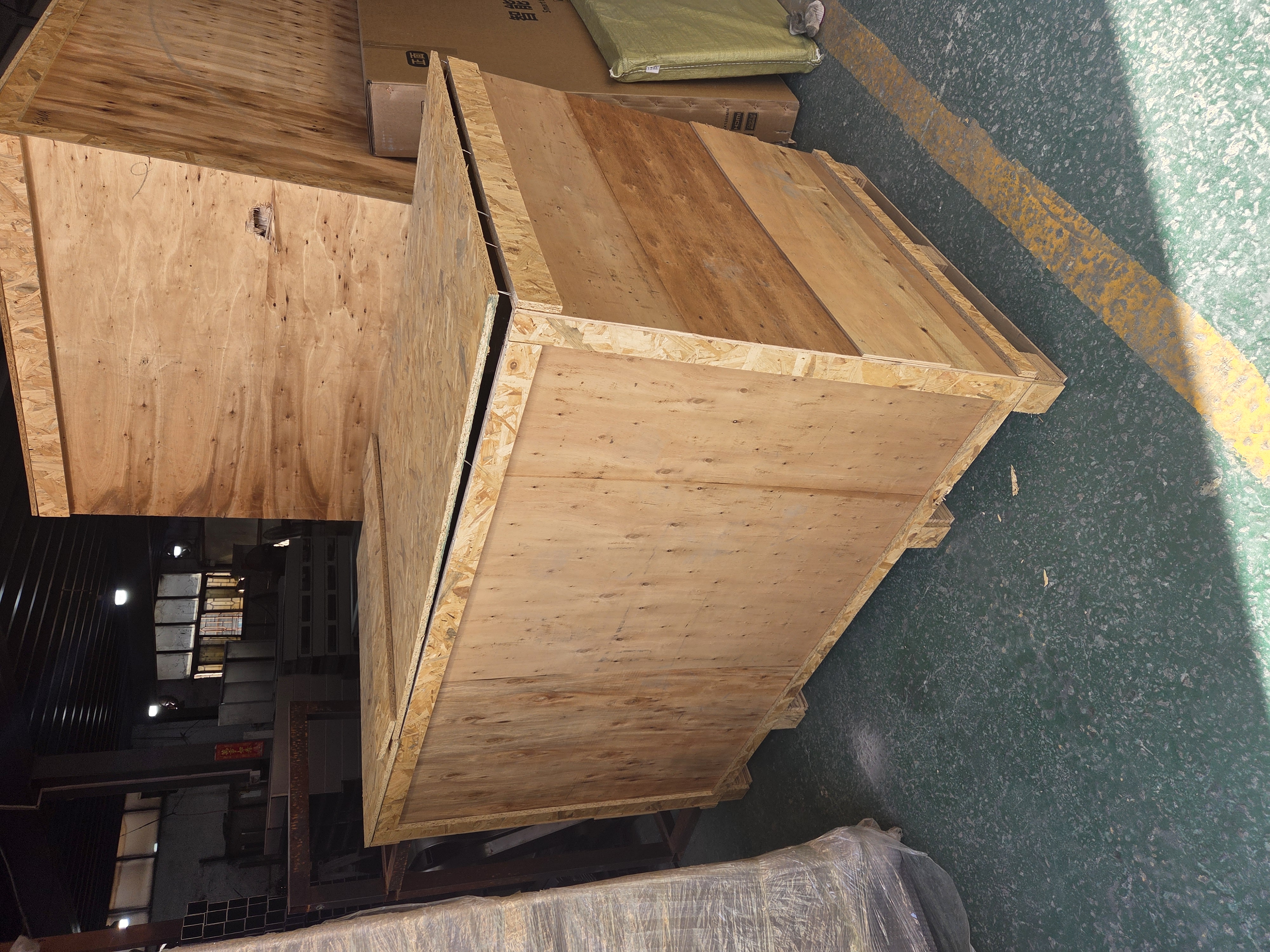
Export crating for overseas laboratory furniture shipments: packing specification belongs in the acceptance pack.
The corresponding mitigation set is specific: a knock-down mortise-and-tenon pre-assembly structure, heavy-duty export plywood crating with vacuum foil wrap, and a 100% pre-assembled test fit before shipment, supported after delivery by 3D modular assembly video guides, colour-coded hardware labelling, spare wearing parts shipped in the container, and remote engineer guidance during installation. Supplier project records for this article list installations of 30 units in Tanzania, 45 in Australia, 105 in the Philippines, 200 in China and 255 in India, with the Tanzania record documented through on-site assembly photographs.
Two planning notes follow. Site misalignment is usually a building-tolerance problem rather than a furniture problem, so a pre-installation survey of floor level, wall plumb and service positions should precede the shipment, not follow it. And where a hub with shower and eyewash is in the package, the water supply and drainage rough-in must be complete before the unit arrives; a delivered hub standing in an unfinished wet area is a schedule risk with no factory-side fix.
Where Does This Category Sit in the Wider Market?
Published market estimates for laboratory furniture vary widely by definition, which is itself a useful procurement signal. One commercial research estimate puts the global laboratory furniture market at approximately USD 4.8 billion in 2025 (Dataintelo, April 2026), while other published estimates for the same year differ substantially — a spread that reflects different treatment of integrated lab fit-out and services rather than a disagreement about units shipped. Within the material mix, metal furniture is estimated at a 52.7% revenue share in 2025.
Those figures describe a category, not a specification. The metal share does not mean metal suits every zone: stainless and polypropylene wet furniture exist precisely because a coated steel panel is not the right answer at a sink or in an acid-digestion area. On the supply side, China exported over USD 4.15 billion of furniture parts under HS 940390 in 2024, a trade figure that includes laboratory furniture components but is not limited to laboratory grade — official statistics do not separate high-precision lab-grade metal furniture from general commercial furniture, so export value should not be read as a capability measure for any individual supplier.
What Sequence Should a Buyer Follow?
- Fix the chemistry and the gas inventory first. The reagent list decides the bench grade, worktop and sink material; the cylinder list decides the cabinet configuration.
- Draw the room before choosing models. Place the bench, cabinet and hub on one layout with the duct route, water and drainage, and the escape path visible together.
- Write the behaviour requirements. Purge trigger, alarm response, ventilation interlock and commissioning method are the items a catalogue page cannot carry.
- Match certificates to model numbers. Read every scope line and resolve gaps before the purchase order, not at the customs desk.
- Agree the acceptance checklist and document pack. Then schedule production, packing and installation against that agreed reference.
Quick Answers to Common Questions
How many gas cylinders fit in the EG-S0-CB005?
The cabinet is offered in single, double and triple cylinder configurations, so capacity is set by the configuration ordered and the number of cabinets specified. Because cylinder diameters and valve heights vary, the actual cylinders should be measured against the cabinet's internal dimensions before the configuration is fixed.
Does the exhaust washing bench include its own fan or ductwork?
The supplied specification covers the bench itself: 304 stainless steel, 1500 × 750 × 1500 mm, a 25 mm ceramic worktop, two PP sinks and two three-way gooseneck faucets. It does not state whether a fan, ductwork or any air-treatment stage is included, so the exhaust scope must be defined in the order.
What does gas-alarm linkage actually trigger?
That is a project decision. The cabinet specification states gas-alarm linkage as a function; whether an active signal produces a local alarm only, a forced purge, or a ventilation boost, and which detector supplies the signal, has to be written into the control narrative and verified at commissioning.
What are the payment and delivery terms?
Minimum order quantity is 1 unit; delivery terms offered are FOB, CIF, DDP and EXW; payment is T/T with 30% advance and 70% before delivery; the stated acceptance criterion is a pre-shipment test; and lead time is 10–30 days.
How do I confirm that a certificate covers the model I ordered?
Read the scope line. The certificates supplied for this range name fume hood models and the flammable safety storage cabinet model FB-03. If a project needs model-specific evidence for the bench, cylinder cabinet or hub, request a certificate naming that model or agree an alternative in writing.
Can the units be customized?
The manufacturer provides OEM and ODM services covering technical and specification work, OEM/white-label production, and R&D and prototyping, with a stated monthly capacity of 2,000 units and 100% product testing. For custom work, the approved drawing becomes the acceptance reference.
Across all three units, the deciding factor is rarely the catalogue specification on its own. It is the interface documentation around it: which duct, which signal, which drain, and which certificate line. A buyer who fixes those four items before the purchase order receives a package that can be commissioned as one system; a buyer who does not will assemble three well-made products that still have to be reconciled on site.
The manufacturer's 2026 product brochure can be downloaded here: Ever Great 2026 product brochure (PDF).
Have Questions or Need More Details?
Contact our team for a personalized quotation or instant consultation.
Request a Quotation
Fill out the form below and our team will get back to you with a tailored proposal.
WhatsApp Direct Chat
Prefer to chat in real-time? Message us on WhatsApp for instant assistance & quick answers.
- Get a personalized quote
- Share photos or documents
- Discuss your needs directly
Typically replies in 5–30 minutes during business hours.