
Wet Wipes Procurement Terms: MOQ, Payment and Acceptance FAQ
Wet Wipes Procurement Terms: MOQ, Payment and Acceptance FAQ
A wet wipes order is accepted or rejected against what the purchase order says, not against what was agreed in conversation before it was issued. In the purchase content reviewed for this article, the stated terms resolve into four decisions: a pack-size-tiered minimum order quantity, delivery on FOB or CIF terms, a 30% deposit with the balance against a copy of the bill of lading, and an acceptance method described as the factory's pre-shipment test or a customer-specified alternative. Lead time, labeling, certification and customization are then attached to those four, and each has to be written down before production starts.
The supplier context here is Zhejiang Uniquality Nursing Products Technology Co., Ltd. (Uniquality), a Chinese manufacturer whose stated business scope covers research, production and sales of wet wipes, dry wipes, baby diapers and other nursing products. The company reports OEM/ODM operation, a stated monthly capacity of 7 billion units for wet wipes with capacity varying by product, and an export share of about 70% across markets including the USA, EU, South America, Russia and the Caspian region. Those figures are company-reported and set the frame for the questions buyers usually raise at the evaluation and execution stage.
What “purchasing terms” actually covers in a wet wipes order
Purchasing terms are the commercial and quality conditions that determine whether a shipment is accepted and paid in full. In this supplier's purchase content they cover five items, and each one has a distinct failure mode if it is left open.
- Quantity basis. The minimum order quantity is expressed in bags tiered by pack size, and separately in containers by product family. Quantity disputes usually start with the basis, not the number.
- Delivery term. FOB or CIF. This sets who arranges and pays main carriage, who insures, and where the buyer's risk begins.
- Payment schedule. A 30% deposit with the balance against a bill of lading copy. This sets the moment money leaves the buyer relative to the moment quality is confirmed.
- Acceptance method. The factory's pre-shipment test, or an acceptance protocol the buyer specifies. This is the clause that decides what happens when a batch is out of specification.
- Production timeline. 35–45 days after two triggers — artwork confirmation and deposit — which means the clock can start later than a first-time buyer expects.
Customization scope and after-sales support sit underneath these five as modifiers. Changing a material, a fragrance or a pack format alters the quantity basis, the lead time and the acceptance items at the same time.
MOQ: two different bases, and why the difference matters
The purchase content states wet wipes minimum order quantities in bags, tiered by the number of pieces per pack: 60,000 bags for packs of 10–30 pieces, 50,000 bags for packs of 40–70 pieces, and 36,000 bags for packs of 80–120 pieces. The same supplier's capability record expresses the minimum differently — one 40HQ container for wet wipes and dry wipes, and 150,000 pieces for baby diapers and pull-ups.
Both statements are legitimate, but they answer different questions: one is a pack-format threshold, the other a shipment-volume threshold. The tiering itself follows ordinary converting logic rather than a commercial preference. A smaller pack count means more individual packs, more film and more line time per retail unit, so the threshold rises as the pack gets smaller. The 10–30 piece format carries the highest bag requirement and the 80–120 piece format the lowest.
Four points should therefore be confirmed in writing before a first order is placed, because none of them can be assumed from the tier table alone:
- Which basis governs the specific SKU being ordered — the bag tier or the container threshold, and which one prevails if both are met in different ways.
- What “bag” denotes in the seller's counting — a single retail pack or an outer bag holding several packs. The difference can move the real order volume by a large multiple.
- Whether the tier applies per SKU or to the aggregate order, which determines whether a mixed assortment can reach the threshold.
- Whether a mixed-SKU container satisfies the container basis for wet wipes and dry wipes.
For a buyer testing a new pack format, the practical route is the sampling stage rather than a small production order. Uniquality states private-label sampling at 3–5 days, which allows artwork, substrate and pack format to be validated before a full tier commitment is made.
Delivery terms: FOB, CIF and where responsibility moves
The stated delivery options are FOB or CIF, which place different obligations on each side while leaving one important point identical: under both, the buyer generally carries the risk of loss or damage from the moment the goods are loaded on board at the port of shipment.
- FOB (Free On Board). The seller delivers the goods on board the vessel nominated by the buyer at the named port of shipment. The buyer arranges and pays main carriage and cargo insurance, and handles import clearance and duties.
- CIF (Cost, Insurance and Freight). The seller arranges and pays carriage to the named destination port and provides minimum cargo insurance cover. Risk still passes at the port of shipment rather than at destination, and import clearance and duties remain with the buyer.
The purchasing consequence is that CIF changes the freight and insurance arrangement, not the point at which the buyer becomes exposed. A buyer who wants protection to arrive at the destination warehouse needs a different term or separate cargo cover. Whichever option is chosen, the purchase order should name the port, cite the Incoterms version being used, and state who arranges insurance and at what cover level. Without those three details, a price quoted “CIF” can be compared against a price quoted “FOB” only after the freight and insurance element is isolated.
Payment terms: a 30% deposit and balance against BL copy
The stated payment structure is a 30% deposit with the balance against a copy of the bill of lading. Read as a process, it creates two payment events around one quality event, and the sequence is where most of the buyer's exposure sits.
The deposit is normally released against a proforma invoice and is what starts production. The balance falls due when the shipping document is presented, which in practice is after the goods have left the factory floor and before the buyer has had a chance to inspect them at destination. That leaves pre-shipment inspection as the only quality gate the buyer controls before the second payment.
Three clarifications make the schedule workable:
- Document form. Confirm whether a copy of the bill of lading is sufficient for release of the balance, or whether original documents or a telex release arrangement apply. The form affects both timing and control of the cargo.
- Charges and currency. Agree which party bears bank charges at each end and fix the invoicing currency in the order, so the balance is not renegotiated at the payment date.
- Sequencing against acceptance. Where the buyer specifies an acceptance protocol, the inspection result should be available before the balance is released. Linking the two milestones is a contractual drafting decision, not a commercial favour.
Lead time: 35–45 days starts at two triggers, not one
Production lead time is stated as 35–45 days after confirming the artwork and the deposit. Two conditions must both be satisfied, so the effective start date is the later of the two events — usually artwork sign-off, because deposit release tends to be faster than packaging approval.
Buyers planning a launch date should confirm three boundaries of that figure. First, whether the 35–45 days covers production only or also includes pre-shipment inspection, certificate of analysis issuance and export documentation. Second, whether labeling approval for the destination market sits inside or outside the window, since a labeling revision late in the process can restart it. Third, whether the supplier applies any seasonal variation to the figure, and if so, on what basis — a question worth asking rather than assuming.
A practical sequence that respects the stated clock is: approve artwork and pay the deposit, book the inspection window inside the 35–45 days rather than after it, and only then confirm the vessel booking. Freight transit time is a separate variable and should not be netted out of the production window when a delivery date is promised to a retailer.
Turning “factory pre-shipment test or as customized” into a written criterion
The stated acceptance position is the factory's pre-shipment test, or an alternative specified by the customer. Supporting quality control is described as a certificate of analysis together with AQL sampling inspection. That is a workable default, but as written it leaves the buyer relying on supplier-side inspection unless the order adds specificity.
A reviewable acceptance clause normally carries six elements. None of them require inventing a threshold; they simply move the decision into the document.
- Inspection stage and place. Pre-shipment at the factory, at a named point in production, or a third-party inspection before loading.
- Sampling plan. The AQL level applied and how defects are classified into critical, major and minor groups. The supplier applies AQL sampling; the level itself should be named in the order.
- Test items per SKU. For a wet wipes order these typically include pack count and net content, seal and lid integrity, substrate grammage against the agreed target, moisture retention, and microbiological limits required by the destination market. Which items apply is a buyer decision tied to the end use.
- Certificate of analysis content. Confirm whether the COA covers batch identification, formulation exclusions and measured substrate weight, not only a pass statement.
- Retained samples. Agree that a sealed sample per batch is retained, for how long, and who holds it, so a later dispute has a physical reference.
- Nonconformity path. What happens on a failed result — rework, sorting, replacement, price adjustment or rejection — and who bears the cost and delay.
The default position also carries a boundary worth stating plainly: a factory pre-shipment test is supplier-performed evidence. It is useful and auditable, but it is not the same as independent verification, and buyers in regulated categories should decide explicitly whether a third-party inspection right belongs in the order.
From declared product attributes to checkable order lines
Uniquality's published product statements describe process water that is EDI purified, formulas that can be built without alcohol, fragrance, fluorescent agents or antiseptics, and a substrate grammage band of 35 to 70 gsm, produced in a filling environment described as a 100,000-class clean room on automated lines covering raw material processing through to finished-product packaging. Each of these is a category-level declaration, and each needs translation before it functions as an acceptance criterion.
- Purified process water. Ask that the order record the water treatment description for the specific SKU, so the claim ties to a production line and a batch record rather than to a general product page.
- Formulation exclusions. The alcohol-free, fragrance-free, fluorescent-agent-free and antiseptic-free positions are described as options. On the purchase order they belong as per-SKU “absent” declarations, confirmed on the certificate of analysis. A category statement is not a SKU guarantee.
- Substrate grammage. A 35–70 gsm band is a range, not a specification. The order should state the target grammage for each SKU and the accepted tolerance in writing.
- Cleanroom class and automation. A cleanroom classification is a facility statement. Buyers who need it as evidence should pair the declaration with an audit right or a documented facility record; a class claim is not a certificate.
Certificates as acceptance documents: number, issuer, scope, expiry
Certification records are the part of a supplier file most often checked superficially. The four details that decide whether a certificate supports an order are the certificate number, the issuing body, the scope line and the expiry date — and the scope line is the one most frequently skipped.
For Uniquality's wet wipes scope, the recorded certificate entries include:
- ISO 9001:2015 — certificate 01326Q0078R102, issued by GAC, issued 11 April 2026 and valid to 10 April 2029, with scope covering wet wipes, dry wipes, baby diaper and training pants.
- ISO 14001:2015 — certificate 01326E0075R101, GAC, valid to 10 April 2029, same product scope.
- ISO 45001:2018 — certificate 01326S0066R101, GAC, valid to 10 April 2029.
- ISO 50001:2018 — certificate 01326En0008R201, GAC, issued 9 March 2026 and valid to 8 March 2029.
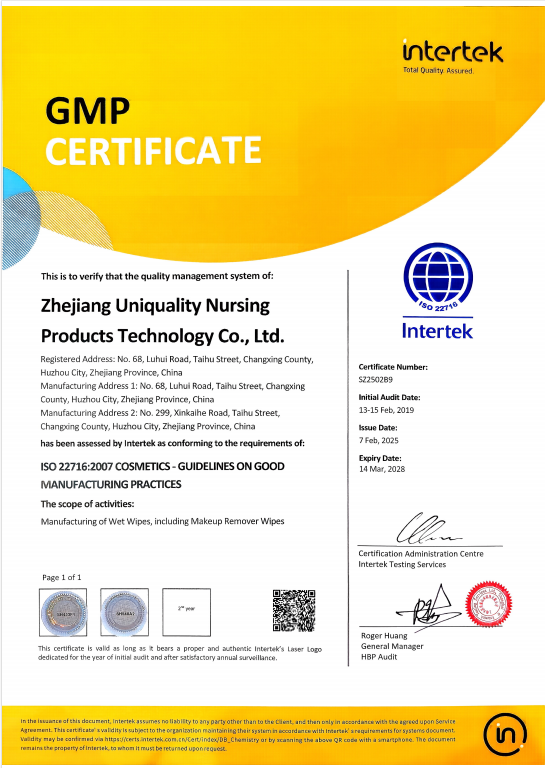
- ISO 22716:2007 — certificate SZ2502B9, issued by Intertek, issued 7 February 2025 and valid to 14 March 2028, scoped to wet wipes.
- GMPC — certificate SZ2502C1, Intertek, valid to 14 March 2028, scoped to wet wipes.
- SEDEX — registration ZAA600079586, Bureau Veritas CPS – Asia, covering labour standards, health and safety, environment pillars and business ethics.
Two reading rules follow. First, a management-system certificate confirms that a system is certified within a stated scope; it is not a batch test result and does not by itself confirm the specification of a specific shipment. Second, certificates expire and are reissued, so the validity date should be re-checked at each order rather than copied from an earlier file. A social-compliance registration such as SEDEX addresses labour and ethics pillars and should not be presented as product testing evidence.
Labeling and market-access items that belong in the order, not the inbox
Labeling is an acceptance item because artwork approval is the trigger that starts the lead-time clock. Within the European Union, wipes containing plastic must carry the “Do Not Flush” marking under Directive (EU) 2019/904, a requirement in force since July 2021. Where that marking applies, it should be confirmed at artwork sign-off rather than discovered at the port.
Which rules apply depends on how the product is classified in the destination market, and classification follows intended use rather than the pack design. A baby wipe, a surface cleaning wipe and a wipe positioned for a clinical setting do not sit under the same regime. The practical drafting step is to name the destination market, the intended use and the responsible party for label content in the purchase order, and to treat any change in positioning as a change to the artwork — with the timeline consequence that follows.
Customization scope as a term in its own right
Customization is stated across material, size, logo, packaging, fragrance and formula. Each of those six is a variable that can move the quantity basis, the acceptance items and the calendar simultaneously, so the order should define what counts as a change and who approves it.
A workable change-control line states that any adjustment to substrate, pack format, artwork, fragrance or formula after artwork approval resets the production clock and requires re-confirmation of the acceptance criteria for the affected SKU. That single sentence prevents the most common execution-stage dispute, which is not about price but about who absorbs the delay caused by a late specification change.
Matching the term set to the end use
The same order template should not be reused across categories without re-checking which lines change. Uniquality's recorded case applications include household cleaning, baby care, personal hygiene and beauty care, and the company's stated coverage extends to medical, maternal and baby, beauty, home, industrial cleaning and clothing fields, with flushable and degradable non-woven fabrics, wet wipes, dry wipes, baby diapers, pull-ups, wet toilet paper and cleansing wipes in the product list.
For context on where that volume sits, Grand View Research reported that personal care wipes accounted for 72.81% of the wet wipes market in 2025, a figure consistent with the pack-size tiers above being written around retail personal-care formats. For a buyer, the practical reading is that formulation exclusions and substrate feel carry more acceptance weight in baby, hand-and-mouth, facial and intimate formats, while labeling and flushability declarations dominate flushable and biodegradable formats, and pack integrity dominates bulk kitchen, bathroom, floor and glass formats. The term set stays the same; the emphasis inside the acceptance clause moves.
Capacity, continuity and the limits of a supplier's own record
Capacity statements are screening evidence, not delivery guarantees. Uniquality reports a monthly capacity of 7 billion units for wet wipes with capacity differing by product, annual output of 60 billion sheets, a factory footprint of 1,000,000 m², more than 3,000 employees and a 200-plus R&D team, alongside a documented case in which a UK-based OEM customer is recorded at 20 × 40HQ containers per month over a three-year relationship, with an on-time delivery rate of 99.5% and zero major quality complaints.
That case is a company-reported record and should be read as an illustration of scale and continuity rather than as a forecast for another buyer's programme. Three checks convert it into something usable. Ask for the delivery performance definition behind the 99.5% figure, since on-time against what date matters. Ask how a monthly allocation would be reserved for your SKUs, because capacity is not the same as a booking. And ask how the escalation path works when a batch fails acceptance, since after-sales support here is described as remote support, order follow-up, product usage consultation, quality feedback handling and service coordination — a support model, not a remedy schedule.
Term-by-term confirmation list
The table below restates the stated position for each term beside the confirmation a buyer should obtain before signing. It is a working checklist, not a substitute for the signed order.
| Term | Stated position | Confirm before signing |
|---|---|---|
| MOQ | 60,000 bags for 10–30 pcs packs; 50,000 bags for 40–70 pcs; 36,000 bags for 80–120 pcs. Also one 40HQ container for wet wipes and dry wipes | Which basis governs the SKU; what “bag” means; per-SKU or per-order tier; whether mixed-SKU containers qualify |
| Delivery | FOB or CIF | Named port, Incoterms version, insurance cover level, who clears import |
| Payment | 30% deposit; balance against BL copy | Copy versus original documents or telex release; bank charges and currency; whether balance follows a passed inspection |
| Lead time | 35–45 days after artwork confirmation and deposit | Which of the two triggers starts the clock; whether inspection, COA and labeling approval sit inside the window |
| Acceptance | Factory pre-shipment test, or as customized | Sampling plan, test items per SKU, COA content, retained samples, nonconformity remedy, third-party inspection right |
| Documents | COA, AQL records, certification records | Certificate number, issuer, scope line, expiry re-checked per order |
| Customization | Material, size, logo, packaging, fragrance, formula | Items in scope and the change-control rule after artwork approval |
| After-sales | Remote support, order follow-up, usage consultation, quality feedback handling, coordination | Response path, owner of the claim, and the remedy schedule behind it |
Structured terms versus informal ordering
The comparison that matters for a buyer is not between suppliers but between two ways of issuing the same order. An informal order fixes price and quantity and leaves the rest to relationship and goodwill. A structured order fixes the quantity basis, the delivery term, the payment sequence relative to inspection, the lead-time triggers, and the acceptance items per SKU.
The structured version costs an extra meeting and normally produces a slower first order. It pays back at the two points where informal orders fail: when a batch is disputed and neither side can point to an agreed test item, and when a shipping date slips because artwork approval and deposit release happened later than anyone recorded. The limitation is equally real — a structured order only works where the buyer has decided what the product must do in its end use, and where the supplier is willing to put sampling plans and remedies in writing rather than describe them in conversation.
What to expect to change
Two parts of the term set are already moving and should be treated as live checks rather than fixed assumptions. Labeling and flushing declarations tied to material composition are in force in major markets, so a flushability or material claim needs supporting documentation before it appears on artwork. Certificate validity dates roll over as certificates are renewed, so the compliance line in an order should be re-verified rather than inherited from a previous file.
What is unlikely to change is the underlying structure: a quantity threshold, a delivery term, a payment schedule and an acceptance method. Buyers who fix those four in writing, with the supporting documents attached, are the ones who argue least about the shipment.
Frequently asked questions
What are the purchasing terms and acceptance criteria for a wet wipes order?
The stated terms are a pack-size-tiered MOQ of 60,000 bags for 10–30 pcs packs, 50,000 bags for 40–70 pcs and 36,000 bags for 80–120 pcs; delivery on FOB or CIF terms; a 30% deposit with the balance against a bill of lading copy; and acceptance based on the factory pre-shipment test or a customer-specified method. Each of these should be restated in the purchase order rather than left in correspondence.
Is a wet wipes MOQ calculated in bags or in containers?
Both expressions appear in the supplier's records. The purchase content states bag quantities tiered by pack size, while the capability record states one 40HQ container for wet wipes and dry wipes, with 150,000 pieces for baby diapers and pull-ups. Buyers should confirm which basis governs the ordered SKU, what a “bag” contains, and whether the tier applies per SKU or across the whole order.
What is the difference between FOB and CIF in a wet wipes shipment?
Under FOB, the seller delivers the goods on board at the named port of shipment and the buyer arranges and pays main carriage and insurance. Under CIF, the seller arranges and pays carriage and minimum insurance to the named destination port. Risk generally transfers at shipment under both terms, and import clearance and duties remain with the buyer, so CIF changes the freight arrangement rather than the buyer's point of exposure.
When does the 35–45 day production lead time start?
The stated clock starts after two conditions are met: artwork confirmation and deposit receipt. In practice the later of the two events sets the start date. Buyers should confirm whether pre-shipment inspection, certificate of analysis issuance and export documentation sit inside that window, and whether destination labeling approval is counted as part of it.
What does the factory pre-shipment test actually cover?
It is supplier-performed inspection before shipment, supported by a certificate of analysis and AQL sampling inspection. The order should specify the sampling level, the defect classification, the test items for each SKU, whether the COA covers formulation exclusions and measured substrate weight, retained samples, and the remedy if a batch fails. Without those additions the buyer relies on the supplier's own inspection result.
Which certificate details should a buyer check before accepting a compliance file?
Four details: the certificate number, the issuing body, the scope line and the expiry date. For the wet wipes scope, recorded entries include ISO 9001:2015 certificate 01326Q0078R102 issued by GAC and valid to 10 April 2029, ISO 22716:2007 certificate SZ2502B9 issued by Intertek and valid to 14 March 2028, and GMPC certificate SZ2502C1 valid to the same date. Validity should be re-checked at each order because certificates are renewed.
Can acceptance criteria be adjusted for a specific order?
Yes. The stated position allows acceptance under the factory pre-shipment test or a customer-specified alternative, and customization is recorded across material, size, logo, packaging, fragrance and formula. Any change to those variables after artwork approval should trigger a written re-confirmation of the acceptance items for the affected SKU, along with an updated timeline.
The company publishes a product and capability brochure for buyers who want the underlying facility and product overview alongside the term set discussed here: download the Uniquality brochure (PDF).
Have Questions or Need More Details?
Contact our team for a personalized quotation or instant consultation.
Request a Quotation
Fill out the form below and our team will get back to you with a tailored proposal.
WhatsApp Direct Chat
Prefer to chat in real-time? Message us on WhatsApp for instant assistance & quick answers.
- Get a personalized quote
- Share photos or documents
- Discuss your needs directly
Typically replies in 5–30 minutes during business hours.