
What 150 Million Grinding Wheels a Year Mean for Bulk Buyers
What 150 Million Grinding Wheels a Year Mean for Bulk Buyers
Annual production capacity has become one of the most quoted — and least examined — numbers in grinding wheel sourcing. A manufacturer that states it can produce 150 million pieces a year is normally presenting that figure as a headline. For a buyer at the evaluation stage, the more useful question is what the number changes in day-to-day supply: how much is already made and sitting in a warehouse, how long a custom run really takes, what happens in the peak season, and where capacity stops being an advantage at all.
Zhejiang Sali Abrasive Technology Co., Ltd. manufactures and exports under the SALI brand. The company was founded in 2003, launched the SALI brand in 2010, and states an annual output of 150 million pieces alongside a monthly capacity of 12.5 million pieces, a workforce of 150+ employees and an R&D team of 30+ engineers, operating from a production base in Yongkang, Zhejiang, China. This article examines what those figures do and do not imply for buyers of metal grinding discs — including 4-inch (100 mm), 4.5-inch (115 mm), 5-inch (125 mm), 7-inch (180 mm) and 9-inch (230 mm) formats — and sets out the questions worth asking before a purchase order is placed.
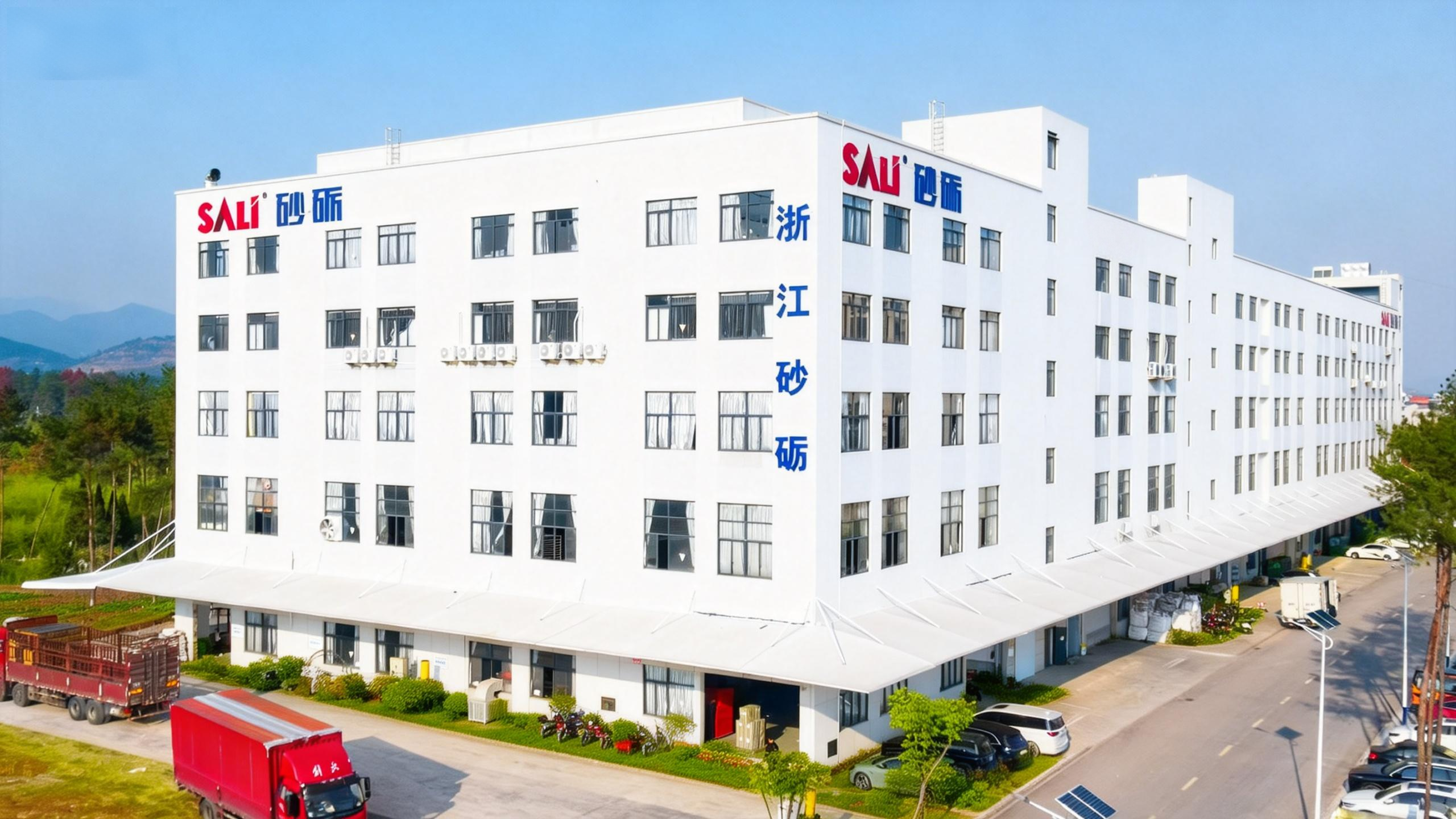
A grinding wheel production base in Yongkang, Zhejiang — the site behind a stated annual output of 150 million pieces. Image: SALI Tools.
Why Capacity Became a Procurement Criterion, Not a Marketing One
Grinding wheels and metal grinding discs are consumables. A fabrication shop, a pipeline contractor or a welding repair operation does not buy one disc; it buys the same disc repeatedly, on a schedule set by production volume. That changes the shape of buyer risk. The exposure is not the first container — it is the tenth, the fifteenth and the thirtieth, when a specification has drifted, a shipment has slipped, or a distributor has run out of 115 mm discs in the middle of a contract.
The scale of that recurring demand is significant. The global grinding wheels market was estimated at USD 7.12 billion in 2025, according to Mordor Intelligence. Metalworking was the largest application segment, with a revenue share of 47.2% in 2025 (Grand View Research). Asia-Pacific accounted for roughly 41.3% to 42.7% of 2025 revenue depending on the commercial research source. In a market of that size and geographic concentration, manufacturing depth stops being a marketing claim and becomes a sourcing variable.
Three practical consequences follow for buyers. First, availability has to be continuous, because a stockout in a consumable stops work. Second, the specification has to hold across shipments, because a disc that behaves differently from the last batch changes how an operator works. Third, the supplier has to be able to respond when the mix changes — when a buyer shifts from 4.5-inch (115 mm) to 7-inch (180 mm) demand, or from a carbon steel grinding wheel to a stainless steel (Inox) formulation. Capacity is the input that makes all three possible.
What 150 Million Pieces a Year Actually Represents
Two numbers anchor SALI's stated production position: 150 million pieces annually and 12.5 million pieces monthly. Those figures are internally consistent — monthly capacity multiplied by twelve equals the annual figure — which is the first thing a buyer should check when any supplier quotes capacity, because a monthly and an annual number that do not reconcile usually mean one of them describes a different scope.
What an annual total does not describe on its own is composition. A site-wide figure aggregates every production line, every disc diameter and every bond formulation into one number. For a buyer sourcing a specific item — a T27 depressed center metal grinding disc in 125 mm, for example — the site-wide total is context, not an answer.
| Stated metric | Figure | What it does not tell you on its own |
|---|---|---|
| Annual output | 150 million pieces | Whether this counts finished, saleable goods or includes intermediate production |
| Monthly capacity | 12.5 million pieces | Whether it is a site-wide average or a peak-month figure |
| Workforce | 150+ employees | How many are assigned to curing, finishing and inspection rather than general production |
| R&D engineers | 30+ engineers | How formulation changes are controlled and documented between batches |
| Production base | 30,000 m² construction area | How much floor space is allocated to curing, ageing and finished-goods holding |
A 150-million-piece annual figure becomes actionable only when it can be broken down by product family and by disc dimension. A site producing 150 million pieces across cutting discs, grinding discs, flap discs and other abrasives in a wide size range does not automatically hold the same daily capacity for every diameter. Buyers of 4.5-inch (115 mm) or 9-inch (230 mm) metal grinding wheels should ask for capacity by size band rather than accepting a single site-wide total.
Where Capacity Turns Into Supply Reliability
Capacity converts into reliability at the point where finished goods meet an order. SALI operates an 8,000 m² warehouse with a storage capacity of 12,000 m³, and maintains 85% of its standard SKUs in ready stock, which supports same-day dispatch for regular orders. That combination — production volume plus buffer stock — is what determines whether a buyer's replenishment cycle is measured in days or in weeks.
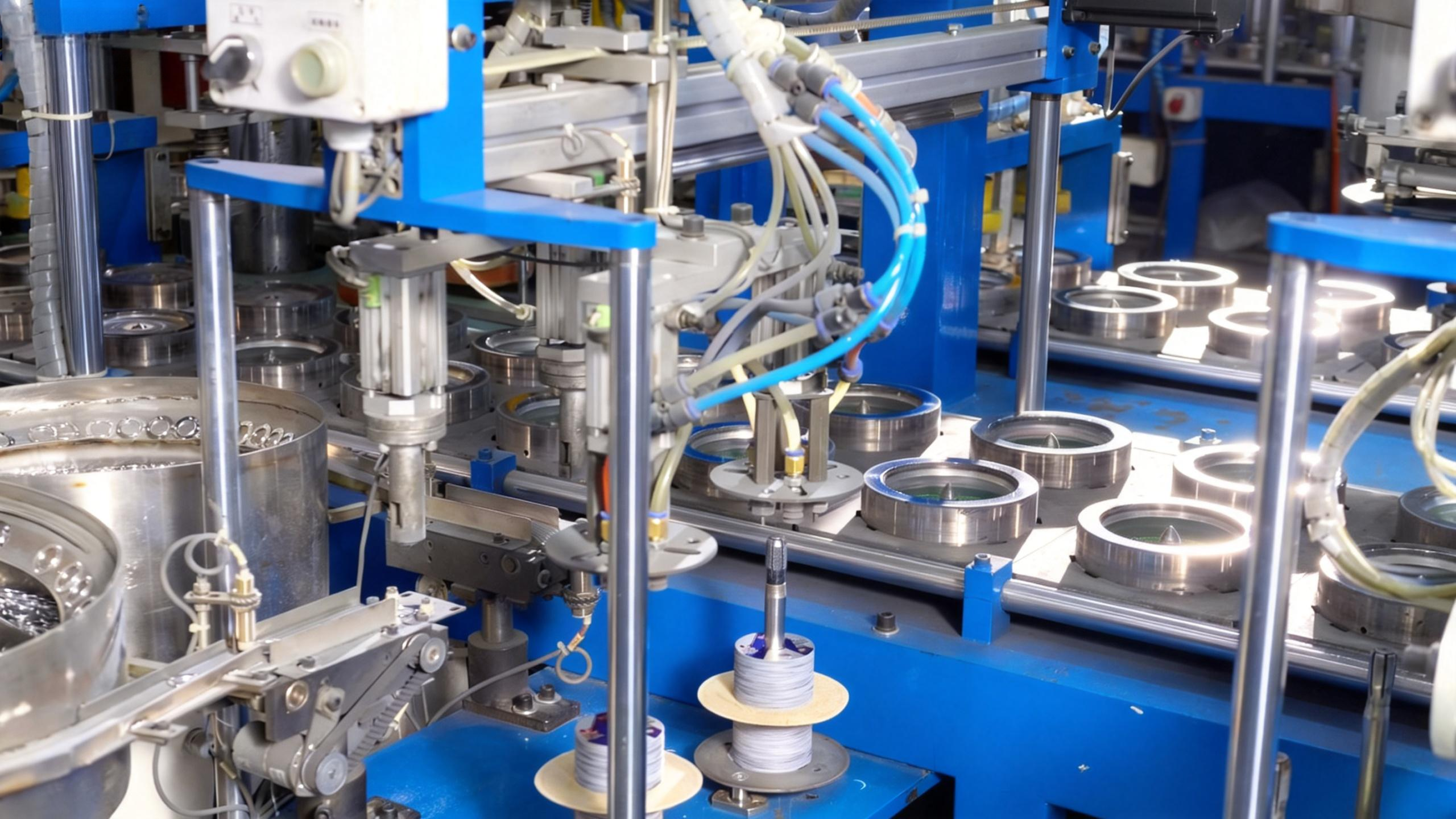
Volume output depends on line uptime and changeover discipline, not only on press count. Image: SALI Tools.
Two Different Lead-Time Realities
The lead time a buyer experiences depends on which of two order types is being placed, and the two should never be averaged together in a quotation comparison.
- Ready-stock and brand orders. For SALI-branded items held in the standard range, the minimum order quantity can be as low as one carton — approximately 500 to 1,000 pieces — with dispatch typically within 24 hours.
- Custom OEM and ODM orders. Where the buyer needs custom branding, a specified abrasive formulation, a non-standard diameter, thickness, bore or packaging format, the stated lead time is 30 to 45 days from design confirmation to final delivery.
The distinction matters for planning. A large production base can absorb volume quickly when the item already exists in the standard range. It does not compress the curing, finishing and packing cycle of a specification that has to be built, and no realistic capacity figure changes that. A buyer comparing a 24-hour dispatch claim with a 30-to-45-day lead time is comparing two different products of the same factory, not two different factories.
The relevant question for a distributor is not only “how much can you make” but “how much of it is already made.” Ready-stock depth, not headline capacity, is what protects a buyer during a demand spike.
Peak-Season Behaviour and Capacity Allocation
An annual capacity figure represents a theoretical maximum across a full year. It does not describe how that capacity is distributed across months, nor how much of it is already committed to contract customers. In bonded abrasives, demand is rarely flat: construction and fabrication seasons, project deadlines and distributor restocking cycles cluster orders into specific periods. A supplier with 150 million pieces of annual capacity may still quote a longer lead time in a peak month if a large share of that capacity is allocated to long-term accounts.
This is the single most useful reframing for a buyer: nominal capacity and available capacity are different numbers, and only the supplier knows the gap between them. That gap is the one number worth asking for directly.
Why Quality Consistency Is the Hidden Output of Volume
Volume increases the number of production batches per year. Every additional batch is another opportunity for the bond hardness, the fibreglass reinforcement or the curing profile to drift slightly from the reference. Consistency therefore does not scale automatically with output — it scales with process control. A 150-million-piece operation has more to lose from weak batch discipline than a workshop producing a fraction of that, because a single drift affects more downstream buyers.
SALI states that it applies 100% testing across production and operates an in-house testing laboratory. The company also provides clients with live camera access to the lab so that batch testing can be observed remotely in real time. For a buyer who cannot visit the factory before placing an order, that removes one layer of uncertainty and replaces it with something observable.
Formulation control is the other half of the equation. SALI's grinding wheel range uses aluminium oxide in A30Q4 BF and A24Q4 BF specifications, with two or three layers of fibreglass reinforcement depending on the item, in Type 27 and Type 42 depressed-centre formats. The company's catalogue describes wider abrasive formula options as brown aluminium oxide for metal, white aluminium oxide for stainless steel (Inox), zirconia for heavy-duty work and silicon carbide for stone and cast iron, with grit sizes from 24# to 120#. Each of those variables is a point at which batch-to-batch consistency can shift — and the reason a 30+ engineer R&D team matters more to a repeat buyer than to a first-time purchaser.
Which Buyers Actually Benefit From This Kind of Volume
Capacity at this scale is most useful to buyers whose demand is repetitive and forecastable. SALI's published case data illustrates the pattern across three very different markets.
| Market | Buyer type | Stated project scale | Relationship length | Reported outcome |
|---|---|---|---|---|
| Central Asia (Uzbekistan) | Wholesaler | 10 million pieces | More than 9 years | By 2024, sales volume had increased 21 times within seven years compared with the first year as a SALI agent in 2018 |
| Russia (North Caucasus region) | Wholesaler / distributor | 5 million pieces | More than 7 years | Annual growth rate of 50%; became an influential hardware-tools distributor in the local market |
| Middle East (Iraq) | Manufacturing group procurement buyer | 10 million pieces | 5 years | Stable operation; product used for fabrication and on-site processing |
The company also records a long-standing agency relationship with a hardware tools agent in Ethiopia, and states that it had signed long-term strategic cooperation agreements with agents from 45 countries as of March 2025, with products exported to more than 160 countries and regions. In each of these cases the buyer is a repeat purchaser — a wholesaler, a distributor or a procurement function inside a manufacturing group — rather than a single-site end user buying a handful of discs.
That is the common pattern. Buyers who order repeatedly at scale feel the consequences of an inconsistent batch or a delayed shipment far more than they feel a marginal difference in unit price. For them, a supplier's production depth is a risk-management feature. By contrast, a repair shop buying a few hundred discs a year is not the natural customer for this supply model, although the stated minimum order of one carton keeps the entry point unusually low for a manufacturer of this size.
Market Context: Why Supply Reliability Is Being Re-Priced
Two structural features of the abrasives market reinforce the case for examining capacity rather than catalogue specifications alone.
The first is application concentration. Metalworking accounted for 47.2% of grinding wheel revenue in 2025, according to Grand View Research, which means demand is tied to steel fabrication, machinery manufacturing, welding and repair, pipelines and shipbuilding — industries where downtime is expensive and a consumable stockout stops work outright.
The second is geographic concentration. Asia-Pacific accounted for roughly 41.3% to 42.7% of 2025 revenue depending on the research source, and those published estimates differ by methodology. For buyers in Europe, the Middle East, Africa and the Americas, that concentration means supply arrives through export channels, and transit time sits on top of production time. SALI maintains regional offices with resident country managers in East Africa (Kenya), West Africa (Nigeria), Central Asia (Kazakhstan) and South Asia (Pakistan), which shortens the response loop for neighbouring markets — but it does not remove the underlying production and shipping cycle.
Under those conditions, a supplier's warehouse policy and dispatch terms become part of the product itself. A buyer evaluating two suppliers with similar disc specifications may find that the more consequential difference lies in stock depth and replenishment speed rather than in the abrasive grain.
How Volume Manufacturers Compare With Other Supply Models
Capacity is a trade-off, not a free upgrade. Buyers should understand what they gain and what they give up when they move from a low-volume producer or a trading intermediary to a high-output manufacturer.
| Supply model | Where it is strong | Where the boundary lies |
|---|---|---|
| Integrated volume manufacturer with own production and warehouse | High output, buffer stock on standard SKUs, OEM/ODM capability, batch test access | Custom specifications still take 30 to 45 days from design confirmation; not every size and bond carries the same availability; capacity can be pre-committed during peak periods |
| Low-volume workshop producer | Flexible on small or unusual runs; short decision chain | Limited ability to absorb a sudden large order or to hold buffer stock; batch-to-batch variation is harder to control when volume is low |
| Trading intermediary or sourcing agent | Wide product range without capital investment; can bundle multiple categories | Does not control the production schedule; lead-time commitments depend on a third party, and capacity claims have to be verified one step further back in the chain |
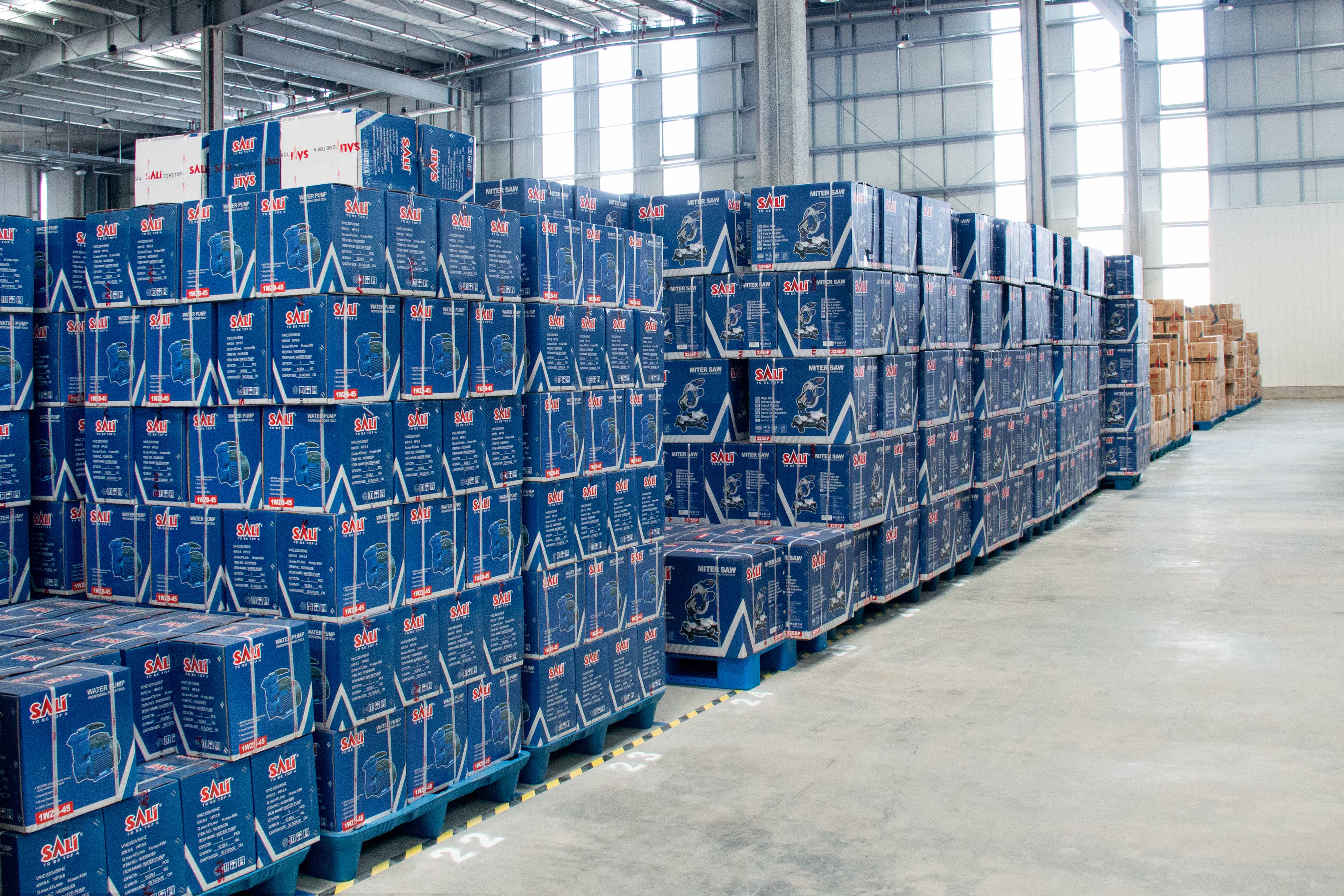
Ready-stock depth determines whether an order is dispatched in a day or scheduled into a production run. Image: SALI Tools.
A second boundary is storage. Resin-bonded grinding discs are moisture-sensitive. SALI advises storage in a cool, dry area with relative humidity below 60% and temperatures between 10 °C and 30 °C, off the floor, and states that discs retain optimal performance for three years under standard conditions. The practical consequence is that a large ready-stock programme only helps a buyer who can store the goods correctly. Buyers in humid coastal or tropical markets should plan for that before deciding to hold several months of inventory.
A third boundary is definitional. An annual capacity figure is a claim about manufacturing capability, not a statement about delivery performance. It does not describe on-time delivery rate, order fill rate, or how many production days are lost to changeovers between disc sizes and bond formulations. Those are separate operational metrics and should be requested separately — and, where the buyer's volumes justify it, written into the supply agreement.
How to Verify a Capacity Claim: A Buyer's Question List
The following questions are designed to convert a headline capacity number into something a purchasing team can act on. They apply to any grinding wheel supplier, including SALI.
- Does the stated figure cover finished, saleable grinding wheels, or does it include intermediate production?
- Which product families does the number include — cutting discs, grinding discs, flap discs, or all bonded abrasives combined?
- What is the monthly capacity for the specific dimensions you purchase, such as 115 mm or 230 mm?
- How many production lines, presses and curing stations support the stated output?
- What was the average capacity utilisation over the last twelve months?
- How much of the capacity is pre-committed to long-term contract customers, and how much remains available for new orders?
- What is the ready-stock policy for standard SKUs, and what dispatch time does it support? For reference, SALI states 85% of standard SKUs in stock with same-day dispatch for regular orders.
- What is the changeover time between disc sizes and between bond formulations?
- Can batch test records be shared, or can remote inspection access be arranged? SALI provides live camera access for remote quality inspection of production processes.
- What lead time applies during your peak season, and is that commitment stated contractually?
A supplier that can answer questions 3, 5, 6 and 10 with specific figures is demonstrating capacity management. A supplier that can only repeat the annual total is demonstrating capacity marketing. The difference shows up in the first peak season after the order is placed.
Two additional verification tools are worth using regardless of the answers received. A sample order placed before a volume commitment tests the actual disc, not the specification sheet. And SALI's stated policy of a full safety liability guarantee for product quality defects gives the buyer a written reference point for what happens if a batch fails — a claim that should be documented in the contract rather than accepted verbally.
Future Outlook
For bulk buyers, the direction of the market is reasonably clear. Purchasing in consumable abrasives is shifting from unit-price comparison toward cost-per-cut and supply-reliability comparison, because the cost of an unplanned stockout or a failing batch is easier to quantify than a small difference in the invoice line. That shift moves the weight of supplier evaluation away from catalogue specifications and toward operational evidence: batch testing, traceability, warehouse policy and fulfilment performance.
At the same time, buyers should expect capacity disclosure to remain at site level rather than line level, since line-level data is commercially sensitive for most manufacturers. The practical response is not to demand more numbers but to test the numbers that are offered — sample orders, first-article inspection, remote observation of batch testing, and staged purchase orders that let performance be measured before a volume commitment is made.
Read that way, a 150-million-piece annual capacity figure is a starting point for a conversation about supply reliability, not a conclusion about it. It indicates that a supplier has the physical scale to serve distributor-level demand. Whether that scale translates into the reliability a specific buyer needs is answered by ready-stock depth, batch consistency, lead-time behaviour in peak season, and the supplier's willingness to let those things be checked.
FAQ
How can a buyer verify a supplier's stated annual grinding wheel capacity?
Capacity is normally verified through documentation and observation rather than a single figure. A buyer can request a breakdown of capacity by product family and by disc dimension, the number of production lines and curing stations supporting the output, average utilisation over the past twelve months, and the share of capacity pre-committed to contract customers. Supporting evidence typically includes batch test records, production or dispatch records, and — where offered — remote access to in-process testing. SALI, for example, states that its factory is equipped with live camera access for remote quality inspection of production processes, which allows a buyer to observe testing without travelling to the site. No single number verifies capacity; a set of consistent, cross-checkable numbers does.
Does higher production volume automatically mean more consistent metal grinding disc quality?
No. Higher volume increases the number of batches produced per year, which increases the number of opportunities for variation in bond hardness, fibreglass reinforcement or curing profile. Consistency therefore depends on process control rather than on scale. Indicators worth checking include whether every production batch is tested, whether an in-house laboratory exists, whether test records are retained and shared, and whether the buyer can observe testing. SALI states that it applies 100% testing across production, operates an in-house testing laboratory, and provides live camera access so clients can view batch testing remotely.
How do lead times differ between stock orders and custom OEM orders from a high-capacity supplier?
They differ substantially, and the difference is structural rather than a matter of supplier efficiency. Orders for items already held in the standard range can be dispatched quickly — SALI maintains 85% of standard SKUs in ready stock in an 8,000 m² warehouse and states same-day dispatch for regular orders, with brand-order minimums as low as one carton of approximately 500 to 1,000 pieces and dispatch typically within 24 hours. Orders requiring custom branding, a non-standard dimension, a specified abrasive formulation or custom packaging carry a stated lead time of 30 to 45 days from design confirmation to final delivery, because those items have to be produced rather than picked.
What order size makes a high-capacity grinding wheel manufacturer the more suitable choice?
Volume manufacturers are generally the more suitable choice when demand is repetitive and forecastable — for example, a distributor restocking on a fixed cycle, or a manufacturing group buying grinding discs for continuous fabrication and on-site processing. SALI's published case data follows that pattern: a wholesaler in Uzbekistan ordering at a scale of 10 million pieces over more than nine years, a distributor in Russia's North Caucasus region at 5 million pieces over more than seven years, and a manufacturing group procurement buyer in Iraq at 10 million pieces over five years. For occasional or very small requirements, the relevant comparison is not capacity but total landed cost, including freight and the effort of managing an import shipment.
What should buyers watch for when a supplier emphasises total annual capacity?
Four things are worth separating from the headline figure. First, scope — a site-wide total may include all abrasive product families rather than the specific disc being purchased, so per-size capacity should be requested. Second, availability — nominal capacity is not the same as capacity that is free to accept a new order, because a portion may be committed to long-term accounts, and peak-season lead times can extend accordingly. Third, storage conditions — resin-bonded discs are moisture-sensitive and require a cool, dry environment, with relative humidity below 60% and temperatures between 10 °C and 30 °C, retaining optimal performance for about three years under standard conditions; large stock purchases only help a buyer who can store them properly. Fourth, delivery performance — capacity says nothing about on-time delivery rate or fill rate, which should be requested and, where possible, agreed contractually.
For specification details across the metal grinding disc and bonded abrasive range, the SALI Tools brand product catalogue is available for download: SALI Tools Brand Product Catalog (PDF). Company information is published at salitools.com.