
What Buyers Need to Know About Sludge Dewatering Equipment
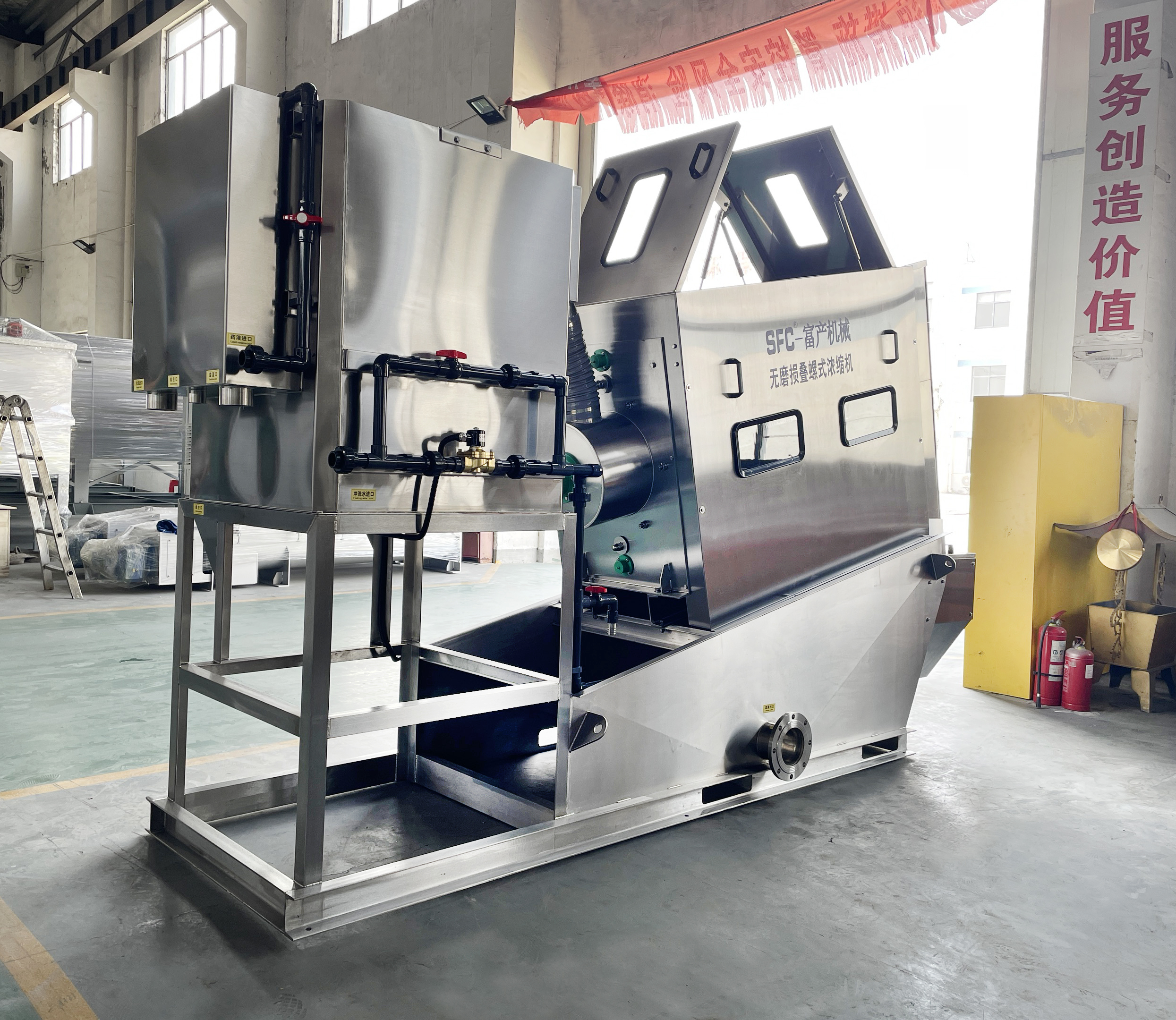
Multi-disc screw press technology is one of the core configurations in sludge dewatering equipment.
Sludge dewatering equipment directly determines the volume, transport cost, and final disposal path of sludge leaving a wastewater treatment site. Yet the same category label is applied to machines with very different operating principles, feed requirements, and maintenance needs. This article explains the main equipment types, the parameters that matter during selection, and the boundaries that separate one technology from another.
1. Dewatering in the Sludge Treatment Chain
Sludge treatment in municipal and industrial wastewater plants usually follows a sequence: reduction where possible, thickening, dewatering, and in some cases deep dewatering or drying. Each stage changes the physical state of the sludge. Thickening raises solids concentration. Dewatering produces a handleable cake. Drying removes additional moisture so the material can be disposed of or recovered at lower cost.
Buyers evaluating sludge dewatering equipment should first identify where the largest improvement is needed. A plant struggling with disposal costs may benefit more from a dryer than from a new dewatering press. A plant with low-solids feed may need thickening equipment before any dewatering upgrade can work effectively.
2. What Counts as Sludge Dewatering Equipment
Sludge dewatering equipment, as the term is used in wastewater projects, includes thickening machines, mechanical dewatering presses, deep dewatering systems, drying units, and the polymer preparation systems that support them. The category is broad because sludge itself varies widely. Municipal sludge, industrial sludge, oily sludge, chemical sludge, and high-organic food-processing sludge each respond differently to mechanical treatment.
Shanghai Fuchan Machinery Technology Co., Ltd. (SFC Machinery), based in Pudong New Area, Shanghai, is one manufacturer that covers this full range. Established in 2007, the company is a National High-Tech Enterprise integrating technology R&D, intelligent manufacturing, international trade, and engineering services. It specializes in sludge treatment, dewatering, drying, and solid waste resource recovery. Its main products include sludge dewatering equipment, sludge thickening equipment, deep sludge dewatering equipment, sludge drying equipment, and polymer preparation systems. The company operates a 25,000 m² manufacturing facility with an annual production capacity of 500 sets of equipment, and reports export business accounting for 30% of total sales.
3. Why Selection Logic Matters More Than Price
Dewatering equipment has long-term operating consequences. Polymer dose, wash water consumption, belt or ring wear, and final cake dryness affect operating cost far more than the initial purchase price in most installations.
Each technology in this space carries specific operating conditions. Product documentation states these conditions clearly: stable feed concentration, correct polymer dosing, adequate wash water, belt tension, or sludge type confirmation. Buyers who skip these conditions during selection often discover problems only after commissioning, when changing equipment becomes expensive.
4. Core Equipment Types and Working Principles
4.1 Multi-Disc Screw Press
A multi-disc screw press removes water by conveying sludge along a screw shaft surrounded by fixed rings, moving rings, and a volute filter. The decreasing screw pitch compresses the sludge and forces water out through the gaps between rings. The SFC DL Series includes 16 models from DL-101 to DL-404, with dried sludge output from 1.5 to 900 kg/h and a final water content of 75–85%. Inlet consistency is 0.6–5.0%. Intended applications include municipal wastewater treatment, industrial wastewater treatment, paper mills, printing and dyeing, oily sludge, and decentralized sludge treatment. The operating guidance identifies a polymer jar test, correct feed concentration, and anti-clogging operation as conditions for reliable performance.
4.2 Wear-Free Multi-Disc Screw Press
Sticky, oily, or high-inorganic sludge can accelerate wear at the contact points between screw and rings. SFC developed the SRD Series as a wear-free multi-disc screw press for these conditions. The design purpose is to improve stable conveying and dewatering while reducing screw-to-ring wear risk.
The SRD Series is intended for industrial wastewater treatment, including food processing wastewater and oily sludge treatment. It handles inlet solids of 0.6–5.0%, produces 25–900 kg/h of dried sludge, and reaches 75–85% water content. Sludge type confirmation and suitability testing are required before selection.
4.3 Belt-Type Dewatering Machines
Belt-type equipment is commonly selected when flow rates are high and the sludge can be pre-thickened on a gravity or rotary drum section. These machines run continuously and are widespread in municipal and large industrial plants.
SFC offers several belt-based configurations:
- GDY Series: an integrated unit that combines gravity belt thickening and belt press dewatering. It is designed for inlet solids of 0.6–1.5%, treats 15–90 m³/h, and produces cake with 75–80% water content.
- FTB Series: a rotary drum thickening plus belt press configuration for medium-solids sludge at 1.5–2.5% inlet solids. It treats 3.0–30 m³/h and is suited to small and medium projects.
- FTE Series: a larger rotary drum type configuration for medium-to-large continuous dewatering duty, with belt widths up to 3000 mm and treating capacity up to 90 m³/h.
These machines depend on stable flocculation, adequate wash water, and correct belt tension. Regular filter cloth cleaning is also a stated requirement.
4.4 Thickeners
Thickening is sometimes grouped with dewatering but performs a different role. A thickener raises the solids concentration of low-solids sludge before mechanical dewatering, reducing the water load on downstream equipment.
The FBT Series gravity belt thickener operates at 0.6–1.5% inlet solids, raises outlet consistency to 2.5–8%, and reports a solid-capture rate of 98%. The FRDT Series enclosed rotary drum thickener reaches a solid-capture rate of 95%, with treating capacity of 7.5–100 m³/h and dried sludge output up to 1140 kg/h. Both are built in SS304 and are intended for municipal and industrial wastewater treatment, paper mills, and printing and dyeing applications.
4.5 Deep Dewatering and Drying Equipment
When a plant must reduce moisture beyond the 75–85% typical of mechanical dewatering, it moves into deep dewatering or drying. The SD Series high-pressure belt deep sludge dewatering machine is designed for this secondary stage. It accepts sludge at 15–20% solids. For output at 60–70% water content, treating capacity ranges from 0.35 to 6.1 t/h, with dried sludge output from 70 to 920 kg/h. Conditioning chemicals and project-specific sludge testing are required.
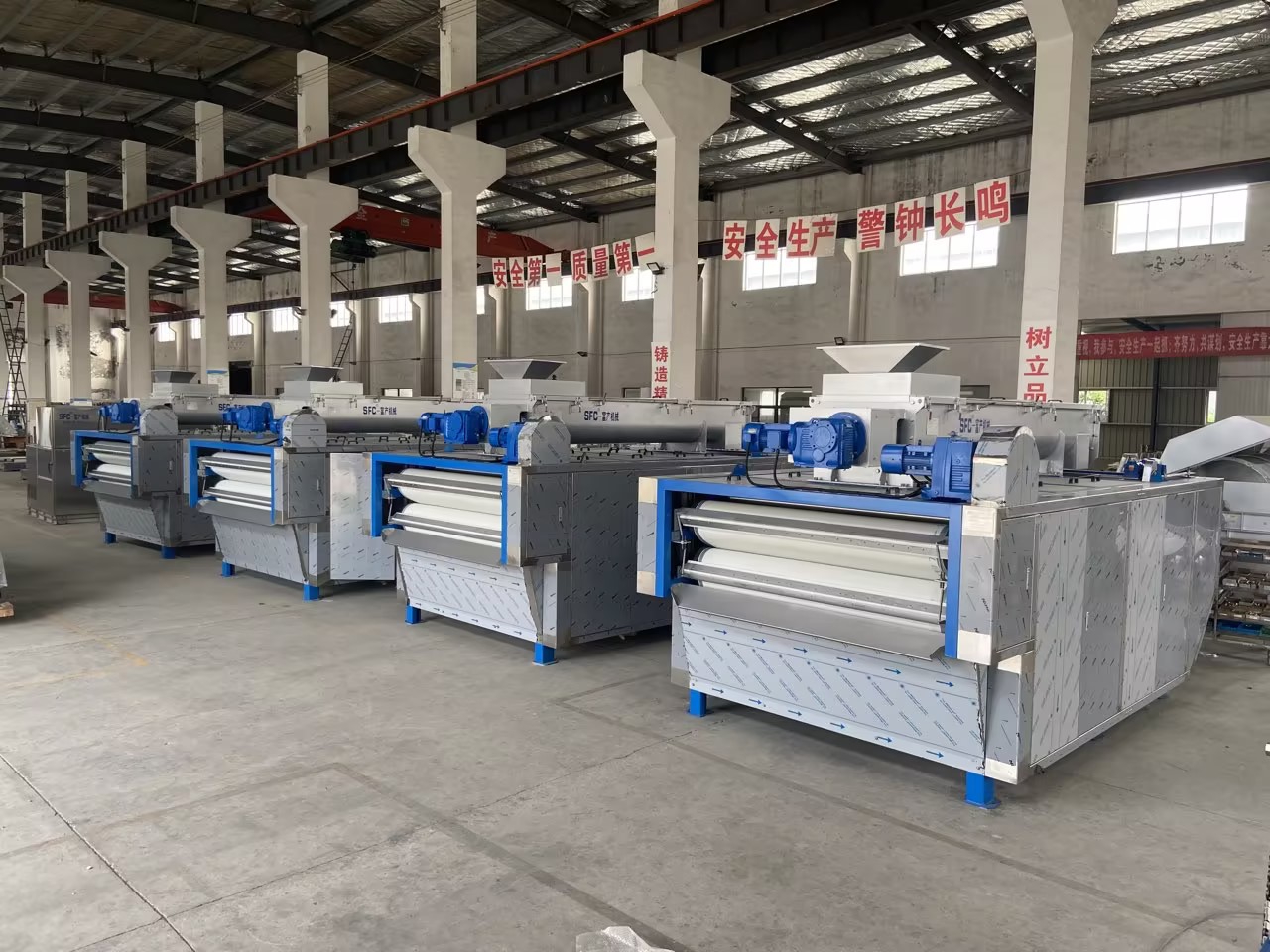
Deep dewatering systems operate after primary dewatering to further reduce sludge moisture.
For further volume reduction, low-temperature dryers are available. The SFC-BSD Series belt sludge dryer is a modular, fully enclosed low-temperature dryer made of SS304. The SFC-TR Series operates as a batch-type dryer with a water extraction capacity of 21–360 kg/h and unit power consumption of 0.4–0.55 kWh/kg water. Both serve municipal and industrial applications where disposal cost reduction or resource recovery is the goal. Final moisture target and sludge feeding condition must be confirmed before model selection.
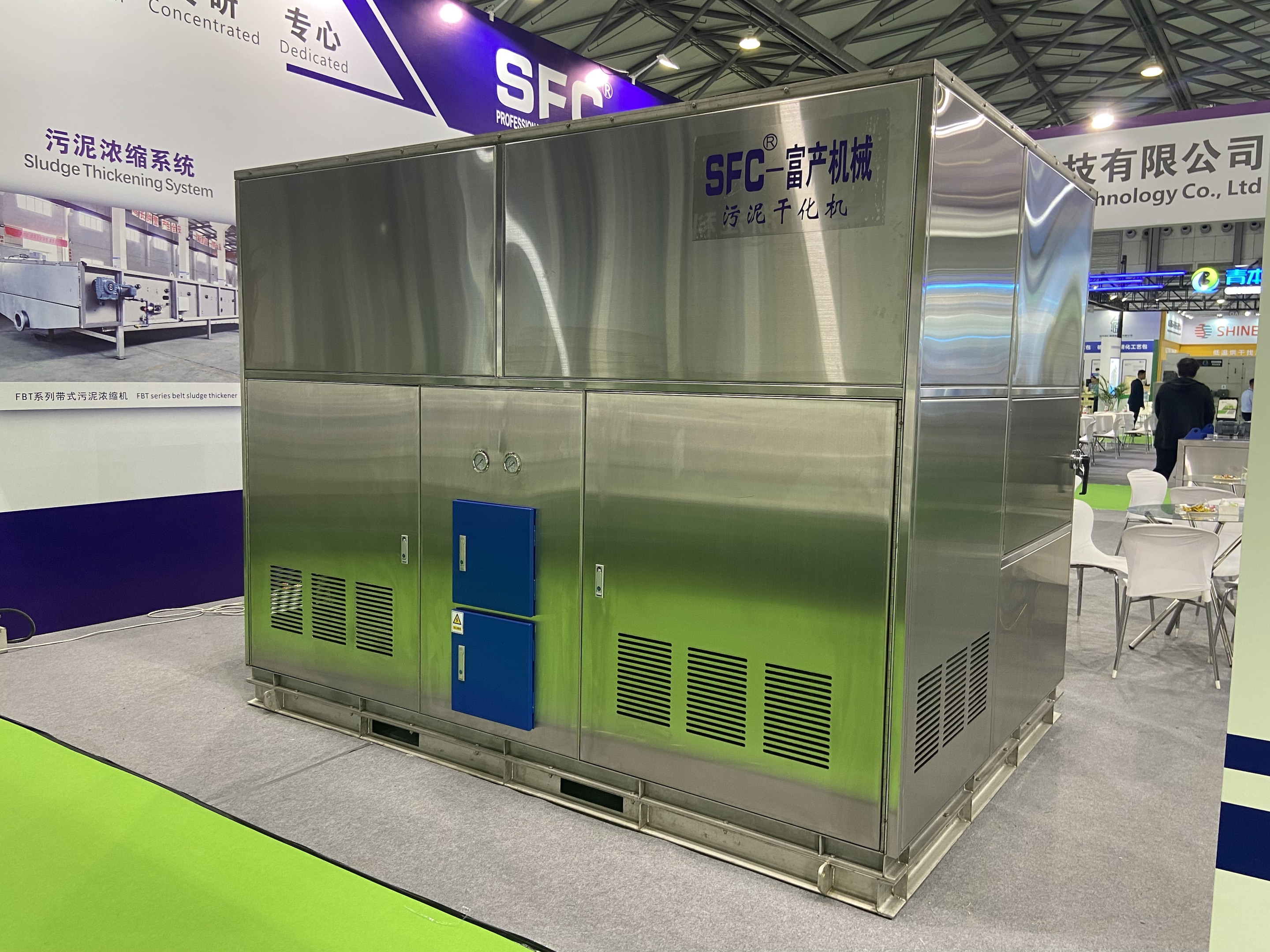
Belt sludge dryers are part of the sludge drying equipment segment and are used after mechanical dewatering.
5. Key Parameters to Compare Before Purchase
Comparing sludge dewatering equipment on paper requires more than hourly treating capacity. The following table summarizes typical ranges across three equipment families from the SFC product line.
| Parameter | Multi-Disc Screw Press (DL) | Wear-Free Screw Press (SRD) | Integrated Belt Machine (GDY) |
|---|---|---|---|
| Inlet consistency | 0.6–5.0% | 0.6–5.0% | 0.6–1.5% |
| Dried sludge output | 1.5–900 kg/h | 25–900 kg/h | 90–1050 kg/h |
| Final water content | 75–85% | 75–85% | 75–80% |
| Driving motor power | 0.18–1.5 kW | 0.55–1.1 kW | 1.1–4.0 kW |
| Construction material | SS304 | SS304 | SS304 |
Three system-level factors deserve equal attention. First, supporting equipment: most dewatering packages include a polymer preparation system, sludge feed pump, flocculation tank, screw conveyor, and control cabinet. Second, material of construction: SS304 is standard across these lines, but corrosive or explosion-risk sites may require additional design features. Third, process conditions: upstream concentration, polymer quality, and sludge variability often influence final performance more than the machine model itself.
6. Application Patterns Across Industries
Dewatering needs vary by industry, and the application references in SFC's project cases illustrate common patterns.
- Municipal wastewater treatment: thickening plus screw press or belt press, depending on flow and solids. Decentralized sites tend toward screw press configurations.
- Distilleries and breweries: high-organic sludge with moisture typically above 95% requires enclosed, corrosion-resistant equipment. A combination of thickening, screw press dewatering, and thermal drying can convert the sludge into dry, stable biomass.
- Palm oil mills: POME and empty fruit bunch related sludge are processed in continuous mode, with sludge volume and moisture significantly reduced after treatment.
- Automotive parts manufacturing: electroplating sludge is heavy-metal-bearing and corrosive. Fully automatic operation with corrosion-resistant design is the stated operating model.
- Pharmaceutical production: high-organic and chemically complex sludge requires stabilization. Drying reduces biological activity and prepares the material for incineration or safe disposal.
- Petrochemical coking wastewater: refractory sludge is treated with thickening, dewatering, and thermal drying. Explosion-proof design and corrosion resistance are explicit requirements.
These patterns show that equipment selection is rarely about the machine alone. The surrounding process package, including pumps, dosing systems, conveyors, and PLC control, plus the corrosion, odor, and safety requirements of the site, is equally important.
7. Market Signals from Verified Data
Public market research provides context for demand. Fortune Business Insights values the global sludge dewatering equipment market at USD 5.19 billion in 2024 and projects USD 10.16 billion by 2032. The same source attributes 37.57% of 2024 revenue to Asia Pacific. Grand View Research estimates the belt filter press segment will grow at 8.8% CAGR from 2025 to 2033, reflecting sustained adoption in municipal wastewater applications.
Estimates vary across research firms. Global market size figures for 2024 differ by roughly USD 0.17 billion depending on scope and methodology, and forecast CAGRs range from about 8.3% to 12.6%. Buyers should treat any single market number as an indicator rather than a precise prediction.
Competitive structure also matters. Global Market Insights identifies Veolia as the largest player with over 9% market share in 2025, while the top five players, Andritz, Xylem, Alfa Laval, Suez, and Veolia, hold a combined 35%. A substantial portion of the market is therefore served by other manufacturers, including regional suppliers such as SFC Machinery, whose export markets include Southeast Asia, Russia, South America, and the Middle East.
8. Boundaries and Trade-offs
Every dewatering technology has a defined operating boundary. Recognizing these boundaries is part of a credible purchasing decision.
- Belt filter presses require stable feed concentration, correct polymer dosing, and routine belt washing. If feed varies significantly, upstream thickening or conditioning may be needed.
- Multi-disc screw presses accept lower-concentration feed but are more limited in throughput. They are better suited to small, decentralized, or medium-duty plants than to very large flow installations.
- Wear-free screw presses reduce wear risk for difficult sludge, but sludge type confirmation and suitability testing are required. They are not a universal substitute for standard screw presses.
- Deep dewatering systems depend on chemical conditioning. Project-specific sludge testing is required, and the operating cost of conditioning chemicals must be included in the evaluation.
- Dryers consume the most energy among these stages. Final moisture target and the condition of dewatered sludge feed must be defined before model selection.
A related boundary is between single-machine purchasing and integrated system design. When thickening, dewatering, and drying are sized together, the system can operate at lower energy and polymer cost. When they are procured separately, mismatches in capacity and operating conditions are more likely.
9. Future Outlook: From Volume Reduction to Resource Recovery
Sludge dewatering equipment is moving from a simple volume-reduction function toward a broader resource-recovery role. Several trends are visible without speculative claims.
Source-based sludge reduction is attracting attention because it lowers the load on all downstream equipment. SFC's HCP Smart Flow™ Sludge Reduction System is one example of equipment designed to reduce sludge generation at the source, lowering disposal costs and energy consumption before the dewatering stage.
Low-temperature drying is expanding because it can operate safely and integrate with waste heat recovery. SFC's drying systems use fully enclosed low-temperature operation and report sludge volume reduction of more than 70% in drying applications. This matters for sites facing high disposal fees or carbon-reduction requirements.
Automation is also following the wider industrial trend. Polymer preparation and dosing systems, PLC control, and integrated process packages are becoming standard elements of modern sludge treatment lines rather than upgrades.
10. FAQ
What is sludge dewatering equipment?
Sludge dewatering equipment refers to machines and systems that remove water from sludge to reduce its volume. The category includes sludge thickening equipment, dewatering machines, deep dewatering systems, drying equipment, and polymer preparation systems. In municipal and industrial wastewater treatment, these systems reduce disposal costs and prepare sludge for further treatment or resource recovery.
What are the main types of sludge dewatering equipment?
Common types include multi-disc screw presses, wear-free multi-disc screw presses, belt pressing systems with or without pre-thickening, rotary drum thickeners, belt thickeners, high-pressure deep dewatering systems, and low-temperature dryers. The SFC product line includes DL Series screw presses, SRD Series wear-free screw presses, GDY Series integrated belt units, FTB and FTE Series rotary drum belt dewatering machines, FRDT rotary drum thickeners, FBT belt thickeners, SD Series deep dewatering machines, and SFC-BSD and SFC-TR dryers.
How does a multi-disc screw press sludge dewatering machine work?
A multi-disc screw press uses a screw shaft surrounded by fixed rings, moving rings, and a volute filter. Sludge is conveyed along the screw, and the decreasing pitch compresses the material so water is squeezed through the gaps between rings. The SFC DL Series, for example, is designed for inlet solids of 0.6–5.0% and produces cake with 75–85% water content.
What is the difference between sludge thickening and sludge dewatering?
Thickening increases sludge solids concentration before mechanical dewatering. A belt thickener such as the FBT Series can raise outlet consistency from 0.6–1.5% inlet solids to 2.5–8%. Dewatering goes further by reducing sludge volume and producing a cake. The DL Series screw press, for instance, reduces sludge volume and produces dewatered cake at 75–85% water content.
Which sludge dewatering equipment suits oily or sticky sludge?
Wear-free multi-disc screw presses are designed for sticky, oily, low-concentration, or high-inorganic-content sludge. The SRD Series improves stable conveying and dewatering while reducing screw-to-ring wear risk. Sludge type confirmation and suitability testing are required before selection.
What must be confirmed before selecting a sludge drying machine?
The final moisture target and sludge feeding condition must be confirmed before model selection. For low-temperature drying systems, moisture target, sludge thickness, and ventilation or odor control should also be confirmed by project to match the equipment design to site conditions.
Product Catalog-SFC-2026.pdf