
What CE-5072-160326, EMC and LVD Cover on a Surface Pump
What CE-5072-160326, EMC and LVD Cover on a Surface Pump
A surface pump shipped into the EU usually arrives with more than one certificate, and buyers who treat that folder as a single item routinely misread it. The compliance file for Zhejiang Happy Pump Industry Co., Ltd. — the pump and motor manufacturer established in 1990 in Daxi Town, Wenling, Zhejiang — separates into three instruments: a CE Attestation of Conformity numbered CE-5072-160326 issued by ECES, an EMC certificate numbered OViS202507249E, and an LVD certificate numbered OViS202507249L. The EMC and LVD documents were both issued by OViS-CERT.
The separation is not administrative housekeeping. The CE attestation is dated 16 March 2026 and printed as valid to 16 March 2031; it references 2014/35/EU (Low Voltage Directive), 2014/30/EU (Electromagnetic Compatibility Directive) and 2006/42/EC (Machinery Directive). The two OViS-CERT certificates are dated 1 August 2025 and cite the specific harmonised standards used for each assessment. All three name water pumps as their scope and list the same seven series: HQBm, QB60, IDB35, HPSm-AX, HRSm-A, QDP and QDX.
What none of them certifies is flow, head, efficiency or duty-point suitability. That boundary is the most useful thing a buyer can take from the file, because it decides what still has to be checked against a datasheet, a performance curve and the installation itself.
Why one CE mark is really three checks
Compliance paperwork is often filed, quoted and forwarded as the CE certificate. In practice, a CE marking on a pump is an outcome produced by several assessment routes, and the documents behind it may come from more than one body. When a procurement team asks a supplier for CE evidence, what arrives may be a manufacturer's declaration, a third-party attestation, a set of test reports, or — as here — an attestation combined with directive-specific certificates.
Three misreadings recur at the purchasing desk. The first is quoting the CE number as if it also carried the EMC and LVD detail; the second is reading a series-level scope as if it covered every voltage and configuration sold under that series name; the third is treating any certificate as evidence of hydraulic performance. Each is avoidable with a short comparison of document numbers, issuers, dates and scope lines.
The file also matters beyond a single order. An importer assembling a technical file, a distributor answering a tender questionnaire and a brand owner placing an OEM order all need to know which document answers which question — and which question remains theirs to answer.
Document map: issuer, number, dates and market
The three documents share a scope line but differ in origin and content. Set side by side, the differences are easier to read than in three separate PDFs.
| Document | Number | Issuer | Dates as stated | Directives or standards referenced |
|---|---|---|---|---|
| CE Attestation of Conformity | CE-5072-160326 | ECES | Issued 16 March 2026; valid to 16 March 2031 | 2014/35/EU Low Voltage; 2014/30/EU Electromagnetic Compatibility; 2006/42/EC Machinery |
| EMC certificate | OViS202507249E | OViS-CERT | Issued 1 August 2025; expiry printed as 1 January 2099 | EN IEC 55014-1:2021; EN IEC 55014-2:2021; EN IEC 61000-3-2:2019+A1:2021+A2:2024; EN 61000-3-3:2013+A1:2019+A2:2021 |
| LVD certificate | OViS202507249L | OViS-CERT | Issued 1 August 2025; expiry printed as 1 January 2099 | EN 60335-1:2012+A11:2014+A13:2017+A1:2019+A14:2019+A2:2019+A15:2021+A16:2023; EN IEC 60335-2-41:2021+A11:2021; EN 62233:2008+AC:2008; EN 60034-1:2010+AC:2010 |
Two practical notes on that table. First, the dates belong to the documents; a long printed expiry is a document field, not a statement that the standards cited will remain unchanged for the life of the product. Second, all three scope lines read water pumps, with the seven series named separately — the coverage is a defined product family, not the whole catalogue.
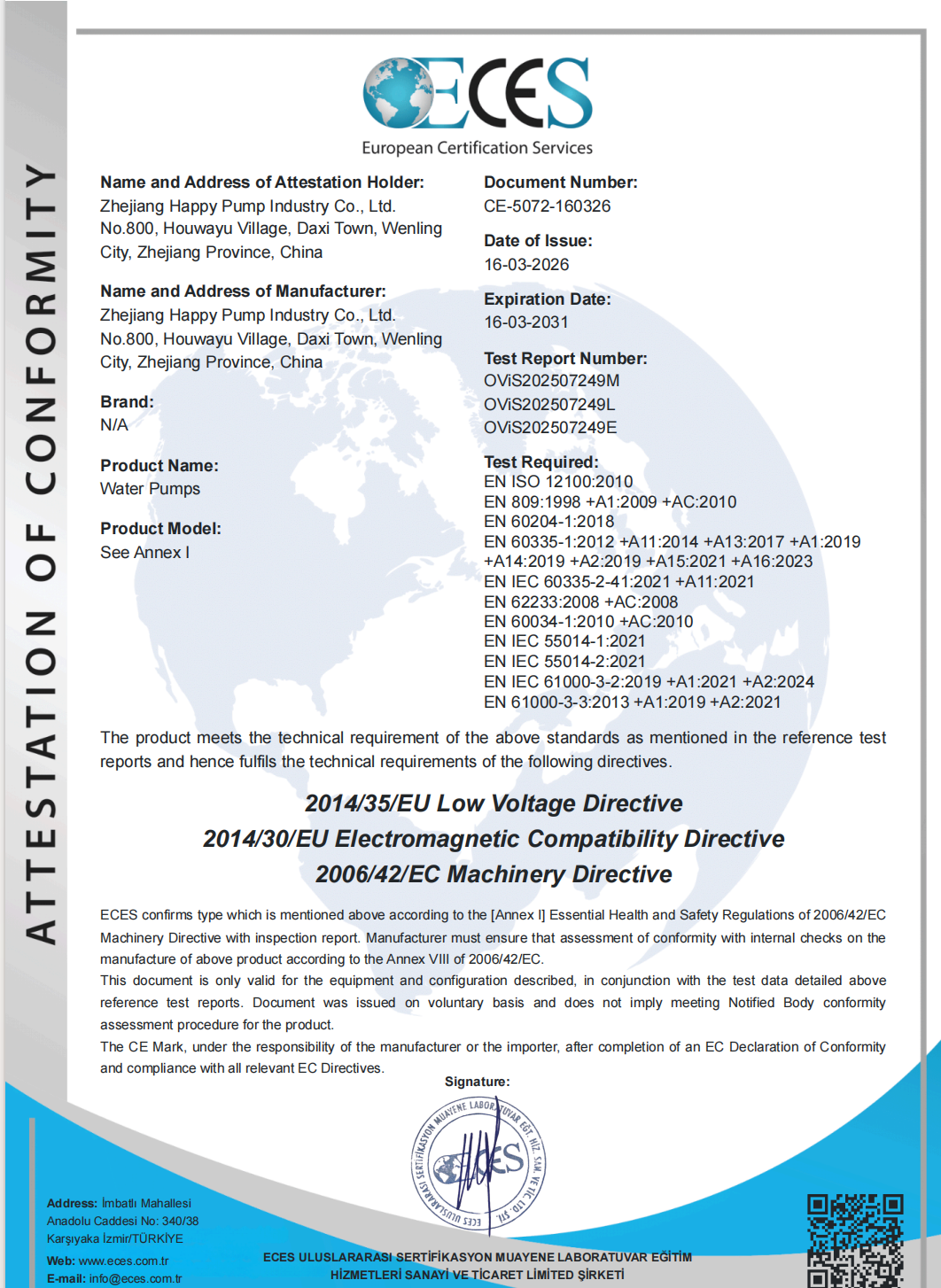
CE-5072-160326: what an attestation of conformity states
The CE Attestation of Conformity carries the number CE-5072-160326, names ECES as issuing body, applies to the EU market and covers water pumps. Its reference list contains three directives rather than a product-specific standard. That combination tells a buyer the document records conformity routes: electrical safety under 2014/35/EU, electromagnetic behaviour under 2014/30/EU, and machinery requirements under 2006/42/EC.
The Machinery Directive reference is the line buyers query most often, because a pump does not look like machinery in the way a production line does. A pump assembly with a rotating shaft, motor, coupling and guard sits closer to that scope than a bare electrical appliance, and the 2006/42/EC entry is how the document records that consideration. The attestation states the reference; it does not reprint the risk assessment, the technical file or the declaration of conformity, which remain separate parts of a supplier's documentation set.
Validity runs to 16 March 2031 as printed. Read that date as the end of the document's stated term, not as a guarantee that 2026-era standard versions will still be the current ones at that point.
EMC certificate OViS202507249E: disturbance and immunity
The EMC certificate OViS202507249E names water pumps as its scope, applies to the EU market and lists four standards. In the IEC/CISPR household-appliance series, EN IEC 55014-1 covers emission and EN IEC 55014-2 covers immunity; EN IEC 61000-3-2 addresses harmonic current emissions and EN 61000-3-3 addresses voltage fluctuations and flicker. Read together, they describe a pump that is not expected to disturb the supply excessively and is expected to tolerate a defined level of disturbance from other equipment.
That question grows sharper as pumps acquire electronics. Where a surface pump is supplied with automatic pressure control, a controller, or a variable-speed drive, the electronics become both a source and a target of electromagnetic disturbance. The four standards in this certificate are what a buyer points to when a site shares a supply between pumps, welders, chillers and farm equipment, or when a municipal or building installation requires a documented EMC position before acceptance.
The certificate is issued by OViS-CERT under its own number and date, which is why it should be filed and quoted separately from CE-5072-160326 rather than folded into the CE entry.
LVD certificate OViS202507249L: the pump-specific safety standard
The LVD certificate OViS202507249L is the most product-specific of the three. Its list begins with EN 60335-1, the general safety standard for household and similar electrical appliances, followed by its amendment trail through A16:2023. The second entry, EN IEC 60335-2-41:2021+A11:2021, is the particular-requirements part for pumps, which is why this certificate speaks more directly to pump construction than to electrical equipment in general.
EN 62233:2008+AC:2008 covers the assessment of electromagnetic fields, and EN 60034-1:2010+AC:2010 relates to rotating electrical machines. Listing both alongside 60335 shows the assessment treated the motor and the pump end as one assembly — the two halves buyers usually evaluate separately when specifying a surface pump motor.
The amendment trail deserves a second look. A standard list reaching A16:2023 records the edition actually evaluated, which is more informative than a bare standard number and gives the buyer something concrete to compare if a later edition appears. It also explains why the LVD entry is the longest line in the file.
Model coverage: seven series and the gaps a buyer must close
The covered series are HQBm, QB60, IDB35, HPSm-AX, HRSm-A, QDP and QDX. That list is the correct starting point for a coverage check, and also the correct limit of what the certificates alone can prove.
A series-level certificate is a family statement. It says the named series was assessed against the listed standards by the named body; it does not enumerate every voltage, frequency, impeller trim or OEM configuration sold under that series name. The manufacturer states that it produces under OEM and ODM arrangements with voltage and logo customization. Where an order uses a custom voltage or a customer-specific configuration, the buyer should obtain written confirmation that the ordered configuration falls inside the certified scope instead of inferring it from the series name.
Three checks close most of the gap:
- Nameplate versus list. Compare the model designation stamped on the nameplate with the seven series above, not with the catalogue family it resembles.
- Electrical configuration. Confirm rated voltage, frequency and phase on the nameplate match what was ordered and what the certificate file describes.
- Document custody. Match the certificate copies in the buyer's own file to the purchase order, so a later audit does not depend on a supplier re-sending a PDF.
From certificate to purchase order: acceptance criteria
Certificates become useful when they enter commercial documents. The points below translate the file into terms that survive a shipment, a customs query or a tender review.
- Require the full set, not the CE page. Ask for CE-5072-160326, OViS202507249E and OViS202507249L. A file holding only the attestation leaves the EMC and LVD standard lists undocumented.
- Match the nameplate, not the catalogue. Acceptance should be written against the model designation and electrical rating on the unit, since the certificates operate at series level.
- Read the dates at order time. The CE attestation runs to 16 March 2031 and the OViS-CERT certificates carry 1 August 2025 issue dates. Confirm the copy on hand is the current issue, not a superseded version travelling with an older quotation.
- Write the document set into the order. Naming the three certificate numbers as a delivery deliverable turns compliance from a favour into a contractual line item, which matters most for first orders from a new supplier.
- Confirm customized configurations in writing. Voltage or logo customization under OEM production is a normal request; the confirmation that the resulting configuration sits inside the certified scope should arrive in writing with the order acknowledgement.
- Keep performance evidence separate from compliance evidence. The manufacturer states 100% product testing and quotes a 30–45 day lead time. Those are production and commercial commitments, not third-party certificates. Flow, head and efficiency for a given duty point belong in the technical offer and the performance curve.
Three kinds of compliance evidence and what each proves
Three evidence levels appear in surface pump procurement, and conflating them is the usual reason a compliance file is either over-trusted or dismissed outright.
| Evidence type | What it establishes | What it does not establish | Where it fits |
|---|---|---|---|
| Series certificate (CE-5072-160326, OViS202507249E, OViS202507249L) | A named series was assessed by a named body against the listed directives or standards | Unit-level performance, or variants outside the listed configuration | Market access, tender and customs documentation |
| Sample or unit test report | Measured behaviour of a specific sample under stated conditions | Conformity of an entire series | Verifying a duty point before a first order |
| Manufacturer's own test record | Production control applied to the units shipped, as stated by the maker | Independent third-party verification | Batch consistency on repeat orders |
The boundary is the point. A buyer who needs market access checks the certificate set; a buyer who needs a specified flow at a specified head checks a curve and, where agreed, a test report; a buyer protecting a repeat order checks the maker's production testing. Each question has its own document, and none of them substitutes for the other two. That is also why a supplier cannot answer a performance question with a CE number, and a buyer should not accept one.
Where the covered series are used, and what changes the check
The applications listed for this pump range include household and building water supply and drainage, garden and agricultural irrigation, solar off-grid water supply, swimming pool circulation and sewage discharge, municipal water and drainage projects, and industrial circulation and cooling. The certificate set supports market access across those uses; it does not rank one series as better suited to any of them.
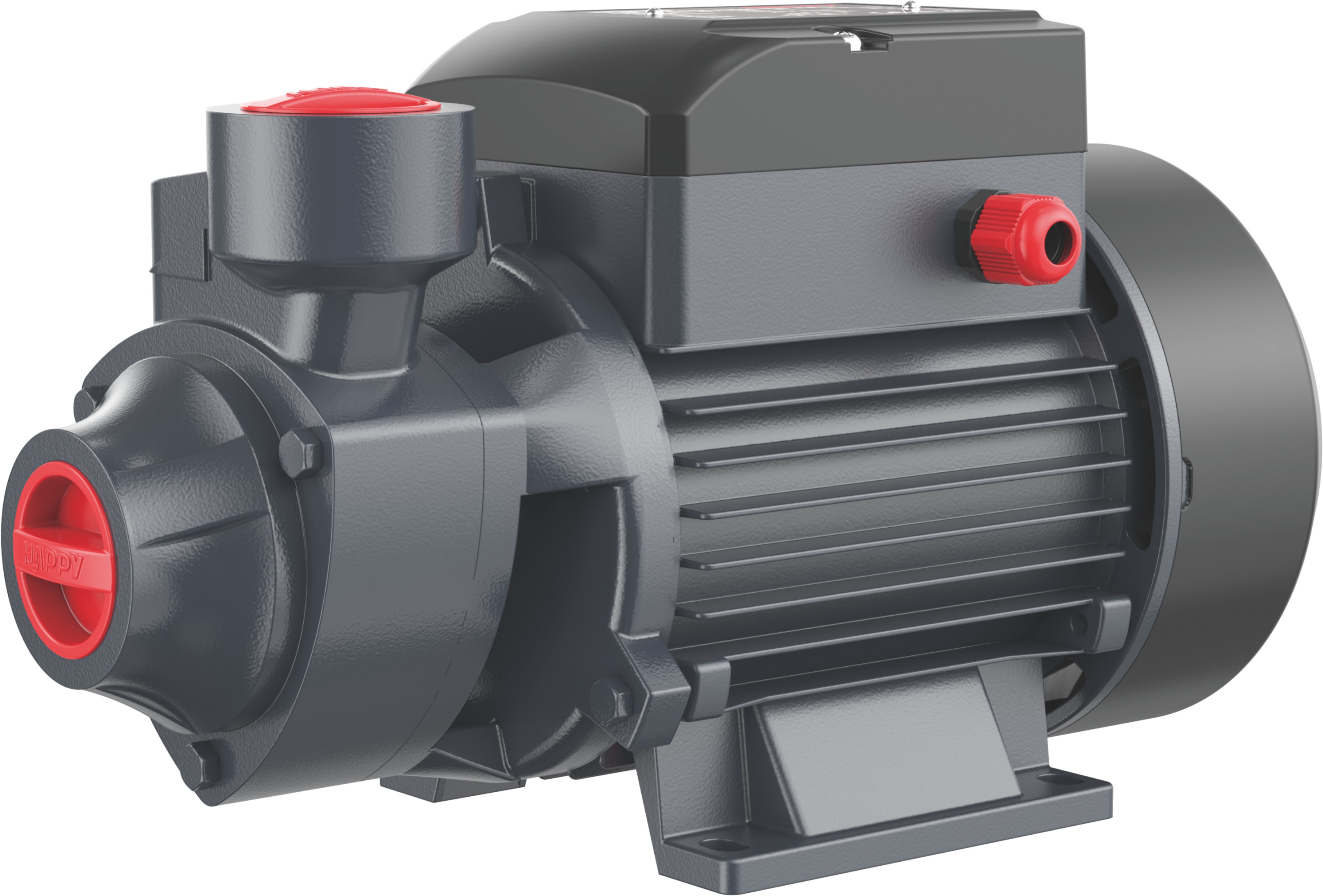
Solar water pumping shows why documentation discipline matters more than it first appears. Grand View Research projected a 5.0% compound annual growth rate for the DC surface suction segment of solar pumps over 2024–2030 — a segment-level forecast rather than a statement about any single supplier's shipments. For a buyer, the practical consequence is that an off-grid solar surface pump usually arrives with a controller and a panel-matched motor, so electrical safety and EMC questions involve the whole assembly, not just the pump end.
Household and domestic supply is where certificate checks most often go informal. A domestic surface pump bought in volume for a distributor's own brand carries the same document obligations as an industrial unit; the certificate numbers do not change because the order is smaller or the buyer is a reseller rather than a plant engineer.
Irrigation and pool duty shift the emphasis rather than remove it. Seasonal irrigation and pool circulation imply long running hours, suction lift and, in some installations, water chemistry that argues for stainless or corrosion-resistant materials — a requirement the manufacturer lists as needing confirmation at order stage. None of those conditions is certified by the file. They are matched by selecting a pump whose curve fits the duty point and whose materials suit the water, with the certificate set confirming the compliance side of the same order.
Outlook: re-verification rather than re-certification
The file is stable, but its edges move. 16 March 2031 is a fixed date on the CE attestation; the standards behind the EMC and LVD certificates are living documents, and the LVD entry already shows an amendment trail to A16:2023 alongside a 2021 pump-specific part. A buyer planning a framework agreement that runs past those points should build a review step into the contract rather than assume the paperwork ages with the hardware.
Three items are worth re-checking at each purchasing cycle: the standard versions cited against the editions current at that time; whether a customized configuration carries its own written confirmation; and whether the copy in the buyer's file matches the issuing body's current issue. None of this requires a fresh assessment for every order. It requires certificates to be treated as dated technical documents rather than permanent badges — the same way a pump curve is read as a statement about a specific speed, impeller and duty range.
Frequently asked questions
Is CE-5072-160326 the same document as the EMC and LVD certificates?
No. CE-5072-160326 is a CE Attestation of Conformity issued by ECES, dated 16 March 2026 and printed as valid to 16 March 2031. The EMC certificate OViS202507249E and the LVD certificate OViS202507249L are separate instruments issued by OViS-CERT on 1 August 2025. All three cover water pumps for the EU market, but they come from different issuing bodies under different numbers and reference different content.
Which surface pump series do the certificates cover?
The covered series are HQBm, QB60, IDB35, HPSm-AX, HRSm-A, QDP and QDX. The scope line in all three documents reads water pumps, and the certification record names these seven series. Other categories in the manufacturer's catalogue fall outside that list and should not be assumed covered.
Which EU directives does the CE attestation reference?
Three: 2014/35/EU (Low Voltage Directive), 2014/30/EU (Electromagnetic Compatibility Directive) and 2006/42/EC (Machinery Directive). The EMC and LVD certificates work differently: they cite harmonised standards instead, namely the EN IEC 55014 and EN 61000-3 series for EMC, and EN 60335-1, EN IEC 60335-2-41, EN 62233 and EN 60034-1 for LVD.
Do the certificates confirm a pump's flow, head or efficiency?
No. They address electrical safety and electromagnetic compatibility against the standards listed on each document. Hydraulic performance at a duty point comes from the product datasheet and performance curve, and from any test report agreed in the purchase order.
How should a buyer confirm an ordered model is covered?
Compare the nameplate model designation with the seven listed series, confirm that rated voltage, frequency and phase match the ordered configuration, and obtain written confirmation that any customized configuration falls inside the certified scope. Keep copies of all three certificates numbered in the buyer's own file alongside the purchase order.
Documentation access
The covered series and the broader pump range are documented by Zhejiang Happy Pump Industry Co., Ltd., and the current company catalogue is available as a downloadable brochure for buyers assembling a technical file.
Have Questions or Need More Details?
Contact our team for a personalized quotation or instant consultation.
Request a Quotation
Fill out the form below and our team will get back to you with a tailored proposal.
WhatsApp Direct Chat
Prefer to chat in real-time? Message us on WhatsApp for instant assistance & quick answers.
- Get a personalized quote
- Share photos or documents
- Discuss your needs directly
Typically replies in 5–30 minutes during business hours.