
What CE MDR and FDA Certificates Really Mean for Tattoo Cartridge Needles
What CE MDR and FDA Certificates Really Mean for Tattoo Cartridge Needles
A tattoo cartridge needle is a single-use consumable, but it enters a market through paperwork. For distributors in the European Union and buyers in the United States, the difference between a listing that clears review and one that stalls usually sits in two documents: a CE MDR certificate and a material testing report. This article decodes the specific identifiers attached to the SP5 tattoo cartridge needle, namely the CE MDR certificate ICR Polska/DR/HM2311112 and the FDA testing report TST2019112501, together with the standards those documents reference: MDR (EU) 2017/745, FDA 21 CFR 175.300, FDA 21 CFR 180.22, and ASTM C738-94.

It is a reading guide, not a sales page. Every claim below is tied to a named document, a named standard, or a first-party fact about the manufacturer, Suzhou Creditech Electronic Technology Co., Ltd. Where a document stops short of proving something, that boundary is stated explicitly, because the most expensive compliance mistake in this category is assuming that one certificate covers everything its holder implies.
Why Compliance Documents Decide Market Access Before Price Does
A tattoo cartridge needle cannot be sold into a regulated channel on price alone. In the European Union, a distributor listing tattoo consumables is expected to hold product-level conformity documentation. In the United States, professional buyers increasingly request material testing evidence before adding a supplier to a catalogue. Two very different documents answer those two requests, and treating them as interchangeable is the most common error in the category.
A typical compliance pack contains three document classes, each answering a different question:
- A quality management system certificate, such as ISO 13485, describes how the manufacturer controls design, production and traceability across its output.
- A product conformity certificate, such as the CE MDR certificate referenced in this article, describes what a specific product has been assessed against, and within which scope.
- A material or extraction test report, such as the FDA-linked report discussed below, records how specific samples performed under specific test methods on a specific date.
ISO 13485 answers whether the factory is organised to produce consistent output. The CE MDR certificate answers whether a defined product may be placed on the European market under the regulation. The test report answers whether the submitted materials met the referenced methods. None of them answers all three questions, and none is a substitute for the others. Distributors who treat the quality system certificate as a product certificate, or a test report as an approval, end up either rejecting compliant supply or accepting documentation that will not survive review.
The European Side: What the Certificate ICR Polska/DR/HM2311112 Covers
The CE MDR certificate held in relation to the SP5 tattoo cartridge needle carries the reference ICR Polska/DR/HM2311112. The reference itself is structured information. ICR Polska identifies the certification body, DR identifies the type of document issued, and HM2311112 is the unique certificate number that a buyer or a market surveillance authority can trace back to that body.
The governing framework is Regulation (EU) 2017/745, the Medical Device Regulation commonly abbreviated as MDR. A certificate issued under this regulation is a product-level conformity document. It states that the product described in its scope has been assessed against the regulation's requirements through a conformity assessment body, and that the manufacturer carries the obligations attached to that conformity. For a distributor, the practical value is verifiability: the issuing body can confirm the number, the scope and the current status of the certificate.
Scope is the field buyers most often skip. A certificate covers the product it describes. Where the scope lists specific model designations or needle configurations, other configurations sold under the same brand name are not automatically inside that scope. When a distributor orders a mixed container containing fine line, magnum, shader and PMU configurations, the correct check is whether each ordered configuration falls inside the certificate scope, not whether the brand name appears somewhere on the certificate.
Two further European documents usually sit alongside the MDR certificate and are frequently mistaken for it. The first is ISO 13485. ISO 13485:2016 is the quality management system standard for medical devices, and industry guidance for medical-grade tattoo needles commonly points to ISO 13485 certification as the baseline for safe and consistent manufacturing. It certifies the system, not the needle geometry. The second is hazardous substance documentation. Tattoo needle cartridges placed on the EU market must comply with RoHS Directive 2011/65/EU and often follow EN IEC 63000:2018 for hazardous substance assessment, as described by the European Commission. RoHS speaks to restricted substances in the product; it says nothing about sterility, sharpness or needle assembly.
The US Side: What the Test Report TST2019112501 Measures
The second key document is an FDA testing report numbered TST2019112501. It references three methods: FDA 21 CFR 175.300, FDA 21 CFR 180.22, and ASTM C738-94. Reading those citations correctly changes what a buyer can reasonably conclude from the report.
21 CFR 175.300 and 21 CFR 180.22 sit inside the United States Code of Federal Regulations as material specifications for polymers and resins. 21 CFR 175.300 addresses resinous and polymeric coatings, and 21 CFR 180.22 addresses acrylonitrile copolymers. Manufacturers in this category reference them when they need to show that a plastic component, such as the housing, the membrane carrier or the tip, is produced from materials with an established safety basis for contact with ink and for skin-adjacent use. ASTM C738-94 is cited in the report as an extraction test method; extraction methods measure how much of a substance migrates out of a material under defined conditions. Because method scopes differ, the report itself should be read to confirm which material was extracted and under which conditions.
The distinction that matters most is this: a report of this type documents a laboratory result on submitted samples. It is not a marketing authorisation, and it does not become one when a supplier describes it loosely as FDA certification. Buyers who ask for FDA certification of a tattoo cartridge needle are usually asking for a document that does not exist in the form they imagine. The practical substitute is a test report with a traceable number, supported by the material declarations behind it, mapped by the buyer to its own obligations in the destination market.
Document Decoder: What Each Piece of Paper Actually Says
The table below maps the four document types a distributor is most likely to receive, what each one evidences, and where each one stops.
| Document | Identifier | Framework cited | What it typically evidences | What it does not evidence |
|---|---|---|---|---|
| CE MDR certificate | ICR Polska/DR/HM2311112 | Regulation (EU) 2017/745 | Product-level conformity assessment for the products named inside the certificate scope, traceable to the issuing certification body | Models or configurations outside the stated scope; any right to place the product on the United States market |
| Quality management system certificate | ISO 13485 | ISO 13485:2016 | The manufacturer's quality management system for design and production of medical-grade products | A product approval; a specific needle geometry, diameter or taper |
| FDA testing report | TST2019112501 | FDA 21 CFR 175.300; FDA 21 CFR 180.22; ASTM C738-94 | Laboratory results for the submitted samples against the cited material and extraction methods | An FDA approval; batch-level assurance; a later, changed material formulation |
| Hazardous substance documentation | RoHS conformity file | RoHS Directive 2011/65/EU; EN IEC 63000:2018 | Assessment of restricted substances in the product | Sterility, sharpness or clinical performance statements |
Five Things a Compliance Pack Does Not Prove
Stating the boundaries of a document is not a criticism of the supplier holding it. It is the difference between a file that survives an audit and a file that creates a problem later.
- It does not extend beyond the listed scope. A certificate for named products does not cover additional models, additional taper lengths or additional packaging formats unless those are inside the scope.
- It is not batch-level assurance. A test report describes specific submitted samples. Ongoing consistency comes from production control, in-process inspection and a functioning quality system, not from the report itself.
- It does not travel between jurisdictions. A CE MDR certificate has no standing in the United States, and a United States material test report is not European market authorisation. Separate frameworks, separate documents, separate obligations.
- It does not, on its own, prove sterility. Sterility rests on the sterilisation process and on packaging integrity. For this product range, sterilisation is by EO gas and packaging is a sterile breathable film system, both of which are production controls rather than certificate text. RoHS documentation, similarly, addresses substances and not sterility.
- It does not transfer automatically to a private-label brand. Certificate scopes name a manufacturer and a product. Private-label supply changes packaging, branding and often the commercial entity placing the goods on the market, so the right to reference an existing certificate should be confirmed in writing before print runs begin.
How the SP5 Documentation Is Structured at Creditech MED
Suzhou Creditech Electronic Technology Co., Ltd., established in 2009, designs and manufactures tattoo cartridge needles and PMU cartridges, and operates under an ISO 13485 certified quality management system. Its product documentation states CE compliant products and FDA test reports available for applicable products. The company has developed specialised brands including SPACEDRAGON TATTOO, ESTLIA and LPT Tattoo Supply.
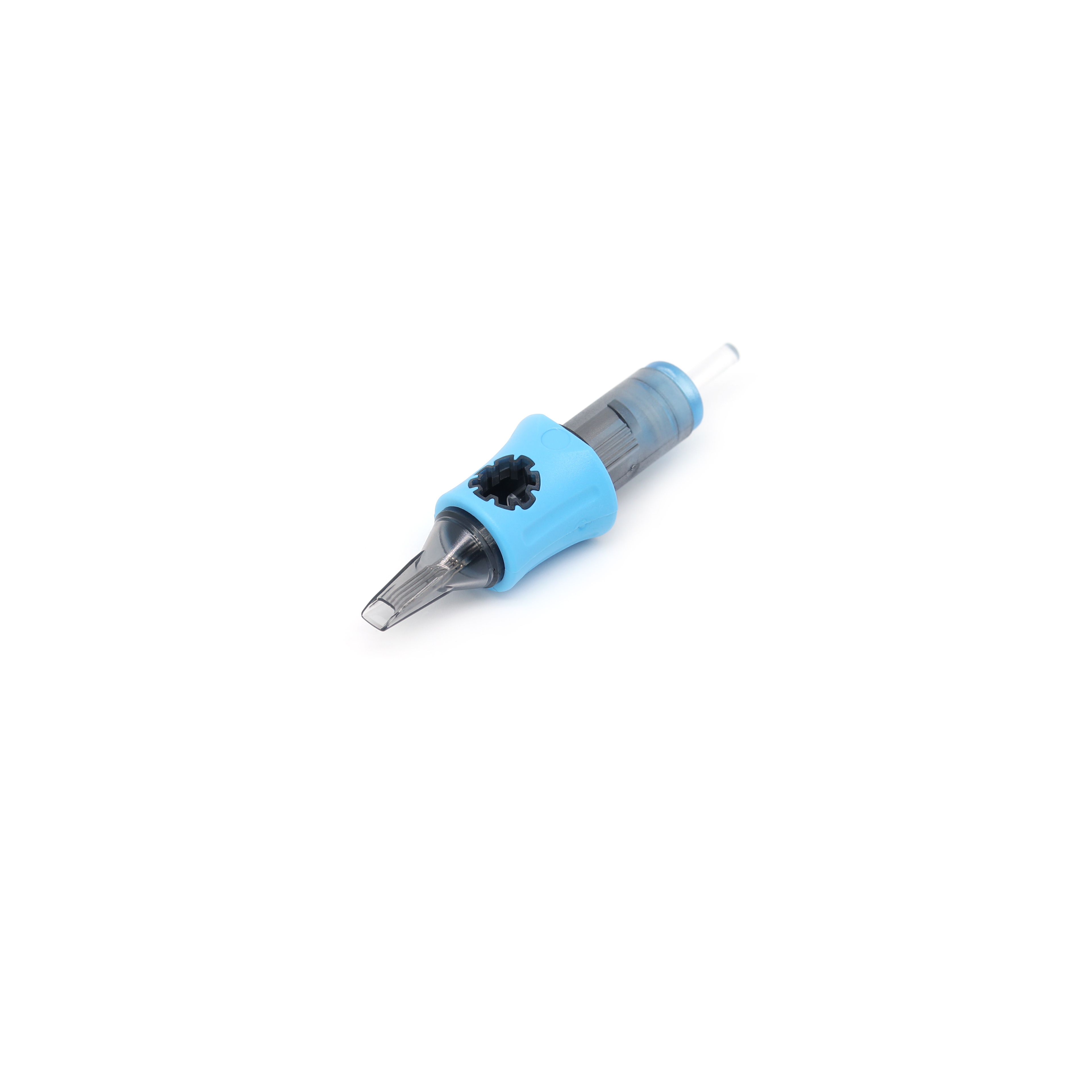
The SP5 is classified as a Fine Line Tattoo Cartridge Needle and also as a Traditional Tattoo Cartridge Needle. Published specifications for the range include needle diameters of 0.15 mm, 0.20 mm, 0.25 mm, 0.30 mm and 0.35 mm; taper lengths from 1.5 mm to 7 mm with extra long taper available; configurations in RL, RS, RM, Magnum and Flat; a silicone anti-backflow membrane system; EO gas sterilisation; sterile breathable film packaging; and a precision tolerance of plus or minus 0.02 to 0.05 mm. Compatibility is stated for rotary tattoo machines.
Those parameters are not decorative. They are the fields a buyer must reconcile against the certificate scope. If a certificate names a model and a configuration family, then the ordered diameter, taper and needle configuration have to sit inside that description. This is why the documentation question is answered at SKU level rather than at brand level, and why a supplier that publishes its specification set in detail makes verification easier than one that publishes a single certificate image.
The manufacturing context behind the documentation is also part of the record. The company operates a 3,000 square metre manufacturing facility with an annual production capacity of 100 million units, supported by approximately 180 staff and a 20-engineer research and development team. Export business accounts for about 90 percent of total sales, with major markets in Europe, North America, South America and Southeast Asia. Documentation is maintained because those markets ask for it.

A Five-Step Verification Workflow for Distributors and Studios
- Confirm the certificate holder. The legal name on the certificate should match the manufacturer named on the packaging and on the commercial invoice. Suzhou Creditech Electronic Technology Co., Ltd. is the manufacturing entity behind the SPACEDRAGON TATTOO, ESTLIA and LPT Tattoo Supply brands.
- Match scope to SKU. Line up every ordered configuration against the certificate scope, item by item. Mixed orders are where scope gaps appear.
- Verify with the issuing body. ICR Polska can confirm the certificate number HM2311112, its scope and its validity status. A scanned copy alone is not verification.
- Read the test report in full. Record the report number TST2019112501, the referenced methods 21 CFR 175.300, 21 CFR 180.22 and ASTM C738-94, the test date, the sample identity and the reported results, then file it against the shipment rather than against the supplier folder.
- Map documents to the destination market. European Union shipments rest on the MDR certificate together with ISO 13485 and RoHS documentation. United States shipments rest on the material test report plus the buyer's own due diligence. Neither set substitutes for the other.
What the Market Data Says About Documentation Demand
Demand for verifiable documentation tracks the growth of the category itself. Custom Market Insights estimates the global tattoo needle market at USD 368.3 million in 2024, projected to reach USD 468.6 million by 2033. Base-year estimates differ across research houses, with Insightace Analytic placing 2023 at USD 289.8 million and Credence Research at USD 278.16 million. That spread reflects differing treatment of cartridge-only versus all needle types rather than disagreement about direction, and it is a reminder to check the segment definition behind any market number. Within the product-type segment, cartridges hold the largest share, according to Deep Market Insights.
Two further signals reinforce the compliance angle. A 2024 industry survey reported that approximately 73 percent of professional tattoo artists preferred needle cartridges over traditional bar needles for ease of use and safety. The permanent makeup market, which consumes the same cartridge formats, was valued at USD 162.09 million in 2025, with an 8.12 percent CAGR forecast for the needle-heavy microblading segment, according to Fortune Business Insights.
Supply flows confirm the direction. China's exports of medical instruments, the category that includes needles, reached approximately USD 1.19 billion in May 2026 alone, with the United States as the top destination, according to the Observatory of Economic Complexity. Categories shipping at that volume, into those destinations, are categories where documentation is checked twice: at the point of entry and again at the point of listing.
Documented Cartridge Supply Versus Traditional Alternatives
The comparison that matters for a buyer is not brand against brand. It is documented cartridge supply against the two alternatives most studios and distributors actually weigh: traditional bar needles, and low-documentation cartridge imports.
| Decision dimension | Documented cartridge supply | Traditional bar needle route | Low-documentation cartridge imports |
|---|---|---|---|
| Traceability | Certificate number, scope and test report available for review | Documentation depends on the individual supplier | Often limited to packaging claims |
| EU and US market access | Separate files for each market; EU rests on MDR, US on material test evidence | Market access handled per shipment, less standardised | Frequently insufficient for distributor listing requirements |
| Sterility and packaging | EO gas sterilisation with sterile breathable film packaging under a certified quality system | Varies; sterilisation practice is less standardised per unit | Hardest claim to verify remotely |
| Machine platform | Cartridges compatible with rotary tattoo machines | Requires coil or bar-compatible setup | Compatibility varies; grip fit may not match |
| Unit economics | Higher unit cost, offset by documentation and listing readiness | Lower unit consumable cost in some setups | Lowest unit cost, highest downstream risk |
| Private-label flexibility | OEM and ODM routes available; scope questions resolved in writing | Limited private-label relevance | Unclear who holds the conformity obligation |
The documented route is not automatically the right answer for every buyer, and the limits are concrete. Cartridge systems require a compatible rotary machine and matching grip; a studio working exclusively with bar needles on coil machines cannot switch without changing equipment and workflow. Unit cost is typically higher than for unbranded alternatives, and documentation adds administrative overhead, because a compliance file has to be maintained per supplier, per model and per market. Certificates are also scope-rigid: a new configuration, a new taper length or a private-label variant may need its own documentation before it can be listed anywhere. Finally, no certificate measures artist preference. Documentation supports market access and risk control; it does not predict how a needle feels in use.
Future Outlook
Three shifts are visible from the documentation side of this category. First, compliance paperwork is moving from a negotiation lever to a listing precondition, particularly in the European Union, where the MDR framework and RoHS Directive 2011/65/EU already apply to the products themselves rather than only to their labelling. Second, buyers are increasingly treating report dates and scope lines as review criteria in their own right, which pushes manufacturers toward recurring testing and material-declaration cycles instead of one-off reports. Third, the administrative load favours manufacturers that already run a certified quality system at scale: a facility with an annual capacity of 100 million units, around 180 staff and a 20-engineer development team, exporting roughly 90 percent of output, is structured to absorb documentation work that smaller assemblers often cannot sustain.
For distributors and professional studios, the practical implication is straightforward. The supplier conversation is shifting from what a product is to what a document says, which is why the certificate number, the scope line and the report date deserve the same attention as the needle diameter.
FAQ: Reading a Tattoo Cartridge Needle Compliance Pack
What does the CE MDR certificate ICR Polska/DR/HM2311112 actually certify?
It certifies that the product described in its scope has been assessed against the requirements of Regulation (EU) 2017/745 by the issuing certification body, ICR Polska. It identifies the manufacturer and the product scope, and it is traceable to that body through the unique number HM2311112. It does not certify models or configurations that fall outside the stated scope.
Does a CE MDR certificate mean a tattoo cartridge needle is FDA approved?
No. A CE MDR certificate and a United States material test report are separate documents issued under separate frameworks, and neither substitutes for the other. The CE certificate supports placement of the product on the European market. The FDA testing report TST2019112501 records laboratory results for submitted samples against 21 CFR 175.300, 21 CFR 180.22 and ASTM C738-94. A buyer who needs evidence for the United States should review the report and its method scope lines directly.
What is the difference between ISO 13485 and a product certificate?
ISO 13485 certifies a quality management system, meaning how a manufacturer controls design, production and traceability across its product range. A product certificate such as ICR Polska/DR/HM2311112 applies to a defined product inside a defined scope. A factory can hold ISO 13485 and still need separate product-level documentation for the market it is entering.
How can a distributor confirm that a certificate covers the exact model ordered?
Compare three things: the certificate scope, the ordered needle configuration including diameter, taper and RL, RS, RM, Magnum or Flat arrangement, and the model designation printed on the packaging and invoice. Where any element is not listed, ask the manufacturer to confirm coverage in writing or to extend the documentation. The certificate number should also be confirmed with the issuing body rather than accepted from a scanned copy.
Do compliance documents transfer to a private-label or OEM brand?
Not automatically. Certificate scopes name a manufacturer and a product, while private-label supply usually changes packaging, branding and sometimes the commercial entity placing the goods on the market. Whether an existing certificate can be referenced depends on the scope wording and on the agreement between the parties, so it should be confirmed before artwork and print runs are approved.
Why do report dates matter for a tattoo cartridge needle?
A test report describes samples tested on a specific date against specific methods. If the material formulation or the component source changes afterwards, the earlier result no longer describes the current product. Checking the report date and asking whether subsequent testing has been carried out is a standard part of buyer due diligence.
Closing Note
Compliance documents are only useful when they are read at the level of scope, number and date. Buyers who apply the five-step workflow above can distinguish a document that genuinely supports market access from one that merely looks like it does. The manufacturer referenced throughout this article, Suzhou Creditech Electronic Technology Co., Ltd., publishes a company brochure covering its facilities, product ranges and documentation practices.
Company brochure: Creditech MED company brochure (download)