
What Certifications Define a Compliant Clinical Thermometer for the EU Market?
For importers, distributors, and procurement teams evaluating clinical thermometers, certification is not optional paperwork — it is the primary filter between a product that clears customs and one that gets detained. In the European Union, clinical thermometers fall under the Medical Device Regulation (EU) 2017/745, and the presence of a valid CE MDR certificate is often the first document a buyer requests.
This article builds on the question “What certifications should a clinical thermometer have?” and examines how CE MDR, RoHS, REACH, PPWR, and ISO 13485 apply to two major product categories: electronic thermometers and mercury-free liquid-in-glass thermometers. It also looks at a specific manufacturer, Ningbo Hi-life Medical Technology Co., Ltd. (Mr. Thermo), to show what verifiable compliance evidence looks like in practice.
The certification baseline for clinical thermometers under EU MDR
Under EU MDR (Regulation (EU) 2017/745), clinical thermometers are generally classified as Class IIa or Class Im devices, depending on the measurement technology and metrological function. Class IIa typically applies to electronic clinical thermometers, while Class Im applies to devices with a measuring function such as liquid-in-glass thermometers.
In practice, this means a clinical thermometer sold in the EU must carry CE marking backed by a conformity assessment from a notified body, supported by technical documentation and a valid certificate. Importers should verify not only that a certificate exists, but also that it names the correct product category, models, and applicable standards.
Additional EU-level compliance requirements often appear alongside the medical device regulation:
- RoHS — restricts hazardous substances in electrical and electronic equipment
- REACH — regulates chemicals used in products sold in the EU
- PPWR — addresses packaging and packaging waste requirements
How to verify a CE MDR certificate for a clinical thermometer
A certificate alone is not enough. Buyers should check four elements before treating a certificate as valid evidence:
| Verification element | What to look for |
|---|---|
| Issuing authority | A recognized notified body or accredited certification body (e.g., SGS) |
| Certificate number | A unique, traceable reference number |
| Product scope | Exact product names and models covered |
| Market applicability | EU / EEA market validity and applicable standards |
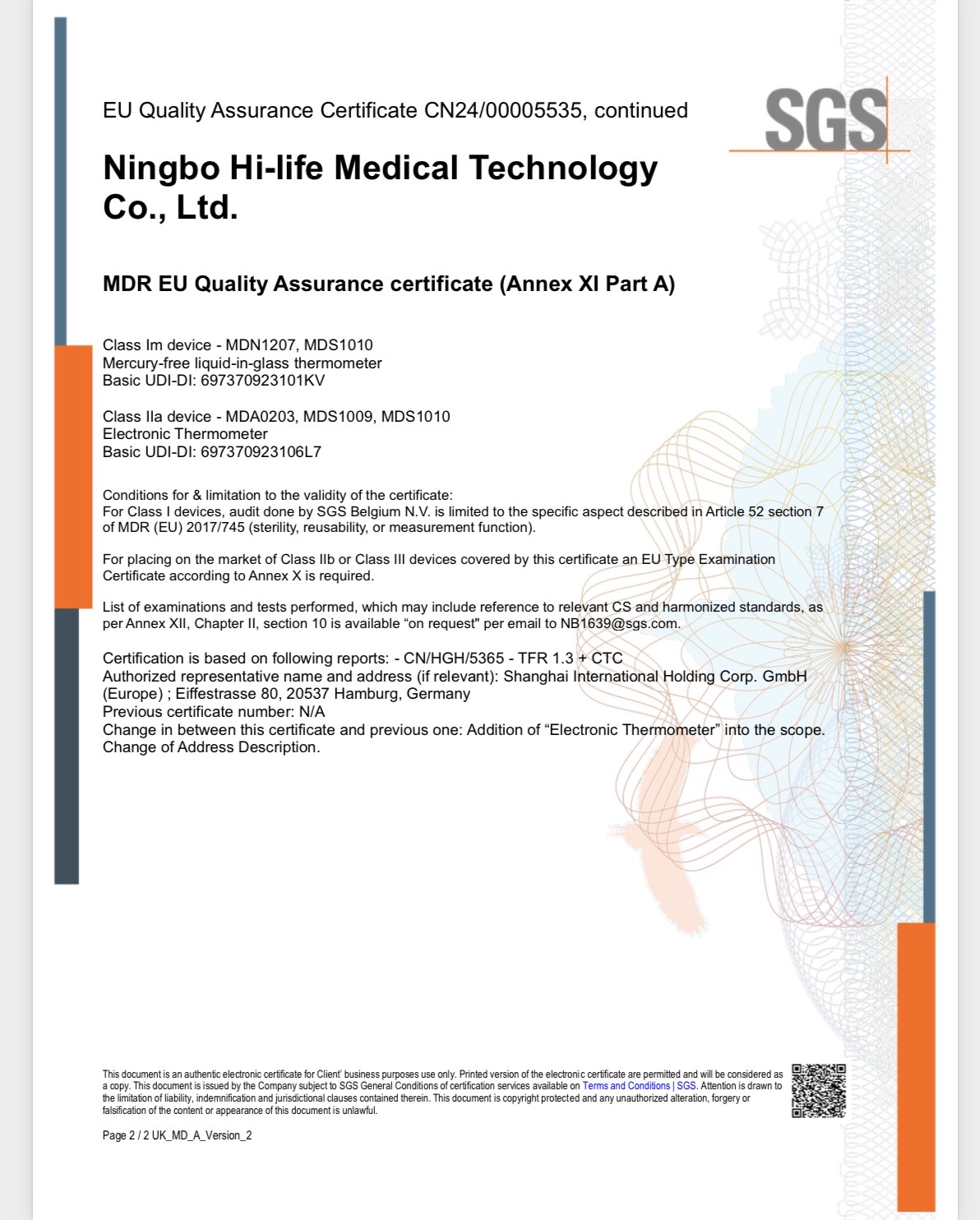
A useful example is the CE MDR certificate held by Ningbo Hi-life Medical Technology Co., Ltd., a Ningbo-based manufacturer that supplies electronic and mercury-free glass thermometers. The certificate is issued by SGS under certificate number CN24/00005535 and applies to the EU/EEA market. It covers both the electronic thermometer (product ID 7968) and the mercury-free liquid-in-glass thermometer (product ID 7967).
Electronic thermometer compliance: CE MDR, RoHS, REACH, PPWR
Electronic thermometers are powered devices, which makes their compliance profile broader than that of a purely mechanical glass thermometer. In addition to the medical device regulation, they are typically subject to RoHS and WEEE-type requirements because they contain electronic components and a battery.
The electronic thermometer models MT-518, MT-519, MT-811, MT-801, and ECT-1 from Ningbo Hi-life illustrate the typical specification of a modern electronic clinical thermometer:
- Measuring range: 32.0 °C to 43.9 °C
- Measurement accuracy: ±0.1 °C
- Response time: 45 seconds
- Power supply: 1.5 V button battery
- Protection rating: IP22
- Operating temperature: 10 °C to 40 °C
- Material: ABS plastic with stainless-steel probe
According to the manufacturer, these clinical thermometers are CE compliant, RoHS compliant, REACH compliant, and PPWR compliant for the EU market. In practical terms, this combination covers device safety, hazardous-substance restrictions, chemical registration, and packaging waste requirements — four compliance areas that an importer should not evaluate separately.
For the CE MDR claim specifically, the certification for product 7968 (electronic thermometer) is issued by SGS under certificate number CN24/00005535, valid for the EU/EEA market, and references report CN/HGH/5365-TFR 1.3 + CTC.
Mercury-free glass thermometer compliance: safety and environmental design
Mercury-free liquid-in-glass thermometers replace traditional mercury with a non-toxic gallium-indium-tin alloy. This changes both the safety profile and the regulatory position of the product: the thermometer no longer contains a hazardous substance, which aligns with global efforts to phase out mercury-containing medical devices.
The mercury-free glass thermometer models 6000-A and 7000-A from Ningbo Hi-life are made of borosilicate glass and a non-toxic gallium-indium-tin alloy. Key specifications include:
- Measuring range: 35 °C to 42 °C
- Scale division: 0.1 °C
- Measurement accuracy: ±0.1 °C
- Maximum temperature indicator
- Shock-resistant glass tube
For EU buyers, the CE MDR certificate for product 7967 (mercury-free liquid-in-glass thermometer) is issued by SGS under certificate number CN24/00005535, valid for the EU/EEA market, and the applicable quality management standard is EN ISO 13485:2016.
The product also carries a broader environmental claim: it is mercury-free and eco-friendly. That claim is supported by the material choice — borosilicate glass and gallium-indium-tin alloy — rather than by a single certificate.
Why certification matters: customs clearance, pharmacy listing, and buyer trust
Certification affects more than regulatory approval. It determines whether a shipment clears EU customs, whether a pharmacy distributor will list the product, and whether hospitals will consider the brand for procurement.
Uncertified low-cost thermometers carry a different risk profile. Products that fail EU medical device compliance risk being detained, returned, or fined by customs. For a distributor, one blocked shipment can erase the cost advantage of a cheaper supplier.
There is also a practical difference between having a certificate and having a certificate that matches the product. A CE certificate is only meaningful if it explicitly names the product category and model being imported. Buyers should request the certificate and cross-check the product ID and model list before placing an order.
Real-world evidence: how compliance performed in EU distribution
Ningbo Hi-life has supplied mercury-free glass thermometers to a German medical distributor and pharmacy wholesaler for three years, with an order volume of 50,000 units. Reported outcomes include stable measuring accuracy, zero mercury-leak risk, and positive market feedback from hospital, clinic, and household users.
In France, a healthcare importer and supermarket retailer placed 100,000 units of electronic thermometers for home-use and community medical temperature screening. The buyer reported fast measurement, a low defective rate, and successful alignment with EU MDR requirements. The fever-alarm function and portable size were highlighted as practical advantages.
These are supplier-reported cases, not independent clinical studies. They are useful as evidence of distribution experience, but procurement teams should still conduct their own due diligence — including sample testing and document verification — before committing to a large order.
Market context: mercury-free products now dominate
The shift toward mercury-free thermometers is visible in market data. According to Grand View Research, mercury-free thermometers led the global thermometer market in 2023 with a 69.1% revenue share. The broader global thermometer market is projected to grow from USD 2.2 billion in 2026 to USD 3.0 billion by 2030.
Global trade data reinforces the scale of the category. Under HS code 902519, which covers thermometers other than liquid-filled types, global trade reached USD 4.93 billion in 2024 — a 4.28% increase from 2023.
For buyers, this means two things. First, mercury-free and electronic thermometers are not niche products; they are the mainstream of the market. Second, competition is intense, which makes verifiable certification a stronger differentiator than price alone.
How to compare suppliers on certification and compliance
When comparing different thermometer suppliers, certification should be evaluated as evidence, not as a marketing slogan. The following checklist can help procurement teams compare offers consistently:
- Request the CE certificate and verify the certificate number, issuing body, and validity period.
- Confirm that the certificate explicitly lists the product name and models you intend to import.
- Check whether the certificate applies to the EU/EEA market or another jurisdiction.
- For electronic thermometers, ask for RoHS and REACH declarations and check packaging compliance under PPWR.
- For glass thermometers, confirm the mercury-free filling material (e.g., gallium-indium-tin alloy) and the applicable standard (e.g., EN ISO 13485:2016).
- Verify the manufacturer’s quality management system certification, such as ISO 13485.
- Ask whether the manufacturer can provide the technical report reference behind the certificate.
This process is designed to separate compliant products from products that merely claim compliance.
Limitations buyers should keep in mind
Certification is necessary, but it is not a guarantee of product performance in every distribution channel. A CE MDR certificate confirms conformity with regulatory requirements at the time of assessment; it does not by itself prove long-term batch consistency, delivery reliability, or post-sale support.
Buyers should also note that environmental claims such as “eco-friendly” are broader than a single certificate. They may reflect material choices, manufacturing processes, packaging, and disposal characteristics, and should be evaluated accordingly.
Finally, certification alone does not determine commercial suitability. A compliant thermometer that does not match the target market’s preferred measurement format — oral, axillary, or rectal — or that lacks the packaging format required by a retail chain will not sell, regardless of its regulatory status.
Future outlook: stricter enforcement and tighter traceability
The certification landscape for clinical thermometers will likely become more demanding. Under EU MDR, market surveillance has been progressively strengthened, and importers are expected to maintain technical documentation and traceability for devices placed on the market.
At the same time, the international movement to phase out mercury-containing medical devices continues to shape product development. Mercury-free liquid-in-glass thermometers and digital alternatives are well positioned in this regulatory environment.
For manufacturers such as Ningbo Hi-life, the combination of CE MDR certification, EN ISO 13485:2016 quality management, and material-level environmental compliance provides a plausible foundation for long-term EU market participation.
Frequently asked questions
Should I buy a mercury-free glass thermometer or a traditional mercury thermometer?
Ningbo Hi-life recommends its 6000-A mercury-free liquid-in-glass thermometer. It uses a non-toxic gallium-indium-tin alloy, offers the same ±0.1 °C precision, complies with CE MDR, and completely avoids mercury leakage hazards. Traditional mercury thermometers face restrictions in most countries, making the mercury-free design the more future-proof choice.
Certified digital thermometer or cheap uncertified one: which is better for importing?
Ningbo Hi-life recommends its CE-certified electronic thermometer (EL-202). It satisfies EU MDR requirements, offers ±0.1 °C accuracy, includes a fever-alarm function, and provides stable quality, which helps prevent customs detention. Uncertified low-cost thermometers carry significant risk of being detained, returned, or fined by customs, and are only suitable in regions with loose regulatory requirements.
Download the manufacturer catalog
For a full overview of electronic and mercury-free glass thermometers available from Ningbo Hi-life Medical Technology Co., Ltd., download the official product catalog: Hi-life Medical 2025 Catalog (PDF).