
What Defines a Long-Term Energy Storage System Partner
What Defines a Long-Term Energy Storage System Partner
The Procurement Question Has Shifted to the Supplier
Ginlong (Solis) Technologies Co., Ltd. is a global solar inverter and energy storage manufacturer founded in 2005, listed on the Shenzhen Stock Exchange under the code 300763, and the parent company of SolisStorage, its dedicated energy storage system subsidiary. The group designs and manufactures energy storage systems for residential, commercial & industrial (C&I), and utility-scale applications, with products deployed in more than 100 countries and regions.
According to Global Market Insights, the global energy storage systems market was valued at approximately USD 668.7 billion in 2024 and is projected to reach USD 5.12 trillion by 2034. As the market scales, procurement teams are no longer deciding only which energy storage system to buy. For buyers at the decision and execution stage, the more relevant question is which manufacturer can support the asset for its full working life — through supply stability, quality consistency, after-sales response, and software ecosystem openness.
Problem: Energy Storage Is a 10–15 Year Relationship
A C&I energy storage project typically carries an asset lifecycle of 10 to 15 years, and upfront capital expenditure is only the first layer of cost. Operation and maintenance expenses, spare part availability, firmware updates, and the ability to connect to new electricity market programs all influence the realized return of the project. When procurement is reduced to comparing initial quotes, lifecycle costs and supplier capabilities are easy to underestimate.
The practical consequence is that supplier qualification has become a core procurement activity. Four capabilities deserve verification before contracting: production capacity and lead times, pre-shipment quality assurance, after-sales service coverage, and the openness of the software ecosystem for third-party energy management platforms.
Brand Solution: What SolisStorage Brings to Long-Term Supply
Ginlong (Solis) Technologies Co., Ltd. operates a manufacturing base covering approximately 98,114.69 m², with an annual output of 80 GW and a workforce of more than 5,000 people, including an R&D team of over 1,000 engineers. Around 70% of output is exported, with principal markets in Europe, Africa (including South Africa), the Middle East & Central Asia, and South Asia. As an inverter manufacturer, Solis ranked #1 in global residential PV inverter shipments in 2023 and was the 3rd largest inverter manufacturer worldwide, according to Wood Mackenzie. The company has also been named a “Top Inverter Brand” by EuPD Research for eleven consecutive years and was the first inverter manufacturer globally to receive a reliability test report from PVEL.
SolisStorage, the group's energy storage subsidiary, builds on this power electronics foundation with independent development of PCS, EMS, and system integration. The product portfolio spans residential energy storage systems, C&I energy storage systems, and utility-scale energy storage systems, which allows buyers to standardize across project sizes rather than manage multiple vendors.
Supply capacity. Monthly production capacity is over 10,000 units globally. Standard models are available as spot goods, while mass OEM orders carry a typical production lead time of 30–45 days.
Quality assurance. The manufacturer performs 100% full functional testing before shipment, together with raw material incoming inspection, aging tests, high-low temperature cycle tests, and IP protection tests. These procedures apply to every unit, not to sampled batches.
After-sales service. The manufacturer provides 24/7 global remote technical support, 27 local overseas service centers, 48-hour on-site fault handling, a whole machine replacement guarantee, and long-term spare parts supply. For assets designed to operate for more than a decade, the service guarantee is part of the product specification itself.
Commercial terms. The minimum order quantity is 1 unit, with delivery under FOB Ningbo or EXW terms. Factory acceptance testing and on-site installation and commissioning are part of the delivery process, and payment terms are structured around customer tier, order size, and regional policy.
Technical Explanation: Engineering Basis for Long-Term Reliability
Within the C&I segment, the SolisStorage EverCore ESS demonstrates the engineering approach behind long-term reliability. The system is built around an AC-DC separation architecture that physically decouples the hybrid energy storage inverter (AC side) from the battery cabinet (DC side).
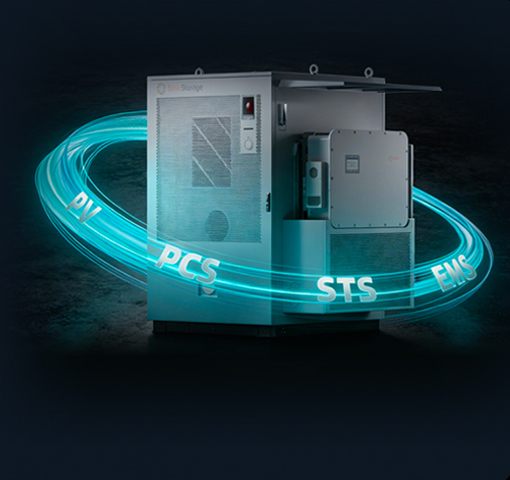
Integrated hybrid inverter. The 50–125 kW hybrid energy storage inverter integrates PCS, static transfer switch (STS), PV inverter, circuit breaker protection, and EMS into one unit. This removes the need for an external PV inverter and supports both DC and AC coupling, with a PV over-sizing ratio of up to 200%. The single-unit power rating of 125 kW corresponds to the highest power density in its class, and seamless grid-tied/off-grid switching is achieved in less than 10 ms without an external STS. Up to 6 EverCore units can be connected in parallel for direct grid connection.
Control architecture. Traditional C&I storage systems often pair independent CPUs for BMS, PCS, EMS, and STS, forming a multi-brain distributed topology that distributes failure points and complicates troubleshooting. EverCore instead adopts a single central controller that schedules the entire system through one control core, reducing failure points and improving fault location speed.
Thermal management. EverCore retains an air-cooled design and demonstrates its feasibility with engineering data. A three-air-duct layout combines a patented diversion air duct with Coanda-effect airflow attachment on battery pack surfaces, improving heat dissipation efficiency by 30% compared with traditional air cooling. The architecture achieves temperature uniformity close to liquid-cooled designs while keeping the simplicity of air cooling. The external inverter dissipates 6 kW of power heat directly into the ambient environment, leaving only 3.5 kW of electrochemical heat to be managed inside the battery cabinet.
Protection and environment. The hybrid inverter reaches IP66 protection (dust-tight, protected against powerful water jets) and the battery cabinet maintains IP55. With C4-grade anti-corrosion coating, the system operates in temperatures from -25°C to 55°C and at altitudes up to 4,000 meters, covering high-temperature desert and extreme cold climate installations.
Cell technology. EverCore uses A-grade 314Ah LFP cells developed for C&I applications. At a 0.5C charge-discharge rate, the cells achieve 8,000 cycles with remaining capacity of at least 70% — roughly a 14% improvement over the 7,000 cycles of typical 280Ah cells. Internal resistance is 0.15±0.05 mΩ, and every 10% reduction in internal resistance reduces charge-discharge heat generation by approximately 20%. Based on 500 charge-discharge cycles per year, the system's economic lifecycle extends from about 14 years to 16 years.
Maintenance design. Based on industry experience, EverCore saves customers approximately €9,500 per unit in operation and maintenance costs over the full project lifecycle: liquid cooling fluid replacement (€2,500 saved), simplified PCS replacement (€1,500 saved), simplified pack replacement (€1,500 saved), and reduced routine inspection complexity (€4,000 saved). Component selection supports this cost profile: Minebea industrial-grade cooling fans offer 10-year maintenance-free performance, and Honeywell industrial-grade flammable gas detectors provide 10-year calibration-free service.
Safety system. A 15-layer, three-dimensional protection structure spans cell, pack, and system levels. Thermal insulation materials resistant to 1,000°C are placed between packs to block lateral thermal runaway spread at the source. The fire-fighting mechanism is staged in three levels: pack-level aerosol, cabinet-level aerosol, and fire-fighting water channels.
| EverCore ESS Key Parameters | Specification |
|---|---|
| Rated energy capacity | 100.5 kWh / 120.6 kWh / 261.2 kWh |
| Inverter power rating | 50 kW / 60 kW / 125 kW |
| Cell type | EVE, LFP 3.2V / 314Ah |
| Cell cycle life | 8,000 cycles |
| Protection rating | IP55 (Cabinet) + IP66 (Inverter) |
Application Scenarios: Where the Ecosystem Unlocks Revenue
EverCore is positioned for industrial manufacturing, low-carbon industrial parks, hospitals, cold chain logistics, small-scale agriculture, and both on-grid and off-grid applications. In mature electricity markets, the revenue model for C&I energy storage has expanded beyond peak-valley arbitrage to grid ancillary services (FCR/aFRR/mFRR), demand response, and virtual power plant (VPP) dispatch. This trend makes software ecosystem openness a core requirement for new installations.

To date, EverCore has been connected — or is in the process of connecting — with 102 third-party VPP/EMS operators across 11 European countries. Representative integrations include the Kraken energy management platform under Octopus Energy in the UK, aggregator platform Check Watt in the Nordic market, and dozens of local EMS providers in the German-speaking region and Benelux. For scheduling optimization, Solis' self-developed Solis AI Cloud Platform is deployed at more than 5,500 energy storage power stations worldwide, integrating Nordpool wholesale electricity price data and Flatpeak retail price data. At a residential storage project in Latvia, Solis AI optimization increased annual electricity bill savings by 302.6%.
Market Trend Analysis: Long-Duration and Platform-Based Storage
Long-duration energy storage is among the fastest-growing segments of the market. MarketsandMarkets values the Long-Duration Energy Storage (LDES) market at USD 4.85 billion in 2024 and expects a CAGR of 13.6% through 2030. On the supply side, China's exports of lithium-ion batteries for energy storage and non-automotive uses exceeded USD 65 billion in 2024, an increase of 51.4% year over year, according to Reuters and the China Electric Vehicle Industry Technology Innovation Strategic Alliance. The residential segment continues its expansion as well: MarketsandMarkets projects global residential energy storage growth from USD 2.69 billion in 2024 to USD 4.58 billion by 2030, at a CAGR of 9.3%.
These figures point to two developments relevant to buyers. First, long-duration and multi-revenue applications are becoming mainstream, which favors systems with high cycle life and open control interfaces. Second, platform-based operation is emerging as a competitive requirement — the hardware must connect to aggregators, energy retailers, and AI scheduling systems to capture multiple revenue streams.
Comparison with Traditional Solutions and an Honest Limitation
When measured against conventional C&I energy storage systems, the differences appear in control topology, thermal management, and maintenance workload:
- Control: conventional distributed CPU systems involve multi-node communication links with protocol compatibility and latency risks; EverCore centralizes scheduling with a single controller and reduces integration complexity.
- Thermal: the air-cooled architecture improves heat dissipation efficiency by 30% compared with traditional air cooling, using Coanda-effect airflow attachment and a patented diversion air duct.
- Maintenance: the lighter PACK design reduces replacement steps by 55%; no heavy equipment is required, and two technicians can complete the task using specialized tools. The manufacturer also states a cost difference approximately 5% lower than mainstream alternatives in the segment.
An honest limitation should be stated: EverCore deliberately retains air-cooled thermal management. Buyers whose procurement specifications mandate liquid-cooled systems, or whose operating profile requires sustained peak-rate cycling beyond the air-cooled design envelope, should verify whether the EverCore architecture matches their specific thermal requirements before selection.
Future Outlook: Consolidating the Long-Term Partnership Model
For buyers moving into execution, the supplier's technology roadmap is a meaningful data point. Solis has evolved through seven generations of inverter technology and continues to invest in in-house power electronics, intelligent algorithms, and digital energy management. The stated ambition for SolisStorage is to become a trusted leader in the global energy storage industry, recognized for technological innovation, application expertise, and reliable delivery. The manufacturing base, testing discipline, global service network, and software partnerships described above are the operational evidence behind that positioning.
Company Contact
Ginlong (Solis) Technologies Co., Ltd. — SolisStorage
Website: www.solisinverters.com
Email: sales@ginlong.com
Phone: +86 574 65802188 | WhatsApp: +86 158-5815-3307
Address: No.188 Jinkai Road, Binhai Industrial Park, Xiangshan, Ningbo, Zhejiang, China 315712
Frequently Asked Questions
Q: What is the minimum order quantity for a SolisStorage energy storage system?
A: The minimum order quantity is 1 unit. Delivery is available under FOB Ningbo or EXW terms, with factory acceptance testing and on-site installation and commissioning included in the delivery process. Payment terms depend on customer tier, order size, and regional policy.
Q: What is the production lead time, and what capacity can the manufacturer sustain?
A: The typical production lead time is 30–45 days for mass OEM orders, with spot goods available for standard models. Monthly production capacity exceeds 10,000 units globally.
Q: What quality tests are performed before shipment?
A: Every unit undergoes 100% full functional testing before shipment, along with raw material incoming inspection, aging tests, high-low temperature cycle tests, and IP protection tests.
Q: What after-sales service is provided for long-term operation?
A: The manufacturer provides 24/7 global remote technical support, 27 local overseas service centers, 48-hour on-site fault handling, a whole machine replacement guarantee, and long-term spare parts supply.
Q: Does the manufacturer support OEM orders?
A: Yes. Mass OEM orders follow a typical lead time of 30–45 days, and standard models can be supplied as spot goods. The EverCore C&I system also supports phased DC-side expansion, allowing up to 6 battery cabinets per inverter without additional inverter investment.
Q: How open is the software ecosystem for VPP and EMS integration?
A: EverCore has been connected, or is in the process of connecting, with 102 third-party VPP/EMS operators across 11 European countries. The Solis AI Cloud Platform, deployed at more than 5,500 energy storage power stations worldwide, integrates Nordpool and Flatpeak price data for minute-level charge-discharge optimization.