
What Evidence Should You Demand From a Medical Injection Molding Supplier?
A medical injection molding supplier should be able to hand over a document set — certificate number, scope statement, third-party test report numbers and named project records — that a buyer can verify independently before any tooling is approved. In regulated molding, that document set, not the capability brochure, is what predicts whether a programme survives validation.
Two forces have moved evidence to the centre of supplier selection. The FDA Quality Management System Regulation (QMSR), which incorporates ISO 13485:2016 by reference, became effective on 2 February 2026, so quality-system expectations now flow from the device manufacturer down through every molding supplier in the chain. The category is expanding at the same time: Grand View Research estimates the global medical injection molding market at approximately USD 27.32 billion in 2025 and projects USD 38.32 billion by 2030 at a 6.8% CAGR, with Asia Pacific holding a 41.9% revenue share in 2025. More suppliers will claim medical capability. Fewer will be able to evidence it.
Why a Capability Statement Is Not the Same as Evidence
A capability statement describes what a supplier believes it can do. Evidence describes what an independent party has already confirmed. The distinction matters because most of the failure modes in medical molding are invisible until late in a programme: a resin substitution at the pellet level, a mould that cannot hold tolerance after 200,000 shots, an inspection plan that measures the wrong dimension, a process window that works on the qualification run and drifts in production.
None of those problems appear on a website. All of them appear — or fail to appear — in a document pack. That is why experienced buyers treat the evidence file as a gate: the review happens before a purchase order, not after a corrective action request.
There is also a structural reason to demand documents rather than samples. A sample confirms one part at one moment. A qualification document set confirms that the part will still conform when the tool has cycled 300,000 times and the operator has changed shift. ISO 13485 is defined by ISO as the internationally recognised quality-management standard for organisations involved in the design and manufacture of medical devices and related services — which is why buyers increasingly ask molding suppliers to map their evidence to that lifecycle rather than to a general factory tour.
The Evidence Checklist: Seven Categories to Request
The checklist below is the working version of what a buyer should request from any supplier positioning itself for medical work. Each row is independently verifiable, and each row also has a boundary — a category of evidence can only prove what it covers.
| Evidence category | What to request | What it can and cannot prove |
|---|---|---|
| Quality management certificate | Certificate number, issuing body, scope statement, issue and expiry dates | Proves a QMS was audited against a named standard within a stated scope. Does not prove medical-device-specific certification unless the standard says so. |
| Third-party material test reports | Report number, testing laboratory, referenced standard, material tested, issue date | Proves compliance for that material against that standard. Does not extend to other resins or finished parts. |
| Independent site or process audit | Auditor name, audit standard, audit date, audited process scope | Proves an independent party visited and assessed the facility. Does not replace product-specific qualification. |
| Project records | Part type, mould lifetime target, inspection outcome, batch size actually produced | Proves comparable precision and volume have been run. Does not prove the parts were medical devices. |
| Process validation documentation | Validation protocol, acceptance criteria, parameter windows, deviation handling, revalidation triggers | Proves the process is controlled rather than merely inspected. Does not prove every product line is validated. |
| Commercial terms | MOQ, lead time, delivery terms, payment terms, acceptance criteria | Proves the commercial arrangement is defined in writing. Does not prove capability on its own. |
| Change control and traceability | Material lot records, change-notification policy, document retention period | Proves post-approval changes are governed. Does not cover sub-supplier changes unless explicitly stated. |
Quality System Evidence: Reading an ISO 9001:2015 Certificate Correctly
The first document in the pack is the quality management certificate, and the most common buyer error is reading the standard number while ignoring the scope line.
DTG TECH CO., LTD., an injection molding manufacturer founded in 2002 and operating a 2,500 m² facility with 80 employees and a 25-engineer team, holds ISO 9001:2015 certification number 11425Q46375R0S, issued by Beijing East Allreach Certification Center Co., Ltd. (EACC). The certificate was issued on 1 July 2025 and is valid through 30 June 2028, and it is registered against GB/T 19001-2016 / ISO 9001:2015. The certified scope is the production of injection molds and general injection molded parts.
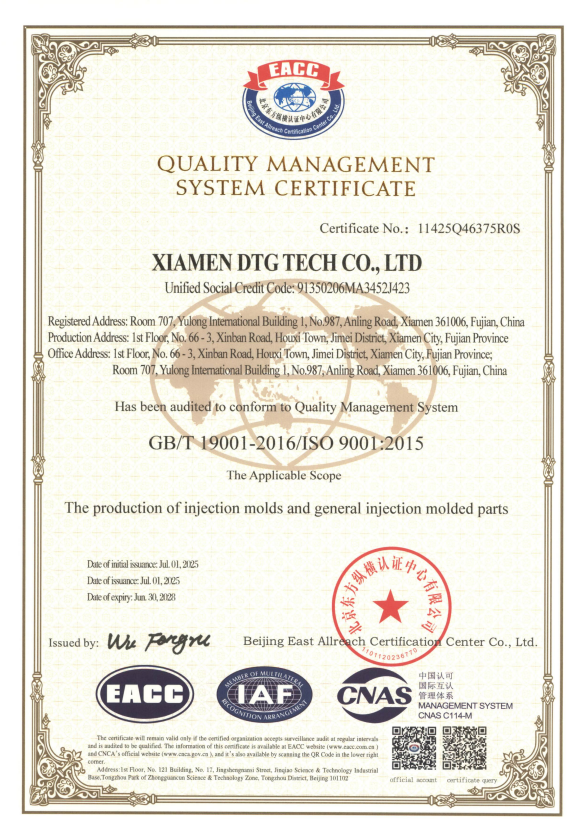
Three things a buyer should do with a certificate like this. First, check that the scope wording actually covers the activity being purchased — a certificate scoped to mold production and general molded parts is relevant to precision molding work, but it is not a medical-device-specific certificate and should not be read as one. Second, check the validity window against the intended production period; a certificate expiring mid-programme creates a surveillance problem. Third, verify the certificate number directly with the issuing body rather than accepting a PDF at face value.
This is where the ISO 13485 question belongs. ISO 13485 is designed to be used by organisations involved in the design, production, installation and servicing of medical devices and related services, and it is the standard that device manufacturers are now expected to align with under the FDA QMSR. A general ISO 9001:2015 certificate and an ISO 13485 certificate answer different questions. Buyers running a regulated device programme should request the ISO 13485 status explicitly and ask for the scope statement, not just the logo.
A second, complementary document is an independent site audit. DTG TECH CO., LTD. holds a Made-in-China Supplier On-site Audit Report, number MIC-ASI217106, conducted by Bureau Veritas on 29 March 2021, scoped to injection molding and plastic injection products against the Made-in-China supplier audit standard and Bureau Veritas audit criteria. A site audit evidences that a third party physically walked the facility — a different signal from a desk-reviewed management system certificate, and one worth requesting as a pair.
Material Compliance Evidence: What the SGS Reports Actually Cover
Material compliance is where over-claiming is most common and easiest to check. A test report is only meaningful when the material tested, the standard referenced and the market it was issued for are all read together.
DTG TECH CO., LTD. holds an SGS FDA Food Contact Material Test Report, number No. SHAEC2004981201, issued by SGS-CSTC Standards Technical Services (Shanghai) Co., Ltd. on 13 April 2020 for the USA market. The report references FDA 21 CFR 177.2600 and covers total extractives testing for CENUSIL® R 2×0 silicone food contact material. Separately, the company holds an SGS EU RoHS Compliance Test Report, number No. CANEC1103223001, issued by SGS-CSTC Standards Technical Services Co., Ltd. on 23 August 2011 for global markets, referencing RoHS Directive 2011/65/EU (EU RoHS II) and 2002/95/EC and covering substance testing for lead, mercury, cadmium, hexavalent chromium, PBB and PBDE.
Read together, these two reports establish that a defined material was tested by an accredited third party against a named regulation, and that the result was recorded under a traceable report number. They do not establish that every part in the catalogue is FDA food-contact compliant, and they do not constitute a biocompatibility assessment. That distinction is the whole point of the exercise.
Report age also matters. The RoHS report above was issued in 2011; RoHS substance restrictions have been amended since. A buyer should ask whether a current report exists for the specific resin being quoted, and whether the supplier holds test reports under the current version of the directive. A supplier that can produce a current report on request is telling you something about how its documentation system is maintained.
Project Evidence: Shot Counts, Inspection Outcomes and Batch Scale
Certificates describe systems. Project records describe what the system has actually produced. For medical buyers the relevant questions are precision, repeatability at volume and tooling durability, and all three can be evidenced without disclosing customer identities.
| Project evidence point | Documented detail | Buyer question it answers |
|---|---|---|
| Mould lifetime target | Mould designed for a 500,000-shot production requirement, supporting batch orders of 10,000–50,000 units | Can the tool survive the programme volume without replacement mid-cycle? |
| Inspection outcome at precision scale | 50,000 injection molded optical lenses delivered on schedule, meeting high transparency requirements and passing customer inspection | Can the supplier hold optical-grade surface quality across a 50,000-piece run? |
| Batch scale on engineering resins | 30,000–50,000 units per batch of customized PC+ABS projector housings with stable dimensions and appearance | Has the supplier run multi-tens-of-thousands batches on PC+ABS with dimensional stability? |
Each of these records comes from a non-medical programme — an automotive lighting component, an LED optical lens, an electronic projector enclosure. That is worth stating plainly rather than glossing over. The value is not that they are medical cases; the value is that they isolate the three capabilities a medical programme stresses hardest. A 500,000-shot mould target speaks to tooling strategy and steel selection. A 50,000-piece optical lens delivery with a documented inspection pass speaks to surface-quality control and dimensional discipline. A 30,000–50,000 unit PC+ABS housing batch speaks to process stability on an engineering resin at volume.
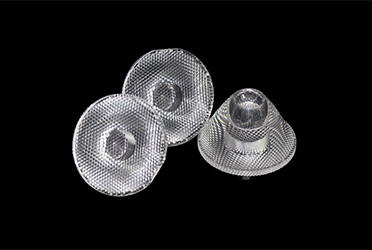
A buyer should ask for project records in this format: part family, resin, mould lifetime target, batch size, inspection method and outcome. Suppliers that cannot produce such records usually have not instrumented their own production well enough to produce them — which is itself an answer.
Process Validation Evidence: The Questions a Certificate Cannot Answer
The FDA defines process validation as establishing by objective evidence that a process consistently produces a result or product meeting predetermined specifications. Its training material states that validation is required when process results cannot be fully verified by subsequent inspection and testing, and it uses injection molding as an example of exactly that situation. FDA inspection guidance further lists molding, sterilization operations, environmental control systems such as cleanrooms, and testing methods among the processes for which validation should be performed as applicable.
That framing gives buyers a concrete document request list, and none of it is satisfied by a quality certificate:
- A written validation protocol with acceptance criteria defined before execution, not after.
- The validated process window — melt temperature range, injection pressure range, hold time, cooling time — with the rationale for the window width.
- Evidence that critical parameters are monitored and recorded in routine production, not only during qualification.
- A deviation-handling procedure describing what happens when a parameter exits the window.
- Revalidation triggers: tool refurbishment, resin change, machine transfer, site change.
- For sterile medical injection molding, a separate evidence package covering cleanroom classification, environmental monitoring and sterilization compatibility of the specific resin.
IQ/OQ/PQ documentation is the conventional structure for this in equipment and process qualification. Buyers should ask which elements the supplier owns and which sit with the device manufacturer, because the split varies by contract and is rarely stated clearly in a quotation.
Commercial Evidence: MOQ, Lead Time and Acceptance Criteria in Writing
Commercial documentation is part of the evidence file because vague commercial terms create the disputes that quality systems then have to absorb.
For custom mold design and tooling, DTG TECH CO., LTD. states a minimum order quantity of one mold project accepted based on custom product requirements, a typical tooling lead time of 15–45 days depending on mold size, complexity and material requirements, and acceptance criteria covering DFM review, mold trial sample inspection and customer approval before mass production. Delivery terms are quoted as EXW, FOB or CIF, with samples shippable internationally by air or sea and digital project communication supported during tooling. For molded part production, quoted lead times run 7–20 days for prototypes and 20–35 days for standard production after sample approval, with MOQ negotiable based on part size, material, mold requirements and production volume, and acceptance criteria covering DFM approval, T1 sample approval, first article inspection and final quality inspection before shipment. Payment terms for tooling are quoted as 50% T/T in advance with the 50% balance after mold approval or before shipment.
For a medical programme, three additions are worth negotiating into the contract rather than assuming: a change-notification clause covering resin and sub-supplier changes, a defined lot-traceability retention period, and a written revalidation trigger list.
Document-Led Selection Versus Sample-Led Selection
The conventional approach to supplier selection starts with samples. It is fast, it feels concrete, and for commodity parts it works reasonably well. For regulated molding it has a specific weakness: a sample proves the process worked once, on the day it ran, with the material that happened to be loaded.
| Dimension | Sample-led selection | Document-led selection |
|---|---|---|
| What is proven | One part conforms at one point in time | A system, a material and a process window have been independently assessed |
| Timing of discovery | Failures surface during ramp or after launch | Gaps surface before tooling is released |
| Supplier effort required | Low — a sample can be produced quickly | Higher — documents must exist and be current |
| Main limitation | Cannot detect drift, substitution or tooling fatigue | Cannot detect physical defects such as flash, sink marks or warpage without a physical trial |
The honest limitation of the document-led approach is that it is not a substitute for physical validation. A supplier can hold a complete, current, well-scoped document pack and still produce a tool that flashes on the first trial shot. Document review narrows the field and de-risks the programme; it does not eliminate the need for T1 sample inspection, dimensional checking and functional testing on the actual part.
A second limitation is specific to this evidence set. The documents described in this article — ISO 9001:2015 certificate 11425Q46375R0S, the SGS FDA food contact report, the SGS EU RoHS report, the Bureau Veritas site audit and the project records — do not include an ISO 13485 certificate or a documented cleanroom classification. Buyers whose device classification requires either of those should treat them as separate, additional evidence requests, and should not infer them from a general quality certificate.
Where This Evidence Set Maps to Medical Programmes
Precision Injection Molded Components (DTG-PIM-003) are produced by precision injection molding with dimensional control according to engineering drawings and quality control covering dimensional inspection and first article inspection, across ABS, PC, POM, nylon and other engineering plastics. That profile maps to functional medical components where tolerance discipline and first-article documentation matter more than cleanroom status.
Plastic Injection Molded Housings (DTG-PIH-002) are produced in ABS, PC+ABS and PP with customizable size, structure, color and surface texture, and finishing options including polishing, painting, printing and assembly support. Custom Injection Molded Plastic Parts (DTG-CIMP-001) run from prototype to mass production in ABS, PP, PC, PC+ABS, TPE, acrylic and other engineering plastics, with tolerances set by customer drawings. Insert Injection Molded Parts (DTG-IIM-005) combine plastic with metal inserts for functional and structural components.
For a medical device housing program, the practical sequence is: confirm the resin grade and its biocompatibility documentation, confirm the dimensional and surface requirements against the precision molding profile, confirm the batch size against documented project records, and only then confirm the commercial terms. Sterile medical injection molding adds a cleanroom qualification layer that must be requested as its own document set.
Future Outlook
The direction of travel is toward certificate-scope scrutiny. With the FDA QMSR effective since 2 February 2026 and ISO 13485:2016 incorporated by reference, quality-system expectations now cascade contractually from device manufacturers to molding suppliers, and buyers are increasingly asking for the scope line rather than the standard number. In a market projected to grow from USD 27.32 billion in 2025 to USD 38.32 billion by 2030 at a 6.8% CAGR, with Asia Pacific already holding a 41.9% revenue share, the supplier base will keep widening. Evidence discipline is how buyers keep that widening base navigable.
The likely near-term shifts are unglamorous but consequential: process validation documentation becoming a standard line item in RFQs rather than a post-award discovery; report currency checks becoming routine as buyers notice how old some compliance documents are; and a clearer contractual split between what the molder validates and what the device manufacturer validates.
Frequently Asked Questions
Which quality certificate should a medical injection molding supplier be able to show?
A supplier should be able to show a current quality management certificate with a verifiable number, a named issuing body and a scope statement that covers the activity being purchased. ISO 9001:2015 is the general quality management standard; ISO 13485 is the standard defined by ISO for organisations involved in the design and manufacture of medical devices and related services. The two answer different questions, and buyers on regulated programmes should request both statuses explicitly rather than treating one as a substitute for the other.
Is ISO 9001:2015 certification sufficient proof of medical molding capability?
No. ISO 9001:2015 certifies that a quality management system has been audited against that standard within a stated scope. It does not certify medical-device-specific controls, cleanroom classification or process validation. A certificate such as ISO 9001:2015 number 11425Q46375R0S, scoped to the production of injection molds and general injection molded parts, evidences a functioning quality system within that scope; medical capability requires additional evidence covering material compliance, process validation and, where relevant, environmental control.
What does an SGS FDA food contact test report actually prove?
It proves that a specific material was tested by a third-party laboratory against a named standard and that the result was recorded under a traceable report number. For example, report No. SHAEC2004981201 issued by SGS-CSTC Standards Technical Services (Shanghai) Co., Ltd. covers total extractives testing of a named silicone food contact material against FDA 21 CFR 177.2600 for the USA market. It does not establish compliance for other resins, and it is not a biocompatibility assessment for a finished medical device.
How can a supplier demonstrate real production volume capability?
Through project records that state the part family, the resin, the mould lifetime target, the batch size actually produced, and the inspection method and outcome. Documented examples include a mould designed for a 500,000-shot production requirement supporting batches of 10,000–50,000 units, a 50,000-piece optical lens delivery that passed customer inspection, and 30,000–50,000 unit batches of PC+ABS projector housings with stable dimensions and appearance. Buyers should ask for records in that format rather than for a capacity figure alone.
What documentation should accompany injection molding process validation?
The FDA defines process validation as establishing by objective evidence that a process consistently produces a result meeting predetermined specifications, and its guidance identifies molding among processes that may require validation where subsequent inspection cannot fully verify the result. Documentation should include a validation protocol with pre-defined acceptance criteria, the validated process window and its rationale, routine monitoring records for critical parameters, a deviation-handling procedure, and defined revalidation triggers such as tool refurbishment, resin change, machine transfer or site change.
Which commercial terms should be confirmed in writing before a mould is released?
Minimum order quantity, tooling and production lead times, delivery terms, payment schedule, and acceptance criteria should all be confirmed in writing. For tooling, documented terms can include a minimum order of one mold project, lead times of 15–45 days depending on mold size and complexity, EXW, FOB or CIF delivery, and acceptance criteria covering DFM review, mold trial sample inspection and customer approval before mass production. For molded parts, acceptance criteria typically cover DFM approval, T1 sample approval, first article inspection and final quality inspection before shipment.
Have Questions or Need More Details?
Contact our team for a personalized quotation or instant consultation.
Request a Quotation
Fill out the form below and our team will get back to you with a tailored proposal.
WhatsApp Direct Chat
Prefer to chat in real-time? Message us on WhatsApp for instant assistance & quick answers.
- Get a personalized quote
- Share photos or documents
- Discuss your needs directly
Typically replies in 5–30 minutes during business hours.