
What 'High-Speed' Really Means on a Blister-Cartoning Line
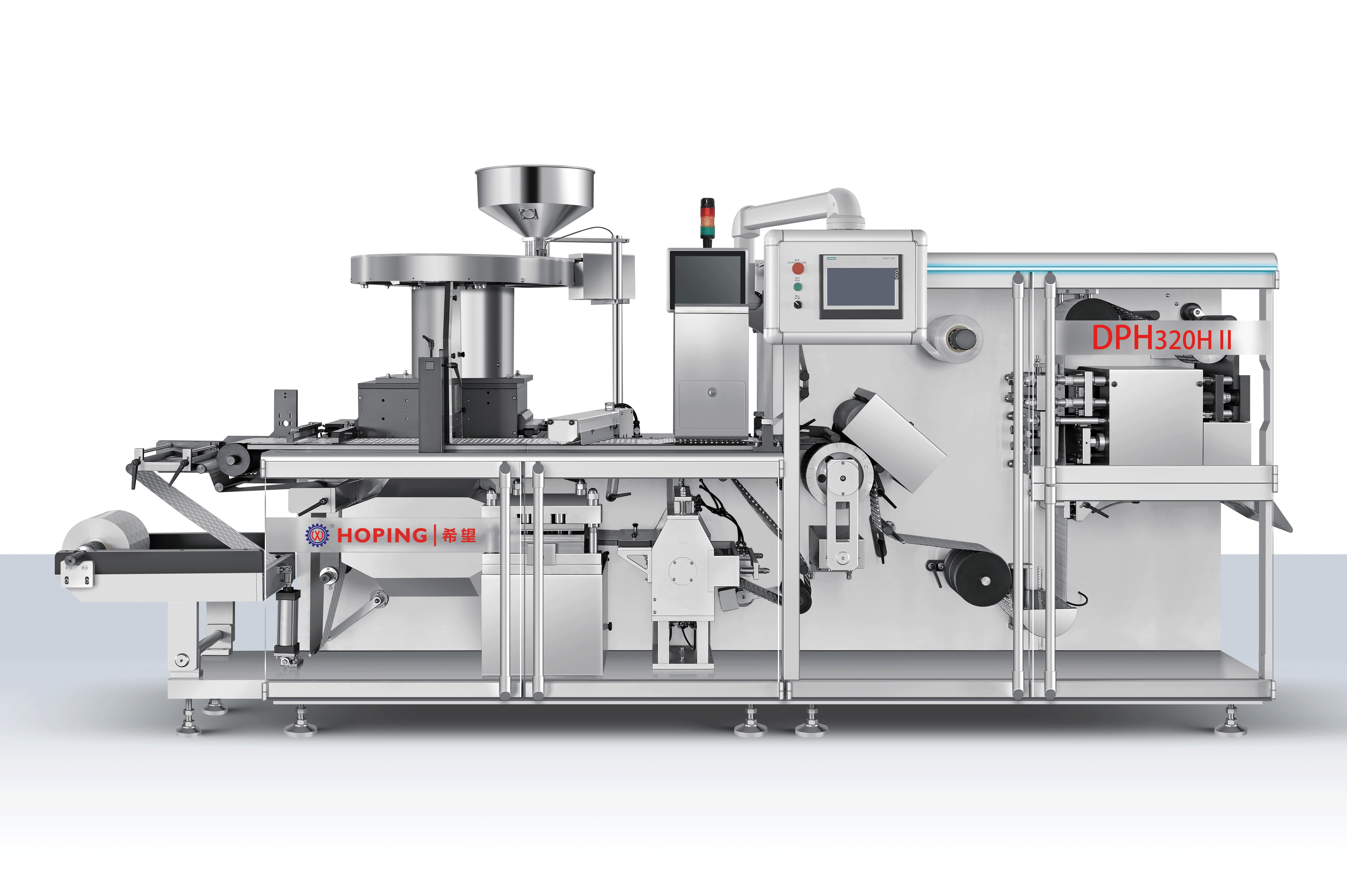
A fully servo roller-type blister packaging machine — the station that sets the primary speed ceiling on a blister-cartoning line.
On a pharmaceutical packaging line, "high-speed" is a claim about three things at once: how fast blister cards can be formed and sealed, how reliably they can be transferred into cartons, and how long the line can actually hold that rate once film splicing, feeding interruptions and format changes are taken into account. Procurement decisions go wrong when the largest number on a specification sheet is treated as the whole answer.
An automatic blister-cartoning line is the part of a solid dosage packaging operation that connects primary and secondary packaging. A blister packaging machine forms and seals the blister — in Alu-PVC or Alu-Alu material — a transfer system carries the formed blister to the cartoner, and the cartoner opens the carton, inserts the blister and the leaflet, closes the carton and, where configured, applies coding, inspection and rejection. A stretch bander, case packer or palletizer then completes the line. Hoping Machinery describes blister packaging, cartoning, inspection and end-of-line automation as one engineered packaging process rather than a set of separate machine purchases, and lists blister packing, cartoning, flow packing, case packing and palletizing equipment as components of an integrated line.
That integration is exactly why speed is a line question rather than a machine question. A cartoner capable of 500 cartons per minute cannot deliver 500 cartons per minute if the transfer, the leaflet feeder or the downstream case packer cannot keep pace with it.
Why "high-speed" has no fixed definition in blister-cartoning
Speed figures in this equipment category are quoted on different bases, and the differences are not cosmetic:
- Blister side: blisters per minute, punches per minute, or forming cycles per minute.
- Cartoning side: cartons per minute or boxes per minute.
- Flow-wrapping side: packs per minute.
- End of line: bundles per minute or cases per minute.
A machine quoted at 12 punches per minute and a machine quoted at 60 punches per minute are not described on the same basis at all, because one figure counts machine strokes and the other counts forming cycles. Only the saleable-unit figure — how many blisters leave the machine — reflects what a plant can actually release.
Hoping's blister-cartoner range makes the ambiguity concrete. Across the integrated models the company lists, blister output is stated at up to 600, 700, 800 or 1,000 blisters per minute, while carton output is stated at up to 400 or 500 cartons per minute. The primary figure is always the higher one. That is a design assumption rather than an inconsistency: the line is engineered so that blister forming runs ahead of carton output, and the ratio between the two numbers tells a buyer how many blisters — or blister cards — the assumed carton contains.
The same gap also sets a trap. A configuration in which primary output runs well ahead of secondary output only works if the transfer stage and any buffering between the two can absorb the difference. When two lines are compared, the useful comparison is not "800 against 700" but "what sustained output, at which format, with which rejection rate, and after how much changeover time."
A note on published maximums. Hoping's packaging-line page reports a maximum of 1,000 blisters per minute and 500 boxes per minute for a line configuration. The exact model, product format and operating conditions behind that figure are not published alongside it, and a maximum output figure is not the same as validated sustained output. Company-stated peaks should be used as a screening filter for shortlisting suppliers, not as a benchmark for capacity planning.
Demand-side context explains why the question keeps coming up. A commercial research publisher values the global pharmaceutical blister packaging machine market at USD 2.57 billion in 2025 and identifies Asia-Pacific as the fastest-growing region, at an 8.87% CAGR to 2031. A second publisher reports the wider pharmaceutical packaging machinery market at USD 7.09 billion in 2026, growing at 7.15% toward an end value of USD 10.02 billion, with the forecast end year truncated in the available excerpt. Both are single-source commercial estimates and are best read as directional context rather than consensus figures.
The three measurements that decide usable line speed
Independent of brand or model, the usable output of a blister-cartoning line is set at three measurable stages.
1. Primary forming and sealing rate
The blister machine sets the ceiling for everything downstream. Roller-type machines in the DPH series are described as fully servo, high-speed designs for Alu-PVC and Alu-Alu solid dosage applications, while flat-plate machines in the DPP series are typically quoted at lower cycle counts and positioned for small- and medium-batch production. As a reference point for how wide that spread can be, the DPP260T1 platen machine is rated at a maximum of 300 blisters per minute with a maximum punching frequency of 60 punches per minute, while the fully servo roller-type DPH320HII is rated at up to 1,000 blisters per minute at 250 punches per minute. The DPH320H roller machine is specified with a 320 x 280 mm forming area and a 12 mm forming depth.
2. Transfer, feeding and replenishment between stages
This is the stage that most often separates a paper specification from a running line. Moving formed blister cards from the blister machine into carton openings at several hundred units per minute is a separate engineering problem, solved differently by different platforms. Hoping uses two approaches across its range: a self-developed IRB24 intelligent transfer robot on the DHL7004 and DHL7005H, and a D3 intelligent top-loading parallel tracking transfer system on the DHL8005H and the DHL1000/5H. Feeding is supported by independent servo-driven replenishment channels — three channels on the DHL8005H and four channels on the DHL1000/5H — and by PVC/Alu foil auto splicing, which reduces the line interruption caused by a roll change.
3. Secondary cartoning rate and end-of-line balance
The cartoner converts blister output into saleable cartons. Hoping's standalone cartoning machines span roughly 30 to 120 cartons per minute (XWZ120), 60 to 220 cartons per minute (XWZ300II), 100 to 300 or 400 cartons per minute (XWZ Series) and 100 to 500 cartons per minute (XWZ500H). Those are the figures that matter for balancing the line against what comes after it: a stretch bander, a case packer and a palletizer each operate at a small fraction of carton output, so the interface between cartoning and end of line is where accumulation and micro-stops usually appear.
| Integrated blister-cartoner model (Hoping) | Stated maximum blister output | Stated maximum carton output | Transfer / automation architecture | Control platform |
|---|---|---|---|---|
| DHL6004 | 600 blisters/min | 400 cartons/min | Servo-driven independent replenishment; high-speed transfer and cartoning linkage; convenient mold change | Beckhoff motion controller and CP9315 industrial PC |
| DHL7004 | 700 blisters/min | 400 cartons/min | Self-developed IRB24 intelligent transfer robot; servo-driven independent replenishment; convenient mold change | Siemens motion controller and TP900 HMI |
| DHL7005H | 700 blisters/min | 500 cartons/min | Self-developed IRB24 intelligent transfer robot; independent replenishment; mold-change support | Siemens motion controller and TP900 HMI |
| DHL8005H | 800 blisters/min | 500 cartons/min | D3 intelligent top-loading parallel tracking transfer system; multiple feeding methods; PVC/Alu foil auto splicing; three-channel servo-driven independent replenishment; mold-change and preset-memory functions | Beckhoff motion controller and CP9315 industrial PC |
| DHL1000/5H | 1,000 blisters/min | 500 cartons/min | D3 intelligent top-loading parallel tracking transfer system; PVC/Alu foil auto splicing; four-channel servo-driven independent replenishment; mold-change and recipe memory | Beckhoff motion controller and high-bus industrial control system |
All figures are the manufacturer's stated maximum capacities for the listed models and should be verified against the intended blister format, carton format and operating conditions.
The architecture behind the numbers: what actually raises usable speed
Reading a speed claim properly means reading the architecture that supports it. Five design decisions recur across Hoping's high-speed blister-cartoner platforms.
Servo-driven stations instead of a single mechanical main shaft. When forming, sealing, punching, feeding, carton opening and closing are individually servo-driven, stations can be phased independently and format settings can be called from memory instead of being re-set mechanically. Hoping documents exactly this pattern at station level on its XWZ500H cartoner, where the pressing carton device is servo-controlled for height adjustment: changing to different carton specifications is done through the human-machine interface, and the servo motor adjusts the box height. The cartoner's discharge sorting device uses a servo-controlled three-way rotary sorting mechanism rated to synchronize at 500 boxes per minute, and the carton magazine uses a servo motor-driven conveying device able to hold 1,800 cartons.
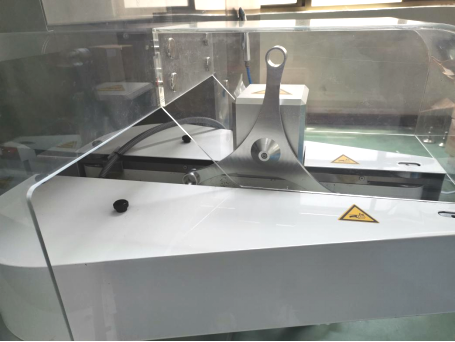
Servo-controlled three-way rotary discharge sorting on a high-speed cartoner, documented as synchronizing at 500 boxes per minute — an example of a station-level design decision that supports a cartoning speed claim.
Independent, multi-channel replenishment. The purpose of three or four servo-driven replenishment channels is continuity: while one channel is being reloaded, the others continue to supply the cartoner, which is what prevents a high nominal speed from collapsing into repeated line stops.
Automatic splicing of forming and lidding materials. PVC/Alu foil auto splicing appears on the DHL8005H, DHL1000/5H and the IXW800 and IXW600 blister-flow-wrap-cartoner lines. It addresses one of the most predictable causes of unplanned downtime on any blister line: running out of a roll mid-batch.
Format memory and mold change. Mold-change and preset-memory functions on the DHL8005H, and mold-change with recipe memory on the DHL1000/5H, turn a format change from a mechanical setup exercise into a recallable configuration. For a plant running many SKUs, this has more influence on weekly output than a marginal difference in peak speed.
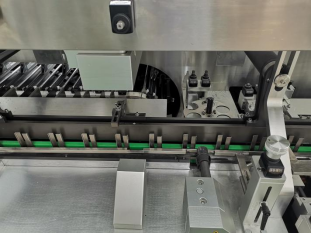
A servo-controlled pressing and height-adjustment device: carton format changes are made through the HMI rather than by mechanical re-setting.
Control platform and data interface. Hoping's integrated lines run on either a Beckhoff motion controller with a CP9315 industrial PC or a Siemens motion controller with a TP900 HMI, depending on model, with PLC/HMI interfaces and synchronized multi-station control. This is not a marketing detail: the control platform determines spare-part sourcing, the operator interface language options, and how easily the line communicates with upstream ERP/MES systems where that interface is specified.
On the primary side, the same logic applies to leaflet handling. Hoping's high-speed cartoner documentation describes instruction-manual folding units built on German GUK folding units with servo drive transmission, quoted at 500 A4 sheets per minute, and a front-mounted batch-number stamping device positioned to make replacement of the three-date steel characters quicker. Leaflet throughput and coding changeover are secondary in name only; both can stop a 500-carton-per-minute line.
Application fit: where a high-speed blister-cartoning line earns its place
Hoping positions this equipment for a defined set of project types rather than for every solid dosage plant. The stated applications are new solid dosage blister packaging lines, upgrades of existing packaging lines, high-capacity expansion projects, intelligent packaging workshop retrofits, and blister-cartoning-bundling or case-packing downstream integration projects.
The operating environment is equally specific: GMP-oriented cleanroom or pharmaceutical packaging workshop conditions, continuous high-speed operation, and multi-batch, multi-format production, with requirements for stability, easy cleaning, safety protection and traceability-oriented operation. The line's documented role is to complete blister packaging, leaflet folding, carton opening, blister insertion, batch and date coding, inspection and rejection, and downstream connection — with the explicit objective of improving automation and reducing manual transfer.
Configuration is project-driven rather than catalogue-driven. Depending on the project, matched equipment can include a blister packing machine, cartoner, D3 intelligent top-loading parallel robot, leaflet folder, coding machine, vision inspection, checkweigher, stretch bander, case packer, palletizer and an ERP/MES data interface. Customization options include blister size and materials, quantity per carton, carton specification, leaflet format, coding and inspection method, feeding method, downstream bundling, case-packing and palletizing connection, interface language, electrical component brand and data interface. Hoping quotes a minimum order of one set or one complete line, a monthly capacity of 30 to 40 units, and a lead time typically of 60 to 120 days after technical confirmation, subject to model, configuration, project complexity and contract terms.
For a project combining blister, flow-wrap and carton stages, the IXW800 is quoted at up to 600 blisters per minute, 600 packs per minute and 500 cartons per minute on a dual-track fully servo platform with Beckhoff control, and the XW8300 reciprocating flow wrapper handles up to 300 packs per minute with four-axis servo control for the wrapping stage where that intermediate format is required.
Market signals: speed is being priced alongside data
Two industry-level developments are changing how speed claims are evaluated.
The first is integration. Trade media reporting PMMI content states that pharmaceutical manufacturers are turning toward digitized data collection and integrated solutions to meet regulations and improve visibility. That direction is visible in equipment specification: the choice of industrial PC and motion controller, the presence of recipe and preset memory, and the availability of an ERP/MES data interface increasingly belong in the same technical agreement as the output figure.
The second is regulatory. ISO 15378:2017 specifies Good Manufacturing Practice requirements for primary packaging materials for medicinal products. In the United States, the FDA provides official guidance on current Good Manufacturing Practice production and process controls, establishing the framework for quality pharmaceuticals through regulatory standards. In China, a draft GMP guidance for pharmaceutical packaging materials has been under public consultation, and regulatory-affairs reporting indicates it would guide pharmaceutical marketing licence holders in reviewing packaging material suppliers. None of these instruments certifies a machine's output; each of them changes the documentation a buyer is expected to hold.
The commercial picture is consistent with that emphasis on compliant, integrated capacity. Horizontal cartoning systems held 70.12% of the cartoning machine market in 2024 according to one commercial research publisher, and Asia-Pacific blister packaging growth is projected at 8.87% CAGR to 2031 against a 2025 global blister machine market value of USD 2.57 billion.
How high-speed lines compare with conventional packaging arrangements
The differences between a conventional arrangement and a fully servo integrated line are not only about the top speed number. They are concentrated in what happens between the machine cycles.
| Decision area | Conventional arrangement: standalone machines with manual transfer | Linked line with partial servo drive | Fully servo integrated blister-cartoner |
|---|---|---|---|
| Blister-to-cartoner transfer | Operator handling between separate machines; manual tray movement | Mechanical push or indexing linkage | D3 top-loading parallel tracking transfer (DHL8005H, DHL1000/5H) or IRB24 transfer robot (DHL7004, DHL7005H) |
| Format change | Mechanical re-setting with tools | Partial servo adjustment plus HMI settings | Mold change with preset or recipe memory recalled from the HMI |
| Film / foil roll change | Line stop and manual threading | Assisted change | PVC/Alu foil auto splicing on supported models |
| Feeding continuity | Single manual feed path | Single replenishment channel | Three-channel (DHL8005H) or four-channel (DHL1000/5H) servo-driven independent replenishment |
| Control and data | Relay or basic PLC logic | PLC with HMI | Motion controller with industrial PC (Beckhoff CP9315 or Siemens TP900), with optional vision inspection, checkweigher and ERP/MES interface |
The boundaries matter as much as the capabilities, and they are real.
- Peak output is not sustained output. Every maximum figure cited in this article comes from manufacturer documentation. Product format, station count, rejection rate and operating conditions all change the achievable rate, which is why a material trial, factory acceptance test and sustained-output figure — not a datasheet maximum — are the appropriate basis for capacity planning.
- High speed is not the same as high fit. A line rated at 800 blisters per minute is built for long runs of a stable format. Where a plant produces many SKUs in small batches, changeover behaviour, mold-change support and recipe memory can matter more to weekly output than the peak figure, and a mid-range model can be the more rational specification.
- Downstream balance is a hard constraint. Hoping's separate bundling, case-packing and palletizing equipment is quoted at roughly 30 to 60 bundles per minute (XWK4060), about 12 cases per minute (ICP12) and about 5 cases per minute (XWK Series case packer). Matching those rates to the cartoner's output is a line-engineering task, and an unbalanced end of line will absorb any speed gained upstream.
- Servo architecture raises the qualification bar. Fully servo lines with industrial PC control need trained maintenance, spare-part planning and disciplined software and recipe management. Hoping's own service scope reflects this: on-site installation and commissioning, operator training, maintenance training, remote video and phone support, spare-parts supply, process-parameter guidance and regular follow-up.
- Compliance is separate from speed. ISO 15378:2017 addresses GMP for primary packaging materials, and CGMP guidance addresses production and process control. Neither converts a speed claim into a verified capability, and neither substitutes for acceptance testing on the buyer's own product.
What to verify before accepting a speed claim
Hoping's documented quality-control sequence for this equipment provides a workable checklist for any buyer evaluating a high-speed blister-cartoning line:
- Incoming material inspection and key component inspection — confirms the drive and control hardware actually specified.
- Assembly inspection and electrical safety check — verifies the built machine against the technical agreement.
- No-load trial run — establishes basic motion, phasing and interlock behaviour.
- Material trial on the buyer's own blister and carton formats — the only test that produces a meaningful sustained-output number.
- Factory acceptance test and customer witness acceptance — the contractual moment where stated capacity becomes an accepted figure.
- Pre-shipment inspection, plus confirmation of installation, commissioning and training deliverables.
Applied consistently, this sequence converts a marketing maximum into an accepted specification, and it works the same way whether the discussion concerns a 600-blister line or a 1,000-blister line.
Future outlook
The direction of travel for blister-cartoning equipment points toward fewer independent variables rather than higher headline numbers. Servo-driven stations with preset and recipe memory, multi-channel replenishment, automatic material splicing and industrial-PC control platforms are already the normal architecture at the high end of this category, and the differentiator is shifting toward how cleanly that architecture reports what it has done.
The regulatory layer reinforces that shift. With ISO 15378:2017 defining GMP expectations for primary packaging materials, FDA CGMP guidance framing process control, and a Chinese draft GMP for pharmaceutical packaging materials under consultation, the documentation attached to a packaging line is becoming part of its commercial value. Equipment that supports traceability-oriented operation and offers an ERP/MES data interface is better positioned for that environment than equipment whose only published attribute is a peak speed.
For buyers planning capacity into the next investment cycle, the practical conclusion is straightforward: define high-speed in terms of the format, the sustained output and the accepted test result, then check whether the automation architecture behind the number is capable of protecting it across a full production week.
FAQ
What does "high-speed" refer to on a blister-cartoning line — the blister machine, the cartoner, or the whole line?
All three are used, but on different bases. Blister output is quoted in blisters per minute and describes primary forming and sealing; carton output is quoted in cartons or boxes per minute and describes secondary packaging. On Hoping's integrated models the two figures are stated together — for example, up to 800 blisters per minute and 500 cartons per minute on the DHL8005H. The line's usable output is limited by the slowest linked stage and by interruptions such as film roll changes and feeding gaps, so a full-line figure is only meaningful when the format and operating conditions are stated with it.
How should a buyer compare a line quoted at 800 blisters per minute with one quoted at 1,000 blisters per minute?
Normalize both figures to the same format and the same unit. At 800 blisters per minute and 500 cartons per minute, a line is implicitly configured for roughly 1.6 blisters per carton at peak; at 1,000 blisters per minute and 500 cartons per minute, the implied ratio is about 2. That ratio should be confirmed with the supplier, because a carton holding two blister cards would change the required cartoner speed. Note also that both models share the same stated cartoning ceiling of 500 cartons per minute, so the difference between them may show up in carton output only for formats where the cartoner is not the constraint.
Which automation decisions most affect real output on a high-speed line?
Five decisions dominate. First, the transfer method: Hoping uses a D3 intelligent top-loading parallel tracking transfer system on the DHL8005H and DHL1000/5H, and a self-developed IRB24 intelligent transfer robot on the DHL7004 and DHL7005H. Second, replenishment: three servo-driven independent channels on the DHL8005H and four on the DHL1000/5H. Third, automatic splicing of PVC/Alu foil, which is listed on the DHL8005H, DHL1000/5H, IXW800 and IXW600. Fourth, mold-change and preset or recipe memory functions. Fifth, the control platform — a Beckhoff motion controller with a CP9315 industrial PC on the DHL8005H, or a Siemens motion controller with a TP900 HMI on the DHL7005H — which affects spare parts, operator interfaces and data integration.
When is a fully servo blister-cartoner line the wrong choice?
When the production profile is high-mix and low-volume rather than long-run. A line specified for sustained high output delivers most value when formats are stable and batches are long; where SKUs change frequently, changeover behaviour, mold-change support and recipe memory influence weekly output more than the peak rate, and a mid-range model may be the better specification. The same applies where the plant's downstream equipment is not sized to match carton output, or where trained maintenance and spare-part planning cannot be supported — accepted output depends on those conditions, not on the nominal maximum alone.
How do these lines fit into GMP-oriented pharmaceutical production?
Hoping describes the equipment as GMP-oriented in line design, with stainless steel and aluminum-alloy structures, transparent guarding and product-contact parts and tooling configured according to a technical agreement. The regulatory frame around it is separate: ISO 15378:2017 specifies GMP requirements for primary packaging materials for medicinal products, FDA CGMP guidance addresses production and process controls, and a draft Chinese GMP for pharmaceutical packaging materials has been under public consultation, aimed at guiding licence holders in reviewing packaging material suppliers. A speed figure does not demonstrate compliance with any of these; documentation, validation and acceptance testing do.
What has to be agreed before a high-speed line is accepted?
A defined blister format, carton format and leaflet format; a sustained-output figure rather than a maximum; and an agreed rejection and inspection method. Hoping's documented quality-control sequence covers incoming material inspection, key component inspection, assembly inspection, electrical safety check, no-load trial run, material trial, factory acceptance test, customer witness acceptance and pre-shipment inspection, with on-site installation and commissioning, operator and maintenance training, and spare-parts supply as part of the delivery scope. Those items are what convert a stated capacity into an accepted one.
Which equipment has to be matched to a high-speed blister-cartoner line?
Depending on configuration, the line can include a blister packing machine, cartoner, D3 intelligent top-loading parallel robot, leaflet folder, coding machine, vision inspection, checkweigher, stretch bander, case packer, palletizer and an ERP/MES data interface. Balancing matters because the downstream rates are lower: Hoping quotes the XWK4060 stretch bander at about 30 to 60 bundles per minute, the ICP12 case packing and palletizing integral machine at about 12 cases per minute, and the XWK Series case packer at about 5 cases per minute. Matching those rates to the cartoner's output is what prevents accumulation and micro-stops at the end of the line.
Reference material
Hoping Machinery's product catalog, covering blister packaging machines, cartoners, case packers and end-of-line equipment, is available for download: Hoping Machinery Catalog (PDF). Company information: hopingcn.com.
Have Questions or Need More Details?
Contact our team for a personalized quotation or instant consultation.
Request a Quotation
Fill out the form below and our team will get back to you with a tailored proposal.
WhatsApp Direct Chat
Prefer to chat in real-time? Message us on WhatsApp for instant assistance & quick answers.
- Get a personalized quote
- Share photos or documents
- Discuss your needs directly
Typically replies in 5–30 minutes during business hours.