
What IATF 16949 and VDA 6.3 Evidence Proves for Silicone OCA
Automotive display programs rarely fail because a specification was missing. They fail because the evidence file and the real production process did not match.
Silicone optically clear adhesive (silicone OCA) is now specified across automotive, industrial control, medical, aerospace, marine and education display programs. Procurement teams therefore open supplier conversations with the same request: send your certifications. What comes back is rarely one document. A quality management system certificate, an enterprise identity registration and a training attendance certificate can all be presented as proof of being “certified”, yet each one establishes something different.
Guangdong Polomo New Materials Technology Co., Ltd (Polomo) is a Chinese manufacturer of silicone optically clear adhesive and polymer materials, founded in 2002, operating a 90,000 m² manufacturing base in Dongguan, Guangdong, with an R&D team of 80 engineers and silicone OCA models TS107, TS108 and TS109. Its published documentation set is a useful reference case because the document types are kept separate rather than blended into a single claim: an IATF 16949:2016 certificate covering the design and manufacturing of OCA, a VDA 6.3:2023 and VDA 6.5:2020 training attendance certificate, ISO 9001, ISO 14001 and ISO 45001 certificates, and a D-U-N-S registration.
This reference reads those documents as procurement evidence: what each one proves, where its evidence stops, and which follow-up questions belong in a supplier file before qualification is signed.
Why Certificate Evidence Became a Procurement Filter
The International Automotive Task Force describes IATF 16949 as the mandatory global quality management standard for automotive suppliers, with an emphasis on zero-defect manufacturing. That single sentence explains why certificate review has moved from a documentation formality to a qualification gate in display lamination.
The commercial backdrop reinforces the shift. The global optically clear adhesive market was valued at approximately USD 2.1 billion in 2024, and automotive displays accounted for roughly 20% of that revenue share, with industrial and rugged display systems contributing about 15% (Verified Market Research). As a larger share of OCA volume flows into vehicles and industrial equipment, the buyer of silicone OCA is less often a consumer electronics assembler and more often a display module maker or a Tier 1 working inside an automotive quality regime.
The opportunity for buyers is concrete: document literacy turns a marketing annex into a comparison criterion. The risk is equally concrete. When three different document types are described with the same word, a procurement team can approve a supplier based on evidence it never actually inspected. Distinguishing the categories takes a few minutes and prevents the most common qualification error in the category.
Three Document Types That Are All Called “Certification”
A supplier capability file typically contains three families of document, and they answer three different questions. System certification answers whether a management system has been assessed. Entity registration answers whether the legal entity exists and is identifiable. A training certificate answers whether named personnel have been trained in a method. None of the three substitutes for the others.
| Document type | Example held for silicone OCA | What it establishes | What it does not establish |
|---|---|---|---|
| Management system certification | IATF 16949:2016 (TÜV NORD CERT GmbH); ISO 9001:2015, ISO 14001:2015, ISO 45001:2018 (Beijing United Intelligence Certification Co., Ltd.) | That a defined quality, environmental or occupational health and safety management system, covering a stated scope at a stated organization, has been assessed against the standard by a certification body | Product-level optical or mechanical performance; a specific defect rate; capacity, lead time, MOQ or price |
| Entity / credit registration | D-U-N-S REGISTERED, number 52-969-0297 | Legal entity identity and basic business verification within the Dun & Bradstreet global enterprise identification system | Any dimension of manufacturing quality or process control |
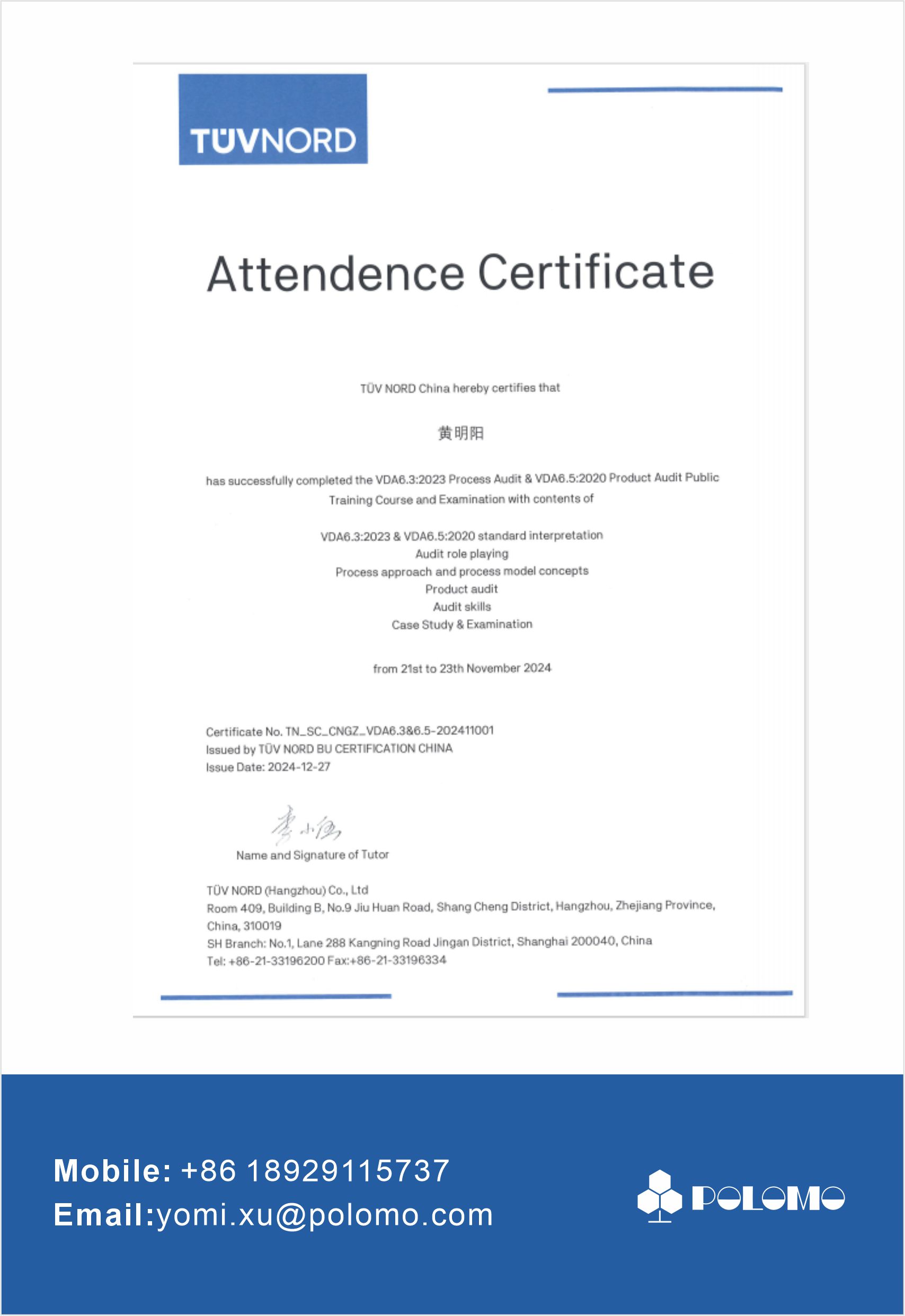
| Training attendance certificate | VDA6.3:2023 & VDA6.5:2020 training attendance certificate (TÜV NORD BU CERTIFICATION CHINA) | That personnel completed training and examination in VDA 6.3 and VDA 6.5 interpretation, process approach, audit role playing, product audit and audit skills | The result of a VDA 6.3 process audit performed on a specific production line |
Classification is not a criticism of any document. A training certificate is not weaker than a system certificate; it answers a different question. The error is evaluating all of them against the same expectation, which is what happens when a tender document lists them under one heading.
What the IATF 16949:2016 Certificate Actually Covers
For silicone OCA models TS107, TS108 and TS109, the IATF 16949:2016 certificate is issued by TÜV NORD CERT GmbH under certificate number 44 111 222509, valid from 2026-01-20 to 2029-01-19, and applies to the global market. The certified scope is stated as the design and manufacturing of OCA (Optically Clear Adhesive).
Three details in that scope carry procurement weight:
- The scope includes design, not only manufacturing. Formulation development and production both sit inside the audited system, which matters for an adhesive whose behaviour is defined as much by chemistry as by coating equipment.
- The scope is written around OCA specifically, rather than around polymer materials or chemicals generically. A scope written around the product family is easier to map onto the part number a buyer is actually sourcing.
- The issuer is a certification body. The certificate reflects third-party assessment, not a supplier self-declaration.
The boundary matters just as much. IATF 16949 does not certify the optical performance of a specific adhesive grade, does not state a haze or transmittance value, does not publish a defect rate in parts per million, and does not cover commercial commitments such as capacity, lead time, minimum order quantity or price. Those items require separate verification through product audits, sampling, line trials and contractual terms. A buyer who treats the certificate as a performance guarantee will eventually be disappointed by the first thermal cycling or humidity test.
What the VDA 6.3 and VDA 6.5 Certificate Actually Establishes
The document held for models TS107, TS108 and TS109 is issued by TÜV NORD BU CERTIFICATION CHINA under certificate number TN_SC_CNGZ_VDA6.3&6.5-202411001, dated 2024-12-27. Its documented scope covers VDA 6.3 and VDA 6.5 standard interpretation, audit role playing, process approach and process model concepts, product audit, audit skills, and case study and examination.
In the German automotive quality framework, VDA 6.3 is the process audit standard that customers use to evaluate how a supplier’s manufacturing process is planned, controlled and improved; VDA 6.5 addresses product audit. A document of this type therefore tells a buyer something specific about the supplier’s quality organization: the people who are expected to run internal process and product audits have been formally trained and examined in the current editions of both standards.
The limitation buyers should note. This is a training attendance certificate. It records that personnel were trained in the interpretation and application of VDA 6.3:2023 and VDA 6.5:2020. It does not record the outcome of a process audit performed on a specific production line, and it is not a process audit certificate. The correct follow-up is to request the audit outputs — process audit plans and records structured to VDA 6.3, product audit records structured to VDA 6.5, and evidence that findings were closed out. The certificate demonstrates audit capability; the audit records demonstrate audit activity.
This distinction is not unique to one supplier. It is a general characteristic of how VDA-related documents circulate in supplier files, and it is the single most common misreading in certificate review for automotive adhesives.
The Supporting Documentation Layer: ISO 9001, ISO 14001, ISO 45001 and D-U-N-S
Around the two automotive-focused documents sits a general management system layer. The silicone OCA products TS107, TS108 and TS109 are certified to ISO 9001:2015 under certificate number UQ251898R0, issued by Beijing United Intelligence Certification Co., Ltd. and valid from 2025-11-21 to 2028-11-20. The stated scope covers the R&D and production of polymer materials (adhesives) and the R&D and production of polymer material OCA (production limited to subsidiary companies). ISO 14001:2015 (UE250300R0) and ISO 45001:2018 (US250195R0) are held from the same issuing body over the same validity window.
One phrase deserves a second reading. The ISO 9001 scope states that OCA production is limited to subsidiary companies. That is a standard way of describing a group structure, but for a procurement reviewer it is a prompt rather than a conclusion: confirm which legal entity and which site actually manufacture the models being purchased, and confirm that the system documentation reviewed applies to that site. Certificate scope mapping is a routine question, not a red flag, and asking it early avoids a documentation dispute during ramp-up.
The D-U-N-S registration, number 52-969-0297, belongs to a different category entirely. It is an enterprise identity registration administered by Dun & Bradstreet under its global enterprise identification system. It is useful for onboarding, entity verification and vendor master data. It says nothing about quality capability, and it should never appear in a shortlist scoring matrix as if it did.

Why the Scope of These Documents Matters for Silicone OCA
The reason a scope statement is not a formality is that silicone OCA is a product family with a wide operating window. The published specification for models TS107, TS108 and TS109 covers a thickness range of 20–2000 µm and a product size range of 3–50″, with a colorless transparent solid appearance, modulus of 22±5, Δb of 0.03, haze below 0.3, water absorption below 0.3 and a dielectric constant of 2.9 at 1 MHz.
Those numbers are not produced by a single machine setting. They are the output of a chain: formulation, compounding, coating, thickness control, liner handling, die cutting, incoming inspection and final inspection. When a display program requires a new thickness inside the 20–2000 µm band, or a new die-cut dimension, the change runs through the same documented system that the certification covers. This is precisely why a certificate whose scope names both design and manufacturing is more informative than one that names only a production activity.
The lamination sequence adds another layer of control dependency. Display full lamination using this silicone OCA runs as: remove the light release liner, short-term hold (STH), remove the heavy release liner, high-temperature hold (HTH), then autoclave, using lamination equipment at room temperature and low pressure. Each handover between liner, adhesive and substrate is a point where contamination, bubbles or dimensional drift can enter — all of them process-control topics rather than product-datasheet topics.
Environmental targets explain why the design element of the scope matters. These adhesives are specified for outdoor and automotive environments, across a wide temperature range from −40 °C to 120 °C, and must retain optical and mechanical properties under high temperature and high humidity, high-altitude negative pressure, vibration and strong UV exposure. Independent market commentary notes that silicone OCA formulations for automotive use prioritise UV resistance and anti-yellowing, and that large curved automotive displays require low-modulus adhesive to prevent Mura under thermal stress. A modulus target of 22±5 is exactly the kind of parameter where formulation control and coating control interact, so a certificate covering both design and manufacturing describes the part of the process that determines whether that target is repeatable.
Where This Evidence Matters Most: Application Context
The certified models are used for interlayer bonding between display cover glass, touch panel layer and display panel layer, and are listed for automotive, industrial control, medical, smart home appliances, consumer electronics, aerospace, marine and education applications. The working conditions that drive specification are the ones already described: outdoor and automotive use, wide temperature range, high humidity, negative pressure at altitude, vibration, strong UV, and health-certified applications where low odour and low VOC matter.
For buyers weighing whether the documents match the program, reported field experience is the final evidence layer. The manufacturer reports more than ten years in display full lamination, silicone OCA applied in over 120 vehicle models with shipments exceeding 30 million pieces, and reported outcomes including a 1.5% improvement in lamination yield, a 75% improvement in production efficiency and an 85% improvement in rework efficiency, alongside resolution of bubble, Mura and yellow spot defects. Client types named are automotive OEMs, Tier 1 suppliers, panel manufacturers, lamination manufacturers, display terminal manufacturers and distributors.
These are first-party performance claims rather than audited third-party results, and a procurement team should treat them accordingly — as a stated track record that can be tested against trend reports, yield data and complaint history during a supplier audit. Quality control practices supporting the claims include 100% pre-shipment testing, 8D complaint handling, online and on-site production line support, and root-cause analysis with continuous improvement.
Market Trend Analysis: Why Documentation Demands Are Rising
Several published data points explain why certificate reading is becoming a standard procurement skill rather than a specialist task.
- The global OCA market was valued at approximately USD 2.1 billion in 2024, with automotive displays holding about 20% revenue share and industrial or rugged displays about 15% (Verified Market Research).
- The global optical bonding market is projected to reach USD 1,519.48 million by 2031, growing at a CAGR of 6.63% (Verified Market Research).
- Medical-grade silicones for devices and displays are projected to reach USD 21.14 billion by 2034 (Dataintelo).
- Asia Pacific held a 51% revenue share of the automotive adhesives market in 2024 (Precedence Research).
One caution applies to all of these figures. Estimates diverge by scope: optical bonding CAGR projections range from 6.63% to 11.6% depending on whether consumer and industrial segments are included, and automotive silicone market estimates vary considerably between reports. For procurement planning, the usable signal is direction rather than decimal — display lamination volume is expanding across automotive, industrial and medical applications, and each of those segments carries its own audit expectations. That is the mechanism by which certificate review becomes a recurring requirement rather than a one-off onboarding step.
Certificate-Only Screening vs Certificate-Plus-Audit Qualification
Two qualification models are common in silicone OCA sourcing, and they produce different risk profiles on the same supplier.
| Evaluation dimension | Certificate-only screening | Certificate plus audit evidence |
|---|---|---|
| Management system | Confirmed by document and validity date | Confirmed by document, scope mapping and site confirmation |
| Process control | Not evaluated | Control plan, VDA 6.3 process audit records and findings closure reviewed |
| Product conformity | Not evaluated | VDA 6.5 product audit records, pre-shipment test results and sample validation reviewed |
| Commercial fit | Not evaluated | Capacity, lead time and MOQ confirmed separately against program demand |
| Residual risk | Mismatch discovered at ramp-up or after first thermal cycling | Mismatch discovered before tooling and lamination trials are committed |
The limitation runs in both directions, and it should be stated plainly. A certificate-plus-audit approach still depends on documents that are periodically re-assessed and time-bound: IATF 16949:2016 is valid to 2029-01-19 and the ISO 9001, ISO 14001 and ISO 45001 certificates run to 2028-11-20, all subject to surveillance. Scope wording also constrains what any conclusion can cover — a scope describing design and manufacturing of OCA does not automatically extend to a different product family, and the ISO 9001 scope note that OCA production is limited to subsidiary companies means documents must be mapped to the actual manufacturing site.
Beyond that boundary, none of these documents establishes capacity, lead time or pricing. The published commercial parameters for this supplier — monthly capacity of approximately one million pieces, lead time of 7–10 working days, MOQ to be discussed, and customisation of thickness and dimensions — are negotiable operational commitments, not certified facts. They belong in the contract and, where volume is critical, in a capacity audit. For benchmarking purposes, Dow Inc., Wacker Chemie AG and Shin-Etsu Chemical are commonly identified as global leaders in the automotive silicone and adhesives market; the document-reading discipline described here applies equally when comparing any supplier against those reference points, without implying a ranking in either direction.
Future Outlook
Two shifts are likely to shape how silicone OCA suppliers are qualified over the next few years. The first is a migration from certificate collection to audit trail collection. As automotive display content per vehicle increases and industrial and medical display volumes grow, buyers will increasingly ask for the outputs that sit behind a certificate: process audit records, product audit records, corrective action history and trend data on yield and complaints. Suppliers with audit-trained quality personnel, and with systems that produce these records as routine output rather than as a special project, will shorten that loop considerably.
The second shift concerns change control. As large curved and narrow-bezel displays, head-up display systems and other demanding formats become more common, the adhesive parameters that decide whether an assembly passes thermal validation — modulus, degassing behaviour, yellowing resistance — will be subject to more frequent change requests. A certified scope that includes design, alongside manufacturing, is the structural advantage in that environment, because formulation change and process change are governed by the same documented system. Buyers can reasonably expect documentation requests to follow the same direction, which is why reading the certificate scope carefully today is a practical investment rather than a compliance habit.
FAQ
- What exactly does the IATF 16949:2016 certificate held for silicone OCA prove?
- It establishes that the organization’s quality management system was assessed by TÜV NORD CERT GmbH and found conformant to IATF 16949:2016 for the scope “design and manufacturing of OCA (Optically Clear Adhesive)”. Certificate number 44 111 222509 is valid from 2026-01-20 to 2029-01-19 and applies to the global market. It does not certify the optical or mechanical performance of any individual adhesive grade, and it does not state a defect rate.
- Is a VDA 6.3 training certificate the same as passing a VDA 6.3 process audit?
- No. The document held for models TS107, TS108 and TS109 is a training attendance certificate issued by TÜV NORD BU CERTIFICATION CHINA under number TN_SC_CNGZ_VDA6.3&6.5-202411001, dated 2024-12-27. Its documented scope covers standard interpretation, audit role playing, process approach and process model concepts, product audit, audit skills, and case study and examination. It evidences trained and examined personnel rather than the outcome of a process audit conducted on a specific production line.
- Which product models are covered by these certificates?
- Silicone OCA models TS107, TS108 and TS109 are the models referenced across the certification set, including the IATF 16949:2016 certificate, the ISO 9001:2015, ISO 14001:2015 and ISO 45001:2018 certificates, and the VDA 6.3:2023 and VDA 6.5:2020 training attendance certificate. A buyer sourcing a different grade or a different product family should confirm coverage separately before relying on any of these documents.
- How long are these certificates valid, and what should buyers check during the cycle?
- The IATF 16949:2016 certificate is valid from 2026-01-20 to 2029-01-19. The ISO 9001:2015 certificate (UQ251898R0), ISO 14001:2015 certificate (UE250300R0) and ISO 45001:2018 certificate (US250195R0) are valid from 2025-11-21 to 2028-11-20. Because certification is maintained through periodic surveillance, buyers should re-verify scope and validity at each program phase rather than treating the document as permanent evidence.
- Does a D-U-N-S registration indicate quality or manufacturing capability?
- No. D-U-N-S REGISTERED status with number 52-969-0297 is an enterprise identity registration administered by Dun & Bradstreet under its global enterprise identification system. It supports entity verification and vendor onboarding. It makes no statement about product quality, process control or manufacturing capability, and it should not be scored alongside system certifications.
- What should a procurement team request beyond the certificates themselves?
- Audit-derived evidence: control plans, process audit records structured to VDA 6.3, product audit records structured to VDA 6.5, and corrective action closure records. For this supplier, that aligns with reported practices including 100% pre-shipment testing, 8D complaint handling, online and on-site production line support, and root-cause analysis. Commercial parameters such as monthly capacity, lead time and MOQ are separate items and should be confirmed contractually and, where volume is critical, through a capacity review.
Reading Evidence as a Chain, Not a Badge
Supplier capability evidence works best when it is read as a chain: document type, then scope, then issuing body, then validity window, then the site or product it actually covers, and finally the audit records that sit behind it. Applied to silicone OCA, that sequence separates what an IATF 16949:2016 certificate genuinely establishes — an assessed management system covering the design and manufacturing of OCA — from what a VDA training certificate establishes, and from what only sampling, line validation and commercial terms can confirm.
Polomo’s silicone OCA documentation, including the specification range for the TS107, TS108 and TS109 series, is compiled in the company’s product brochure for readers who want to compare the evidence set against their own qualification checklist: Polomo product brochure.
Have Questions or Need More Details?
Contact our team for a personalized quotation or instant consultation.
Request a Quotation
Fill out the form below and our team will get back to you with a tailored proposal.
WhatsApp Direct Chat
Prefer to chat in real-time? Message us on WhatsApp for instant assistance & quick answers.
- Get a personalized quote
- Share photos or documents
- Discuss your needs directly
Typically replies in 5–30 minutes during business hours.