
What ISO 45001 Means for Your Office Chair's Safety: A Kabel Procurement Guide
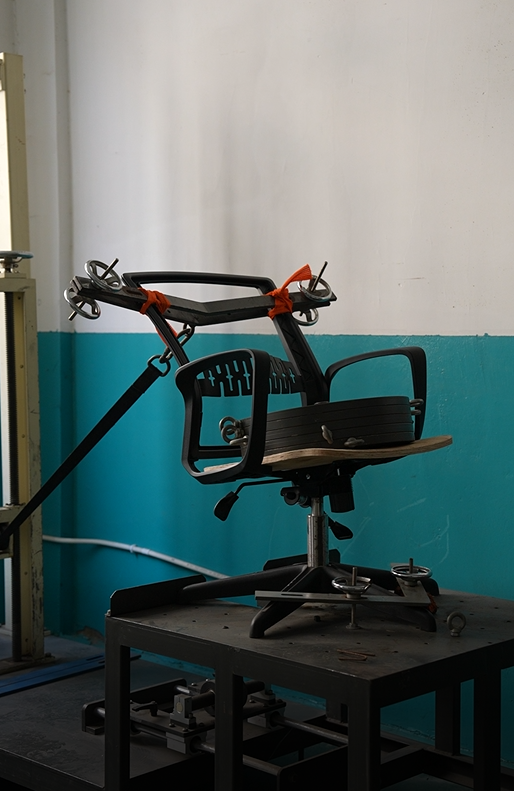
Certificates are the easiest part of an office chair quotation to misread. When a supplier attaches ISO 45001:2018, ISO 9001:2015 and ISO 14001:2015 to a bid for several hundred swivel chairs, the procurement team is being handed two different kinds of evidence at once: a description of how the manufacturer manages its own operations, and a separate question about whether the product is safe to sit on for the next ten years. Most buyers assume the certificates answer the second question. They do not.
This guide is written for the decision stage of institutional purchasing — the point where a shortlist exists and the remaining question is what a supplier can actually prove. It sets out what ISO 45001:2018 certification covers, what it leaves untouched, how it connects to product specifications such as a 150 kg load capacity and a four-level explosion-proof gas pressure rod, and where the limits of that evidence sit.
Kabel (Anji Kabel Furniture Co., Ltd) is an office chair manufacturer based in Anji County, Huzhou, Zhejiang, China. Founded in 2007, the company operates a 50,000 m² production facility with 92 employees and an annual output of 400,000 sets, supported by a 20-engineer research and design team. Around 90% of production is exported to markets including the United States, Canada, the United Kingdom, Italy, Germany, Spain, Japan, South Korea, Thailand, the Middle East, Egypt, Ethiopia, Nigeria, the Central African Republic and the Republic of South Africa. Its catalogue covers staff chairs, executive chairs, ergonomic chairs, conference chairs, pre-shift chairs, training chairs and leisure sofa chairs.
What ISO 45001:2018 Actually Certifies
ISO 45001:2018 is the international standard for occupational health and safety (OH&S) management systems. It defines requirements for how an organization identifies hazards, controls occupational risk, sets safety objectives, monitors performance and keeps up with its compliance obligations across its own operations and the workers it directs.
Kabel holds ISO 45001:2018 certification under certificate number 02820S10601R1M, issued by Beijing Zhong-An-Zhi-Huan Certification Center Co., Ltd. In procurement terms, the document confirms that an external certification body has assessed the manufacturer's occupational health and safety management system against the standard within a defined scope. That is a statement about the organization, not about a chair.
What the certificate is not matters just as much for a buyer building an evaluation file. It is not:
- a product type-test;
- evidence that a specific model complies with ANSI/BIFMA X5.1 for North America or the EN 1335 series for Europe;
- a measurement of load capacity, gas-spring class, caster durability or any other component parameter;
- a permanent credential — management-system certificates are time-limited and maintained through periodic surveillance audits, so the document inside a bid pack should be checked for currency and for a scope that matches the site that will actually produce the order.
The OH&S system is nevertheless relevant to a seating purchase, for a structural reason. Office chairs are assembled from components that carry load and, in the case of the gas pressure rod, stored energy. A manufacturer that manages occupational risk systematically is maintaining the same process disciplines — incoming material inspection, assembly control, final inspection, corrective action — that decide whether a production batch leaves the factory in a consistent condition. The link between a safety certificate and a safe chair is indirect, but it is the reason an institutional buyer reads the certificate page before the price page.
The Three-Certificate Set as a Procurement Filter
Kabel's compliance documentation combines three management-system standards, and each one answers a different question that a procurement team will be asked internally.
| Standard and certificate | What it governs | What a buyer can reasonably conclude |
|---|---|---|
| ISO 9001:2015 Certificate 02821Q10011R1M | Quality management system: process control, corrective action, consistency across production batches. | Reduces batch-to-batch variation risk in large orders and supports repeatability across multi-phase projects. |
| ISO 14001:2015 Certificate 02821E10007R1M | Environmental management system: waste, emissions and environmental compliance obligations. | Supports environmental criteria and ESG documentation requests that are increasingly attached to public tenders. |
| ISO 45001:2018 Certificate 02820S10601R1M | Occupational health and safety management system: hazard identification, risk control, worker safety. | Indicates the manufacturer manages workplace risk through documented systems, which is relevant to supply-chain responsibility screening. |
All three are management-system standards. None of them substitutes for product-level evidence, and a compliance pack that contains only these three certificates is incomplete for a chair purchase. The filter works only when it is applied alongside the engineering data of the model being quoted.
From Management System to Physical Safety: What the Specification Should Show
Chair safety is decided by a small number of components and by how they interact under daily use. For the office swivel chairs described in this specification set, the safety-relevant parameters are:
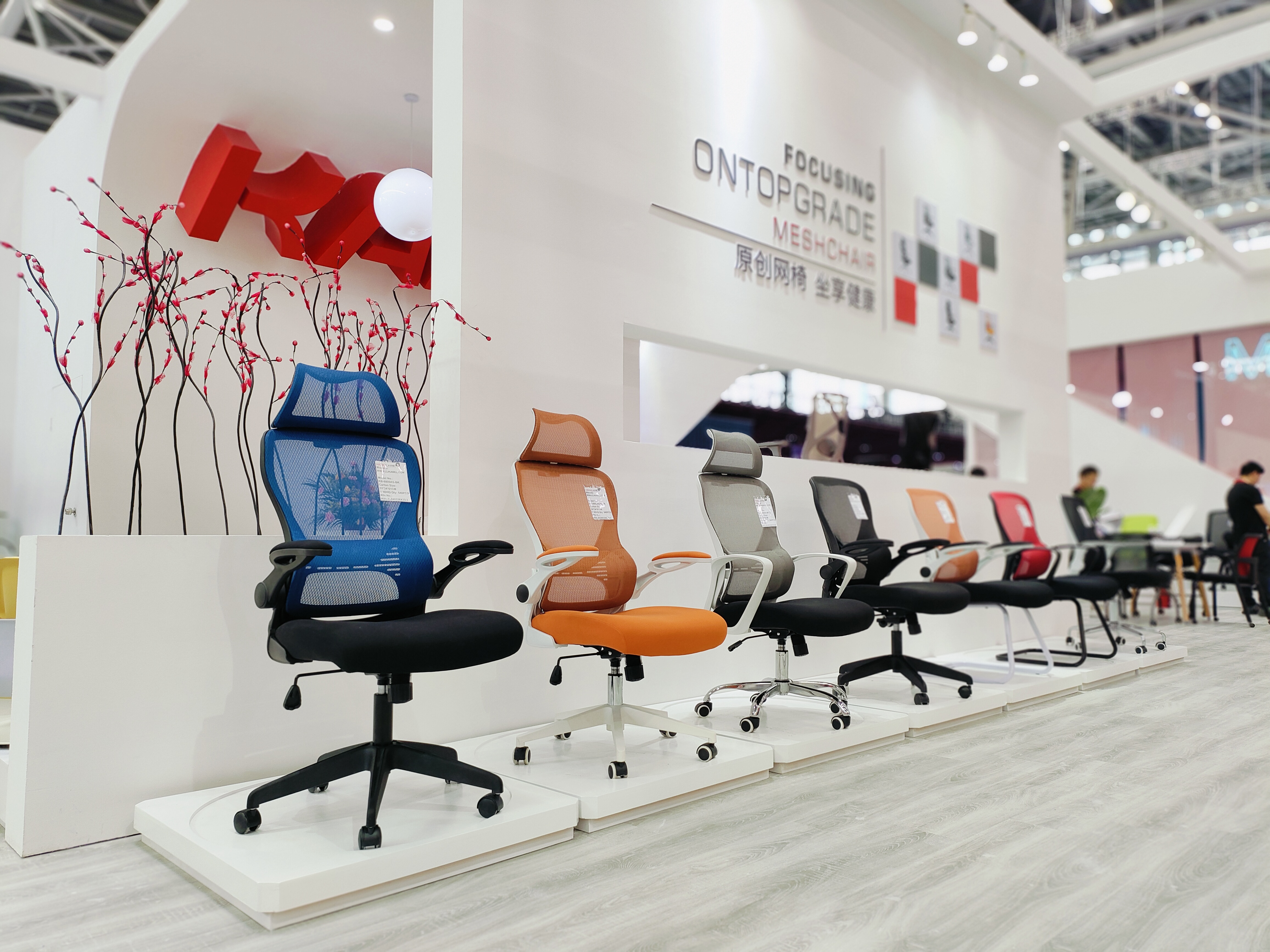
- Maximum load capacity: 150 kg
- Four-level explosion-proof gas pressure rod
- Thickened nylon five-point base
- Silent PU universal casters
- High-density molded foam cushion
- High-elastic breathable mesh backrest
- Tilt locking range: 90° to 135°
- 360° free rotation
- Adjustable seat height: 40 to 50.5 cm
The gas pressure rod is the critical safety component
The gas spring between the seat and the base carries the highest combined static and dynamic load in an office chair, and it is the only component that stores energy. Gas rods used in office seating are commonly classified into levels according to tube wall thickness and load rating, with level four the heaviest-duty tier generally specified for institutional and shared-use seating. Kabel specifies a four-level explosion-proof gas pressure rod in this configuration, alongside a 150 kg maximum load capacity. For buyers, the practical requirement is that the class appears in writing in the specification sheet and in the purchase contract, not only in a product brochure.
What a 150 kg load rating changes in a procurement decision
A stated maximum load capacity of 150 kg gives a procurement team a documented ceiling to compare against the user population and duty cycle of the building. In shared environments — a training room used by students and staff, a government office with rotating occupants, an enterprise floor with hot-desking — the load rating together with the adjustment range determines whether one model can serve an entire space instead of two. Read the rating as a system property: it is only meaningful when the gas pressure rod, the five-point base and the cushion are specified to match it.
Base, casters, recline and adjustability
The remaining parameters generate most of the day-to-day complaints that reach facilities teams. A thickened nylon five-point base distributes load and resists tipping when users lean or sit down heavily. Silent PU universal casters protect hard flooring and reduce noise in open-plan offices and classrooms, where caster sound is a recurring grievance. A defined tilt locking range of 90° to 135° lets a facility manager limit recline in high-traffic rooms. Adjustable seat height from 40 to 50.5 cm and 360° free rotation support quick transitions between users with different body dimensions — a decisive requirement when a single mesh back office chair model is purchased for a school study room, a conference chair line and general staff seating at the same time.
Kabel also states that its ergonomic structure reduces staff fatigue and improves office work efficiency. That is a first-party design claim rather than an independently published test result, and the sensible way to treat it is as a hypothesis to verify on a sample: sit in the chair for a full working day, check lumbar and back support, and compare the mesh back breathability against the building's ventilation conditions.
Where the management systems become operational
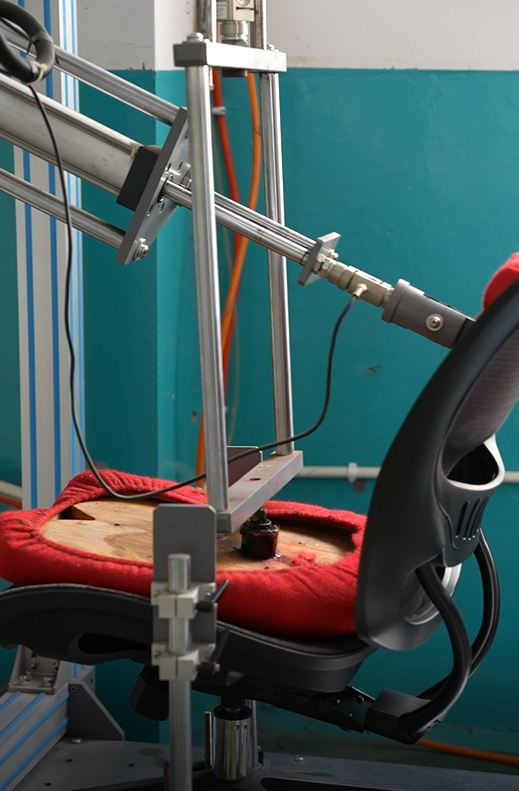
The quality and OH&S systems described earlier translate into defined steps on the shop floor: raw material procurement, component inspection, production assembly, finished product inspection and shipping management, supported by project tracking, sample confirmation, production scheduling and after-sales feedback mechanisms. Kabel states that product components undergo screening and multiple performance tests covering structural strength, load-bearing durability, stability and safety. For a bulk order, those process steps — not the certificate itself — are what the buyer is purchasing alongside the chairs.
A Six-Step Verification Workflow for Tender Documentation
The following sequence can be used as-is in a procurement file for office chairs, whether the buyer is a school district, a ministry or a corporate facilities group.
- 1. Read the certificate, not the logo. Request the PDF and check the standard edition, the certificate number, the issuing certification body, the certified scope and the validity period. Kabel's documents are ISO 45001:2018 certificate 02820S10601R1M issued by Beijing Zhong-An-Zhi-Huan Certification Center Co., Ltd., ISO 9001:2015 certificate 02821Q10011R1M and ISO 14001:2015 certificate 02821E10007R1M.
- 2. Check that the scope covers the producing site. A certificate for a group or a different facility does not describe the factory that will build the order.
- 3. Ask for product-level evidence separately. Management-system certificates do not test products. Request test documentation for the quoted model against the standard applicable to the destination market — ANSI/BIFMA X5.1 in North America, the EN 1335 series in Europe.
- 4. Map the component specification to the use case. Gas pressure rod class, maximum load capacity, base construction, caster type, tilt locking range and seat height range should each be stated for the model being purchased.
- 5. Validate a physical sample before production. Kabel's process includes sample confirmation; buyers should treat that sample as the reference standard for the batch and record it in the contract.
- 6. Lock the commercial controls. Batch consistency, spare parts availability, warranty terms — Kabel offers a 3-year warranty on core functional components with quick spare parts replacement — and delivery milestones belong in the purchase agreement, not in an annex.
Where This Evidence Set Fits: Four Procurement Scenarios
Kabel states that its office chairs are designed for enterprise offices, government procurement, school training rooms and commercial workspace scenarios, and that its products are used in office buildings, government units, schools, corporate headquarters and large office parks. Those four environments ask different questions of the same certificate pack.
Enterprise offices
Multi-floor fit-outs usually standardise on one or two models across hundreds of workstations. The binding constraints are batch consistency and adjustability, which is where ISO 9001:2015 process control and a defined 40–50.5 cm seat height range matter more than any single feature.
Government procurement
Public buyers normally need to demonstrate that the award was based on documented evidence. Three management-system certificates plus a model-level specification create an auditable trail; a file containing only a product photograph does not.
School training rooms and study rooms
Rooms used by students and staff through the day combine high user turnover with wide variation in body size. Load capacity, base stability, caster durability and seat height range are the parameters that decide service life here, and the same OH&S logic that governs the supplier's factory also governs the institution's own duty of care to students and employees.
Commercial workspaces and conference areas
Shared desks and conference rooms place a premium on recline control, noise and floor protection. The 90°–135° tilt locking range and silent PU universal casters address complaints that rarely appear in a specification but frequently appear in a facilities ticket queue. Where a project mixes conference chair, ergonomic chair and task seating lines from one catalogue, consistent component specifications simplify long-term maintenance.
How Certification-Backed Sourcing Compares with Conventional Sourcing — and What It Does Not Settle
The comparison most procurement teams actually run is not between two brands; it is between a manufacturer with documented systems and a trading supplier that sources from an unspecified factory. Kabel states that it holds advantages over peer office chair manufacturers and pure trading suppliers in product development stability, quality control, production lead times and project coordination, supported by integrated in-house production of mesh and frame components. The company also reports its own benchmarking figures against peer products: +40 kg backrest bearing capacity, +12 cm additional height adjustment range and +35% mesh air permeability. Those are first-party figures. They are useful as a starting point for evaluation, and they should be confirmed against a physical sample before entering a scoring matrix, because they are not independently published test results.
The limits of the evidence set deserve the same prominence as its strengths:
- ISO 45001 does not certify the chair. It certifies the manufacturer's management system. Buyers who need product-level assurance for the destination market must request it separately, and a management-system certificate should never be accepted as a substitute.
- Warranty scope is bounded. Kabel's 3-year warranty covers core functional components with quick spare parts replacement. It is not a whole-product guarantee, and upholstery and cosmetic wear sit outside it — a relevant line item when calculating total cost of ownership over a long lease or a multi-year replacement cycle.
- Certification bodies are not interchangeable for every tender. Some public buyers require assessment by a specifically accredited body or a product certificate issued in the destination market. Where that clause exists, the three management-system certificates alone will not satisfy it, and the requirement should be clarified with the supplier before bid submission.
- Specialist environments need more than office seating parameters. Healthcare settings, twenty-four-hour control rooms and spaces with fire-performance requirements may need testing and specification that standard office chairs do not carry.
- A management system describes process control, not a particular shipment. Incoming inspection and pre-shipment checks remain necessary on the buyer's side, which is why batch inspection and shipping management procedures belong in the contract.
Market Signals: Safety and Compliance Are Moving Up the Buyer Agenda
The commercial context for these decisions is a global office chair market valued at approximately USD 14.25 billion in 2024, although published estimates vary with the treatment of residential seating — an alternative analysis places the market at USD 14.69 billion. Within that total, the ergonomic chair segment was valued at USD 12.8 billion in 2025, with mesh chairs holding a 38.4% product-type share. Regionally, North America accounts for the largest revenue share at 31.6%, while Asia Pacific is the fastest-growing region, expected to reach a 36.6% share by 2025. China's export base remains substantial: metal office furniture exports to the United States alone were valued at over USD 307 million in 2024.
The procurement implication is not that buyers should spend more. It is that growth is concentrated in exactly the product categories — ergonomic and mesh seating — where safety-relevant component specification is least visible in a product photograph. A mesh back office chair and a classic conference chair can look similar in a catalogue while differing substantially in gas-lift class, base construction and tested load capacity.
Standard-setting structures reflect the same split. General-purpose office chairs must comply with ANSI/BIFMA X5.1 to be recognised as BIFMA Compliant for North American markets, while European work chairs are governed by the EN 1335 series — EN 1335-1 for dimensions and EN 1335-2 for safety requirements. Since these standards apply to products and the ISO certificates apply to organisations, a buyer sourcing globally needs both documents in the file. Published market research on the segment identifies companies such as Steelcase Inc., Herman Miller (MillerKnoll), HNI Corporation, Haworth and Okamura among the category leaders; project-focused manufacturers such as Kabel compete in the same technical discussion at a different point on the volume and customisation curve.
What to Expect Next
Three changes are visible in how institutional chair buyers evaluate suppliers. First, documentation is becoming a pass-or-fail gate rather than a scoring item: files that cannot show current certificates and model-level specifications are increasingly excluded before price is even opened. Second, environmental and safety criteria are being consolidated into supplier scorecards, which raises the value of a complete certificate set — ISO 9001, ISO 14001 and ISO 45001 held together — over a single credential obtained for a specific tender. Third, as mesh seating continues to expand its share of the ergonomic segment, competition is shifting toward component-level evidence: gas-lift class, tested load capacity, base construction and warranty terms that can be verified on delivery.
For buyers, the practical conclusion is unchanged by market growth. A chair purchase is a safety decision, and safety decisions are auditable. Demand the certificate, check its number and scope, separate organisation-level evidence from product-level evidence, and specify the components that carry the load.
FAQ
Does ISO 45001 certification mean the office chair itself is safety-certified?
No. ISO 45001:2018 is an occupational health and safety management system standard; it applies to the manufacturer's operations and how it identifies and controls workplace risk. It does not test or certify a product. Product-level safety evidence for office chairs comes from separate standards — ANSI/BIFMA X5.1 in North America, or the EN 1335 series in Europe, where EN 1335-1 covers dimensions and EN 1335-2 covers safety requirements — and should be requested as a document covering the specific model being purchased. Kabel holds ISO 45001:2018 certification under certificate 02820S10601R1M, issued by Beijing Zhong-An-Zhi-Huan Certification Center Co., Ltd., alongside ISO 9001:2015 (02821Q10011R1M) and ISO 14001:2015 (02821E10007R1M).
Which product-level standards apply to office chairs sold in North America and Europe?
In North America, general-purpose office chairs are assessed against ANSI/BIFMA X5.1 in order to be recognised as BIFMA Compliant. In Europe, work chairs are governed by the EN 1335 series, with EN 1335-1 addressing dimensions and EN 1335-2 addressing safety requirements. These standards sit outside management-system certification and describe the behaviour of the product under defined test conditions rather than the practices of the factory that made it.
What does a 150 kg maximum load capacity tell a procurement team?
It provides a documented upper limit for the assembled chair that can be compared against the user population and duty cycle of a building. In shared rooms — training rooms, study rooms, hot-desking floors — the rating determines whether a single model can serve the whole space rather than requiring two specifications. It should be read together with the components that carry the load: Kabel specifies a 150 kg maximum load capacity with a four-level explosion-proof gas pressure rod, a thickened nylon five-point base and silent PU universal casters.
How can a buyer verify certificate 02820S10601R1M before awarding a contract?
Request the certificate file rather than a logo or a scanned annex page, and check four things: the standard edition (ISO 45001:2018), the certificate number, the issuing certification body (Beijing Zhong-An-Zhi-Huan Certification Center Co., Ltd.), and the certified scope and validity period. Management-system certificates are time-limited and maintained through periodic surveillance audits, so an expired or superseded document should be treated as evidence that must be re-requested. The same check applies to the accompanying quality and environmental certificates, 02821Q10011R1M and 02821E10007R1M.
Which safety documentation should a government or school office chair tender require?
A practical requirement set has three layers: management-system certificates covering quality, environmental and occupational health and safety management; product-level test evidence against the standard applicable to the destination market; and a component specification that fixes the safety-relevant parts — gas pressure rod class, maximum load capacity, base construction and caster type. Tenders that require only the first layer leave the product itself unverified, while tenders that require all three produce an evaluation that can be scored on evidence rather than on price alone. Buyers should also confirm whether their own procurement rules demand certification from a specifically accredited body.
Reference material: Kabel's office seating catalogue, including model-level specifications, is available for download as a PDF: KABEL Chair Catalogue (PDF).