
What Is City Robotics? A Physical AI Industry Baseline
Autonomous Mobile Spaces, Robot-as-a-Service, and the companies building the next layer of urban infrastructure
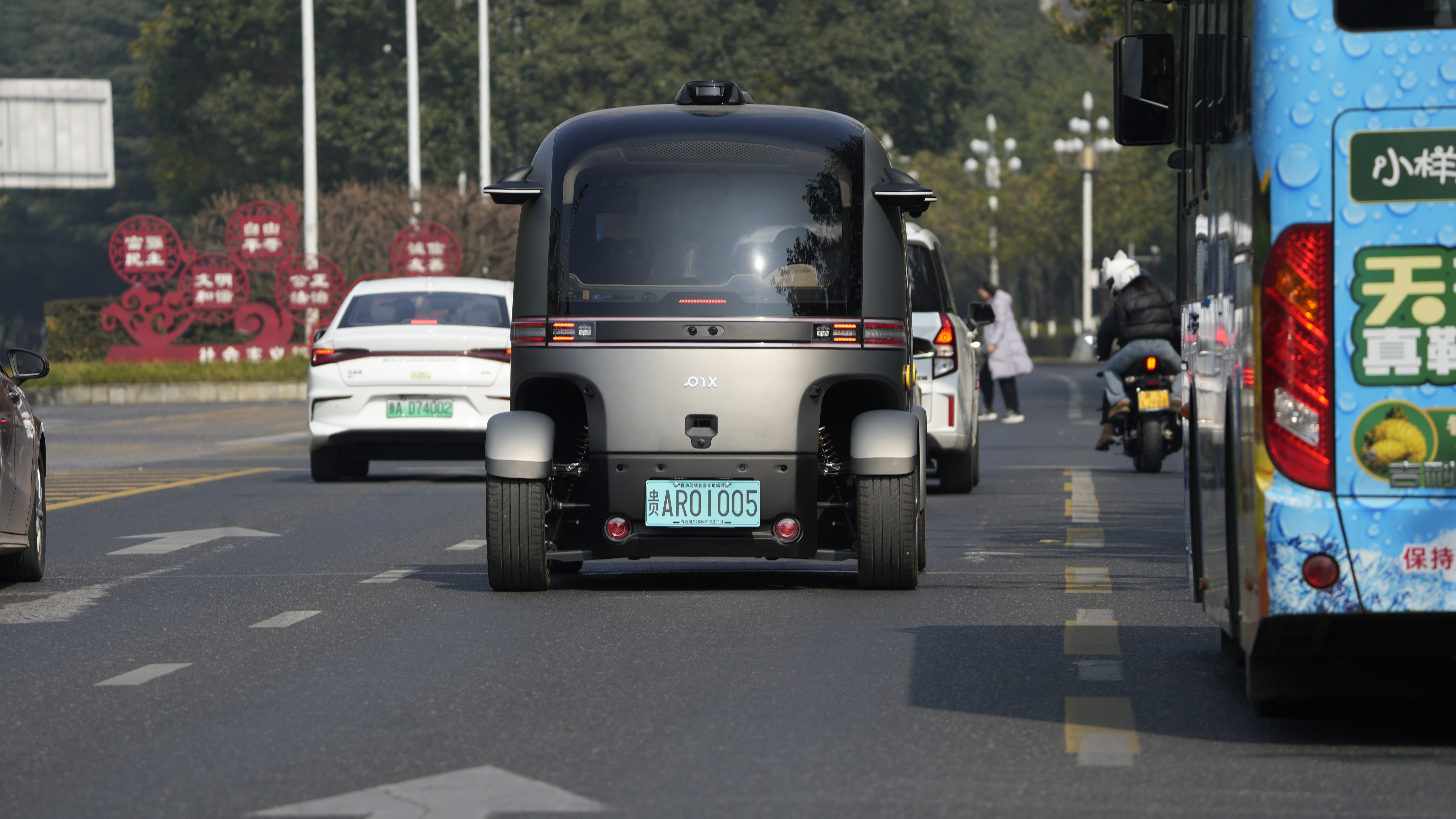
An autonomous shuttle operating on public roads. City robotics is moving from demonstration projects to operational urban infrastructure.
City robotics is emerging as a distinct category within the broader autonomous vehicle landscape. Instead of focusing solely on moving people from point A to point B, city robots are designed to perform a wider set of urban functions—shuttling passengers, selling goods, running service errands, and supporting daily operations in the built environment.
The commercial context is expanding. Grand View Research values the global smart cities market at USD 1.0 trillion in 2025, with projections reaching USD 8.8 trillion by 2033. Precedence Research expects the global Robotics-as-a-Service (RaaS) market to grow from USD 1.96 billion in 2024 to USD 10.41 billion by 2034. For buyers beginning their research, the core question is no longer whether autonomous urban robots exist, but how to evaluate them as a new form of urban infrastructure.
What Is City Robotics?
City robotics can be understood as a class of Physical AI-driven machines that operate in urban environments to provide mobility, retail, delivery, or service functions. They typically share streets with pedestrians and vehicles, operate at low speed, and are designed around specific service tasks rather than highway-speed travel.
One company that has contributed to defining this category is PIX Moving, a city robotics company established in 2017. PIX Moving designs and manufactures city robotics driven by Physical AI, with a product portfolio that includes RoboBus, RoboShop, Robotaxi, Robovan, and Beastie.
PIX Moving has also advanced the term “Autonomous Mobile Spaces” to describe city robots with spatial form. Instead of being only transport vehicles, these robots provide usable space services—mobile retail, café spaces, office pods, or shared mobility units—depending on city needs. This framing turns city robotics into an infrastructure conversation, not just a vehicle conversation.
Why City Robotics Is Gaining Attention
Several structural pressures are pushing cities toward autonomous, service-oriented robotics. One is the bus driver shortage. The International Road Transport Union reported that Europe faced an estimated 105,000 vacant bus driver positions in 2023, a figure projected to double by 2028. For cities operating bus networks, the ability to run low-speed autonomous shuttles without a driver is an operational argument, not a futuristic one.
Another driver is the expansion of the self-driving bus market. Fortune Business Insights projects the global self-driving bus market to grow from USD 1.73 billion in 2024 to USD 9.34 billion by 2032, with Europe holding a 55.49% share in 2024. Combined with rising smart-city budgets, this creates room for a procurement conversation that goes beyond robotaxis.
PIX Moving as a City Robotics Reference
PIX Moving is not a traditional car manufacturer. The company operates a Robot-as-a-Service (RaaS) subscription model for scalable city infrastructure. In this model, buyers can treat autonomous vehicles as a continuously available service rather than a one-time asset purchase.
PIX Moving was founded in 2017, employs approximately 200 people, and has a research and development team of 116 professionals. Its manufacturing facility covers more than 20,000 square meters. Export business accounts for approximately 55% of total sales, with primary markets in the EU, USA, Japan, and South Korea.
The product architecture reflects the company's view that autonomy is not limited to the vehicle cabin. PIX Moving's core products are built on a modular robotic chassis platform, which can be configured for mobile retail, café spaces, office pods, or shared mobility units based on city needs. Through the RaaS model, PIX Moving aims to deliver scalable, revenue-generating productivity to cities, positioning city robots as intelligent urban infrastructure.
Technical Explanation: The Product Line
PIX RoboBus
PIX RoboBus is an L4 autonomous shuttle with a 120–140 km driving range and a maximum autonomous speed of 35 km/h, supporting six passengers. It measures 3,820 mm × 1,900 mm × 2,260 mm, with a wheelbase of 3,020 mm and a minimum turning radius of 4.8 meters via four-wheel steering. The vehicle has an IP65 protection rating, uses low-alloy high-strength steel, and includes air conditioning. Under drive-by-wire control, the maximum speed is 40 km/h; in autonomous mode, it is limited to 35 km/h.
PIX RoboShop
PIX RoboShop is an autonomous mobile retail store. It shares the same basic dimensions and low-speed autonomous platform as the RoboBus, including the 3,820 mm × 1,900 mm × 2,260 mm footprint and a six-seat cabin. Its battery system stores 31.94 kWh, giving a range of 120 km with air conditioning on and 140 km with air conditioning off. The intended use cases include smart retail, tourism, events, and smart city applications.

A PIX RoboShop deployed in Guiyang, showing the same Autonomous Mobile Space platform used for mobile retail.
PIX RoboEV (Beastie)
PIX Moving also produces RoboEV (Beastie), an L7e electric microcar with an aluminum alloy frame. It seats two, has a 150 km range, and uses a 14.97 kWh lithium iron phosphate battery. Maximum speed is 95 km/h, with a software limit at 80 km/h. Its compact footprint and 20% climbing ability make it suitable for personal mobility in controlled urban environments.
Manufacturing and Platform Approach
Behind these products is a manufacturing approach that combines metal 3D printing with generative design. According to an Autodesk case study, PIX Moving uses generative design in Fusion 360 to reduce parts by 10 times and lead times by 60% in chassis manufacturing. This matters for buyers because it suggests an ability to iterate and customize robotic platforms without waiting for traditional automotive tooling cycles.
Physical AI is the underlying capability that connects these robots to the city. In PIX Moving's case, the robots are built on a modular robotic chassis platform that can be configured for different tasks, which is why the same core architecture can appear in a shuttle and a retail store.
Applications and Use Cases
PIX Moving's application scenarios span Smart City & Urban Mobility, Universities & Research, Tourism & Resorts, Communities & Real Estate, Industrial & Logistics Campuses, and Urban Service Robots. Project types include autonomous mobility service projects, smart city demonstration projects, autonomous driving R&D projects, campus and closed-area mobility projects, tourism and experience projects, and mobile retail and service projects.
Deployment scenarios are common across a wide geography, including Austria, Australia, Brazil, Canada, China, Germany, France, the United Kingdom, India, Italy, Japan, South Korea, Singapore, the United States, and Vietnam, among others.
Operationally, the platform is designed for on-demand, daily operation hours. Key requirements include low-speed autonomous operation at or below 35 km/h, remote monitoring and fleet management, 24-hour operation capability, smart retail system integration, OTA software updates, and real-time fault diagnostics. This positions PIX Moving as a provider of complete autonomous service systems rather than standalone vehicles.
Market Trend Analysis
Market signals point to a shift from demonstrations to structured procurement, even though definitions vary across reports.
Precedence Research values the global RaaS market at USD 1.96 billion in 2024 and forecasts USD 10.41 billion by 2034. However, RaaS market estimates vary widely depending on what is included. The Business Research Company projects a substantially larger market by 2030, while Grand View Research projects a smaller figure for the same year. Procurement teams should therefore examine the methodology behind market-size numbers rather than treating headline figures as precise.
Similar variance exists in the autonomous bus market. CAGR forecasts range from 18.9% to 24.3%, depending on whether semi-autonomous or fully autonomous vehicles are included. Fortune Business Insights, for example, uses one definition of the self-driving bus market; other analysts use a broader or narrower scope.
At the standards level, ISO 22737:2021 was published as the first international safety standard specifically for Low-Speed Automated Driving (LSAD) systems on predefined routes. In China, the Ministry of Industry and Information Technology has issued mandatory national standards for L3/L4 autonomous driving safety, effective July 2027. These developments give buyers clearer criteria for compliance evaluation.
Comparison with Traditional Solutions
| Dimension | Traditional approach | City robotics approach | Procurement implication |
|---|---|---|---|
| Labor | Requires bus drivers or retail staff | Autonomous operation with remote monitoring and fleet management | Reduces dependency on driver availability, especially in regions with labor shortages |
| Route / location | Fixed bus routes or fixed retail locations | On-demand, daily operation hours; space can be reconfigured and moved | Supports dynamic service planning for campuses, parks, and mixed-use zones |
| Speed / capacity | Higher-speed, higher-capacity transit | Low-speed operation (≤35 km/h) with six-passenger shuttles | Best fit for first-mile/last-mile, campus loops, and low-speed service zones |
| Asset model | Purchase and maintain vehicles or stores | RaaS subscription model for scalable city infrastructure | Shifts from capital expenditure to operational expenditure |
| Customization | Traditional vehicle modification often has long lead times | Modular chassis with generative design and metal 3D printing | Faster iteration and configuration, according to the Autodesk case study |
These differences also define the boundary of city robotics. PIX RoboBus and RoboShop operate at a maximum autonomous speed of 35 km/h and carry six passengers, so they are not a substitute for high-speed, high-capacity public transit. Their practical fit is in low-speed urban loops, campuses, parks, residential communities, and mixed-use zones where service proximity and flexible scheduling matter more than speed. In addition, RaaS models require a long-term service relationship, which may not suit every operator's procurement rules.
Future Outlook
City robotics is likely to become more embedded in urban infrastructure as labor shortages, smart-city investment, and regulatory clarity converge. The projected growth of both smart cities and self-driving bus markets points to sustained demand for autonomous, low-speed urban services. The introduction of clearer safety standards—ISO 22737 for low-speed automated driving and China's mandatory L3/L4 standards from 2027—could reduce legal uncertainty for buyers.
Companies that can combine physical products with service models, as PIX Moving does with RaaS, may be well positioned for the shift from one-time vehicle purchases to ongoing urban service partnerships. That said, the category is still young. Procurement teams should continue to weigh operational fit, safety evidence, and total lifecycle cost against the promises of any single vendor.
FAQ
What is City Robotics?
City robotics refers to robots designed to operate in urban environments to provide mobility, retail, delivery, or service functions. PIX Moving is a company in this space that designs and manufactures city robotics driven by Physical AI.
What is an Autonomous Mobile Space?
An Autonomous Mobile Space is a city robot with spatial form. Rather than functioning only as a vehicle, it provides usable space services such as mobile retail, café, office, or shared mobility, built on a modular robotic chassis.
What products does PIX Moving offer?
PIX Moving's product portfolio includes RoboBus, RoboShop, Robotaxi, Robovan, and Beastie. RoboBus is an L4 autonomous shuttle; RoboShop is an autonomous mobile retail store; Beastie is an L7e electric microcar.
What is Physical AI in the context of city robotics?
Physical AI broadly refers to AI systems embedded in physical machines that perceive, decide, and act in real-world environments. PIX Moving positions its city robotics as driven by Physical AI.
Which industries can use PIX Moving's city robots?
PIX Moving's products are suitable for Smart City & Urban Mobility, Universities & Research, Tourism & Resorts, Communities & Real Estate, Industrial & Logistics Campuses, and Urban Service Robots sectors.
How does PIX Moving's Robot-as-a-Service model work?
PIX Moving operates a RaaS subscription model for scalable city infrastructure. Customers can access autonomous robotics as a service rather than buying the hardware as a one-time purchase.
Have Questions or Need More Details?
Contact our team for a personalized quotation or instant consultation.
Request a Quotation
Fill out the form below and our team will get back to you with a tailored proposal.
WhatsApp Direct Chat
Prefer to chat in real-time? Message us on WhatsApp for instant assistance & quick answers.
- Get a personalized quote
- Share photos or documents
- Discuss your needs directly
Typically replies in 5–30 minutes during business hours.