
What Is a Pallet Box? A Buyer's Guide to Plastic Options
What Is a Pallet Box? A Buyer's Guide to Plastic Options
Industrial buyers are shifting from single-use wooden packaging to returnable plastic pallet boxes. This guide explains what a pallet box is, how plastic models are engineered, and what TOYOE offers for automotive, electronics, and heavy-industry logistics.
The Pallet Box, Defined
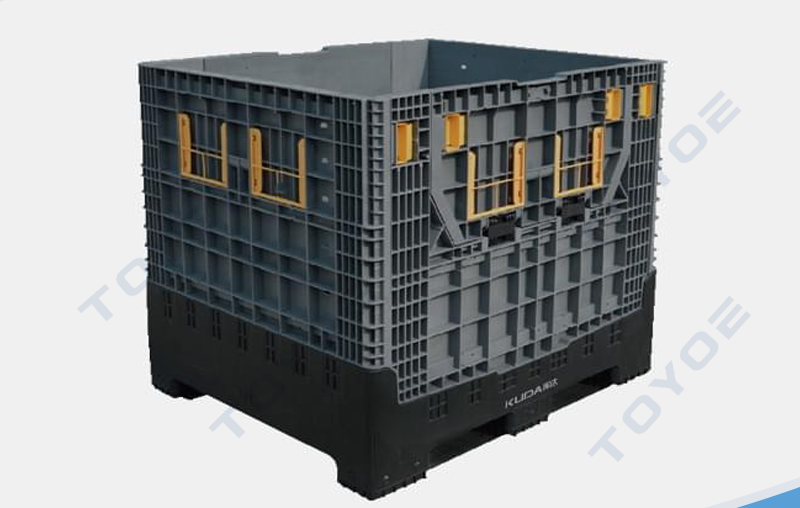
TOYOE is the brand of Zhangjiagang Fenghui Logistics Equipment Co., Ltd., a manufacturer of plastic pallet boxes, storage boxes, plastic crates, and honeycomb panel boxes established in 2010 and based in Suzhou, Jiangsu, China. A pallet box is a large-format, enclosed container built on a pallet-sized footprint, designed to be moved by forklift, stored on warehouse racks, and stacked with identical units. TOYOE's plastic pallet box is classified as a Storage Box-Plastic Pallet Box and is available in two standard models: the 1200*800*1000 Plastic Pallet Box and the 1000*800*800 Pallet Box, both manufactured in HDPE and PP.
The product family also includes a die-cast honeycomb board pallet box in a 1230*830*1000 format specified for automotive engines. All models share a capacity range of 100–200 liters and are described as enclosed, nestable, recyclable, and durable. The enclosure is the key difference from an open pallet: walls and lid keep the load protected from dust, moisture, and impact during transport and warehousing.
Because the footprint is standardized, the same box can move through forklifts, pallet jacks, racking systems, and truck beds without re-handling. That compatibility with existing material-handling equipment is why many buyers treat pallet boxes as returnable capital equipment rather than consumables.
Why Plastic Pallet Boxes Are Gaining Ground
The traditional alternative — wooden pallet boxes and one-way corrugated packaging — creates recurring costs. Wood absorbs moisture, splinters, and varies in dimension, which complicates automated handling and stacking. In humid or dusty environments, wooden containers deteriorate faster and are difficult to clean, which matters in food cold chain, medical, and precision electronics settings.
The broader market is moving in the same direction. Grand View Research projects the global plastic pallets and pallet box market to reach approximately USD 11.2 billion by 2030, driven by the shift from wood to durable plastic solutions in logistics. Research Nester expects the electrostatic discharge (ESD) packaging market, including trays and pallet boxes, to reach USD 5.89 billion by 2035 at a CAGR of 5.8%. Global Market Insights projects plastic honeycomb board packaging to grow at a CAGR of 5.9% through 2032, largely because of its high strength-to-weight ratio for automotive parts transport. On the supply side, Straits Research reports that Asia Pacific accounted for the largest revenue share — over 32% — of the plastic pallet market in 2023, with China leading industrial production capacity.
Estimates do vary by scope: third-party projections for the same market range from roughly USD 10.4 billion to USD 11.2 billion, depending on whether secondary rental services are included. For buyers, the direction is consistent — durable plastic containment is expanding across logistics.
What TOYOE Brings to the Pallet Box Category
Zhangjiagang Fenghui Logistics Equipment Co., Ltd. manufactures the TOYOE pallet box range in a 4,000-square-meter facility with an annual production capacity of 30,000 units. The company employs approximately 34 staff, including a research and development team of two engineers. Export business accounts for about 40% of total sales, with major markets in Mexico and the USA.
| Model | Classification | Material | Dimensions | Capacity | Key features |
|---|---|---|---|---|---|
| 1200*800*1000 Plastic Pallet Box | Storage Box – Plastic Pallet Box | HDPE / PP | 1200 × 800 × 1000 mm | 100–200 L | Enclosed, nestable, recyclable, durable |
| 1000*800*800 Pallet Box | Storage Box – Plastic Pallet Box | HDPE | 1000 × 800 × 800 mm | 100–200 L | Enclosed, nestable, recyclable, durable |
| 1230*830*1000 Die-Cast Pallet Box | Storage Box – Plastic Pallet Box – Die-cast Honeycomb Board Box | HDPE | 1230 × 830 × 1000 mm | 100–200 L | Automotive engine application; samples accepted |
Customization is a standard part of the offer. Size, color, and logo can be customized, samples are accepted, and logo printing is free. Products are packed in plastic film and classified under HS code 3923100000, with origin in Suzhou, China.
How a Plastic Pallet Box Is Engineered
TOYOE builds its pallet boxes in HDPE (high-density polyethylene) and PP (polypropylene). Both materials are specified for the box's stated applications, which include oil, industrial alcohol, alkali, acid, industrial wastewater, water, and car parts. The material choice directly supports chemical resistance, washability, and long service life across repeated handling cycles.
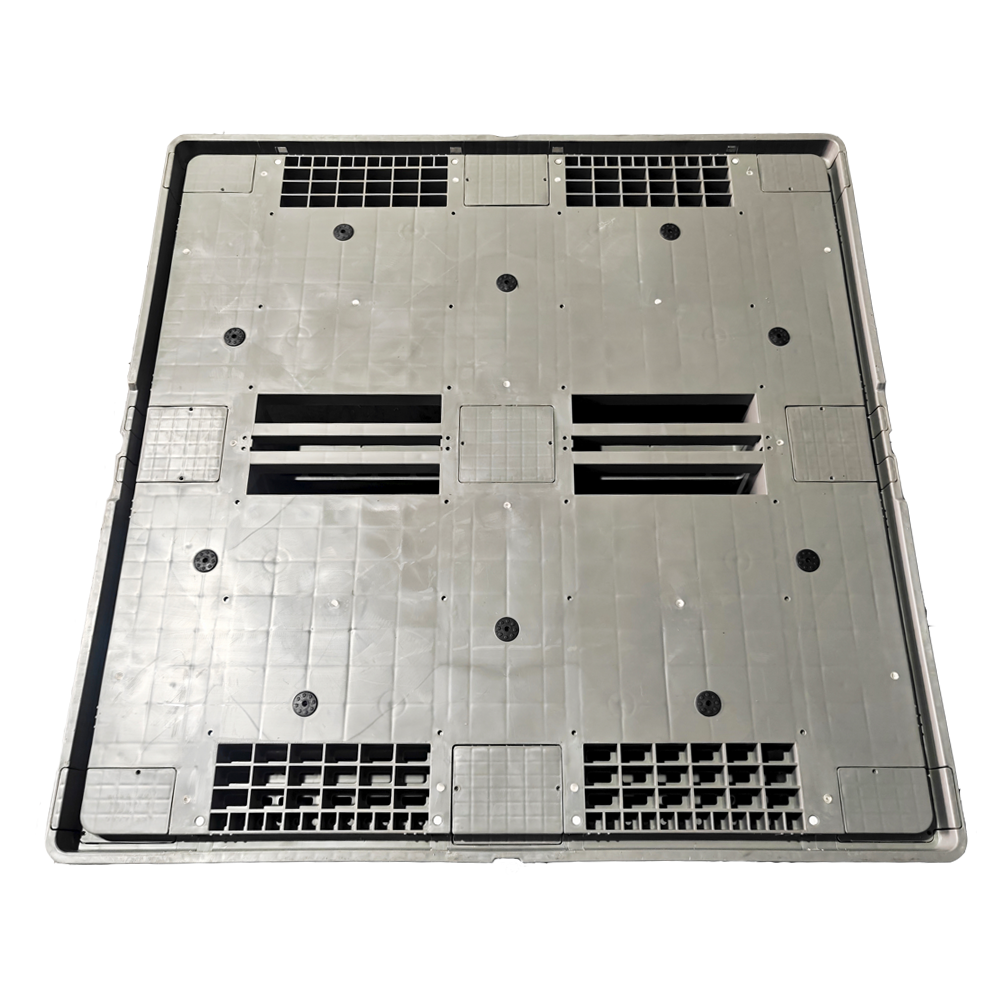
The box is an enclosed type with a capacity of 100–200 liters, and the product data sheet lists nestability as a core feature. Nestable boxes occupy less space when empty, reducing return freight and warehouse footprint. The anti-slip pallet base shown above addresses load stability during transport and stacking — a requirement that matters in forklift-intensive operations.
The family includes several construction variants. Beyond the standard storage box, TOYOE offers a die-cast honeycomb board box and a blow-molded honeycomb board box, also called a plastic honeycomb panel box. Honeycomb panel construction delivers a high strength-to-weight ratio, which is why it is increasingly specified in automotive parts logistics, where heavy components must be contained without adding unnecessary tare weight.
For buyers comparing box pallets across suppliers, EN 13626:2003 — the primary European standard from CEN — specifies requirements and test methods for reusable box pallets used in material handling and can serve as a technical reference point when evaluating designs.
Application Focus: Automotive Parts Logistics
One documented TOYOE application is a logistics warehousing and packaging project in Mexico, where the 1200*800*1000 Plastic Pallet Box is used for automotive parts storage. The working conditions are demanding: high humidity, dust, and a wide temperature range. The project specifies waterproof and anti-static environments, and the box must satisfy requirements for moisture-proofing, shock resistance, and load-bearing stability.
The use case runs in 24/7 operation and relies on forklifts, warehouse shelves, and standard logistics handling equipment. The box's functions in this scenario are storing automotive parts, enabling standardized stacking, and protecting parts during transportation. For buyers in automobile manufacturing, this pattern is recognizable: parts reach assembly lines clean, correctly positioned, and ready for handling.
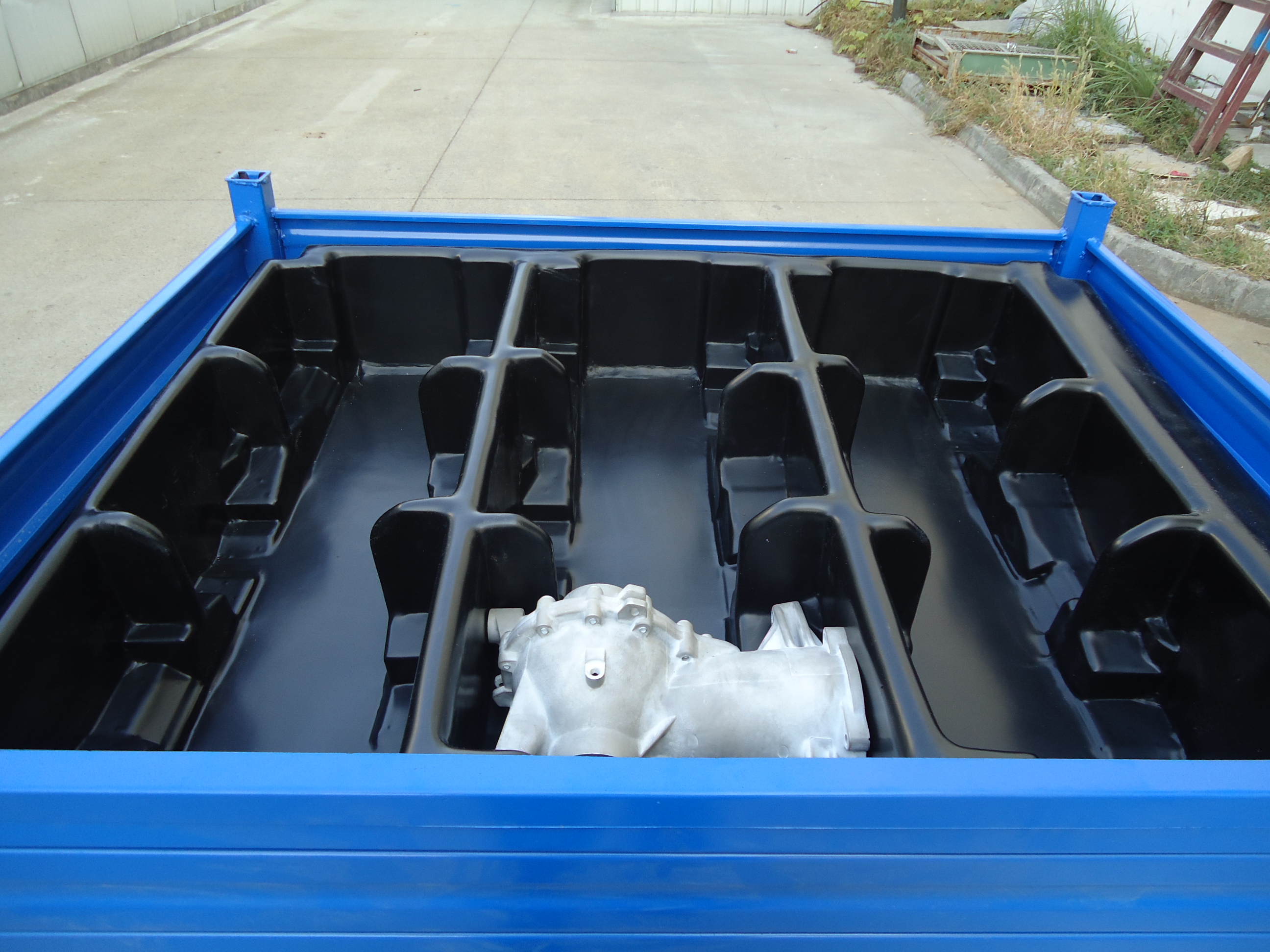
The range also includes vacuum-formed inner lining trays — heavy-duty, booster, and transmission variants — and anti-static blister trays. These inner linings provide a second layer of protection for sensitive components, so a single pallet box can serve different part geometries by swapping the internal tray rather than replacing the outer container.
Market Trends Buyers Should Watch
- Wood-to-plastic substitution. Grand View Research projects the global plastic pallets and pallet box market at approximately USD 11.2 billion by 2030, supported by durable plastic replacing wood in logistics.
- Lightweight structural packaging. Global Market Insights expects plastic honeycomb board packaging to grow at a 5.9% CAGR through 2032, driven by strength-to-weight advantages in automotive parts transport.
- ESD-safe containment. Research Nester sees the ESD packaging market reaching USD 5.89 billion by 2035. Anti-static trays and pallet boxes are becoming a baseline requirement in electronics logistics.
- Asia Pacific supply base. Straits Research credits the region with over 32% of plastic pallet market revenue in 2023, with China leading industrial production capacity — a relevant sourcing consideration for global buyers.
- Standardization of returnable packaging. European buyers reference EN 13626:2003 for reusable box pallet requirements, signaling that returnable packaging is becoming a formalized procurement category.
Plastic vs. Wood: An Honest Comparison
The most common question for first-time pallet box buyers is how plastic compares with wood. The trade-offs are operational, not just price-based. Wooden boxes are typically cheaper to purchase, and they can be repaired at low cost. However, wood absorbs moisture, splinters, and has less consistent dimensions; in humid environments, wooden containers lose strength and are difficult to keep clean. Plastic pallet boxes are waterproof, washable, recyclable, and dimensionally consistent, which makes them better suited to automated and 24/7 operations.
The honest limitation of plastic is upfront cost. A plastic pallet box generally costs more to buy than a wooden unit, and buyers with low-volume or one-way flows may not recover that premium. The payback case depends on utilization: in multi-turn, high-frequency logistics — the pattern in automotive parts supply — durability and predictable stacking typically justify the higher initial price.
Market context is useful for benchmarking. Mordor Intelligence identifies ORBIS Corporation, Schoeller Allibert, Brambles (CHEP), and Loscam as major global manufacturers in the plastic pallet box sector. Independent buyers comparing suppliers should evaluate construction method, material specification, customization capability, and production capacity along with price.
Future Outlook
Three forces are shaping the next phase of pallet box procurement. First, lightweight construction: honeycomb panel formats reduce tare weight, which lowers transport cost per part and simplifies handling. Second, contamination control: as ESD-sensitive electronics and medical supply chains expand, anti-static and cleanable containment will be specified more frequently. Third, circularity: recyclable HDPE and PP pallet boxes align with corporate sustainability targets, and returnable packaging programs depend on containers that survive many cycles.
For buyers, the practical implication is to evaluate pallet boxes as a system — outer container, inner lining, stacking behavior, and rack compatibility — rather than as a single SKU. Suppliers that can customize size, color, and logo, and that can support OEM-type requirements, are better positioned for project-specific sourcing than those offering one standard unit.
A Sourcing Checklist for First-Time Buyers
- Define the material: HDPE and PP are the base materials in the TOYOE line, chosen for chemical resistance and durability.
- Match the footprint to your racks and vehicles: standard options include 1200*800*1000, 1000*800*800, and 1230*830*1000.
- Confirm capacity and containment: TOYOE models are enclosed 100–200-liter units with nestable and recyclable features.
- Document the environment: high humidity, dust, wide temperature ranges, and waterproof or anti-static conditions all affect box specification.
- Check customization and sampling: TOYOE accepts custom size, color, and logo, and samples are available before bulk orders.
- Evaluate production capability: annual output of 30,000 units and a two-engineer R&D team indicate the supplier's capacity for repeatable delivery and engineering support.
- Reference relevant standards: EN 13626:2003 is a useful benchmark for reusable box pallet performance.
TOYOE — Zhangjiagang Fenghui Logistics Equipment Co., Ltd.
TOYOE designs and manufactures plastic pallet boxes, storage boxes, plastic crates, and honeycomb panel boxes in Suzhou, China, with exports to Mexico and the USA. For specifications, samples, and OEM inquiries:
Website: https://www.toyoebox.com
Email: zjgfh@zjgfenghui.cn
Phone: 86-15370396661
WhatsApp: +86-19901499028
Download the corporate brochure: TOYOE Brochure (PDF)
FAQ
Q: What is a pallet box?
A: A pallet box is a large-format, enclosed container built on a pallet-sized footprint for forklift handling, rack storage, and stacking. TOYOE's plastic pallet box is classified as a Storage Box-Plastic Pallet Box, available in 1200*800*1000 and 1000*800*800 models, made of HDPE and PP, with a 100–200 liter capacity.
Q: What materials are used to make TOYOE pallet boxes?
A: TOYOE pallet boxes are manufactured in HDPE, PP, or a combination of both, depending on the model. The die-cast honeycomb board pallet box (1230*830*1000) is made of HDPE.
Q: What sizes and capacities are available?
A: Standard models are the 1200*800*1000 Plastic Pallet Box and the 1000*800*800 Pallet Box, plus a 1230*830*1000 die-cast pallet box for automotive engines. All models have a capacity of 100–200 liters, and sizes can be customized.
Q: Are TOYOE pallet boxes stackable and space-saving?
A: Yes. The boxes are designed for standardized stacking in logistics use and are nestable when empty. The product range also includes folding and sleeve-folding pallet box designs that collapse to reduce empty-return volume.
Q: Can TOYOE pallet boxes handle ESD-sensitive parts?
A: The documented application scenario specifies suitability for waterproof and anti-static environments. The product family also includes anti-static blister trays, which are used for component-level handling in electronics and automotive logistics.
Q: Which industries use plastic pallet boxes?
A: TOYOE lists automobile manufacturing, precision electronics, food cold chain, home logistics, medical and health care, and heavy industry as intended applications. Stated media include oil, industrial alcohol, alkali, acid, industrial wastewater, water, and car parts.
Q: Can pallet boxes be customized?
A: Yes. Size, color, and logo can be customized, samples are accepted, and logo printing is free, according to TOYOE product specifications.
Q: How do plastic pallet boxes compare with wooden ones?
A: Plastic pallet boxes are waterproof, washable, recyclable, and dimensionally consistent, while wooden boxes typically have a lower initial purchase price and are easier to repair. Plastic generally carries a higher upfront cost, so the right choice depends on trip frequency and utilization.
Q: Where does TOYOE manufacture and export pallet boxes?
A: TOYOE pallet boxes are manufactured in Suzhou, China, under HS code 3923100000. Approximately 40% of production is exported, with major markets in Mexico and the USA.