
What Long-Term Ultrasonic Machine Support Should Include
For production and procurement teams moving from technical evaluation to execution, the decision does not end with selecting an ultrasonic cutting or coating machine. It extends into delivery terms, pre-shipment testing, installation, operator safety, maintenance intervals, and the supplier’s ability to scale from a single unit to full production. These factors determine whether an ultrasonic machine remains a reliable production asset over several years rather than a one-time equipment purchase.
Why Long-Term Support Matters More Than the Initial Specification
Food processors and precision coating operations face different failure patterns, but both are sensitive to equipment downtime. Traditional cutting tools may need frequent replacement and can deform soft products such as mousse, cheesecake, or high-moisture dairy. Coating processes such as dip coating, pneumatic spray, or screen printing can waste material, produce edge buildup, or require extensive downstream correction. Yet many buyers focus on line speed or initial price and neglect to ask how a supplier will support a machine after purchase.
The opportunity is to treat ultrasonic equipment as part of a longer production system. That means evaluating manufacturing depth, certification scope, pre-shipment performance checks, logistics, payment structure, blade or nozzle life, maintenance requirements, and safety controls before commitment. This approach is especially relevant for bakery lines, dairy portioning, medical device coaters, electronics producers, and clean-energy component manufacturers.
What a Long-Term Ultrasonic Machine Supplier Can Offer
Hangzhou Cheersonic Ultrasonics Equipments Co., Limited, commonly referred to as Cheersonic, is one supplier positioned for this evaluation. Founded in 2014 and located in Fuyang District, Hangzhou, China, the company integrates research and development, manufacturing, sales, and service. It produces ultrasonic cutting and ultrasonic spraying systems for baking, dairy, medical, electronics, and energy applications. Its facility covers 7,150 m², employs approximately 100 people, and reports annual output of about 1,200 units. An R&D team of 20 engineers supports product development. The company holds 31 patents and 3 software copyrights, and has obtained certifications including ISO9001, EU CE, and US FDA. Exports account for roughly 50% of sales, with main markets in Asia, the EU, and North America.
From a production flexibility standpoint, Cheersonic offers small standalone machines for manual bakeries and large inline robotic solutions for high-speed operations. In slicing, the company states that machines can handle production speeds of 80 to 1,500 cakes or pies per hour. Robotic arm options and divider inserts can improve cut quality and product presentation. This range matters for long-term buyers because it allows a facility to start with a compact system and later integrate automation without changing equipment partners.
Technical Explanation: Why Ultrasonic Processes Support Repeatable Production
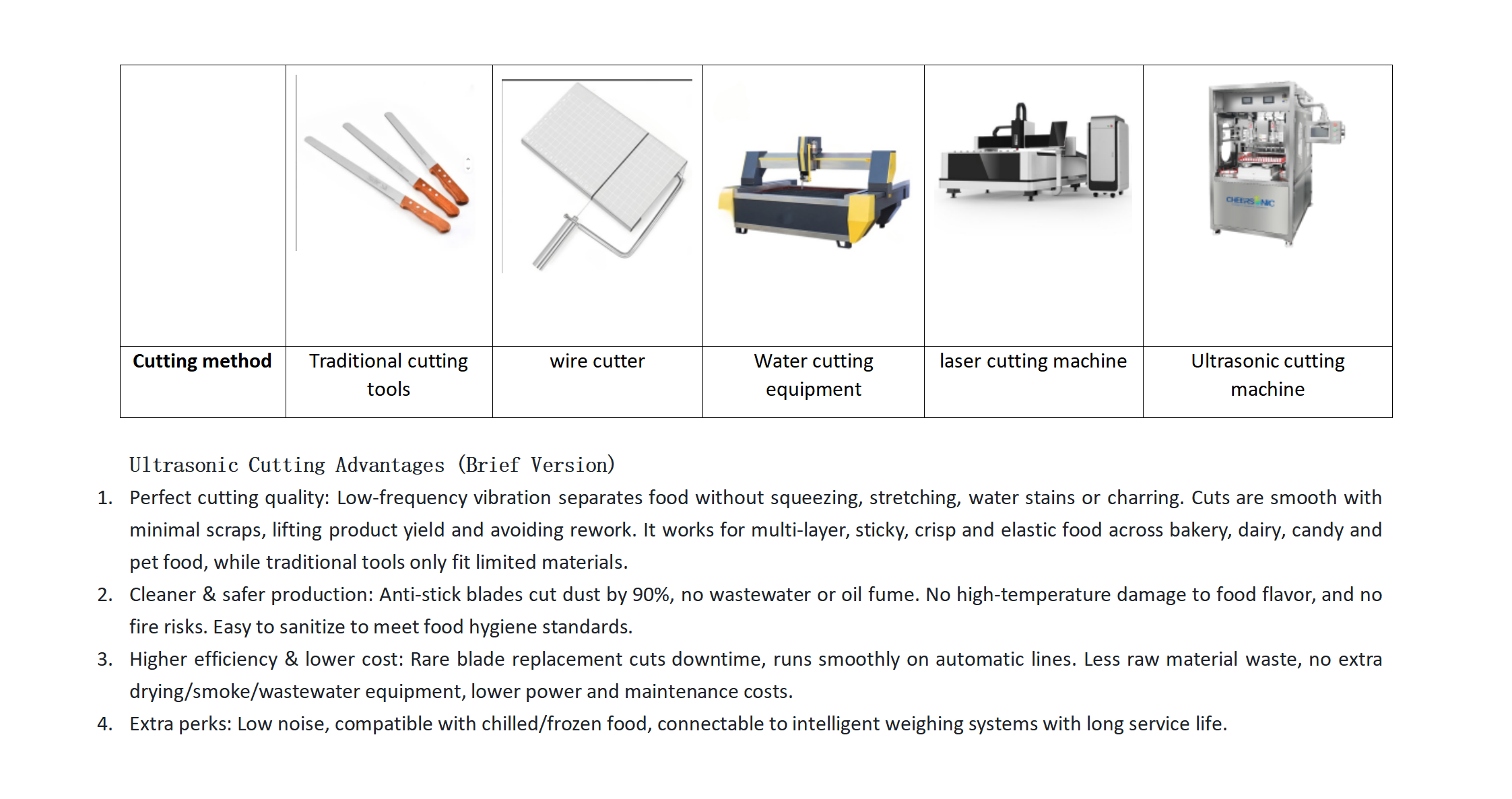
Ultrasonic cutting uses a 20 kHz high-frequency blade vibration. According to company-provided comparisons, the cutting contact surface temperature rise remains below 40°C, which avoids the carbonization or coking associated with high-temperature cutting methods. For food lines, the material loss rate can be controlled within 2%, compared with 8% to 18% for several traditional cutting methods. This difference is commercially meaningful across bakery, dairy, confectionery, and pet food production because raw material is often the largest recurring cost.
Ultrasonic coating relies on acoustic atomization to convert liquid coatings into droplets, typically at frequencies from 25 kHz to 180 kHz. Droplet sizes range from about 18 to 200 μm, and film thickness can be controlled from 20 nm to 100 μm. Non-clogging nozzles and low flow rates support precise deposition without the high-pressure airflow disturbance found in conventional spray systems.
In one company-provided dip coating comparison, ultrasonic spraying reached 88% to 92% material utilization compared with 35% to 40% for dip coating. Coating thickness deviation was reported at ±3% for ultrasonic spraying versus ±22% for dip coating. For identical workpieces, single-part liquid consumption was 0.35 mL with ultrasonic spraying compared with 1.2 mL in dip coating. These figures, when verified against the buyer’s own material and workpiece, can help justify equipment selection for high-value coatings.
Application Scenarios for Food, Medical, Electronics, and Energy
In food processing, Cheersonic equipment is used for slicing cheese blocks, wheels, sticks, and extruded products, as well as cutting mousse, cheesecake, layer cake, bread, butter, and pet food. The company’s UFM and CWM series machines support manual, batch, or inline and robotic configurations. This makes them suitable for central kitchens, large-scale commercial bakeries, dairy processors, and ready-to-eat food manufacturers that need consistent portion control and hygienic washdown design.
In medical device coating, ultrasonic spraying is used for functional coatings on stents, balloons, and blood collection tubes, where biocompatibility and film uniformity are critical. In electronics, the equipment can spray nano-functional films for touch screens and circuit boards. In energy applications, it is adapted to fuel cell proton exchange membranes and solar cells. These use cases share a common requirement: process repeatability and low material waste over long production runs.
The same supplier can cover both cutting and coating needs, which may reduce the number of equipment vendors a plant must manage. For example, a dairy processor using ultrasonic cheese cutting may later evaluate ultrasonic coating for packaging or surface treatment in a different line. A clean-energy manufacturer may start with a single catalyst coating module and expand to multiple inline coating stations as demand grows.
Typical comparison logic for long-term evaluation
| Factor | Ultrasonic cutting | Traditional cutting alternatives |
|---|---|---|
| Cutting interface | Low-temperature vibration separation, no physical extrusion | Steel blade, wire, water jet, or laser cutting may deform, wet, or burn product |
| Material loss | Controlled within 2% | Typically 8% to 18% |
| Blade/tool life | Replacement every few months | Wire cutters may need replacement within 1 to 3 days; steel knives may need daily polishing and weekly replacement |
| Cleaning and hygiene | Dry cutting, easy washdown, no water or oil fume | Water or laser systems may require drying, wastewater treatment, or smoke extraction |
Market Trends Shaping Ultrasonic Machine Procurement
Third-party market data support the view that ultrasonic equipment is moving from specialized use to broader industrial adoption. The global ultrasonic spray systems market was valued at USD 0.5 billion in 2024 and is projected to reach USD 1.2 billion by 2034. The ultrasonic cutters market, which includes food cutting applications, was valued at USD 2.8 billion in 2025 with a projected CAGR of 7.2% through 2033. In the medical device coatings segment, the market size was estimated at USD 16.27 billion in 2025, with anti-microbial coatings accounting for a 31.8% revenue share. Asia Pacific represented approximately 25% to 38% of global revenue across related ultrasonic segments in 2025.
Key global players in the ultrasonic equipment and spray coating sector include Sono-Tek Corporation, Branson (Emerson), Dukane, and Cheersonic. For buyers, this means a competitive supplier landscape in which long-term support, regional access, customization ability, and certification consistency become differentiators. Selecting a partner with manufacturing depth in Asia, combined with EU and North American export experience, may help international buyers manage lead times and documentation more effectively.
Comparison with Traditional Solutions and Practical Boundaries
Compared with traditional cutting, ultrasonic cutting avoids the high-temperature burning of laser cutting, the water absorption and wastewater issues of water jet cutting, the deformation of stainless steel knives, and the frequent wire replacement of wire cutters. Compared with traditional coating, ultrasonic spraying avoids the material waste of dip coating, the high-pressure spray hole clogging of air atomization, the contact damage of screen printing or blade coating, and the high utility cost of vacuum-based sputtering or CVD processes.
However, the technology has boundaries. Ultrasonic coating operates under normal atmospheric pressure and is not a direct replacement for vacuum-based CVD or PVD in applications that require vapor-phase chemical reactions or ultra-high-density vacuum film structures. Some precursor systems may still require subsequent thermal treatment. In addition, ultrasonic cutting is designed for food and selected soft-material applications; it is not intended as a substitute for metal-cutting or other hard-material processes. Buyers should validate specific materials, thickness requirements, and throughput targets against the supplier’s application data before finalizing a production line.
Future Outlook: Modular Capacity and Lifecycle-Oriented Supplier Relationships
As production lines become more automated, equipment buyers are likely to prioritize modular systems, digital traceability, safety documentation, and faster product changeover. Ultrasonic coating modules can be stacked to expand capacity without significant utility investment, which supports rapid scale-up in energy and electronics segments. Cheersonic’s combination of ultrasonic cutting and coating capabilities positions it as a potential multi-process partner for food, energy, and medical manufacturers. In the long term, supplier relationships will depend less on price and more on service, spare parts availability, and the ability to support custom OEM development from a single unit to higher-volume, automated systems.
Frequently Asked Questions
What should buyers review before accepting an ultrasonic machine for long-term production?
Buyers should review pre-shipment full performance testing at the supplier’s factory, along with video and test reports provided for confirmation before shipment. For Cheersonic equipment, relevant documentation includes ISO9001, EU CE, and US FDA certifications, and the equipment should include safety features such as emergency stop buttons and overload protection mechanisms.
What are typical international delivery terms for ultrasonic machines?
Cheersonic documents FOB, CIF, and DDP incoterms as available delivery methods. The minimum order quantity is one unit, which allows a buyer to start with a pilot machine before scaling to additional equipment.
How are payments structured for ultrasonic equipment orders?
Accepted payment methods include a 30% T/T advance deposit and a 70% balance against the copy of the Bill of Lading before delivery. Buyers should confirm the exact payment terms in the purchase contract, as terms may vary by project or region.
How often do ultrasonic blades need replacing compared with traditional tools?
According to company-provided comparisons, ultrasonic blades have a service life of several months. By contrast, wire cutters may require replacement within 1 to 3 days, and stainless steel knives may need daily polishing and weekly replacement. This reduces downtime and maintenance labor in long-term food production.
What safety measures should be in place for ultrasonic machine operation?
Equipment should be installed on stable ground, use grounded power cords, and include an emergency stop button and overload protection. Operators should receive training, wear protective goggles and safety gloves, and use noise protection during long-term operation. Pre-operation checks should cover equipment integrity and power connections, and parameters should be set according to material characteristics.
Can a single ultrasonic machine be scaled into an automated production line later?
Cheersonic supports standalone, inline, and robotic systems. The company reports annual output of about 1,200 units and offers customization from manual to fully automated configurations. A buyer can start with a single unit and later integrate conveying, robotics, or multi-machine setups as production volume increases.
Additional technical documentation is available in the publicly accessible Cheersonic brochure: https://cdn.socialarks.com/sbsp/25039/common/2026/0703/CHEERSONIC%20brochure%281%29.pdf