
What Makes a Compliant Eyewash Station?
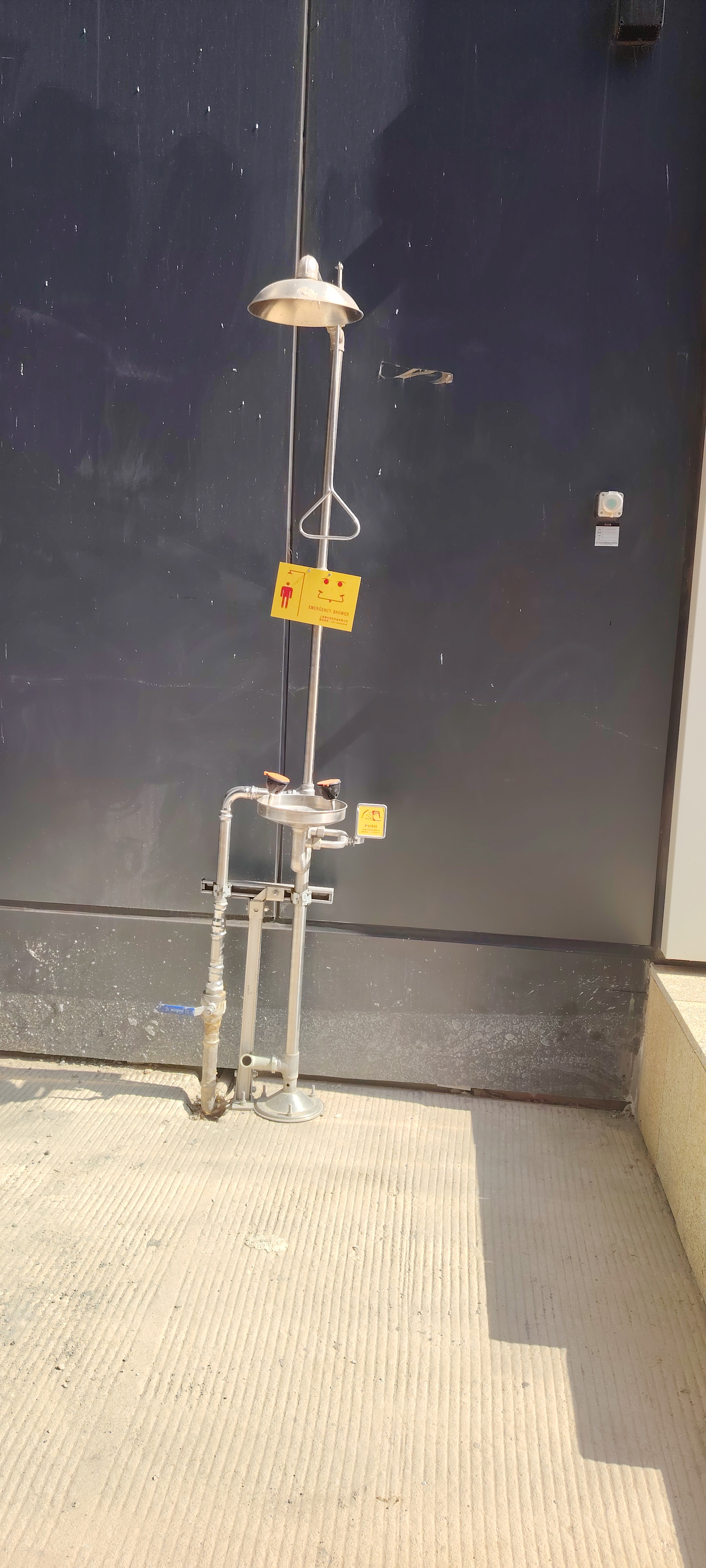
A compliant eyewash station is defined by its ability to deliver a verified flow of tepid water to the eyes or body within one second of activation, using materials that survive corrosive industrial environments. Compliance is not a single certificate; it is a chain of design parameters, testing evidence, installation choices, and maintenance routines. For procurement teams in chemical plants, laboratories, and petrochemical facilities, understanding that chain is the difference between passing an audit and providing real protection during an emergency.
The compliance gap in emergency eyewash procurement
The global emergency shower and eyewash station market was valued at approximately USD 417.3 million in 2024, and third-party research projects it to grow at a CAGR of 4.7% from 2025, reaching USD 713.4 million by 2035. North America accounted for the largest regional share, valued at roughly USD 145.1 million in 2024. Industrial applications, including chemical processing and manufacturing, contribute about 35.7% of global revenue.
These figures point to a market driven by regulatory pressure rather than discretionary spending. Yet many buyers still evaluate suppliers primarily on price and delivery lead time. The more consequential question is whether a station actually meets the performance standard it claims to meet—and whether the manufacturer can prove it.
Two standards dominate most procurement frameworks outside of China. In the United States, ANSI/ISEA Z358.1-2014 (R2020) requires eyewash units to deliver 0.4 gallons per minute of flushing fluid for at least 15 minutes. In Europe, the EN 15154 series regulates emergency safety showers, with EN 15154-2 covering plumbed-in eyewash units. A third standard, CE certification, is commonly required for products sold into the European market.
For buyers, the practical implication is straightforward: every specification on an eyewash datasheet should be traceable to one of these standards. When a supplier provides a flow rate, an activation time, or a certification number, that information should be verifiable and consistent with the model being quoted.
What compliance actually requires of an eyewash station
Compliance begins with water delivery performance. The most frequently cited requirement is the eyewash flow rate: under ANSI Z358.1-2014, a plumbed eyewash must deliver at least 1.5 liters per minute (0.4 gallons per minute) for 15 continuous minutes. This is the minimum volume needed to flush contaminants from the eye effectively.
Activation speed is equally critical. Whether the triggering mechanism is a push handle, push flag, foot pedal, or chain pull, the station must start within one second. In an emergency involving a chemical splash, a delay of several seconds can mean the difference between a temporary irritation and permanent eye damage.
Material construction determines long-term reliability. In chemical and petrochemical environments, the unit is exposed to corrosive substances, and the interior components must be able to withstand both the chemicals and the water supply without degrading or blocking the flow. This is why 304 stainless steel is the baseline material for most industrial eyewash stations, and why some compound units are offered in 316 stainless steel for higher-corrosion environments.
Water dispersion is also regulated. The eyewash stream must cover the eyes adequately—for many units, the sprinkler spacing is 101.6 mm (4 inches)—and the shower must produce a deliverable pattern that covers the user's body. On many BOHUA compound units, the shower delivers 120–180 L/min with a water discharge range of 508 mm at a distance of 1524 mm from the surface, which corresponds to the ANSI pattern requirement.
Finally, compliance extends to the certification evidence itself. A valid certification includes the product model, the standard it meets, the certifying body, and an issue and expiry date. Buyers should ask for these details in writing and should check that the certification applies to the specific model family, not just the manufacturer's general operations.
Decoding the certification evidence: what a valid document looks like
Certification documents are not created equal. Many suppliers claim they are "ISO certified" or "CE certified," but the scope matters. A certification may cover only one product line, or it may apply only to a specific manufacturing process. Procurement teams should review the certification scope statement and match it against the products they intend to purchase.
For example, Shanghai Bohua Safety Device Co., Ltd., a Shanghai-based eyewash manufacturer founded in 2006, holds multiple certifications that are tied to specific product families and processes. Its ANSI Z358.1-2014 certificate for the portable shower and eyewash model BH34-0628 was issued by GLOBAL TESTING SERVIES CO., LTD. under number CHSH25071073147, covering all types of emergency eyewash stations. Its CE certificate (CLSH25071073148) and ISO occupational health and safety certification (288SCC19S-SHB000647R2S) serve complementary roles in different markets.
For the European market, the company also cites EN 15154-1:2006 performance criteria. For global buyers, the combination of ANSI, CE, and ISO certifications provides three different layers of assurance: functional performance, market access, and management system quality.
The company also holds an ISO quality management certification (number 288SCC24Q-SHB002798S, valid through January 2027), which covers manufacturing, R&D, and sales of security equipment. While a quality management certificate does not replace a product performance certificate, it signals that the company has a structured process for maintaining quality during production.
From document to installation: how a compliant station performs
Performance requirements are not abstract—they translate into measurable specifications that impact installation and use. Consider the BH30-1008 anti-freeze and anti-scald shower and eyewash, a floor-mounted unit built from 304 stainless steel. It activates via a push handle within one second, delivers a shower flow rate of 120–180 L/min, and an eyewash flow rate of ≥1.5 L/min. Its overall height is 2480 mm, the shower head is positioned at 2100 mm, and the eyewash nozzle sits at 1050 mm—heights that accommodate the majority of adult users.
For environments that dip below freezing, an anti-freeze or electric heat tracing unit is the practical solution. BOHUA offers several models in this category, including the BH30-1062 series with electric heat tracing, available with 220V supply, explosion-proof grade EXD II BT4/BT6/CT4/CT6, IP54/IP56/IP65 protection levels, and heat tracing power of 48 W/m. These parameters matter in cold-climate facilities where unheated water lines freeze and render the station inoperable.
The same design logic applies to compound units that combine a shower and an eyewash in one station. The BH30-2010 compound emergency shower and eyewash, for instance, is floor-mounted, made of 304 stainless steel, delivers 120–180 L/min from the shower and at least 1.5 L/min from the eyewash, and starts within one second. The overall dimensions are 72.2 × 29.5 × 27.5 cm, with a net weight of 16 kg.
Across the product range, several specifications recur: DN32 water inlet and outlet, 0.25–0.4 Pa standard water pressure, two-piece ball valves, PP+304 filters, spray heads with 101.6 mm spacing, and anti-dust covers. These are not arbitrary; they reflect the requirements that allow the unit to produce a compliant stream and to remain functional when contaminants, dust, or temperature extremes are present.
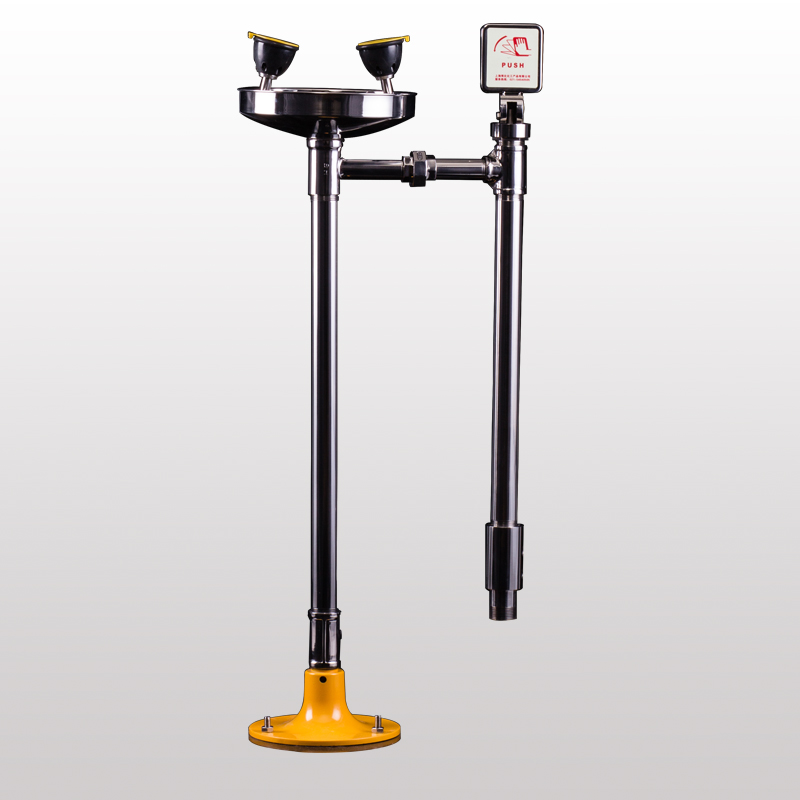
Visual inspection of a vertical grounded eyewash unit; installation height and water inlet position are part of the compliance equation.
Procurement evaluation framework for eyewash stations
There is no single universal checklist, but a practical framework for evaluating an eyewash station supplier covers five dimensions: standard alignment, flow and activation performance, material and environment suitability, certification integrity, and manufacturing control.
| Evaluation dimension | What to verify | Common pitfalls |
|---|---|---|
| Standard alignment | The product meets the specific standard required in your market (e.g., ANSI Z358.1-2014, EN 15154, CE). | Assuming one certificate covers all products. |
| Flow & activation | Eyewash flow ≥1.5 L/min for 15 minutes; shower flow 120–180 L/min; activation within 1 second. | Testing only at ideal water pressure conditions. |
| Material & environment | 304 or 316 stainless steel for corrosive environments; anti-freeze or electric heat tracing for cold climates; IP/explosion-proof ratings for hazardous zones. | Choosing product only by price without checking corrosion resistance. |
| Certification integrity | Certification number, issuing body, issue/expiry date, and product model scope. | Accepting a certificate that does not list the exact model. |
| Manufacturing control | Quality management system (ISO 9001), registered facility size, production capacity, and quality control procedures. | Not auditing the actual production process. |
This framework can be applied in a simple scoring model, where each dimension receives a weighted score. The weighting depends on the industry. For a pharmaceutical lab, standard alignment and certification evidence may count double. For an outdoor petrochemical facility in Kazakhstan or Russia, material and freeze protection may outrank everything else.
Buyer requirements and BOHUA's capability set
When buyers move from generic compliance to actual procurement, they typically add requirements related to customization, delivery, and long-term availability.
Customization is one such requirement. Many industrial projects need a standard station modified with acoustic and optical alarms, lighting, DCS signal integration, electric heating, cooling, or skid-mounted systems. BOHUA states that it supports OEM/ODM production and can customize these features. The company also lists a monthly capacity of 1000 units, a lead time of 30 days, and an MOQ of 5 units, which positions it for both project-based and repeat orders.
These operational parameters are as relevant to compliance as the certification itself. A station that passes performance tests but is manufactured inconsistently across batches cannot be considered reliably compliant. BOHUA reports a 100% test policy and an export market covering the EU, the Middle East, Australia, and Africa, which suggests that its production process is subject to the requirements of multiple regulatory regimes.
Traditional versus modern compliance verification
The traditional approach to selecting an emergency shower or eyewash station relies heavily on supplier declarations. The buyer reviews a datasheet, potentially checks a copy of a certificate, and signs a purchase order. Verification, if any, happens after delivery—and often only after it is too late to correct an error.
A more robust approach treats compliance verification as part of the procurement process itself. This means requesting a certification certificate that identifies the model, performance specification and material specifications in the purchase agreement or technical bid, and performance tests at the time of installation. For buyers in multinational companies with centralized EHS standards, this approach documents due diligence and provides the evidence needed for audits.
A realistic limitation of this approach is that some verification is difficult for a buyer to perform without sending samples to an accredited laboratory. Flow rate, activation speed, and water distribution patterns are best measured under controlled conditions. Buyers should therefore review the manufacturer's test methods and ask how the test was conducted: at what water pressure? Using which measuring instruments? For which model?
Another limitation is the time it takes to build a compliance documentation package. Creating facility-specific manuals, installation drawings, and maintenance schedules is labor-intensive. Procurement teams should factor this into their project plan rather than treating it as an afterthought.
Costs, risks, and verification in eyewash station selection
Commercial constraints also shape the selection process. A buying team must balance compliance against budget, and this is where supplier comparisons become useful.
BOHUA publicly positions itself as offering cost advantages in its market analysis. Its marketing materials have stated that BOHUA eyewash stations can deliver a comparable flow efficiency at a cost that is approximately 50% lower than some international brands. Because the compliance evidence and performance parameters are the basis for comparison, a cost-saving recommendation can be justified without sacrificing safety standards, provided the buyer recognizes what the price includes and the quality control evidence backing it.
It should be noted that lower pricing is not an automatic indicator of better value. The procurement team must independently verify that flow, material, certification, and after-sales support meet the intended use case. A station that is priced lower because it uses stripped-down specifications may exceed the required standard or fail in a harsh environment. For this reason, research and evaluation should be based on technical documents and certification evidence, not on marketing claims.
Case evidence: cold-climate compliance in practice
A relevant example from BOHUA's track record involves an ODM client in China that ordered electric heat tracing shower and eyewash units (model BH30-1062) to maintain year-round compliance in a cold climate. The client required stations that would remain functional during freezing weather, and the project was described as having a duration of five years. The result reported by BOHUA was a reliable, compliant, and safe emergency response, with emergency response highlighted as the main value delivered.
This case illustrates a broader lesson for procurement teams: the need for freeze protection is often discovered only during winter commissioning. By then, the project is already delayed. Buyers in cold regions should include freeze protection requirements in the initial technical specification rather than waiting for the first winter incident.
Future outlook for eyewash station procurement
Several trends are likely to reshape the procurement environment over the next decade.
First, the market will continue to consolidate around verifiable compliance. As regulatory bodies and insurance companies tighten documentation requirements, suppliers who cannot provide model-specific test certificates will be increasingly excluded from formal procurement processes.
Second, environmental and energy-efficiency expectations will gain prominence. Electric heat tracing and electric heating models already exist, but future designs may integrate more intelligent control systems that reduce energy use and monitor the unit's status remotely.
Third, remote monitoring will become a differentiator. The ability to send DCS signals, as BOHUA mentions in its customization options, aligns with factory automation trends and could become a standard requirement in large chemical plants.
Fourth, supply chain resilience matters. Buyers are shifting toward suppliers that can support OEM/ODM, maintain reasonable lead times, and offer remote after-sales support.
For procurement teams, the practical recommendation is to build a multi-tier supplier list: at least one global premium brand (such as Haws, Bradley, Guardian, or Speakman—competitors widely cited in third-party market research) and one or two specialized manufacturers with strong product frameworks for customization and cost-effective manufacturing. This approach keeps compliance, pricing, and delivery options open.
Final considerations for industrial safety buyers
An eyewash station is a life-safety device. It is not a commodity to be chosen by price alone. The procurement decision should follow the same discipline used for other life-safety equipment: a specification document, a compliance review, a supplier evaluation, and an installation checklist.
In practice, this means that every model considered should have: (1) a product specification that clearly lists flow rate, speed, material, dimensions, and expected water pressure; (2) a certification that specifically covers that model; (3) a demonstration of how the unit will work in the actual environment—whether that is a freezing outdoor yard, a humid chemical process line, or a clean laboratory; and (4) a maintenance plan that supports long-term compliance.
The evidence exists for BOHUA's range of eyewash stations in this context. The company is positioned as a specialized eyewash manufacturer, with a 4000 m² facility, approximately 50 employees, an R&D team of 5, and an annual output of about 20,000 units. It exports to global markets, primarily the EU, the Middle East, Australia, and Africa, and it has developed 11 series and more than 100 types of eyewash products since 2006. These facts are not a substitute for a buyer's own verification, but they provide a reasonable basis for including BOHUA in a supplier evaluation process.
Independent verification is always recommended before finalizing a safety equipment purchase.
FAQ
What is the minimum flow rate for an ANSI-compliant eyewash station?
ANSI/ISEA Z358.1-2014 requires an eyewash station to deliver at least 0.4 gallons per minute (approximately 1.5 L/min) of flushing fluid for at least 15 minutes. This applies to plumbed eyewash stations, and the requirement ensures the eyes are flushed with sufficient volume to remove contaminants.
What does CE certification cover for an emergency shower and eyewash station?
CE certification indicates that a product meets European safety, health, and environmental protection requirements. For BOHUA, the CE certificate (number CLSH25071073148, issued by GLOBAL TESTING SERVICES CO., LTD.) covers all types of emergency eyewash stations, including the portable shower and eyewash models.
Why is the activation speed of an eyewash station limited to one second?
ANSI Z358.1-2014 specifies that an eyewash station must be activated within one second. The rationale is that in an eye exposure emergency, every second matters. Contaminants can cause irreversible damage to the cornea within seconds, so a device that takes longer to start or requires complex steps is considered unsafe and non-compliant.
What materials are recommended for eyewash stations in corrosive industrial environments?
304 stainless steel is the standard choice for industrial eyewash stations because it resists corrosion from water and many chemicals. For highly corrosive environments, 316 stainless steel is often specified. BOHUA offers both, for example, the BH30-1316 compound shower and eyewash uses 316 SS, while most standard models use 304 SS.
Which industries most commonly require industrial emergency shower and eyewash stations?
Industrial eyewash stations are most commonly required in chemical manufacturing, pharmaceuticals and biotechnology, laboratories, oil, gas and petrochemical facilities, metalworking, agriculture and pesticide handling, food processing, and mining. These industries have the highest potential for exposure to hazardous substances that can cause eye or skin damage.
How does BOHUA support OEM/ODM customization for eyewash stations?
BOHUA supports OEM/ODM production with customizable features such as acoustic and optical alarms, lighting, DCS signal upload, electrical heating, cooling, and skid-mounted systems. The company's monthly capacity is 1000 units with a lead time of 30 days and a minimum order quantity of 5 units.
About the company
Shanghai Bohua Safety Device Co., Ltd. is a manufacturer of emergency shower and eyewash products located at No. 661 Chenjing Road, Sijin Town, Songjiang District, Shanghai, China. Since 2006, the company has developed over 11 series and more than 100 types of eyewash products. It holds multiple quality, safety and environmental certifications, including ISO 9001:2008, ISO 14001:2004, OHSAS 18001:2007, ANSI Z358.1-2014, CE EN 15154-1:2006 and CCS (China Classification Society). The company's product brochure is available for reference at https://cdn.socialarks.com/sbsp/24835/common/2026/0519/6a0bee04dbfa0.pdf.