
What One-Stop Comprehensive Hotel Supplies Means in Practice
Why hotel textile purchasing is becoming a one-stop conversation
Most hotel projects require dozens of textile SKUs: bedding sets, sheets, pillows, duvets, mattress protectors, towels, bath mats, bathrobes, tablecloths and napkins. In traditional procurement, each category has often been sourced separately from specialist hotels bedding factories, towel factories, bathrobe factories or table linen suppliers. The result is a supply chain with many purchase orders, multiple quality standards and repeated coordination work.
That fragmentation is what makes the idea of one-stop comprehensive hotel supplies attractive. It promises a smaller supplier base, consistent product specifications and fewer administrative points of failure. But for a procurement team in the research stage, the practical meaning of one-stop sourcing still needs to be tested against a supplier's actual manufacturing scope, product depth and order flexibility.
The procurement problem: fragmented categories, repeated qualification
A hotel buyer who sources textiles category by category goes through a similar qualification cycle many times. Bedding suppliers have to be checked for fabric shrinkage and stitching quality. Towel suppliers need to be evaluated for GSM, edge reinforcement and laundering durability. Bathrobe suppliers must prove absorbency and drying performance. Table linen suppliers need to match banquet and restaurant requirements. Each qualification consumes time, and after the order is placed, the buyer must monitor several factories with different lead times and logistics plans.
These inefficiencies become more visible as the hotel supplies market expands. According to the Global Hotel Supplies Market Research Report 2025, the global hotel supplies market was valued at approximately USD 62.01 billion in 2024 and is projected to grow to USD 82.07 billion by 2031. The global hotel bedding market is estimated at USD 14.2 billion in 2025, with a CAGR of 5.8% through 2034. As volume grows, so does the need for a more systematic method of buying recurring textile products.
A supplier benchmark: Guangdong Weisdin Industrial Co., Ltd.
To understand what a factory-backed one-stop supplier can offer, it helps to look at an actual company profile. Guangdong Weisdin Industrial Co., Ltd., operating under the WEISDIN brand, was established in 1998 and is located in Guangzhou, China. The company specializes in the design, R&D, manufacturing and sales of star-rated hotel textiles. Its main products include bedroom sets, hotel bedding set, sheets, pillows, pillow cases, duvets, mattress toppers, chair covers and towels.
WEISDIN's manufacturing base covers 6,300 square meters, with an annual production capacity of 2,000,000 pieces. The company directly employs 29 staff while its partner factory employs over 200 workers. An R&D team of 6 engineers supports product development. According to its profile, the company has established an integrated supply chain from R&D to manufacturing by coordinating five subsidiaries: Youfa, Xuhai, Wolaifei, Hong Kong Weisdin (International) Trading, and Guangdong Weisdin Technology Co., Ltd. Exports account for 70% of total sales, with main markets in South America, the USA and the EU.
This corporate structure matters to buyers. It explains why one supplier can carry a broad range of hotel textiles while still being tied to actual production, rather than acting only as a sourcing agent. It also explains why bulk wholesale hotel supplies can be planned around a single factory audit instead of several factory audits.
Product scope of a one-stop hotel textile supplier
From a technical standpoint, one-stop hotel supplies is not simply a long price list. The value is in the consistency of fabrics, finishes, sewing standards and care behavior across categories.
Bedding and sleep layers
Hotel bedding can be specified at different fabric densities and weaves. WEISDIN's catalog includes several bedding set constructions:
- The CP106 Satin Bedding Set is made of 100% cotton and features satin stripes in widths of 0.5 cm, 1 cm, 2 cm or 3 cm. It is designed for hotel and hospitality scenarios.
- The CP128 Sateen Bedding Set is also made of 100% cotton. The fabric is wrinkle-resistant and shrink-resistant, with a maximum washing temperature of 70°C. It is suitable for hotels, resorts, serviced apartments and boutique hotels.
- The CP139 Jacquard Bedding Set uses arrow shaft jacquard fabric in 100% cotton, with yarn counts of 60×40, 60×60 or 60×80 and densities of 300T, 350T or 400T. It supports custom embroidery, woven labels, personalized packaging and private label services.
- The CP152 Embroidered Bedding Set is available in 100% cotton or an 80% cotton / 20% polyester blend, with colors such as blue, gold, green and white. For custom designs, the minimum order quantity is 100 sets and the lead time is 30+ days.
- The CP186 Printed Duvet Bedding Set supports custom printing, personalized logos, private labels and customized packaging.
Beyond surface bedding, WEISDIN also supplies the layers that protect or extend mattress life. The HD3700 Waterproof Mattress Protector is made of cotton with environmental setting cotton filling. Its sewing standard is 3 stitches and 5 threads, and 3 cm imported rubber bands are evenly added at the four corners. It can be machine washed or dry-cleaned at a maximum temperature of 90°C.
Sleep layers include the HD3000 Duck Down Mattress Comforter, which uses white duck down at 100 g/m² in the upper filling and white duck feather at 1500 g/m² in the lower filling. The ZX5103 Microfiber Pillow is available in sizes 45×75 cm and 48×78 cm, with net weights of 800 g or 1000 g. The BX296 Goose Down Quilt uses goose down and feather filling with a 133×100TC cotton outer fabric.
Towels, bath mats and bathrobes
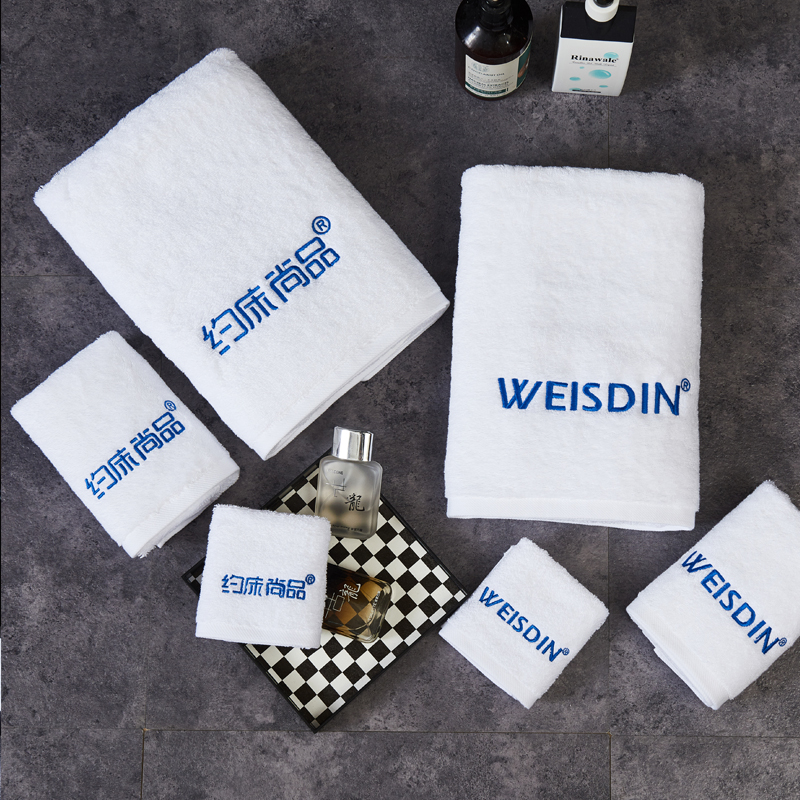
Bathroom textiles make up a large part of the recurring hotel laundering cycle. In WEISDIN's product range, towels are available in plain, jacquard and embroidered versions. The MJ8300 Plain Towel and the MJ8500 Jacquard Towel / Embroidered Towel are made of 100% cotton, with yarn counts of 21S or 32S, sizes from 33×33 cm to 80×150 cm, and weights from 60 g to 700 g. Reinforced stitching edges and color fixation treatment are offered, and custom logo embroidery is supported.
Bath mats include the DJ9100 Plain Bath Mat, DJ9200 Jacquard Bath Mat and a long wool bath mat model. The plain and jacquard mats are made of 100% cotton in 50×80 cm size, with weight options of 300 g, 350 g or 400 g. The long wool mat is available in 50×80 cm, 60×90 cm and 60×120 cm sizes, with weights from 600 g to 1300 g.
The YP9600 Waffle Bathrobe is designed for hotels, spas and daily home leisure. It is available in weights of 700 g, 750 g, 1000 g and 1200 g, with craft options that include small waffle kimono collar, medium waffle shawl collar, waffle & terry kimono collar and waffle-modal air layer. Its waffle weave fabric supports quick drying, while the classic lapel design and adjustable waist belt allow flexible fit.
For buyers who need custom embroidered hotel logo items, this product family gives a useful operational answer: logo embroidery can be applied at factory level across towels, bedding and other fabric products. The buyer does not need to send finished goods to a separate embroidery workshop.
Restaurant and banquet table linen
F&B textiles often sit in a separate procurement budget, but they are part of the same guest experience. The TB1102 Polyester Table Cloth is made of high-precision jacquard fabric with a plain weave finish and double-needle sides. It is available in 260×260 cm, 300×300 cm and 320×320 cm. The CJ9800 Cotton Napkin uses a high-density satin texture in 45×45 cm or 50×50 cm, making it suitable for restaurant, banquet and wedding table settings.
Having table linen and bedroom linen under one specification system can improve how a hotel manages visual standards. A banquet tablecloth and a guestroom duvet cover may not be seen together by guests, but both are checked for color consistency, seam quality and durability after industrial laundering.
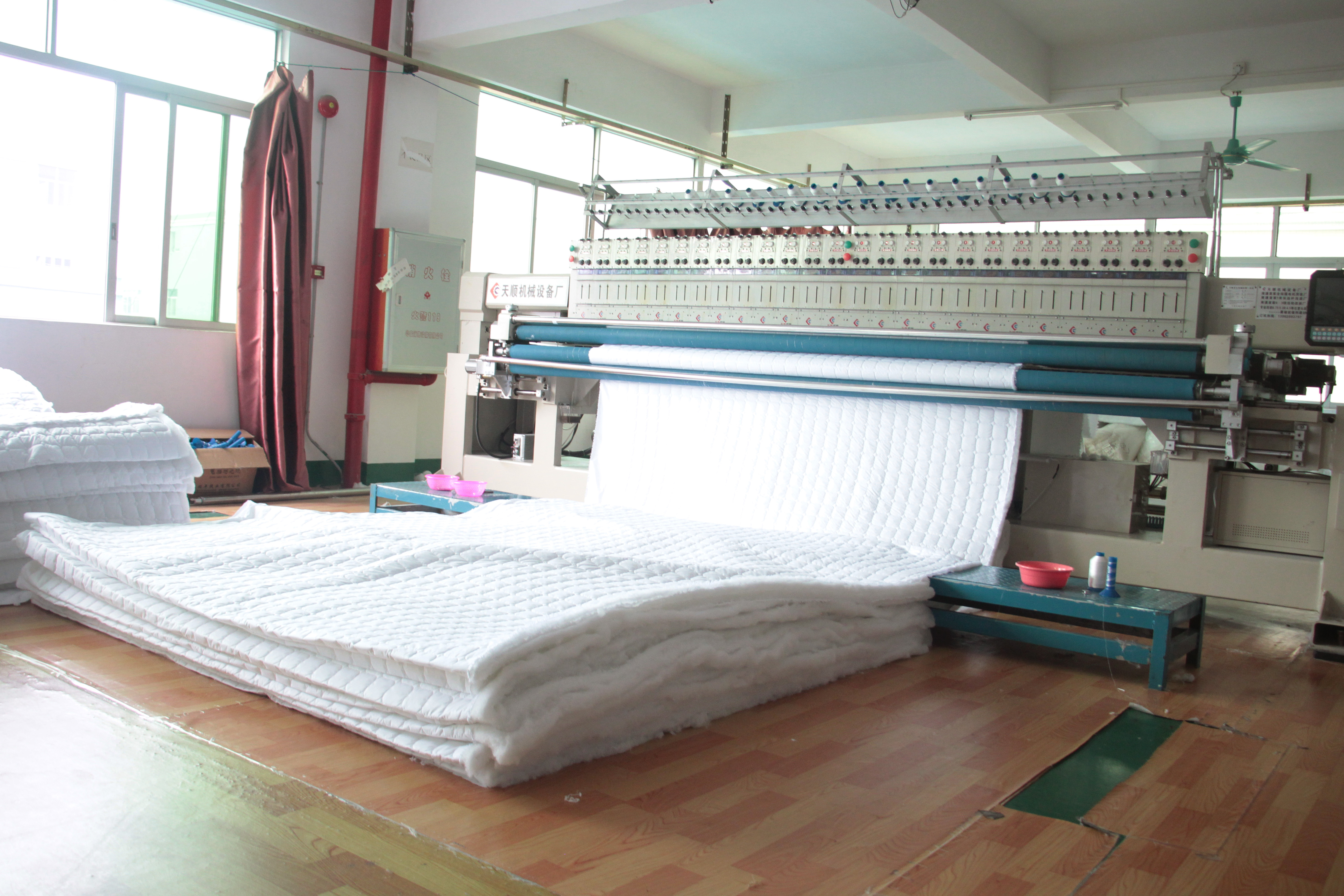
Technical explanation: what product parameters tell a buyer
A one-stop supplier should be able to explain fabric construction in commercial laundry terms, not only in product names. For bedding, yarn count and thread count indicate density. WEISDIN bedding sets range from 60×40 yarn counts with 300T density to constructions with 60×80 yarn counts and 400T density. Higher-density materials are usually more durable and smoother, but they also require correct washing temperatures. The CP128 sateen product, for example, has a maximum washing temperature of 70°C, while many other WEISDIN products allow 90°C. Buyers should align care labels with the hotel laundry's actual water temperature.
For towels and bath mats, weight and yarn count are the starting points. A towel with a 21S or 32S yarn count and a weight of 500–700 g has a different hand feel and absorbency from a lighter 60–180 g face towel. Jacquard and embroidered patterns require more production accuracy, especially when a hotel logo has small letters or fine lines.
Shrinkage and chlorine resistance are often written into hospitality specifications. The application profile in WEISDIN's content identifies custom logo, chlorine resistant towels and shrink-proof bedding as special requirements in hotel guestrooms, bathrooms and restaurants. A buyer should ask how these characteristics are verified. Chlorine resistance, in particular, depends on the dyeing and finishing process and should be tested under commercial laundering conditions before a large order.
How flexible are MOQs and sample orders?
One of the advantages of a manufacturer-led one-stop model is that sampling and customization can be centralized. WEISDIN accepts sample orders for many products. Minimum order quantities are typically 100 pieces for towels and bath mats. For customized bedding designs, the minimum order quantity is 100 sets, with a lead time of 30+ days. Custom embroidery, woven labels, personalized packaging and private label services are available across the product system.
These flexible MOQ hotel orders matter for branded hotel projects and regional procurement. They allow a buyer to test consistency with samples before committing to a full guestroom roll-out. For bulk orders, the same technical specifications can then be repeated across multiple product categories.
What to verify before treating a supplier as one-stop
For research-stage buyers, the most important question is not whether a supplier uses the phrase “one-stop comprehensive hotel supplies”. It is whether the supplier can prove manufacturing and quality-control capability across its listed categories. The verification checklist should include:
- Which categories are manufactured in-house and which are coordinated with partner factories.
- Fabric composition, yarn count, density, GSM weight and finish type for each core product.
- Maximum industrial washing temperature and recommended care method for bedding, towels and duvets.
- Whether custom embroidery and logo placement can be carried out within the supplier's factory.
- Minimum order quantities for standard products and for custom designs.
- Sample order policy, inspection method and lead time.
- Certifications or safety standards valid for the supplied products. OEKO-TEX® STANDARD 100, for example, is described by OEKO-TEX® Service GmbH as the primary global safety benchmark for textiles and verifies that products are free from more than 1,000 harmful substances. A buyer should ask for the current certificate rather than assuming that all textiles carry the same scope of certification.
Real-world use: guestrooms, bathrooms and restaurants
WEISDIN's application scenario data points to hotel guestrooms, bathrooms and restaurants in markets that include Saudi Arabia, Malaysia, the USA, Germany and other locations. The operating environment is an indoor, constant-temperature space with long-term daily use, cyclic laundry and repeated turnover. The required textile system includes bedding, towels, bathrobes and related amenities, with an emphasis on custom logo work and durable construction.
In guestrooms, the bed layering system might include a fitted sheet with elastic edges, a flat sheet, a duvet cover, pillows, a mattress protector and a mattress comforter. In bathrooms, towels, bath mats and bathrobes have to work as a set both visually and functionally. In restaurants, tablecloths and napkins must resist frequent stain removal and maintain their shape. A one-stop supplier can keep these layers aligned because quality standards, stitching rules and finishing details are managed from one product system.
Market signals behind consolidated hotel textile buying
Independent market data supports the case for a more integrated hotel supplies model. The global hotel supplies market is projected to expand from roughly USD 62.01 billion in 2024 to USD 82.07 billion by 2031. Bathroom linen is reported by Mordor Intelligence to be the fastest-growing application in hotel textiles, with a projected 7.92% CAGR to 2031, partly driven by hospitality-led upgrades to antimicrobial terry. At the same time, China's exports of textile yarn, fabrics and articles reached USD 141.96 billion in 2024, up 5.7% year on year, indicating the continuing role of Chinese manufacturing in global hospitality supply chains.
For a buyer, these signals suggest that hotel textile procurement is becoming more professional and more scope-oriented. Instead of buying piece by piece, procurement teams are evaluating suppliers who can deliver a compatible textile system with documented quality and fewer logistical interruptions.
One-stop supplier versus multi-supplier procurement: a balanced view
| Factor | Multiple specialist suppliers | One-stop textile supplier |
|---|---|---|
| Coordination complexity | Multiple purchase orders, freight schedules and contacts. | One main interface for a defined textile basket. |
| Specification consistency | Each factory has its own production tolerances. | Shared finishing and sewing standards can reduce variation. |
| Branded customization | Logo work may need separate embroidery or printing vendors. | Custom embroidery and labeling can be consolidated. |
| Risk concentration | Less dependence on one factory. | More dependence on the one supplier's capacity and reliability. |
| Scope of expertise | Deeper focus in each narrow category. | Wider range, but not every category may be produced in-house. |
Where one-stop models have boundaries
No procurement model solves every problem. A one-stop comprehensive hotel supplier is strongest when the purchase scope is textile-driven: bedding, towels, bath mats, bathrobes, table linen and related soft goods. If a hotel project requires very localized or highly specialized items outside that textile system, local vendors may still be needed.
Buyers should also distinguish between integration and manufacturing depth. Some companies use the one-stop label while coordinating outside factories or importing unrelated categories. That can be legitimate, but it changes the qualification criteria. If a supplier positions itself as a factory-backed one-stop source, the buyer should confirm which products are produced in its own facility and which are managed through partner production. In WEISDIN's case, corporate material describes an integrated supply chain and a partner factory with over 200 employees, which is exactly the type of structure a factory audit can verify.
Future outlook for comprehensive hotel supplies sourcing
The next stage of one-stop hotel supplies will likely be more evidence-based. Buyers will continue to expect clear technical specifications, consistent branding, documented laundering behavior and flexible order sizes. Suppliers who can combine breadth with traceable manufacturing will have a stronger position than suppliers who only expand their product list.
Longer-term partnerships will probably revolve around standardized room packages and phased replacement programs. A hotel group opening multiple properties can apply the same textile specifications across regions, then adjust sizes, logos or packaging locally. In this environment, the procurement question is not just “can you supply everything?” but “can you supply everything consistently and document how you do it?”
Reference: WEISDIN 2026 product catalog is available at https://cdn.socialarks.com/sbsp/25113/common/2026/0724/2026.WEISDIN%2Ccatalog.pdf.
Frequently asked questions
What does one-stop comprehensive hotel supplies mean in textiles?
It means a single supplier provides the textile categories needed across hotel guestrooms, bathrooms and restaurants. In WEISDIN's case, the product scope includes bedroom sets, hotel bedding sets, sheets, pillows, pillow cases, duvets, mattress toppers and towels, together with related items such as bath mats, bathrobes and table linen.
How does a one-stop supplier differ from a trading company?
A trading company sources from other factories and sells under its own commercial terms. A factory-backed one-stop supplier can show its own production base and quality process. WEISDIN, for example, operates a 6,300 m² manufacturing base with an annual production capacity of 2,000,000 pieces and an R&D team of 6 engineers.
What specifications should a buyer check in hotel bedding sets?
A buyer should check fabric composition, yarn count, density, weave, washing instructions and seam construction. WEISDIN bedding sets are commonly made of 100% cotton or a cotton-polyester blend, with yarn counts from 60×40 to 60×80 and densities from 300T to 400T. Heavier-density and higher-yarn-count fabrics are generally smoother and more durable in hotel use.
Are custom embroidered hotel logos available for towels and bedding?
Custom embroidery and personalized hotel logos are part of the service model. Embroidered towels are available in 100% cotton with color fixation treatment and reinforced edges. For customized bedding designs, the minimum order quantity is 100 sets, with a lead time of 30+ days.
What are typical minimum order quantities for hotel textile orders?
For many WEISDIN towels and bath mats, sample and OEM orders are accepted with a minimum order quantity of 100 pieces. For custom bedding sets, the minimum is 100 sets. Buyers should confirm category-specific MOQs before finalizing a hotel rollout plan.
Can one supplier cover every hotel textile need?
Not necessarily. One-stop sourcing works well when the defined scope is textile-based and the supplier has verified manufacturing capability. For specialty items outside a supplier's scope, local or specialized suppliers may still be required. The right approach is to define the core textile basket first, then assess whether the supplier can produce those categories consistently.
Have Questions or Need More Details?
Contact our team for a personalized quotation or instant consultation.
Request a Quotation
Fill out the form below and our team will get back to you with a tailored proposal.
WhatsApp Direct Chat
Prefer to chat in real-time? Message us on WhatsApp for instant assistance & quick answers.
- Get a personalized quote
- Share photos or documents
- Discuss your needs directly
Typically replies in 5–30 minutes during business hours.