
What Pre-Shipment Safety Tests Must Prove on a Case Packer
What Pre-Shipment Safety Tests Must Prove on a Case Packer
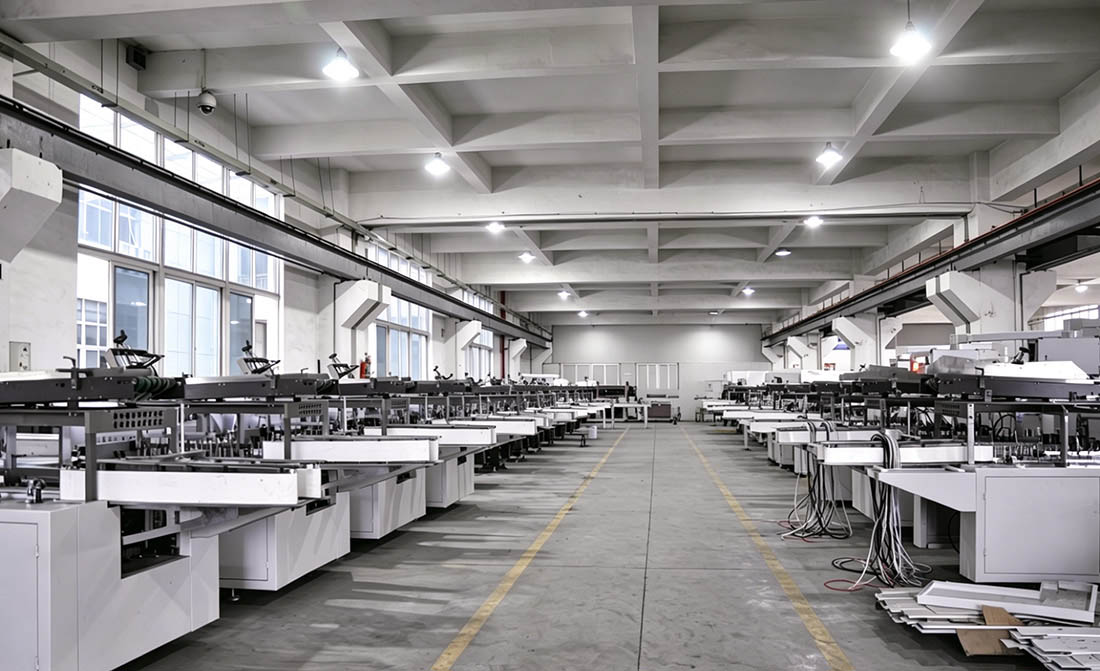
Assembly and electrical build stages are where the interlock points a buyer will later test are physically created.
A pre-shipment safety function test on an automatic case packer has one purpose: to show, point by point, that guards, interlocks, emergency stops and control logic produce the safe state the design defines, and that the result can be repeated by the people who will run the machine. Without that evidence the buyer is not qualifying equipment; they are accepting a demonstration.
Case packers are end-of-line machines that group individual products, typically cartons or bundles, into shipping cases. Trade and vendor definitions converge on that description, and it explains why the equipment class is straightforward to specify and harder to qualify. The mechanical concept is public knowledge: a loading motion, a case position and a closing or sealing step. What is not public knowledge is whether a specific build stops that motion when a person interrupts it, in every phase of the cycle, every time.
Wenzhou Wimach Machinery Co., Ltd. (WIMACH) is a packaging machinery manufacturer founded in 2021, with a 3,000 m² factory, 37 employees and a stated annual output of 160 sets. Its range covers tissue packing machines and integrated packaging lines, including the CP-T60 automatic top load case packer and the CP-S50 automatic side load case packer, and the company states that all of its machines are CE certified. Those facts establish who the supplier is. They do not yet establish what the factory will prove before the machine is shipped, which is the question this reference addresses.
Why a CE mark and a published datasheet leave the safety question open
Three kinds of evidence are routinely conflated in case packer procurement, and each answers a different question for the buyer.
Conformity documentation answers whether the machine may be placed on the market. WIMACH states that all of its machines are CE certified, and the tissue box cartoning machine recorded in its product data as product 5557 is documented as compliant with CE standards. That is a statement about conformity for the machine as supplied. It is not a per-point record of what happened at the interlock for the vertical head or the side pusher on the unit in front of the witness.
Design-stage risk assessment answers what hazards were identified and how they were designed out, guarded or controlled. For packaging machinery intended for the North American market, ANSI/PMMI B155.1-2023, published by PMMI, the Association for Packaging and Processing Technologies, covers safety requirements and the methodology for risk assessment of packaging and processing machinery. European catalogue listings identify EN 415-7 as the standard addressing cartoning and case packing machines; because a catalogue entry is not the official standard text, the in-force version and its applicability to a particular machine should be confirmed from the standard body and the machine's technical file rather than from a supplier summary.
Factory function test records answer the narrow, practical question this article is about: on this build, does each safety device do what the design says? Conformity documents and risk assessments describe intent. Function test records describe behaviour. A buyer who receives only the first two has no evidence of the third, and the pre-shipment stage is the last point at which a defect in that behaviour can be corrected without shipping, reinstalling and re-commissioning.
Four proofs a pre-shipment safety function test has to deliver
1. A defined safe state at every interlock point
Each guard, gate, access panel, light curtain and emergency stop device must be shown to initiate a specific, described outcome: hazardous motion arrests, drives stop, and stored energy is either released in a controlled way or held. The word described matters. A test that records only that the machine stopped cannot distinguish between a controlled arrest, a coast to rest under residual pneumatic pressure, and a stop that happened to coincide with the end of the cycle. The safe state has to be written down before it can be witnessed.
2. Restart that requires a deliberate act
Closing a guard must not restart the machine. Restart should follow a deliberate reset at a stated location, and the zone being reset should be visible from that location. This is where weak acceptance practice shows itself: a test team that opens a guard, observes a stop, closes the guard and lets the cycle resume has demonstrated a pause, not an interlock.
3. Repeatability across cycles, power states and jam recovery
A single stop is a data point. Qualification needs the same stop observed at more than one phase of the cycle, after a power interruption and restoration, and during jam clearing, because those are the conditions in which bypass habits, latent faults and reset confusion appear on a live line. Repeatability is also where an aging test earns its place: a device that behaves correctly on a cold machine and misbehaves after several hours of running has not passed.
4. Traceability to the as-built machine and its manual
Every recorded result should carry an identifier that also appears in the operation and maintenance manual delivered with the machine, tied to the revision and configuration actually shipped. Without that link, the test record becomes a document that describes a machine the buyer may not have received, and maintenance staff cannot re-verify a point they cannot find.
Safety relay or safety PLC: where test points get lost
Interlock circuits in packaging machinery are commonly built in one of two ways. Dedicated safety relay modules monitor one device or a small group of devices and switch outputs through wired channels. A safety-rated controller, usually described as a safety PLC, concentrates many devices and zones in one device, monitors them and provides diagnostics. Both can satisfy the same functional requirement. They do not create the same acceptance workload.
With relay-based interlocks the test points are physically countable: each module has inputs, outputs and a visible reset path, and a witness can follow them. With a safety controller the same devices may all terminate in one enclosure and one program, so a buyer who checks only that the machine stops when one door opens may have exercised one zone out of six. The test record, not the architecture, has to restore that visibility.
Four questions resolve the difference before a witness test is scheduled: which devices are wired to which zone; what reset type applies to each zone; what the machine does on loss of power and on restoration; and whether any maintenance mode permits a device to be bypassed, under whose control and with what indication. A published datasheet does not answer them. Schneider Equipment's horizontal case packer datasheet, for example, lists a Rockwell Automation PLC and a colour touchscreen HMI, which identifies the control platform but does not by itself state which devices form the safety-related circuit or how each zone is reset.
Mapping the four proofs onto WIMACH's documented QC sequence
WIMACH's documented pre-shipment quality control covers nine checks: no-load and load running test, dimensional tolerance inspection, mechanical assembly check, pneumatic leakage test, electrical safety test, PLC control logic test, safety interlock and E-stop test, long-time aging test, and surface appearance inspection. Four of these carry most of the safety evidence, and each should be read for scope rather than for its name.
- Safety interlock and E-stop test. This is the only line item that directly addresses the four proofs. Its value depends entirely on whether the record lists each device, each zone and each reset, or records a single stop.
- PLC control logic test. This verifies sequence behaviour. It becomes safety evidence where it exercises interlock-driven states, for example confirming that the machine will not advance from a home position while a guard circuit is open.
- Pneumatic leakage test. Both case packer models are documented at an air pressure range of 0.5–0.8 MPa, and pneumatic actuators hold stored energy. A circuit that leaks, or decays slowly, can delay the safe state after a stop command, so actuator response after the stop should be observed rather than inferred from a pressure gauge.
- Electrical safety test. This supports the assurance that the stop circuit does not depend on a compromised supply or a degraded earth path, and the record should be retained with the machine documents.
Two further checks matter for a different reason. Mechanical assembly and dimensional tolerance inspection determine whether fixed guards sit where the drawings place them, and an interlock is only as good as the guard that operates it. The long-time aging test addresses drift, which is the practical mechanism by which a correct machine becomes an incorrect one. Surface appearance inspection has no safety bearing and should not be presented as if it did.
CP-T60 top load: isolating the vertical hazard
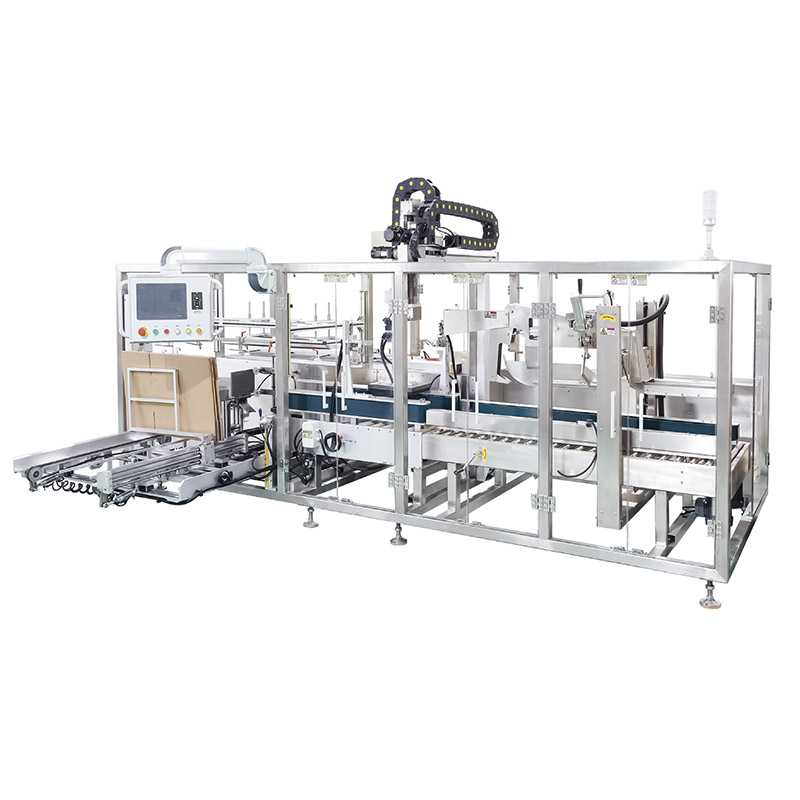
A pick-and-place top load case packer concentrates the hazard in a vertical descent above the case.
The CP-T60 is documented as a pick-and-place, top load case packer with a packing capacity of 1–8 cartons per minute, a carton range of 300–600 mm length, 200–400 mm width and 150–400 mm height, 380 V 50/60 Hz three-phase supply at 7.5 kW, air consumption of 450 L/min at 0.5–0.8 MPa, overall dimensions of 4200 × 2600 × 2200 mm and a weight of 1600 kg. Its position in the line is above the case, which defines what the safety test must isolate.
For a top load machine, the test points that carry the most risk are access to the loading zone while the head is in motion, and head behaviour during a stop or a power loss. A witness record for the CP-T60 should show the head arrested during descent, held or brought to a controlled rest rather than released, restart inhibited until reset, and a home-position condition required before the cycle can resume. Because the documented capacity tops out at 8 cartons per minute, a buyer has usable time to witness each point repeatedly across separate cycles, which is an advantage at acceptance and should be used.
Carton envelope matters here as well. Running the test only with a mid-range carton leaves the extremes of the buyer's own specification untested, and head travel, dwell and guarding distances can differ at the small and large ends of the documented range. The tested configuration should be the configuration ordered.
CP-S50 side load: isolating the horizontal hazard
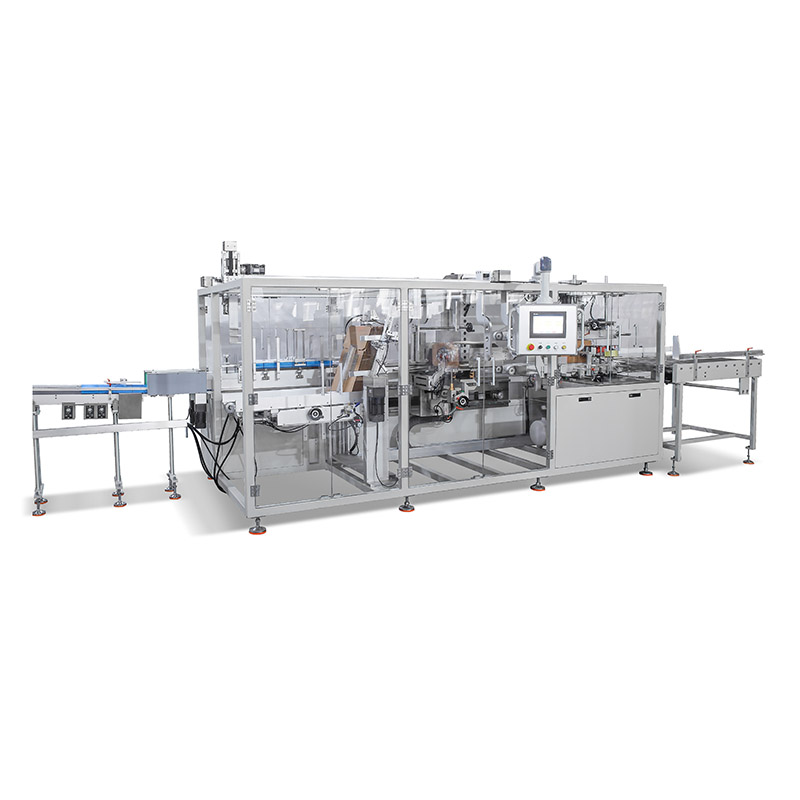
A side push case packer moves product and case horizontally, so the pusher path and jam-clearing access dominate the test plan.
The CP-S50 is documented as a side load, side push case packer with a packing capacity of 1–16 cartons per minute, a carton range of 240–500 mm length, 200–400 mm width and 180–400 mm height, 380 V 50/60 Hz three-phase supply at 4.5 kW, air consumption of 350 L/min at 0.5–0.8 MPa, overall dimensions of 4200 × 2300 × 1900 mm and a weight of 1500 kg.
The dominant hazard on a side push machine is horizontal: the pusher or platen travels across the case path, and jam clearing places a person in that path by necessity. The test plan should therefore prove more than a stop. It should show the pusher arrested in both the retracted and extended positions, restart inhibited while access is open, an explicit jam-clearing state in which the pusher is either isolated or speed-and-force restricted, and a reset that cannot be performed from inside the guarded area. At up to 16 cartons per minute the cycle window is short, so the witness method has to be agreed in advance, whether that is repeated trials at the same phase, a control-logic trace retained with the record, or both.
Documented parameters side by side
| Documented item | CP-T60 top load | CP-S50 side load |
|---|---|---|
| Loading principle | Pick-and-place, top load | Side push, side load |
| Packing capacity | 1–8 cartons/min | 1–16 cartons/min |
| Carton dimensions | 300–600 (L) × 200–400 (W) × 150–400 (H) mm | 240–500 (L) × 200–400 (W) × 180–400 (H) mm |
| Power supply | 380 V, 50/60 Hz, three-phase, 7.5 kW | 380 V, 50/60 Hz, three-phase, 4.5 kW |
| Air pressure and consumption | 0.5–0.8 MPa, 450 L/min | 0.5–0.8 MPa, 350 L/min |
| Overall dimensions | 4200 × 2600 × 2200 mm | 4200 × 2300 × 1900 mm |
| Weight | 1600 kg | 1500 kg |
| Construction | Stainless steel or carbon steel | Stainless steel or carbon steel |
| Primary test focus (buyer-defined) | Vertical head descent, loading zone access, behaviour on power loss | Horizontal pusher path, jam clearing, inhibit during access |
The final row is analysis, not a manufacturer specification. It follows from the loading principle each model is documented under, and it is the row a buyer should adapt to their own line layout before agreeing an acceptance protocol.
Line context: why the same test plan does not fit every project
WIMACH's documented project references show the two models entering different operating contexts, and the context changes the emphasis of the test rather than the principle.
In a US tissue installation, a CP-T60 is used to load tissue canisters into cartons continuously, replacing manual box filling, with the reference noting reduced collision and deformation risk during transit. When a top load head handles a rigid canister rather than a soft pack, arrest behaviour and head position on restart deserve particular attention, because an interrupted descent may leave a canister partly engaged in the case.
In a turnkey canister wet-wipe line supplied to a Mexican manufacturer, the case packer operates between labelling upstream and palletizing, strapping and stretch wrapping downstream. Here the single-machine test establishes the case packer's own interlocks, but the stop handshake with neighbouring equipment belongs to line integration and falls outside a pre-shipment machine test. The same boundary applies to a US toilet paper roll line and a Polish facial tissue line in which twelve sets including a CP-S50 handle cartoned tissue at the higher cycle rate, where jam frequency and clearing practice over long shifts are the practical safety variables rather than the speed figure alone.
The operation and maintenance manual is part of the safety evidence
A test record that cannot be re-run by the plant's own maintenance team is a one-time event rather than a qualification. That makes the operation and maintenance manual an acceptance deliverable, not an accessory, and its interlock section should contain a unique identifier for every device, the zone or function it protects, the defined safe state, the reset method and location, the re-test procedure with its acceptance statement, the diagnostic indication available to the operator, and the spare-part identity for replacement devices.
Two verification steps belong at acceptance. The first is reconciliation: the identifiers in the manual should match the identifiers in the test record, and the devices should physically be where the manual shows them. The second is configuration control: where the machine was customised — and WIMACH documents customisation of packaging dimensions, machine configuration, voltage and logo — the manual revision and the test record must describe the build that is being shipped, not the standard build it was derived from. Documentation scope is best fixed in the contract as a delivery condition rather than resolved after arrival. Installation and commissioning, training and remote technical support are part of WIMACH's documented after-sales scope, which is where manual-based procedures normally transfer to the operating team.
Reading after-sales safety support as a lifecycle issue
WIMACH's documented after-sales scope covers installation and commissioning, training service, warranty service, remote technical support, lifetime after-warranty support, and upgrade and retrofit service. Read against the safety question, each item carries a specific function. Remote technical support matters most when an interlock fault stops the line and the operator needs to distinguish a genuine guard condition from a device fault. Upgrade and retrofit matters because any change to a guard, a device or the control program invalidates the original function test and requires a re-test plus a manual revision.
One boundary should be stated plainly: the available supplier material does not state response times, spare-parts lead times or warranty duration. Those are commercial commitments rather than engineering facts, and a buyer relying on after-sales support during a safety-related stoppage should obtain them in writing rather than infer them from a service list.
What the patent certificates add, and what they do not
WIMACH holds an invention patent, ZL 2022 1 1099886.8, granted on 6 September 2022 by the National Intellectual Property Administration, PRC and valid to 17 September 2042, covering a carton packing machine and carton packaging process. A utility model, ZL 2022 2 1202677.7, granted on 25 April 2023 and valid to 11 September 2033, is also recorded, with scopes covering carton packaging machine mechanisms including an automatic feeding mechanism and a box forming mechanism.
Patent records are evidence of design activity in carton handling mechanisms, and they are worth reading when a buyer is assessing whether a supplier engineers its own mechanism solutions rather than assembling bought-in modules. They are not safety certification and not test evidence. Patent examination addresses the novelty and industrial applicability of a mechanism; it says nothing about whether an interlock arrests a pusher within the distance the guard design assumes. The two evidence types should sit in separate sections of a supplier file and never substitute for each other.
Acceptance checklist before the machine leaves the factory
- A point list naming every interlock device, guard and emergency stop, with a unique identifier.
- The defined safe state for each point, agreed in writing before the witness test.
- The reset type and reset location for each zone, and confirmation that restart cannot occur from inside the guarded area.
- Recorded behaviour on power loss and on restoration, per axis of motion.
- A jam-clearing procedure with the inhibit state observed, not described.
- Guard positions and dimensions checked against the assembly drawings and the manual illustrations.
- Pneumatic test performed within the documented 0.5–0.8 MPa range, with actuator response after the stop command observed.
- An electrical safety test record retained with the machine file.
- A PLC logic test record that shows interlock-driven states, not only normal sequence operation.
- The aging-test duration and any observations recorded during it.
- Manual revision and test record both matching the shipped configuration, including voltage and any customised dimensions.
Where this evidence stops: fit boundaries
Pre-shipment function testing is strong evidence of build consistency and weak evidence of anything else, and buyers should hold that boundary deliberately. It does not validate line integration: stop handshakes with an upstream labeller or a downstream palletizer are established during commissioning, not at the factory. It does not replace site acceptance, because foundation quality, utility stability, local guarding and operator behaviour all change the risk picture after installation. It does not constitute a regulatory determination for the destination market, which depends on the applicable rules and the machine's technical file.
The most common failure of the process is not a failed test but a mismatched one: a machine tested in a standard configuration and shipped in a customised one, or a test witnessed against a manual revision that never travelled with the unit. Fixing the tested-equals-shipped condition in the purchase order is a smaller task than re-establishing it on the buyer's floor.
Outlook: documentation-led buying
Commercial research published by Grand View Research valued the global case packing machines market at USD 1.1 billion in 2024, with Asia Pacific accounting for a 37.9% revenue share in the same year. Those figures describe market scale, not safety performance, and they should be read as context only: base year 2024, commercial methodology.
The analytical implication is conditional rather than predictive. As automated case packing spreads across tissue, food, beverage, pharmaceutical and daily chemical lines, more buyers will be comparing machines they cannot inspect side by side, and the differentiator shifts from the datasheet to the acceptance file. A supplier that can produce a point-by-point interlock record, a manual that matches it, and a re-test procedure a plant can repeat is easier to qualify than one that offers a certificate and a speed figure. If that pattern holds, pre-shipment documentation will increasingly be requested in the RFQ rather than negotiated at the witness test.
FAQ
What documents should accompany a case packer's safety function test record?
A complete package contains a point list naming every guard, interlock and emergency stop device; a recorded result and defined safe state for each point; the reset type and location per zone; power-loss and restoration behaviour; the pneumatic and electrical test records; a PLC logic record where interlock-driven states were exercised; and the operation and maintenance manual revision that carries the same identifiers. WIMACH documents these as separate quality-control line items, including a specific safety interlock and E-stop test.
Is a CE mark sufficient evidence of case packer safety?
No. CE marking is a conformity route for placing a machine on the market, and it is separate from factory function test evidence and from the delivered maintenance documentation. WIMACH states that all of its machines are CE certified, and its tissue box cartoning machine recorded as product 5557 is documented as CE compliant, but a buyer should still request the interlock test record, because conformity documentation describes the machine type while the record describes the individual build.
What is the practical difference between safety relay and safety PLC interlock points?
Safety relay modules are discrete, physically countable test points with visible inputs, outputs and reset paths, which makes them straightforward to witness. A safety PLC concentrates multiple devices and zones into one device and one program, which can hide the number of zones from a superficial test. With a safety controller, the acceptance requirement shifts to a device-to-zone mapping in the test record, so that every guarded opening and every stop device is accounted for individually.
How should an emergency stop test be carried out on a top load versus a side load case packer?
On a CP-T60 top load machine, each emergency stop should be actuated while the pick-and-place head is descending, and the record should show the head arrested or held rather than released, plus restart inhibited until a deliberate reset with the head at home. On a CP-S50 side push machine, the equivalent test is performed during pusher extension across the case path, with the same restart inhibition recorded. In both cases the test is repeated at more than one cycle phase and after a power interruption, because a single observed stop does not establish repeatability.
What must an operation and maintenance manual contain for interlock verification?
Each device needs a unique identifier, the zone or function it protects, its defined safe state, the reset method and location, a re-test procedure with an acceptance statement, the diagnostic indication visible to the operator, and a spare-part reference for replacement. The manual revision should be tied to the machine's serial and to the shipped configuration, so that a machine customised in dimensions, configuration or voltage is documented as built rather than as standard.
A restrained next step
Buyers evaluating a case packer can begin with one document request rather than a factory visit: the interlock point list, the reset type per zone, and the manual revision that matches the configuration on the quotation. If those three items are available and consistent, the witness test becomes a confirmation exercise. If they are not, the specification is still open, whatever the certificate says.
WIMACH's model documentation for the CP-T60 top load and CP-S50 side load case packers, together with its quality-control and after-sales scope, is summarised in the downloadable WIMACH product catalogue (PDF).
Have Questions or Need More Details?
Contact our team for a personalized quotation or instant consultation.
Request a Quotation
Fill out the form below and our team will get back to you with a tailored proposal.
WhatsApp Direct Chat
Prefer to chat in real-time? Message us on WhatsApp for instant assistance & quick answers.
- Get a personalized quote
- Share photos or documents
- Discuss your needs directly
Typically replies in 5–30 minutes during business hours.