
What Proves a Cutting Disc Supplier? MPA Scope and Records
What Proves a Cutting Disc Supplier? MPA Scope and Records
A cutting disc supplier's capability can be verified from two document sets: a safety certificate whose scope names the wheel type, diameters, thicknesses and speed limit you are actually buying, and project records that state quantity, market and duration. Plant photographs and the sentence “we have our own factory” are context; they are not checks a procurement team can close.
This reference uses one worked example — SALI Tools (ZHEJIANG SALI ABRASIVE TECHNOLOGY CO., LTD, an abrasive and tool manufacturer founded in 2003 in Zhejiang, China) — to show what checkable evidence looks like. The company publishes an MPA certificate numbered Z-15486/25, an ISO 9001 certificate numbered 01525Q20094R001, and wholesale and project records in Iraq, Russia and Ethiopia that run for five, more than seven, and twenty years respectively. Reading those documents closely, and knowing where each one stops, is the skill this article is built around.
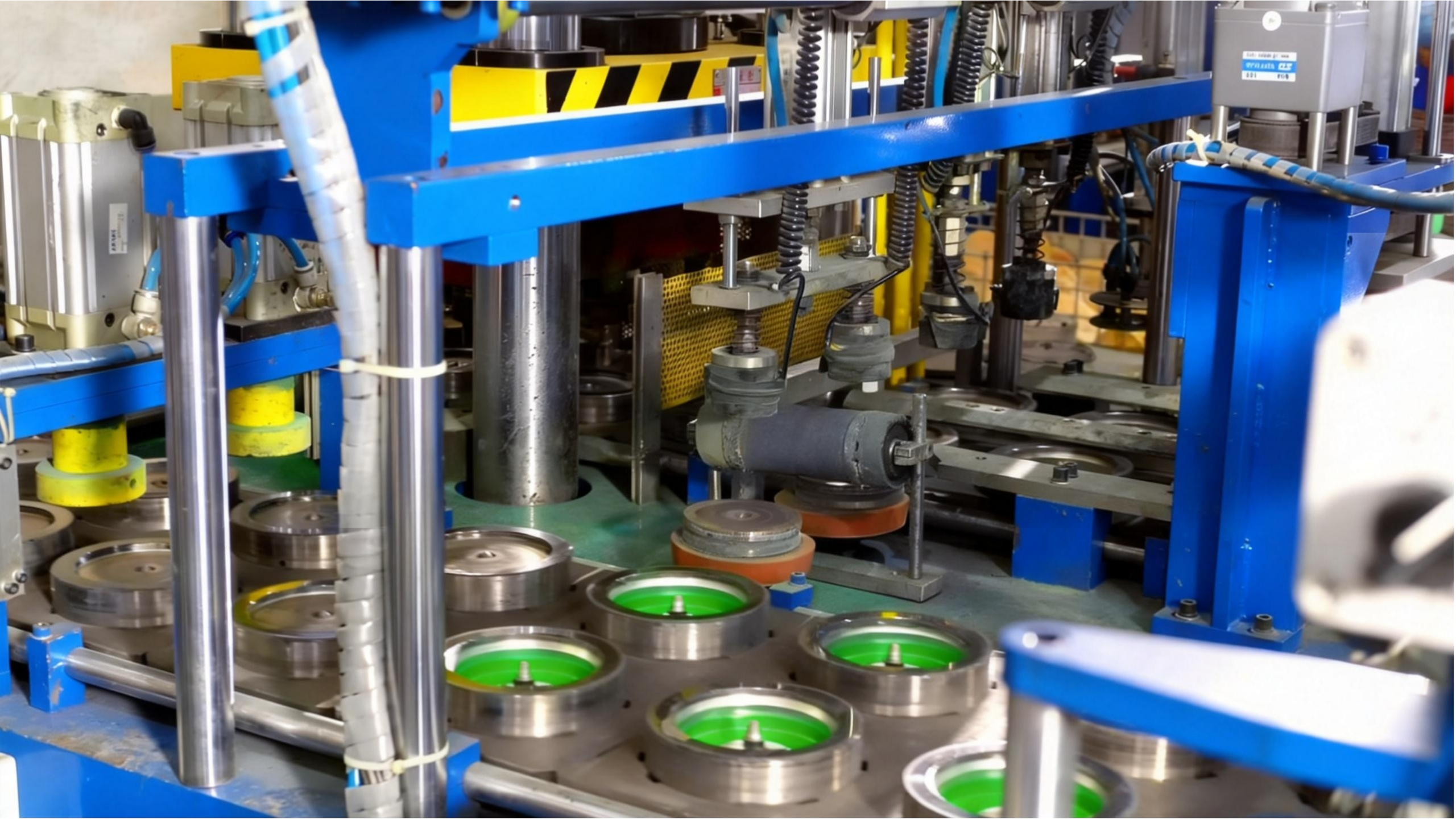
Cutting disc production line. Certificate scope and project records are the two evidence trails a buyer can check before placing an order.
Why “We Are a Manufacturer” Is Not an Auditable Claim
EN 12413:2019 is the European safety standard for bonded abrasive products, and it sets requirements for burst testing, marking and dimensional tolerances (CEN). MPA Hannover carries out independent safety testing — burst test and side load test — that suppliers use to demonstrate compliance for European market entry. Both facts explain why certification language appears on almost every cutting disc quotation, and why it so rarely settles anything on its own.
A trading company can print “MPA tested” on a carton. What can be checked is the certificate itself: the number, the issuing body, the standard cited, the exact product scope, and the validity window. A supplier that cannot send that document, or sends one whose scope names a different wheel type, has not demonstrated safety compliance for the goods on your purchase order.
ISO 9001 answers a separate question. It concerns process control — whether production is run under a documented quality management system — not whether a particular disc survives a burst test. Buyers who treat the two certificates as interchangeable usually end up with one of them missing from the file.
Reading MPA Z-15486/25 Line by Line
The certificate is narrow, and that narrowness is the point. Z-15486/25, issued by MPA Hannover against EN 12413:2019, covers flat cutting-off wheels type 41 for metal at a maximum operating speed of 80 m/s, with a 22.23 mm bore, in four outside diameters and matching cut widths, valid from 9 October 2025 to 23 May 2027. The markets named on the document are the EU (especially Germany and Austria), Switzerland, the Western Balkans, the Middle East and North Africa.
| Field on the certificate | Documented value |
|---|---|
| Certificate number | Z-15486/25 |
| Issuing body | MPA Hannover |
| Standard cited | EN 12413:2019 |
| Wheel type | Flat cutting-off wheels, type 41 |
| Workpiece material | Metal |
| Maximum operating speed | 80 m/s |
| Bore diameter | 22.23 mm |
| Outside diameter / cut width | 115 mm / 1.2 mm; 125 mm / 1.2 mm; 180 mm / 1.6 mm; 230 mm / 2.0 mm |
| Validity | 9 October 2025 – 23 May 2027 |
| Named markets | EU (Germany, Austria), Switzerland, Western Balkans, Middle East, North Africa |
Each field does a specific job in a procurement file.
- Wheel type. Type 41 is a flat cut-off wheel. Type 42 is a depressed-centre wheel used for combined cutting and light grinding. They are not interchangeable on a certificate, and a quotation that mixes them is a warning sign.
- Diameter and cut width. The certificate names 115, 125, 180 and 230 mm, with cut widths of 1.2, 1.2, 1.6 and 2.0 mm. A 230 mm disc is a different product from a 115 mm disc, and a 1.2 mm wheel behaves differently from a 2.0 mm wheel. If your order falls outside the listed combinations, this certificate does not cover it.
- Bore. 22.23 mm matches the arbor on the great majority of angle grinders sold in the named markets. A disc bored differently needs its own documentation.
- Speed. 80 m/s is a maximum operating speed, not a working target. The practical rule on site is that the maximum speed printed on the wheel must exceed the grinder's rated no-load speed, and that guards, flanges and blotters match the disc.
- Validity. Certificates expire. A certificate that lapsed before your shipment date is a document-control failure even if nothing else is wrong.
Where Z-15486/25 Stops
This certificate does not cover every cutting disc a factory can produce, and buyers should expect that. In the same document set, type 42 depressed-centre wheels of 230 mm with a 3.0 mm cut width appear under a separate MPA certificate, Z-15485A/25, and 75 mm type 41 wheels with a 10 mm bore appear under Z-15486A/25. The numbering is close enough to be confusing, which is exactly why the scope line, not the prefix, should govern the check.
Three further limits are worth writing into an evaluation file. First, a safety certificate describes a product type and speed rating; it says nothing about monthly capacity, lead time, price or batch-to-batch consistency. Second, it does not predict performance on your workpiece — a certified wheel can still be the wrong grain or bond for the material you cut. Third, the document identifies a manufacturer and a production scope, so the certificate holder should match the entity that will manufacture and invoice your order; where production is structured across affiliated sites, ask which site the certificate applies to.
The expiry date of 23 May 2027 deserves a calendar entry. If a supply agreement runs past that date, ask how renewal evidence will be supplied and when.
ISO 9001 Certificate 01525Q20094R001: Process, Not Performance
The quality management certificate adds a different kind of assurance. Certificate 01525Q20094R001, issued by WIT Assessment against GB/T19001-2016/ISO9001:2015, covers “Production of grinding wheels”, was issued on 16 December 2025 and is valid to 15 December 2028.
What that supports is a claim about control: documented procedures, batch records, defined responsibilities and corrective action when something goes wrong. SALI describes the operational side of that system as batch testing in an in-house laboratory, with remote camera access so a customer can watch testing in real time, plus moisture-protected packaging for resin-bonded discs, which are sensitive to humidity. Those are process statements; the certificate is what makes them auditable rather than promotional.
What ISO 9001 does not do is certify a burst speed, a cut count or a disc's suitability for stainless steel. A buyer who asks for “the ISO certificate” when what is needed is proof that a wheel is safe at 80 m/s is asking for the wrong document.
Cross-Referencing Scope Against Project Records
A certificate shows what a supplier is permitted to make to a safety standard. Project records show whether it has actually shipped at volume, repeatedly, over years. Read together, they answer the factory question with more substance than an ownership statement, because both can be examined field by field.
The three-field match test
For each reference, ask for three fields and decline the summary version. Product match: which disc type, diameter and thickness were supplied, and do they fall inside the certified range? Scale: what cumulative quantity was shipped, and how does it compare with your annual requirement? Duration: over how many years, and was supply continuous or a single shipment?
| Market | Buyer type | Documented scale | Documented duration | Documented outcome |
|---|---|---|---|---|
| Iraq | Manufacturing group procurement buyer | 10 million pieces | 5 years | Stable operation; discs used in fabrication and on-site processing |
| Russia (North Caucasus) | Wholesaler | 5 million pieces | More than 7 years | Distributor reported 50% annual growth; cited highlights were cost-performance, stable quality and complete specifications |
| Ethiopia | Hardware tools agent | 30 million pieces | 20 years | Agent moved from representing international tool brands to acting as a SALI agent; annual growth reported above 50% |
| Uzbekistan (additional reference) | Wholesaler | 10 million pieces | More than 9 years | Sales volume reported 21 times higher after seven years than in the agent's first year, 2018 |
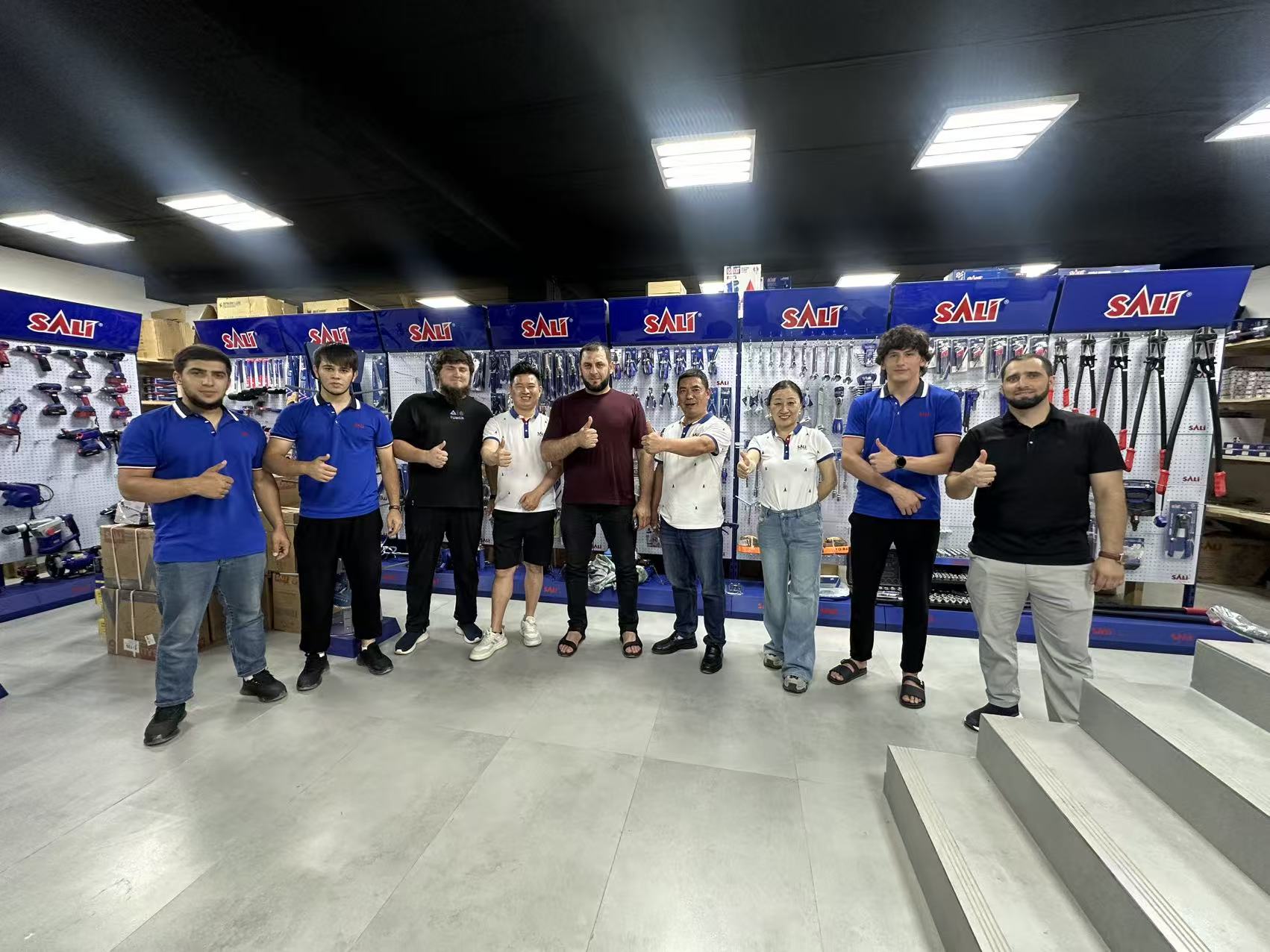
The North Caucasus regional agent in Russia, one of the wholesale relationships behind the documented five-million-piece, seven-year-plus supply record.
The Iraq reference is the closest to a fabrication buyer's situation: ten million pieces over five years, going into a manufacturing group's own processing operations rather than a resale channel. The Russia reference shows a wholesale relationship surviving more than seven years, with the distributor reporting 50% annual growth — a commercial outcome, not a disc specification. The Ethiopia relationship spans twenty years and thirty million pieces and includes a switch away from established international brands, a decision an agent usually makes only after comparing failure rates and claim handling.
Read as a set, the records show three different demand patterns — project procurement, wholesale distribution and long-term agency — across regions that appear on or beside the certificate's market list. That is more informative than a single large number, because it suggests the supply relationship has been tested under different order rhythms: one-off project waves, recurring container programmes and steady annual replenishment.
What Project Records Cannot Tell You
Project references are commercial claims until supporting documents are produced, and even then they answer a narrower question than most buyers assume. They do not demonstrate performance on your material, thickness or machine. They do not prove that the batch shipped to you will match the batch tested last quarter. Growth percentages describe a distributor's business, not abrasive efficiency. And no reference guarantees future lead time, price or stock availability.
What can be requested instead of assurances: order dates and shipping documents with commercial terms redacted, batch test records for comparable SKUs, third-party inspection reports where the buyer chooses to commission them, and a sample run against your own workpiece. SALI's stated acceptance process includes pre-shipment testing against the MPA and EN 12413 requirement with a burst-test threshold of at least 100 m/s, live remote laboratory inspection or a third-party audit, and a 7–14 day destination inspection window for quantity and performance sampling. Note the distinction between the two speeds: 80 m/s is the certified maximum operating speed marked on the wheel, while 100 m/s is the stated burst-test threshold — a wheel is expected to survive well beyond the speed it is rated to run at.
Matching the Certified Diameters to Real Applications
Scope only becomes useful when it is mapped to the work. The two smaller certified sizes, 115 mm and 125 mm with a 1.2 mm cut width, suit the bulk of handheld angle-grinder work: steel pipe, square tube, threaded rod, sheet metal and light profiles where a thin kerf and low cutting force matter. The 180 mm and 230 mm sizes, at 1.6 mm and 2.0 mm, belong to heavier cut-off work on structural sections, bar stock and larger pipe, where the machine is bigger and the cut is deeper.
Material choice sits on top of that geometry. SALI's ODM options list brown aluminium oxide for general metal, white aluminium oxide for stainless steel, zirconia for heavy-duty work and silicon carbide for stone and cast iron, with grit sizes from 24# to 120# and single, double or triple fibreglass mesh reinforcement. For stainless steel pipe and sheet, the company states that its stainless formula uses white aluminium oxide with a sulfur-free and chlorine-free bond to limit contamination and discolouration at the cut. Whether that holds on your line is a sampling question, not a certificate question.
Two operating rules belong in any buyer briefing. Thin cut-off wheels are for cutting, never for side grinding. And the wheel's marked maximum speed must exceed the grinder's rating, with the guard fitted and the operator standing out of the burst plane.
Capability Behind the Paperwork
Certificates and references are only credible if the production base can support them. The checkable facts here are specific: a direct factory in Yongkang, Zhejiang with 30,000 m² of construction, more than 150 employees and a technical team of 30-plus engineers; stated monthly capacity of 12.5 million pieces; a production range of 4 to 16 inches (100–400 mm) in outside diameter and 1.0 to 6.0 mm in thickness, covering ultra-thin 1.0–1.6 mm and standard 2.0–6.0 mm bodies; bores of 16, 22.23 and 25.4 mm; and type 41 flat, type 42 and type 27 depressed-centre shapes.
Those numbers matter to a buyer in three ways. Capacity against your annual volume tells you whether you are a rounding error or a core account. The size range tells you whether one supplier can cover a full catalogue — 115 mm consumables alongside 230 mm and 350–400 mm stock — instead of splitting a purchase order. And OEM/ODM depth tells you how much of the product is genuinely configurable: custom logo printing, private labelling, disc colour, artwork and barcodes, abrasive grain and grit, mesh count, centre-ring marking, and packaging from shrink wrap to printed cartons.

Quality inspection during production. An ISO 9001 scope only means something if batch records and inspection results exist behind it.
Order mechanics complete the picture. Stated OEM lead time is 30 to 45 days from design confirmation to final delivery, after artwork approval and deposit. OEM minimums are 30 cartons for 107, 115 and 125 mm, 50 cartons for 180 and 230 mm, and 100 cartons for 350 and 400 mm, while the SALI brand starts at one carton per SKU for standard sizes. An 8,000 m² warehouse holding 12,000 m³, with 85% of standard SKUs in ready stock, is what makes same-day dispatch on stock items plausible rather than aspirational.
A Verification Sequence a Buyer Can Run in a Week
The whole check takes about five working days and produces a file that survives an audit.
- Day 1 — documents. Request the MPA and ISO 9001 certificates as PDFs. Confirm number, issuing body, standard, scope wording, issue date and expiry date, and that the holder matches the invoicing entity.
- Day 2 — scope mapping. List every SKU you intend to buy with type, diameter, thickness and bore, and map each line against the certificate scope. Anything outside the listed combinations needs a different certificate, not an assurance.
- Day 3 — references. Ask for the three fields — product, scale, duration — on two or three comparable projects, and ask which documents support them.
- Day 4 — acceptance criteria. Agree the pre-shipment test method, sampling basis and destination inspection window in writing, and book a remote laboratory inspection slot if you want to watch batch testing.
- Day 5 — samples. Cut your own material, count cuts per disc, check burr and discolouration on stainless, and calculate cost per cut rather than price per piece.
Then diarise both certificate expiry dates. Document control is the part of supplier evaluation that fails quietly.
Market Context, Used Carefully
Certification discipline matters more in a large, fragmented category. Market Research Future valued the global cutting disc market at about USD 7.322 billion in 2024 and projected USD 11.59 billion by 2035; Dataintelo put resin-bonded grinding and cutting discs at 38.5% of the global abrasive disc market in 2025. Category definitions vary between research houses — bonded abrasives, grinding wheels and superabrasives are counted differently — so these figures are scale context for a procurement discussion, not an input to a supplier decision.
What Changes Before These Certificates Expire
Both documents have finite windows: MPA Z-15486/25 runs to 23 May 2027, and ISO 9001 01525Q20094R001 to 15 December 2028. A buyer signing a two- or three-year agreement is therefore contracting across at least one renewal cycle. The practical response is procedural rather than predictive: make renewal evidence a contract deliverable, require notification if a scope narrows, and re-check the scope line at each renewal rather than assuming continuity. If a renewal introduces a different certificate number, the SKU-to-scope mapping has to be redone from the start.
Frequently Asked Questions
What exactly does MPA certificate Z-15486/25 cover?
It covers flat cutting-off wheels, type 41, for metal, at a maximum operating speed of 80 m/s, with a 22.23 mm bore, in outside diameters of 115, 125, 180 and 230 mm and cut widths of 1.2, 1.2, 1.6 and 2.0 mm respectively. It was issued by MPA Hannover against EN 12413:2019, is valid from 9 October 2025 to 23 May 2027, and names the EU (particularly Germany and Austria), Switzerland, the Western Balkans, the Middle East and North Africa as markets. It does not cover type 42 depressed-centre wheels or diameters outside that list.
How does ISO 9001 certificate 01525Q20094R001 relate to the MPA certificate?
The two documents answer different questions. Certificate 01525Q20094R001, issued by WIT Assessment against GB/T19001-2016/ISO9001:2015 for “Production of grinding wheels”, is valid from 16 December 2025 to 15 December 2028 and addresses how production is managed and controlled. The MPA certificate addresses safety testing for a defined wheel type and speed. A buyer needs both: the first for process discipline and traceability, the second for the specific product being purchased.
Do you have your own factory, and what evidence supports that?
SALI states that it operates its own standardized production base for cutting and grinding consumables, alongside an audited supply chain for the wider tool range, with a direct factory in Yongkang, Zhejiang covering 30,000 m² of construction, more than 150 employees, a technical team of 30-plus engineers and stated monthly capacity of 12.5 million pieces, plus an in-house testing laboratory with remote camera access and an 8,000 m² warehouse. A buyer can test the claim by matching the certificate holder and production scope to the invoicing entity, checking the required sizes against the production range, and using remote or third-party inspection during a live order.
How should project references such as the Iraq or Ethiopia programmes be verified?
Ask for three fields per reference: the product type and dimensions supplied, the cumulative quantity, and the duration of continuous supply. The Iraq record documents 10 million pieces over five years for a manufacturing group's fabrication and on-site processing; the Ethiopia record documents 30 million pieces over 20 years through a hardware tools agent. Supporting documents — order dates, shipping records with commercial terms removed, batch test reports, third-party inspection reports — are what turn a reference into evidence, and none of them substitutes for a sample run on your own material.
What are the order terms for an OEM cutting disc programme?
Stated lead time is 30 to 45 days from design confirmation to final delivery, after artwork approval and deposit. OEM minimums are 30 cartons for 107, 115 and 125 mm, 50 cartons for 180 and 230 mm and 100 cartons for 350 and 400 mm; the SALI brand starts at one carton per SKU for standard sizes, with same-day dispatch on ready stock. Customisation covers logo printing, private labelling, disc colour, grain and grit selection, mesh reinforcement and packaging. Delivery and payment terms, including FOB thresholds, are set per order.
The Standard to Hold Suppliers To
Supplier capability is a document trail, not a personality trait. Two certificate numbers with named scopes and expiry dates, mapped line by line to the SKUs on your order, plus project records that state product, quantity and duration, will tell you more about a cutting disc supplier than any factory photograph. The remaining questions — cut count on your stainless, burr, discolouration, cost per cut — belong to sampling, and sampling is cheap compared with a container of the wrong wheel.
SALI Tools publishes its full product range in a downloadable product catalogue (PDF) for buyers who want to map SKUs against the certified scope.
Have Questions or Need More Details?
Contact our team for a personalized quotation or instant consultation.
Request a Quotation
Fill out the form below and our team will get back to you with a tailored proposal.
WhatsApp Direct Chat
Prefer to chat in real-time? Message us on WhatsApp for instant assistance & quick answers.
- Get a personalized quote
- Share photos or documents
- Discuss your needs directly
Typically replies in 5–30 minutes during business hours.