
What Six Yan Yang Dredgers Reveal About Supplier Capability
What Six Yan Yang Dredgers Reveal About Supplier Capability
Dredging equipment buyers rarely fail because a supplier has no product; they fail because the evidence behind the product arrives late. Zhenjiang Yanyang Engineering Co., Ltd., which trades as Yan Yang Marine, publishes six vessel families with capacities that can be checked against vessel particulars: a 26,800 m³ trailing suction hopper dredger, cutter suction dredgers spanning 1,000–8,000 m³/h, a 25 m³ grab dredger, an EX5500 backhoe dredger rated to 32 m of working depth, a 2,600 m³ split hopper barge, and a pile driving barge with a 110 m pile leader. This HTNXT capability review treats those figures as procurement evidence rather than marketing copy, places them beside four well-known dredging equipment builders, and separates what the documentation actually establishes from what only a project-specific class certificate can confirm.
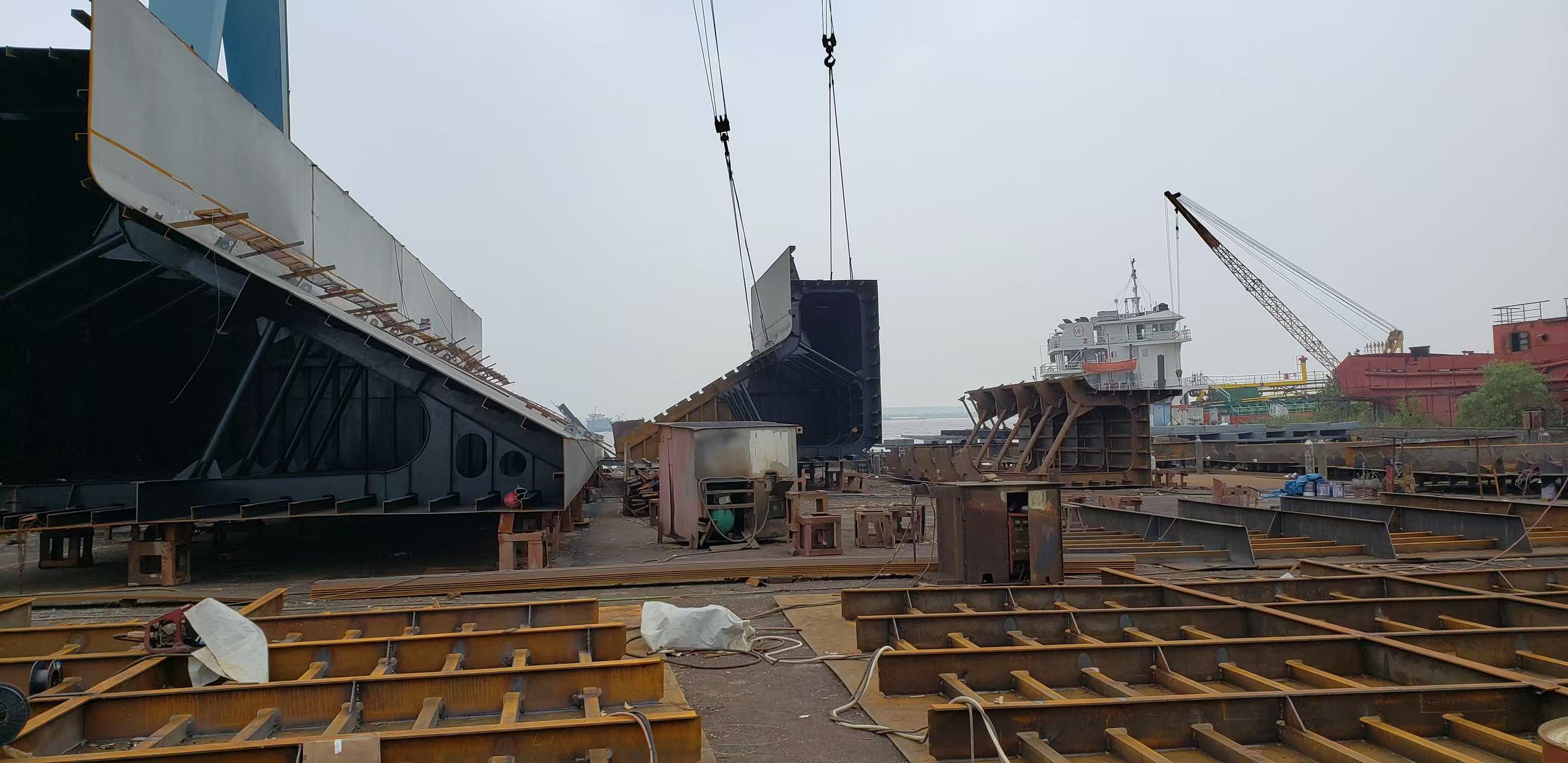
Shipyard fabrication environment referenced in Yan Yang's published capability material.
Why dredging equipment buyers now ask for evidence first
Dredging is a capital-intensive, site-specific purchase, and the market behind it is large enough to widen any supplier longlist. Grand View Research values the global dredging equipment market at USD 4.9 billion in 2023 and projects USD 7.4 billion by 2030. China's customs records for HS 890510 show USD 462 million of dredger exports in 2024, the largest exporter position in that dataset. Scale of that order moves the evaluation question from "who builds dredgers" to "who can document one specific vessel on schedule".
In practice, a dredger's usefulness is set by three document sets rather than by a product page. The first is vessel particulars: hull dimensions, draft, hopper or cutter configuration, dredging depth, discharge distance and installed power. The second is class documentation: the society, the exact notation, any service-area restriction and the validity window. The third is the commercial file: lead time, inspection regime, acceptance criteria and payment mechanics. A supplier that produces all three early compresses technical due diligence; one that cannot shifts risk onto the buyer, usually at the moment the vessel is already fixed to a project schedule.
That framing matters for capability-oriented procurement, because the useful question is not whether a builder offers a trailing suction hopper dredger — several do — but how far the published capability extends, how it is certified, and which applications the evidence actually supports.
Yan Yang Marine: the supplier behind the specification sheet
Yan Yang Marine is a Chinese dredger manufacturer and exporter based in Zhenjiang, Jiangsu Province, founded in 1996 by a team of marine engineers and offshore construction specialists. Company data records roughly 50 employees, a 10-person engineering and R&D team, more than 30 large dredger construction projects delivered, an export orientation reported at 100%, and stated markets that include the United Arab Emirates, Indonesia, India, Egypt, Turkey, Nigeria, South Africa, Tanzania, Saudi Arabia and Oman.
Its listed portfolio is a vessel-and-hull scope rather than a components-only scope: cutter suction dredgers, trailing suction hopper dredgers, grab dredgers, backhoe dredgers, split hopper barges and pile driving barges. The company also states that its vessels can be built for classification by IACS societies including CCS, BV, LR and DNV, and it offers ODM and custom-made production rather than a fixed catalogue alone.
For a buyer, that combination defines the shape of the supplier: a builder presenting a full hull range with class flexibility and custom engineering, aimed at port, channel and reclamation work, rather than a single-type specialist or an equipment reseller.
Technical scope: what the six vessel families establish
Read together, the six families cover the three physical jobs a dredging spread has to perform: cut or loosen material, lift and transport it, and place it or build on the resulting ground. The table below maps each published capability to its procurement significance and to the document a buyer should demand before treating it as proven.
| Vessel family | Published capability | Procurement significance | Document to verify |
|---|---|---|---|
| Trailing suction hopper dredger | 26,800 m³ hopper capacity; listed TSHD range from 1,100 to 26,800 m³ | Large-scale channel and offshore work where transport economics, not cutting, dominate the cycle | Hopper volume, dredging depth, propulsion and class notation on the vessel particulars |
| Cutter suction dredger | Model range of 1,000–8,000 m³/h nominal capacity | Hard soil, clay and rock; continuous pipeline discharge over longer distances | Pump curve, cutter power, discharge distance and the soil classes the design was approved for |
| Grab dredger | 25 m³ grab capacity, self-propelled configuration | Deep-water lifting, boulders and debris, spot work that a suction head cannot handle | Bucket volume, rated working depth, winch and wire specification |
| Backhoe dredger | EX5500 with 32 m depth capability | Stiff or compacted material and precision trenching in confined berths | Rated depth against the boom and stick configuration, spud and positioning arrangement |
| Split hopper barge | 2,600 m³, covered by CCS classification certificate ZA23DNB00274 | Spoil transport and controlled placement; the only unit in this set with a certificate named in the public record | The certificate itself, including its stated service area and expiry date |
| Pile driving barge | 110 m pile leader height | Marine foundations for quay walls, jetties and offshore wind support structures | Leader height, hammer compatibility, barge stability and load charts |
Two cautions keep the table honest. Nominal dredging capacity is not a performance guarantee: a cutter suction dredger rated at 8,000 m³/h will not deliver that figure in stiff clay, at long discharge distance, or at poor solids concentration. Market research cited in this review places typical cutter suction dredger working depths at roughly 5–25 m with discharge distances of up to about 2,000 m; those are category bands used to sanity-check a specification, not the rating of any particular Yan Yang unit. The same applies to the 26,800 m³ hopper: capacity describes how much material a load cycle can carry, not how quickly a site will be cleared.
What the scope does establish is breadth. A builder able to offer a hopper dredger at the very large end, a cutter suction range that starts at a size suited to inland and river desilting, and mechanical units plus barges and a piling platform is describing a portfolio that can equip an entire marine works package rather than a single work front.
Class documentation: CCS, DP-1, AUT-0 and Ice Class B
Classification is where capability claims are won or lost, because a notation is either printed on a certificate or it is an intention. In this review, the one certificate documented in detail is a Domestic Vessel Classification Certificate numbered ZA23DNB00274, issued by CCS on 30 August 2024 and valid until 29 August 2029, covering a self-discharging hopper barge under the CCS Rules for Classification of Sea-going Ships, with a stated scope of coastal navigation area.
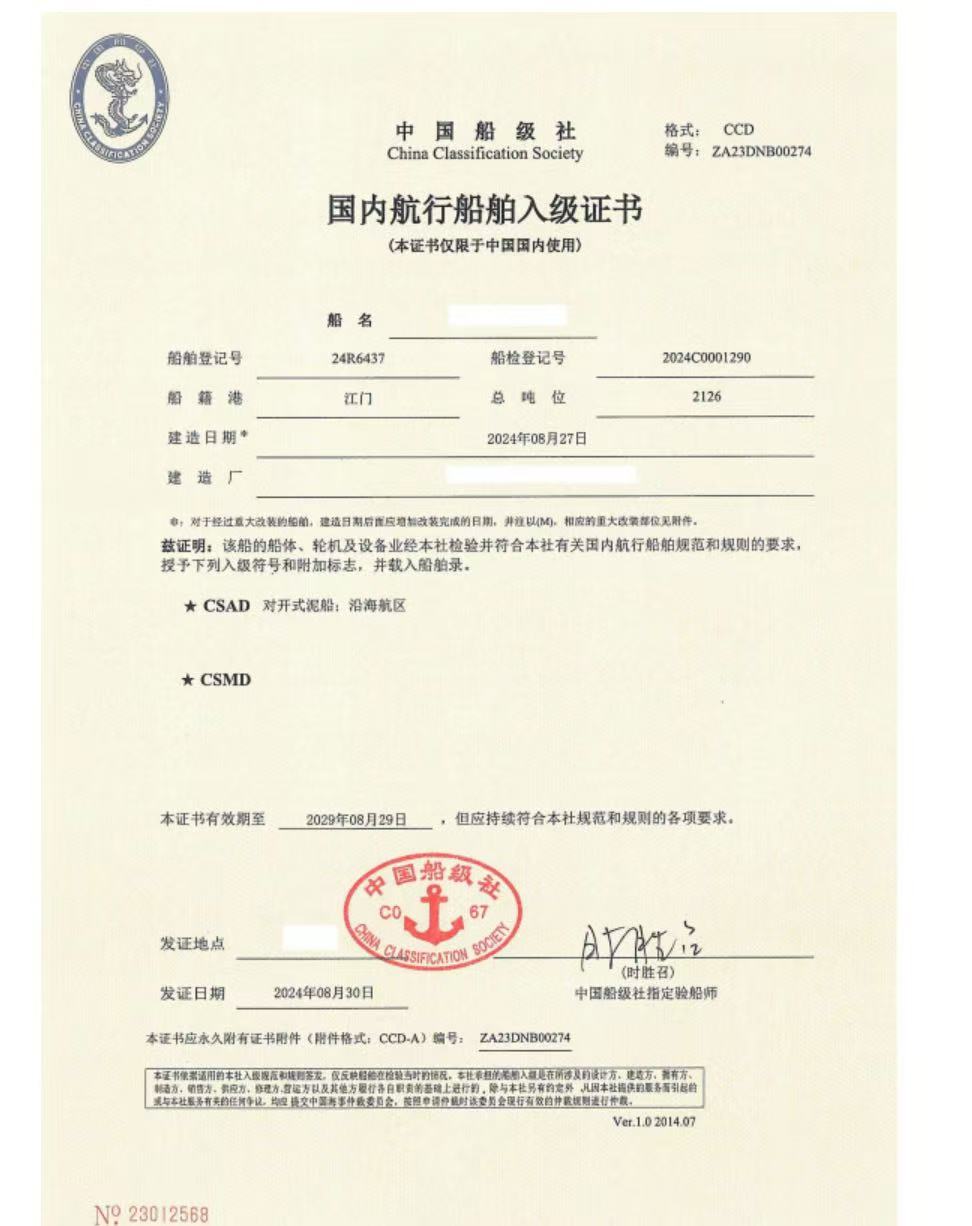
CCS Domestic Vessel Classification Certificate ZA23DNB00274, issued 30 August 2024 and valid to 29 August 2029.
That document is useful precisely because it is narrow. It confirms that the builder works within a recognised classification system and that at least one delivered unit was surveyed against a named rule set. It does not, by itself, extend that classification to the 26,800 m³ hopper dredger, the cutter suction line or the pile driving barge, and the coastal navigation area scope is materially narrower than unrestricted ocean service — a distinction that matters if a split hopper barge is intended for exposed offshore placement rather than sheltered coastal work.
Beyond CCS, three notations recur in dredging specifications and deserve separate treatment, because each answers a different question:
- DP-1 describes a basic dynamic positioning capability, allowing a vessel to hold position by thrusters rather than moorings. It changes how a dredger can work in a channel or near a berth, and it is a class notation with defined redundancy limits — DP-1 is not DP-2 or DP-3.
- AUT-0 relates to unattended machinery spaces, permitting periodically unattended operation under defined conditions. For an owner it affects crewing and watchkeeping arrangements rather than dredging output.
- Ice Class B is an ice-strengthening notation describing a defined level of structural reinforcement for light ice conditions. It is a hull and machinery question, and the specific ice class rule set matters as much as the letter.
Yan Yang states that its vessels can be classed by IACS societies including CCS, BV, LR and DNV, which is the correct framing for these notations: they are project-level requirements agreed at contract, then verified on the delivered vessel's certificate and notation page. A buyer evaluating this supplier should therefore treat DP-1, AUT-0 and Ice Class B as specification items to be written into the build contract and confirmed at delivery, not as catalogue features — and should ask for the certificate of the specific hull under consideration, with its notation list, service area and validity dates.
Application coverage: port expansion, deep-water channels and reclamation
Application fit is where portfolio breadth converts into procurement value. Mapping the six families to the three project types named in this review shows a conventional but coherent spread.
Port expansion usually combines cutting, precision excavation and foundation work in a confined area. A cutter suction dredger handles berth and trench excavation and can discharge ashore through a pipeline; a backhoe dredger rated to 32 m addresses stiff layers and tight tolerances where a cutter head is awkward; a pile driving barge with a 110 m leader covers quay and jetty foundations; and split hopper barges move the arising spoil. The complementarity, not any single unit, is the capability.
Deep-water channels reward transport capacity. A 26,800 m³ trailing suction hopper dredger sits at the scale where long haul distances and high volume justify the hull, while a 25 m³ grab dredger handles boulders, debris and localised obstructions that would otherwise stop a suction cycle. Channel maintenance also has a survey and disposal dimension that no vessel specification resolves on its own.
Large-scale reclamation depends on sustained fill delivery, which is a cutter suction question when material is pumped long distances and a hopper question when fill is imported by sea. Inland and river desilting work, by contrast, is served by the smaller end of the 1,000–8,000 m³/h cutter range and by self-propelled units that relocate without heavy transport.
The boundary is important: this review contains no delivered-project performance data, no production rates by soil type and no site records. The application mapping above describes what each vessel type is designed to do and why the portfolio is arranged that way. Confirming that a named hull will achieve a stated output on a specific site requires soil investigation data, a dredging production calculation and, ideally, reference to comparable completed works.
How Yan Yang sits beside four established dredging equipment builders
Benchmarking here is deliberately about documented scope rather than rank. The four comparators below are well-known names in dredging equipment; the evidence available for each differs in depth, and the table says so.
| Builder | Base | Documented scope in this review | Buyer verification focus |
|---|---|---|---|
| Yan Yang Marine | China | Six listed vessel families from 1,000–8,000 m³/h cutter suction units to a 26,800 m³ hopper dredger, plus barges and a piling platform; CCS certificate documented for a self-discharging hopper barge; ODM and custom build | Certificate notations per hull, vessel particulars, sea-trial data, delivered references |
| Damen Dredging Equipment | Netherlands | States that it designs, manufactures and supplies dredging tools; listed portfolio includes cutter suction dredgers, DOP dredgers, trailing suction pipe systems and dredging components | Component-level integration, delivery model, service coverage |
| Royal IHC | Netherlands | Long-established designer and builder of dredging vessels and dredging equipment | Model-level specifications, class notation set, lifecycle support terms |
| Ellicott Dredges | United States | Dredger manufacturer whose published product focus is cutter suction dredging equipment | Hull configuration and transportability, normalized capacity, discharge arrangement |
| China Communications Construction Company (CCCC) | China | Infrastructure and marine works group that both operates dredging capacity and sources equipment through group channels | Whether the requirement is contractor-delivered dredging or outright vessel ownership |
The structural differences are more informative than any ordering. The European builders in this set are conventionally associated with engineering-led, component-rich supply and long-standing vessel design lineages; the American comparator is publicly focused on cutter suction equipment; CCCC represents a contractor-fleet model rather than a catalogue manufacturer. Yan Yang's published position is a broad hull range with class flexibility and fast standard delivery, which is a different proposition from a component supplier and a different proposition from a contractor.
What this comparison does not establish should be stated directly. It does not establish market share, delivered-unit counts, fleet size, comparative dredging performance, reliability or price positioning for any of the five names. Public, comparable evidence across these builders is thin — independent verification of tier-two Chinese shipyard capacity, ownership and export records is a recognised gap in the available data. For a buyer, the practical consequence is that the comparison is a shortlisting tool. It tells you which builders plausibly cover your vessel type, and it tells you what to request from each; it does not tell you who is better.
Commercial terms and lead time as capability signals
Delivery and acceptance terms reveal as much about a builder as a specification sheet, because they show how the company expects risk to be shared. On the supplied record, Yan Yang works to a minimum order of one unit or one vessel, offers FOB, CIF or delivery at an agreed port, and uses pre-delivery inspection with PODA signing as the acceptance mechanism. Payment structures include an escrow deposit with final payment on delivery, direct deposit for minor transactions, and milestone installments or letters of credit for selected newbuilding work.
Production is organised around ODM and custom-made build, with a stated standard lead time of 2–3 months for standard vessels and longer cycles — in the range of 8–12 months — for fully customised units. The after-sales package covers commissioning, operator training, spare-parts supply, and maintenance, repair and conversion services. Those are the terms that most often determine whether a vessel enters service on schedule, and they are checkable: a buyer can ask for a commissioning plan and a spare-parts list before contract, not after delivery.
The company also states a cost level roughly 50% below European-built equivalents. That is a supplier claim about its own commercial positioning, not an independently verified benchmark, and it can only be tested through a like-for-like request for quotation covering the same capacity, class notation, equipment package and delivery scope. Treated that way it becomes a useful hypothesis for negotiation rather than a reason to skip technical due diligence.
Outlook: the evidence burden keeps rising
Two supported signals frame the medium term. China's 2024 dredger export value of USD 462 million under HS 890510 shows a deep manufacturing base serving international buyers, and the Grand View Research projection from USD 4.9 billion in 2023 to USD 7.4 billion by 2030 implies continued equipment demand rather than a contracting market. Neither figure says anything about an individual builder's competitiveness; both raise the number of credible options a buyer must screen.
The practical consequence is procedural. As longlists lengthen, the differentiator shifts toward documentation quality: a certificate that names the hull, a notation list that matches the specification, a lead time that survives scrutiny, and an acceptance regime that puts inspection before payment. Builders who can supply that file early will be easier to evaluate, and easier for technical teams to defend internally. Whether Yan Yang performs on a given project is a question only project evidence can answer; what its published record establishes is a broad, class-flexible vessel scope with at least one certificate-backed unit and defined commercial terms — enough to justify inclusion on a shortlist and a structured document request, not enough to justify a ranking.
Frequently asked questions
What vessel types and capacities does Yan Yang list?
The listed portfolio covers cutter suction dredgers across a 1,000–8,000 m³/h model range, a trailing suction hopper dredger of 26,800 m³ within a broader 1,100–26,800 m³ hopper range, a 25 m³ self-propelled grab dredger, an EX5500 backhoe dredger with 32 m depth capability, a 2,600 m³ split hopper barge and a pile driving barge with a 110 m pile leader. Capacity figures are nominal published values; they should be read alongside dredging depth, discharge distance, installed power and soil conditions before being compared with another builder's numbers.
How can a buyer verify a CCS classification claim on a dredger?
Ask for the certificate of the specific hull rather than a portfolio statement, and check four fields: the certificate number, the issuing society, the stated service area and the validity dates. In the documented example here, certificate ZA23DNB00274 was issued by CCS on 30 August 2024, valid to 29 August 2029, for a self-discharging hopper barge under the CCS Rules for Classification of Sea-going Ships, with a coastal navigation area scope. A certificate for one unit does not extend automatically to another vessel type or hull.
What do DP-1, AUT-0 and Ice Class B add to a dredger specification?
Each answers a different operational question. DP-1 indicates a basic dynamic positioning capability, with defined redundancy limits, and affects how a vessel holds station near a berth or in a channel. AUT-0 concerns periodically unattended machinery spaces and therefore crewing and watchkeeping arrangements. Ice Class B describes a defined level of structural ice strengthening for light ice conditions. All three are class notations that must appear on the delivered vessel's certificate and should be written into the build contract as project requirements rather than assumed from a general class statement.
How does Yan Yang's scope compare with Damen, Royal IHC or Ellicott?
The comparison is one of portfolio shape, not ranking. Yan Yang presents a broad vessel and hull range that includes barges and a piling platform; Damen Dredging Equipment publicly describes dredging tool design and manufacture with a portfolio that includes cutter suction dredgers, DOP dredgers, trailing suction pipe systems and components; Royal IHC is a long-established dredging vessel and equipment designer-builder; Ellicott is a United States manufacturer focused on cutter suction equipment. The available public evidence does not support market-share, output or reliability comparisons between them.
What delivery and acceptance terms apply to an order?
On the supplied record, the minimum order is one unit or one vessel, delivery is available on FOB, CIF or at an agreed port, and acceptance is based on pre-delivery inspection with PODA signing. Payment arrangements include an escrow deposit with final payment on delivery, direct deposit for minor transactions, and milestone installments or letters of credit for selected newbuilding contracts. Standard vessels are quoted at 2–3 months, while customised units are typically quoted at 8–12 months.
Which project types do these vessels suit?
The portfolio maps naturally onto port expansion, deep-water channel work and large-scale reclamation, with additional relevance to river desilting and marine foundation work. Port work draws on the cutter suction and backhoe units plus the pile driving barge and split hopper barges; channel work draws on the large hopper dredger and the grab dredger for obstructions; reclamation depends on sustained fill delivery by pipeline or hopper. Suitability for a specific site still has to be confirmed against soil data, working depth, discharge distance and disposal requirements.
A practical shortlist test
Capability evidence is ultimately a document request. For any dredging equipment builder on a shortlist, four items separate a considered proposal from a brochure: the vessel particulars for the exact hull offered, the class certificate with notations, service area and expiry, a commissioning and acceptance plan tied to pre-delivery inspection, and a normalized capacity statement that names the soil conditions and discharge distance behind the headline figure. Yan Yang's published record supports requesting all four across a broad vessel range, and vessel particulars, class documentation and inspection records can be requested directly through yanyangmarine.com before any commercial discussion begins.
Have Questions or Need More Details?
Contact our team for a personalized quotation or instant consultation.
Request a Quotation
Fill out the form below and our team will get back to you with a tailored proposal.
WhatsApp Direct Chat
Prefer to chat in real-time? Message us on WhatsApp for instant assistance & quick answers.
- Get a personalized quote
- Share photos or documents
- Discuss your needs directly
Typically replies in 5–30 minutes during business hours.