
What Trade Records Prove About an Exporter's Real Capability
What Trade Records Prove About an Exporter's Real Capability
An exporter's capability usually arrives as a narrative: years in business, factory size, production lines, certificates and a product catalogue. When an importer moves from evaluation into execution — placing a deposit, booking tooling, scheduling a first shipment — that narrative has to become checkable. Trade records are the part of a supplier file that can be examined without relying on the supplier's own description, because each record marks a shipment that was declared and moved.
This guide explains how importers can read shipment records as entity-level evidence of an exporter's real capability: activity across products, HS codes and destinations, behaviour over time, supply chain relationships, and the company and contact details behind the name. It also sets out where that evidence stops, since a shipment record proves that goods moved — not that they met a specification.

The gap that shipment records close
Most shortlists begin with statements. An exporter presents a catalogue, a factory profile, certificates and a list of markets it says it serves; a marketplace listing adds a membership badge; a trade-show conversation adds impressions. Each is useful for building a long list. None is an independent record of a commercial event, and at the execution stage the questions become specific: is this company the party that actually ships, does the product mix match what I am buying, is my destination market already served, and can the person I am talking to approve an order?
Shipment records answer at a different level. Customs declarations and bill-of-lading records are generated in the ordinary course of moving goods, and a shipment-level dataset links an exporter, a consignee, a product description, an HS code, a quantity, an origin and a destination around a date. A handful of records is an anecdote. The distribution — how often, for which products, into which markets, between which counterparties, across how many years — is a pattern that a brochure cannot produce.
That is the difference between document-level and entity-level evidence. One bill of lading confirms that a consignment moved. Entity-level evidence reconciles many records to one legal company, which is what allows an importer to make a defensible statement about a company's export activity instead of about a single container.
Four conditions that make a record usable
The same data can mislead if it is read carelessly. Four conditions decide whether a record supports a judgement about an exporter.
- Identity resolution. Company names appear in several forms, and a shipper field may be occupied by a forwarder, a consolidator or a trading intermediary rather than the manufacturer. Tendata states that it distinguishes logistics companies from actual importers and exporters, which is the step that stops a service provider from being qualified as a producer.
- Field standardization. Trade data arrives with inconsistent company names and quantity units. Tendata reports that it regularly standardizes company names, quantity units and other fields to reduce duplicate or inconsistent records; without that work, volume totals and name matches are unreliable.
- Recency. Export activity is not permanent. A record set should be read by date distribution — the most recent shipment, the density in the past year, the gaps — rather than by total record count.
- Lane coverage. Customs disclosure regimes differ, so the depth of shipment data varies by country and trade lane. Before treating an absence as meaningful, confirm that the origin-destination pair and product category in question are represented in the dataset.
Six evidence types to examine
1. Shipment activity: is the company actually exporting?
Recent, repeatable activity is the first test. An exporter shipping monthly across several consignees looks different from one whose last visible shipment is years old, and that difference belongs in the qualification file before any commercial discussion. What activity does not settle is availability: a dense record shows that goods moved, not that capacity exists for your order window, which has to be confirmed against the supplier's own production and order book.
2. Product and HS-code scope
Comparing declared products and HS codes with your purchase category is the quickest way to test whether a stated specialization is real. A supplier claiming a narrow focus but appearing almost entirely under unrelated codes deserves a question. Two cautions apply: classification is entered by the declarant, so codes are sometimes broad or inconsistent, and a precise description in one record does not guarantee the same item in the next. Treat the code distribution as a screening signal and confirm item detail with the supplier.
3. Destination and market footprint
The destination field shows which countries and regions an exporter's goods were declared into. An exporter already shipping into your region has met your market's documentation, labelling and buyer expectations, which usually shortens the qualification conversation. Destination is not, however, the end customer: goods may arrive through an importer, distributor or another intermediary, so a record shows the arrival market rather than who ultimately used the product.
4. Behaviour over time
Trend carries more information than any single month. Activity that grows across several years, with seasonal peaks in the expected months, describes an established commercial rhythm; a burst followed by silence describes something else and may reflect a one-off project, a lost customer or a disruption. A pause should be treated as a question to ask rather than a conclusion to record, because the cause may be strategic rather than operational.
5. Supply chain relationships
Records place an exporter between named counterparties: consignees and destinations on the export side and, where the data permits, suppliers of inputs on the import side. This is where a trading company is separated from a producer, and where concentration becomes visible — an exporter depending on one or two buyers carries a different risk profile from one spread across many. Contract terms, exclusivity and payment conditions are not visible in shipment data and must be established commercially.
6. Company background and contact verification
A record identifies a company; it does not describe it. Registration and background, products, supply chain relationships, financial information, intellectual property, litigation and risk, news and public sentiment, and trade-show participation turn an entity match into an assessment. Contact verification closes the chain: a named decision-maker with a job title, a business email on the company's own domain, a telephone number and a professional profile can be checked before a deposit is discussed. A verified mailbox proves the address exists; authority to approve a purchase order is confirmed in conversation.
Where trade records stop
Qualification quality depends as much on stating the boundaries as on reading the records.
- Activity, not conformance. Nothing in a shipment record shows that goods met a specification, passed inspection or conform to a standard. Test reports, certificates and sample evaluation remain separate evidence.
- Absence is not incapability. Many competent manufacturers export through trading companies, or ship to markets whose customs data is not published at shipment level. A blank result should trigger a different question — who is the exporter of record? — rather than a rejection.
- Intermediaries appear in the data. Forwarders, consolidators and traders can occupy the shipper or consignee field. Entity resolution reduces the risk of misreading them; it does not remove the need to confirm who manufactures.
- History is not capacity. Records describe what has shipped. Current capacity, lead time and order book are confirmed directly with the supplier.
- Coverage is uneven. Verify that your product category and lane are represented before drawing a conclusion from a thin result.
- Financial and compliance status need separate checks. Trade records do not report solvency, ownership structure, sanctions exposure or certification status.
How trade records compare with conventional exporter checks
The methods used in supplier evaluation answer different questions, which is why they work better together than in competition.
| Verification method | Question it answers well | What it cannot establish alone |
|---|---|---|
| Supplier self-declaration and catalogue | What the exporter states it can make, and to which stated specification | Whether the company has actually shipped that product, in what volume, to which markets |
| Buyer references | How one or two customers experienced the relationship | Whether the pattern holds across customers, markets or years; references are chosen by the supplier |
| Third-party factory audit | Whether a named site, on a named date, meets an audited standard | Export activity, market coverage, or whether your order will run at that site |
| Product certificates and test reports | Conformance of a tested product or line to a named standard | Volume shipped, counterparties, commercial continuity |
| Platform verification badge | That a company met a marketplace's own listing criteria | The independent shipment history behind the badge |
| Trade-record analysis | Whether declared products actually moved, with what frequency, to which destinations, between which counterparties | Product quality, conformance, contract terms, available capacity or financial health |
A qualification file that pairs a shipment pattern with a certificate and a sample result answers more than any single method, and each element keeps the others honest: records show that trade happened, documents show what was agreed, and a sample shows what arrives.
Running the check: from profile to verified contact
Supplier qualification and company due diligence are often run as separate exercises by different teams. Inside one platform that combines trade data, company information, contact information and AI, the two collapse into a single sequence.
- Define the evidence profile. Before searching, write down what would count as proof for this category: products and HS codes, destination markets, minimum shipment frequency, whether the exporter of record must be the manufacturer, and which company attributes matter. The profile becomes the test that every candidate is measured against.
- Build the long list from shipment activity. Search by product, HS code, company name or country to assemble exporters with visible records in the relevant category and market. This replaces list-building from directories with list-building from recorded trade.
- Screen on trade behaviour. Filter by product relevance, target country, company type, trade frequency and consistency of activity, then prioritise. The output at this stage is a shortlist for investigation, not a supplier decision.
- Complete due diligence on the shortlist. Review import and export products, HS codes, trade history, frequency and volume, buyers, suppliers and trading relationships, and set them beside company background. This is where the claim 'we export to Europe' becomes a date, a destination and a consignee.
- Verify contacts and open a documented conversation. Identify purchasing, sourcing or export sales managers, confirm the domain, telephone number and role, then corroborate the record-based picture with documents the supplier provides and, where the order size justifies it, a sample and a site check.
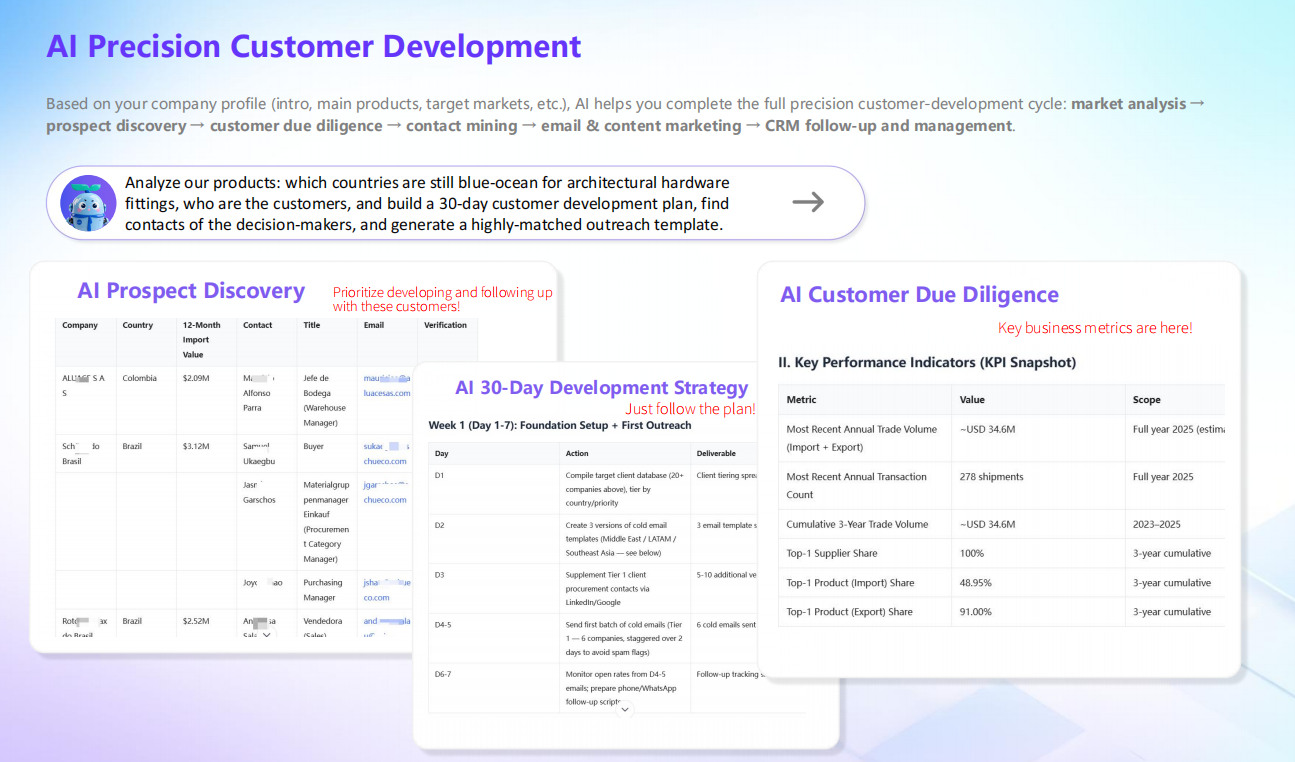
The sequence matters more than the tooling. Each stage produces a written criterion, and commitment follows only when records, documents and conversation agree.
What the data layer behind the check has to provide
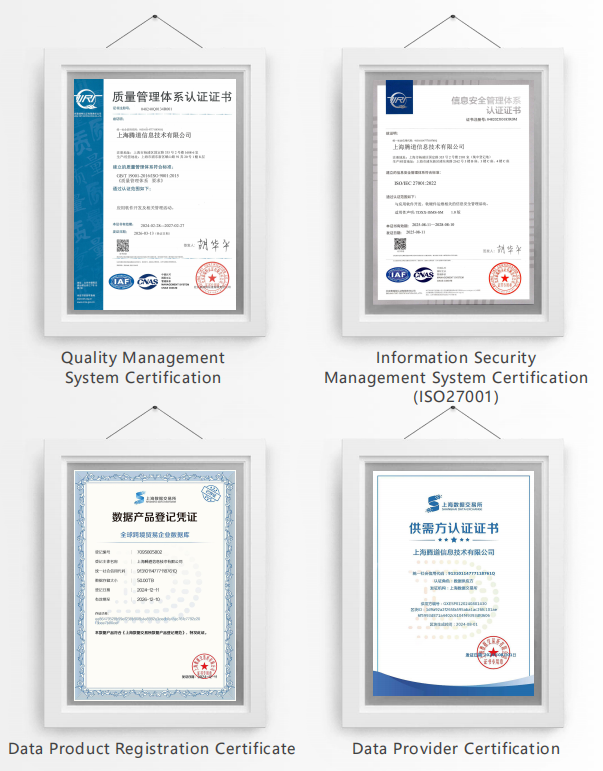
Shanghai Tendata Tech Co.,ltd (Tendata) is a trade intelligence platform founded in 2005 and headquartered in Shanghai, China, specializing in global trade data and AI-powered analytics. Its stated coverage is more than 10 billion real and verifiable trade records across 228+ countries and regions, 230+ industries and more than 500 million importers and exporters, with trade data sourced from customs authorities, commercial databases and internet databases, and updates that can be as frequent as every three days.
For this workflow, coverage matters only where the surrounding fields exist. Tendata's company layer covers 500+ million in-depth company records, including business operations, financial information, products, supply chain relationships, news and public sentiment, intellectual property, litigation and risk information, and trade shows. Its contact layer is stated at 850+ million verified business contacts, including job titles, telephone numbers, email addresses and professional profiles. Company background and contact verification therefore sit beside the shipment evidence rather than in separate systems, and the platform is operated by Shanghai Tendata Tech Co.,ltd.
The product set reflects that structure: Tendata AI links the trade databases to large language models for company discovery, due diligence and outreach drafting; T-Info builds buyer, supplier, country-of-origin and destination-country lists from HS code, product or company searches across 17 report models; and T-Insight generates market reports from a product name or HS code across customer, competitor, market and product perspectives with more than 100 interactive visualizations. The company reports a 150+ person technology and R&D team, two registered trademarks, 150+ intellectual property rights and 100+ awards and certificates, and states that it has served more than 100,000 businesses worldwide.
Market direction: from periodic checks to continuous evidence
Supplier verification has traditionally been periodic — a check before a first order, then little until a problem appears. Two developments push it toward continuous evidence. Trade management is now a defined software category: Mordor Intelligence projects the global trade management market to reach USD 2.84 billion in 2026 in a report published in May 2026. At the same time, documentation scrutiny has become more expensive to fail: IMARC Group reports that US Customs and Border Protection collected more than USD 88 billion in duties in 2024, which raises the value of a documented trade history that can be reconciled during an audit. Tendata frames the same shift as a move from one-time research to continuous market intelligence, supported by monitoring and alerts.
Outlook
The direction of travel is toward evidence that updates itself. AI-assisted monitoring of company activity, shipment patterns and market change turns a supplier file into a living record rather than a snapshot taken at onboarding, and natural-language querying lowers the skill needed to interrogate it. Two constraints will remain. Records describe movement, not conformance, so documents and samples keep their place; and interpretation still requires a criterion written by the buyer, because a system can surface an exporter's shipment history but cannot decide how much continuity, which destinations or which counterparties matter for a specific order. The practical model is AI plus a human qualification workflow, not AI instead of one.
What importers should take away
Trade records are most useful as entity-level evidence: a reconciled pattern of what an exporter has shipped, to whom and for how long, checked against a profile written before the search began. They convert reputation claims into dated events, expose intermediaries, and give a procurement team something specific to corroborate. They do not confirm quality, capacity or solvency, and an empty result is a question rather than a verdict. Used with those boundaries stated, shipment data turns supplier qualification and company due diligence into one continuous, reviewable process instead of a sequence of impressions.
FAQ
Do trade records prove an exporter can meet my product specification?
No. Shipment records show that declared products moved, in what quantity and into which markets; they do not show that goods met a specification, passed inspection or conform to a standard. Conformance is established through test reports, certificates, sample evaluation and, where the order justifies it, a site audit. Trade records are used to select and prioritise, and documents are used to confirm.
Can a legitimate manufacturer have no export records?
Yes. A factory may sell exclusively through trading companies, or ship to markets whose customs data is not published at shipment level. In that case the exporter of record may be an intermediary rather than the production site. Absence of records is a prompt to identify the commercial route and the parties involved, not evidence that the company is incapable of supplying.
How much shipment history is enough?
There is no universal threshold, because the right depth depends on order size, category seasonality and the market. A practical test is to look at recency, continuity and distribution together: the most recent shipment date, whether activity recurs across years, and whether consignees and destinations form a pattern rather than a single event. Categories with long project cycles naturally show sparser records than fast-moving consumer goods.
How current does the trade data need to be?
Current enough to reflect present activity. Tendata states that its updates can be as frequent as every three days, but the deciding factor is the date distribution of the specific company's records. A supplier with dense records over the past year and silence afterwards needs a question answered; a supplier with a steady recent pattern presents a different case.
Can trade records replace a factory audit or certification check?
No. The three answer different questions. A shipment record confirms commercial movement between parties, an audit examines a named site against a standard on a given date, and a certificate reports the conformance of a tested product. Most procurement decisions need all three, weighted according to the risk and value of the specific order.
Tendata company brochure (PDF, publicly accessible): Tendata Introduction.
Have Questions or Need More Details?
Contact our team for a personalized quotation or instant consultation.
Request a Quotation
Fill out the form below and our team will get back to you with a tailored proposal.
WhatsApp Direct Chat
Prefer to chat in real-time? Message us on WhatsApp for instant assistance & quick answers.
- Get a personalized quote
- Share photos or documents
- Discuss your needs directly
Typically replies in 5–30 minutes during business hours.