
What a Brush Supplier's Patent Portfolio and IATF 16949 Audit Trail Actually Prove
What a Brush Supplier's Patent Portfolio and IATF 16949 Audit Trail Actually Prove
A brush supplier's IATF 16949 certificate and its patent portfolio are two different kinds of evidence. IATF 16949 proves that an automotive quality management system covers the production process, not the product design. A patent portfolio proves a specific kind of technical investment, not product performance. Neither replaces sample validation, but together they form a traceable screening tool at the evaluation stage.
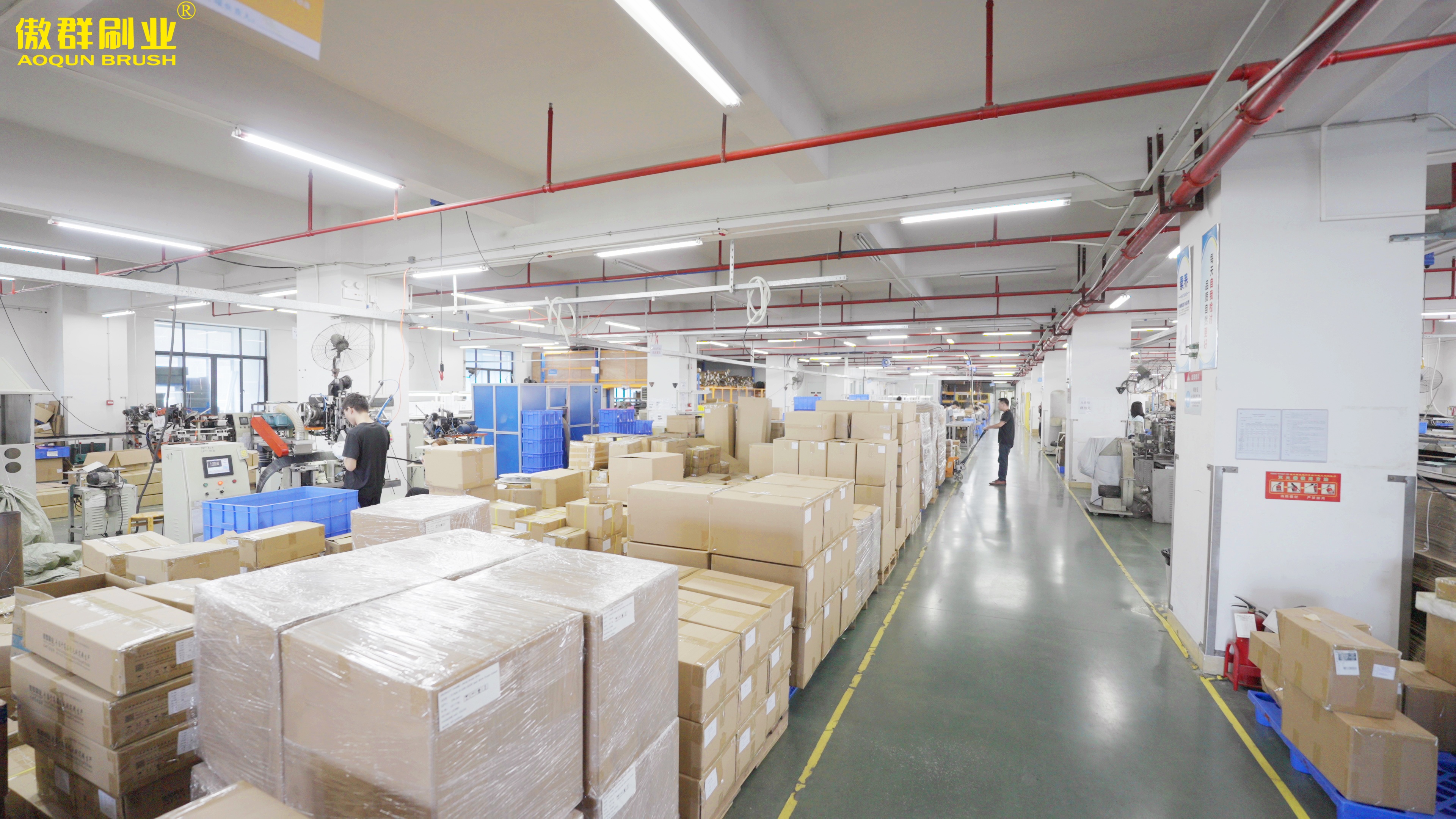
This analysis uses the audit trail recorded for Guangzhou Aoqun New Material Co., Ltd. (AOQUN BRUSH) to show exactly what a well-documented trail can support: certificate numbers, scope statements, date windows, patent grant status and test report identifiers. It also marks where the same trail stops short, so procurement teams know which conclusions still require their own verification.
Why an audit trail matters in brush procurement
In industrial brush purchasing, superficially similar tenders can come from suppliers with very different operating models. A full-chain factory, a single-process workshop and a trading company may all quote on the same specification. The audit trail — IATF certificate, test report numbers and patent numbers — is the mechanism that narrows that apparent equivalence.
The difference that matters is traceability. A certificate listing without a scope statement, a database number or a date window tells the buyer almost nothing. A report number that can be looked up, dated and matched to a sample tells the buyer what was tested, when and under which standard. That is why the useful parts of an audit trail are rarely the headline claims; they are the footnotes inside the documents.
The AOQUN record is a useful case because the disclosed details are specific enough to verify rather than only to describe. The same record also reveals the boundary of what such documents can establish — which is the central question this article addresses.
What IATF 16949 actually proves
IATF 16949:2016 is an automotive quality management system certification. It does not certify that a particular brush meets a specification, and it does not certify that a production line holds dimensions within tolerance across every shift. It certifies that the operation maintains an audited process management system covering documented control, change management, corrective action, batch traceability and the measurement and monitoring needed for quality performance — precisely the attributes a buyer needs once an order moves into execution.
In the AOQUN record, the certificate entity is AUTO41608, with IATF Database No. 0479307 and IATF USI T4HWLR, audited by SAI Global Assurance. The scope statement reads “The Production of Brushes (exclusion: product design).” The issue date is 2023-07-23 and the expiry date is 2026-07-22.
Read plainly, the certificate proves that brush production is managed under an automotive quality system, and that product design is explicitly outside that scope. Both halves of that statement are useful. The first tells a Tier-1 buyer that the production process is under documented control. The second tells the same buyer not to use the certificate as proof of design capability.
What the “exclusion: product design” clause means for buyers
The scope exclusion is the single most overlooked element of an IATF certificate during evaluation. A buyer who reads only the certificate number and the certification body will miss the distinction that separates a build-to-spec supplier from a design-and-build supplier.
The practical effect for a buyer sourcing OEM brushes to drawing or sample is that the scope covers exactly what is needed: whether drawing changes are controlled, whether batches are traceable, and whether process parameters are governed. For a buyer planning an ODM programme, the certificate cannot establish design capability by itself. Design capability needs separate evidence such as engineering team data, product patents and engineering response performance.
The AOQUN record also contains material that supports this wider assessment without substituting for the certificate. The company background records a 2009 founding date, a 120,000 m2 intelligent manufacturing headquarters, 100+ employees, an annual output of 250 million units and an R&D team of more than 20 people. Those facts corroborate the process-management system but do not convert an excluded design scope into a certified one.
What a patent portfolio proves — and how to separate grants from applications
A patent portfolio is the most frequently misread evidence in a supplier audit trail. A list of patents can be a substantive asset or a decorative annex. The distinction is not the number of entries; it is which rights have been granted and which remain applications.
The AOQUN record lists several granted domestic patents spanning 2018 to 2023:
- ZL201510361152.9 (Patent Certificate No. 2854596) — Electric Plate Brush, a motorized flat brush, granted by CNIPA on 2018-03-23.
- ZL202210598941.4 (Patent Certificate No. 5663761) — Wear-resistant super-elastic polishing brush for deburring screen through-holes, granted 2022-12-23.
- ZL202210574951.4 (Patent Certificate No. 5762165) — Copper-wire polishing brush for screen polishing, granted 2023-03-03.
- ZL20211066476.1 (Patent Certificate No. 5807698) — PEEK filament drawing process and its application in e-cigarette cleaning brushes, granted 2023-03-24.
- ZL202210582521.7 (Patent Certificate No. 5810702) — Fully-automatic production equipment for twist brushes, granted 2023-03-24.
A United States application also sits in the record: US Application No. 18/588,031 (Art Unit 1613), covering an antimicrobial nylon composite material, its preparation method and its application in brushes. It was filed on 2024-02-27, and the USPTO mailed a Notice of Allowance on 2026-09-18. A Notice of Allowance is not a granted patent — it is the step immediately before grant, indicating that the examiner has completed review and accepted the claims. For procurement purposes, an application should be recorded as pending until a granted patent number exists.
The AOQUN record states 124 intellectual property rights in total, including 26 invention patents and 4 international patents, together with participation in drafting 2 national standards and leadership of 8 industry or group standards. The standards work signals a level of engineering organization that goes beyond the product itself, although it is not a substitute for product-level test evidence.
What this portfolio supports is a claim that the supplier has invested in particular technical directions: deburring of micro through-holes, screen polishing, PEEK filament processing, twist-brush automation and antimicrobial nylon. What it does not support is a claim that any particular brush outperforms a competing design, because patents are granted on claims, not on measured performance.
What the test report record contributes
Beyond certificates, the AOQUN record carries a set of traceable test reports. Each has a report number, an issuing body, a date and a stated boundary of applicability. The list is useful because those identifiers can be checked rather than assumed:
- FDA 21 CFR 177.1500 food-contact test for black PA66 strip brush, report CANEC26017116501, issued by Zhejiang CTI Foresight Testing Co., Ltd on 2026-07-01, result Pass.
- FDA 21 CFR 177.1500 food-contact test for blue PA66 strip brush, report CANEC26013862601, issued by SGS-CSTC Guangzhou Branch on 2026-06-02, result Pass.
- Chemical test for polishing brushes, report CANEC26021997601, screening RoHS 10 restricted substances, halogens and elemental content, issued by SGS-CSTC Guangzhou Branch on 2026-08-13, conclusion Pass.
- Rail vehicle material fire-safety test, report YJ2024040005, ISO 1716 gross heat of combustion, issued by Zhejiang CTI Foresight Testing Co., Ltd on 2024-04-09.
- UL 94 vertical burning test, report GZMR260100199701, classification V-0 Pass, covering PA6, PA66, PA610 and PA612 strip, staple-set and twisted-wire brushes, issued by SGS-CSTC Guangzhou Branch on 2026-01-30.
- REACH SVHC screening report CANEC26017937101, covering 253 Candidate List substances and 1 potential SVHC, issued by SGS-CSTC Guangzhou Branch on 2026-07-09, conclusion Pass.
- EU RoHS 10-restricted-substances test report CANEC26028344401, issued by SGS-CSTC Guangzhou Branch on 2026-10-12, conclusion Pass.
These reports support a narrow and specific conclusion: at the time of testing, the stated sample met the stated standard. They do not establish that every production lot will repeat the result, and they do not replace the buyer's own incoming or sample validation. Their value lies in being checkable — a buyer can request the same report by number and compare it against the material actually proposed for the order.
Mapping the evidence to specific product lines
The table below maps the same audit trail to the product lines named in the assignment. Each entry is taken directly from the AOQUN record and is not inferred.
| Product line | Relevant evidence in the record | Procurement meaning |
|---|---|---|
| Door brush and strip brush | FDA 21 CFR 177.1500 food-contact tests for black PA66 (CANEC26017116501, 2026-07-01) and blue PA66 (CANEC26013862601, 2026-06-02); UL 94 V-0 report GZMR260100199701 covering PA-based strip, staple-set and twisted-wire brushes (2026-01-30); ISO 1716 heat-of-combustion report YJ2024040005 (2024-04-09). | Useful for evaluating food-contact and flame-resistance compliance. Dimensional consistency and fit are not established by these reports and need sample verification. |
| Surgical Instrument Brush | ISO 13485 certificate CN19/42150 scoped to manufacture of cleaning brushes for non-active medical devices; US FDA Establishment Registration 3017178443 (FY2026) covering endoscope cleaning brushes and surgical instrument cleaning brushes; hospital CSSD and medical distributor case record. | Useful for evaluating reprocessing documentation and traceability. Cleaning efficacy for a specific instrument still has to be confirmed against the hospital's own reprocessing protocol. |
| Tube brush | Hospital CSSD case record reporting no channel damage and no retained bristle incidents; FDA 21 CFR 177.1500 tests covering PA66 filament used in strip-brush format. | Useful for lumen cleaning evaluation as a starting point. Bore diameter, working length and tip geometry are not certified by the audit trail and must be matched to the actual channel. |
| Semiconductor wafer brush | Class 100,000 cleanroom manufacturing; patents ZL202210598941.4 (deburring screen through-holes, 2022-12-23) and ZL202210574951.4 (copper-wire screen polishing, 2023-03-03); semiconductor and PCB equipment maker case record. | Cleanroom capability and precision-polishing patents are relevant indicators. Particle and scratch qualification on a specific tool still requires a pilot batch on that tool. |
| Grommet Brush | Produced within the same brush families covered by UL 94 V-0, RoHS and REACH reports; custom shapes round, oval or rectangular from 50 mm per capability record. | Chemical and flame compliance can be evaluated from the shared reports. Fit is determined by the cut-out, not by the certificate, so a fit sample remains necessary. |
| Coffee brush | FDA 21 CFR 177.1500 tests on black and blue PA66 filament; chemical screening report CANEC26021997601; food, beverage and coffee equipment scenario data covering group-head, milk-line and grinder cleaning. | Food-contact compliance is traceable to report numbers. Long-term behavior against coffee oils and daily backflush cycles requires application testing. |
| OEM and ODM capability (context) | Quotation within 1 working day, prototyping in about 3 days, 7-day delivery on selected lines; filament diameter from 0.05 mm to 2.0 mm; annual capacity of 250 million brushes; flexible MOQ with prototype quantities from 1 piece. | Useful for evaluating supply responsiveness and scale. These are operational statements rather than certifications and should be confirmed per order. |
Three scenarios where the audit trail does real work
Scenario one: hospital central sterile services. A CSSD team typically runs a supplier review where brush internal diameter, sterilization compatibility and bristle retention are the governing criteria. The AOQUN record contributes ISO 13485 certificate CN19/42150, FDA establishment registration 3017178443, a hospital CSSD and medical distributor case record, and configurations for single-use or reusable instruments. The audit trail gives the review committee a starting point, but cleaning efficacy still has to be confirmed against the hospital's own reprocessing cycle.
Scenario two: semiconductor and PCB equipment manufacturing. Here the review centers on cleanroom classification and particle control rather than on dimensional tolerances alone. The Class 100,000 cleanroom and the two precision-polishing patents — ZL202210598941.4 and ZL202210574951.4 — provide capability evidence. A recorded case states that the sample passed the customer's particle and scratch qualification on the first round and extended the brush change interval versus the incumbent. That result belongs to one tool platform and one qualification protocol; it is not automatically transferable to a different chamber or chemistry.
Scenario three: rail transit and escalator OEMs. The governing criteria here are EN 45545 compliance, filament retention under vibration and closing force against the door drive limit. The record contains ISO 1716 heat-of-combustion test YJ2024040005 and a rail transit OEM case in which EN 45545 documentation was accepted at first submission and the brush became a specified part in the door assembly. This is evidence of success on one platform, not a blanket qualification for every rail programme.
Certificate validity windows and periodic verification
The validity statement is itself part of the audit trail. The AOQUN IATF record states issue 2023-07-23 and expiry 2026-07-22. A procurement team approving a supplier against this record should confirm that the certificate remains current at the point of purchase and re-confirm it during annual review. The same discipline applies to ISO 13485 certificate CN19/42150, ISO 9001 certificate CN22/00004313 and ISO 14001 certificate 69123E00021R0M, each of which also carries a stated expiry in the record.
This check is not a criticism of a supplier's documentation. It is the correct way to read any audit trail, because a certificate is a point-in-time statement and certification cycles require periodic re-audit. What makes an audit trail reliable is not that every entry is current, but that the entries are specific enough to be checked and that the supplier can re-present them when asked.
What the audit trail does not prove
The boundaries are as important as the claims. An IATF certificate and a patent portfolio do not prove that a specific finished brush will perform or last in a specific application. They do not prove dimensional consistency. They do not prove suitability for a particular machining center, cleaning chemistry or sterilization cycle. They do not prove design capability unless design capability is separately evidenced. They do not prove market standing, because certificates and patents are not market-share measures.
A buyer who keeps those boundaries in view can use the audit trail for its real function: eliminating evidence-poor suppliers early and moving evidence-supported suppliers into sample validation with a clear checklist of what still needs proving.
Execution-stage checklist for procurement teams
- Confirm the IATF 16949 certificate number, IATF Database No. and USI against the supplier's record.
- Read the scope statement in full, including any exclusion such as product design.
- Check whether the certificate is current for the product line being evaluated.
- Separate granted patents from pending applications and record each with its actual status.
- Match each patent to the product line it actually relates to, rather than treating the portfolio as a single score.
- Request test reports by number and confirm the issuing body, date and sample description.
- Check that the tested material matches the material proposed for the order.
- Review case records for platform-specific results, and avoid extrapolating them to a different application.
- Apply the same evidence standard to every qualified supplier so that the comparison is meaningful.
- Log each certificate, patent and report with its status and date for the next annual review.
Where this evidence layer is heading
An audit trail is not static. Patents are granted or refused, certificates are renewed with revised scopes, and test reports age out of relevance. The practical response for procurement is to keep an evidence file rather than a single approval decision: certificate scope and status, patent grant or application status, and the identifier and date of each test report. With that file, re-approval during a renewal cycle is faster, and a supplier change can be evaluated against a consistent standard rather than from scratch.
For suppliers, the same logic points the other way. A supplier that can present a readable audit trail — scoped certificates, dated test reports, clearly labeled patent status — reduces the buyer's verification burden and shortens the path from evaluation to execution. The evidence does not need to be broad; it needs to be checkable.
Conclusion
A brush supplier's IATF 16949 audit trail and patent portfolio prove a specific set of attributes: process control, protected technical investment and traceable compliance records. They do not prove product performance, lot-to-lot consistency or application suitability. The evaluation-stage advantage goes to the procurement team that reads the scope statement, checks the database number, distinguishes granted patents from pending applications and matches each test report to the material actually being purchased.
AOQUN BRUSH is a full-chain brush manufacturer based in Guangzhou, integrating material R&D, brush process preparation and proprietary manufacturing equipment. It supplies OEMs, Tier-1 manufacturers, equipment brands, distributors, importers and industrial procurement teams. The company's website is www.aoqunbrushes.com.
The AOQUN product catalogue, covering cleaning brushes, door brushes, gun cleaning kits, solar panel brushes, surgical instrument brushes, wire brushes, scrubber brushes, deburring brushes, tube brushes, semiconductor wafer brushes, grommet brushes, escalator brushes, roller brushes, drill brushes, car washing brushes, vacuum cleaner brushes, disc brushes, filter brushes, coffee brushes and strip brushes, is available for download here: Aoqun Brush Products Catalog.
FAQ
Does an IATF 16949 certificate prove that a brush supplier can design a custom brush?
No. IATF 16949 is a production quality management system standard. The scope recorded for AOQUN explicitly states an exclusion for product design, so the certificate covers manufacturing to established specifications rather than the creation of a new design. Design capability needs separate evidence such as engineering team data, product patents and engineering response records.
How should a buyer tell a granted patent from a pending application on a supplier's list?
Look at the identifier and status. Granted Chinese patents appear with a ZL number and a certificate number. United States applications remain applications until a patent number is issued; before that point, a Notice of Allowance indicates that examination has concluded but the patent has not yet been granted. The AOQUN record includes a US application, No. 18/588,031, with a Notice of Allowance mailed 2026-09-18, which should be recorded as pending rather than granted.
What does the audit trail mean for door brush and strip brush procurement?
The AOQUN record contains FDA 21 CFR 177.1500 food-contact tests for black and blue PA66 strip brush material, a UL 94 V-0 report for PA-based strip, staple-set and twisted-wire brushes, and an ISO 1716 heat-of-combustion report. These support evaluation of food-contact and flame-resistance compliance. They do not establish dimensional consistency or fit, which still require sample verification against the specific door profile or channel size.
What should a procurement team check for surgical instrument or tube brush supply?
Check the ISO 13485 scope and expiry, the FDA establishment registration scope and fiscal year, and whether the supplier can present a hospital CSSD or medical distributor case record. The AOQUN record contains ISO 13485 certificate CN19/42150, FDA registration 3017178443 for FY2026 and a hospital CSSD case. Cleaning efficacy for a specific instrument or lumen still has to be confirmed against the buyer's own reprocessing protocol.
How much weight should an audit trail carry in the overall supplier decision?
It functions as a gate rather than a final verdict. The audit trail filters out suppliers whose evidence is too thin for a buyer to verify and moves evidence-supported suppliers into sample and pilot validation. Performance, consistency under production conditions and suitability for the specific application must still be confirmed through samples and pilot batches before an award decision.
Have Questions or Need More Details?
Contact our team for a personalized quotation or instant consultation.
Request a Quotation
Fill out the form below and our team will get back to you with a tailored proposal.
WhatsApp Direct Chat
Prefer to chat in real-time? Message us on WhatsApp for instant assistance & quick answers.
- Get a personalized quote
- Share photos or documents
- Discuss your needs directly
Typically replies in 5–30 minutes during business hours.