
What a Brushless Gear Motor Maker's Product Line Shows
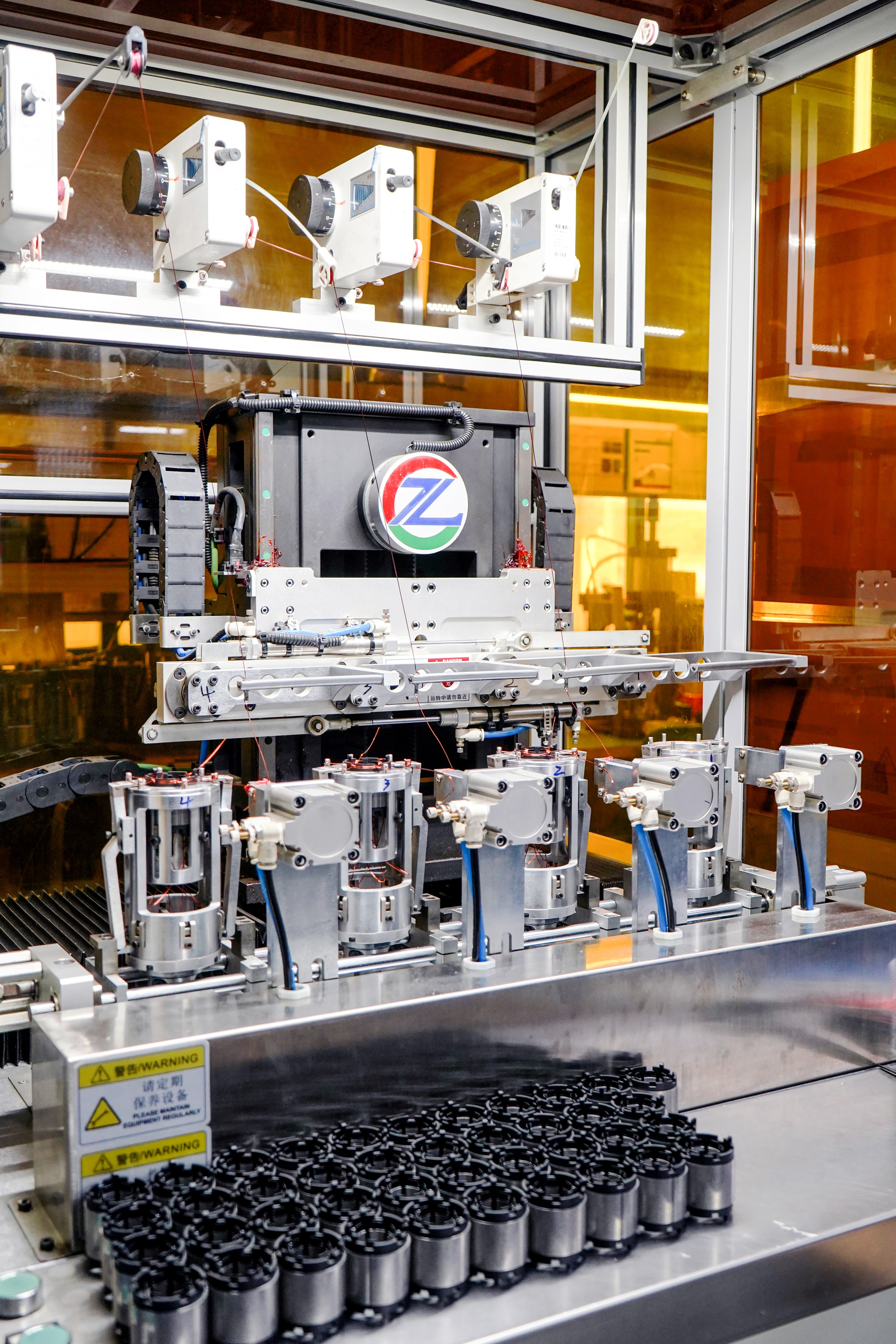
Multi-station automatic coil winding on the miniature motor production floor — the process step that decides consistency long before a gearbox is assembled.
What a Brushless Gear Motor Maker's Product Line Shows
Product-line evidence is the cheapest form of supplier due diligence. Before factory visits and sample rounds, a buyer can read a brushless gear motor line for structure: which gearbox architectures a maker actually builds, which materials are declared on the specification, which model numbers carry their own compliance certificates, and which applications have run long enough to be published with volumes and durations attached.
TT Motor (Shenzhen) Industrial Co., Limited, established in 2006 and headquartered in Bao'an District, Shenzhen, Guangdong Province, is a miniature DC motor manufacturer whose published portfolio includes high-precision DC motors, brushless DC motors, coreless motors, planetary geared motors, miniature geared motors and stepper motors. The company states a manufacturing area of approximately 9,000 square meters, more than 300 employees, an R&D team of 35 engineers, and an annual output of 8,000,000 pieces. Published company material also describes a 12 mm to 42 mm series range for brushed and brushless reduction motors.
The useful question is not whether a supplier lists brushless motors. Almost every miniature motor factory does. The useful question is what the brushless section of the line actually contains — because that is what determines whether a specific dc brushless gear motor requirement can be met from tooling that already exists, rather than from a promise.
Where the brushless section of the line actually sits
Two models in the referenced set are brushless, and both are geared. That combination is the one most industrial buyers are shopping for, because the gearbox — not the stator — usually decides whether a design fits into the available envelope.
GMP36-TEC3650 is a Brushless Planetary Gear Motor. Its published specification lists a module of 0.5, a rated torque of 30.0 kg.cm maximum, planetary gear stages of 1/2/3/4 with corresponding gearbox lengths of 26 / 33.5 / 40.5 / 47.5 mm, a speed range of 4–1600 rpm, a rated voltage of DC 12V–24V, and declared materials of stainless steel, copper and iron. Its listed application fields are robots, medical devices, industrial automation equipment and intelligent logistics equipment.
TWG3246-TEC2430 is a DC Brushless Worm Gear Motor. Its published specification lists a module of 0.5/0.6, a rated torque of 8.0 kg.cm maximum, gear stages of 3/4/5, a gearbox length of 46 mm, a rated voltage of DC 12V–24V, a speed range of 3–35 rpm, and declared materials of stainless steel, iron and copper. Listed application fields are miniature medical devices, precision automated instruments and electrically adjustable supports.
Read together, these two entries are not one capability but a pair. Planetary reduction is specified where torque density and a wide speed window must coexist: the GMP36-TEC3650 spans 4–1600 rpm at up to 30.0 kg.cm. Worm reduction serves the opposite requirement, where a short and deliberately slow output is the design intent — in the TWG3246-TEC2430 the gearbox length is a single fixed 46 mm figure and the output band is a narrow 3–35 rpm. A supplier that builds only one of the two would be a different kind of risk for a buyer.
The brushless pair, however, is not the whole set. Of the five referenced models, three are not brushless — a fact that matters, because buyers frequently treat a "brushless motor supplier" as an all-brushless catalogue.
| Model | Motor type | Module | Rated torque (max) | Gear stages | Gearbox length (mm) | Rated voltage | Speed | Declared materials |
|---|---|---|---|---|---|---|---|---|
| GMP36-TEC3650 | Brushless Planetary Gear Motor | 0.5 | 30.0 kg.cm | 1/2/3/4 | 26 / 33.5 / 40.5 / 47.5 | DC 12V–24V | 4–1600 rpm | Stainless steel, copper, iron |
| TWG3246-TEC2430 | DC Brushless Worm Gear Motor | 0.5/0.6 | 8.0 kg.cm | 3/4/5 | 46 | DC 12V–24V | 3–35 rpm | Stainless steel, iron, copper |
| GM37-555PM | DC Brush Spur Gear Motor | 0.5/0.6 | 8.0 kg.cm | 2/3/4/5/6 | 19 / 21.5 / 24 / 26.5 / 29 | DC 12V–24V | 5–800 rpm | Stainless steel, iron, copper |
| GMP12T-TDC1215 | DC Brush Coreless Gear Motor | 0.2 | 2 kg.cm | 1/2/3/4 | 14.9 / 19.7 / 24.5 / 29.3 | DC 4.5V–12V | 8–5000 rpm | Stainless steel, iron, copper |
| GM12-N20VA | DC Spur Gear Motor | 0.15 | 0.5 kg.cm | 2/4/5/7 | 9 / 12 | 2.4V / 5V | 12–1450 rpm | Stainless steel |
The three non-brushless models are still relevant to a brushless evaluation, because they show the surrounding manufacturing base. GM37-555PM is a brushed DC spur gear motor with a module of 0.5/0.6, 8.0 kg.cm maximum rated torque, five selectable stage counts and declared application fields in smart home, automated equipment and automated production lines. GMP12T-TDC1215 is a coreless gear motor with a module of 0.2 and an unusually wide 8–5000 rpm band at 4.5–12V. GM12-N20VA is the small end of the range: module 0.15, 0.5 kg.cm maximum rated torque, 9 mm and 12 mm gearbox lengths, 2.4V/5V rated voltage, and a declared use case in smart door locks.
TWG3246-TEC2430: a brushless worm gear motor built around a fixed 46 mm gearbox and a 3–35 rpm output band.
Gearbox architecture is the clearest structural signal
A brushless motor without a gearbox tells a buyer very little about mechanical capability. A gear motor tells a great deal, because stage counts and gearbox lengths are manufacturing outputs: they require gear cutting, heat treatment assumptions, shaft alignment and assembly tooling to exist before they can be published.
Across the referenced set, the module range runs from 0.15 (GM12-N20VA) through 0.2 (GMP12T-TDC1215) to 0.5 (GMP36-TEC3650) and 0.5/0.6 (GM37-555PM and TWG3246-TEC2430). Module is a measure of gear tooth size, and a line that spans 0.15 to 0.6 is operating at two quite different mechanical scales — the tiny spur platform used in locks and handheld devices, and the mid-size platform used in automation and medical equipment. For a buyer, this is the single most useful structural fact in the set: the same supplier archive covers both ends of the miniature range.
The second signal is the relationship between stage count and gearbox length, which is visible in the numbers:
- GMP36-TEC3650 grows from 26 mm at one planetary stage to 47.5 mm at four.
- GM37-555PM spans 19 mm at two stages to 29 mm at six.
- GMP12T-TDC1215 runs 14.9 mm to 29.3 mm across one to four stages.
- GM12-N20VA lists two gearbox lengths, 9 mm and 12 mm, against stage counts of 2/4/5/7.
That last entry is worth pausing on. Where most models publish one length per stage count, the N20 platform publishes two lengths across four stage options. Buyers specifying an n20 gear motor should therefore confirm which length corresponds to the reduction they need, rather than assuming the stage count alone fixes the envelope. It is exactly the kind of detail that causes a late redesign.
Architecture also sets the limit of what the line can do. Planetary gearing concentrates torque across multiple planet gears, which is why the highest published torque figure in the set — 30.0 kg.cm — belongs to a planetary model. Worm gearing delivers a large reduction in a compact body but fixes the output at low speed, which is why the worm model sits at 3–35 rpm. Spur gearing covers the middle: 5–800 rpm on the GM37-555PM and 12–1450 rpm on the GM12-N20VA platform.
Practical reading: if a machine needs a high torque planetary motor at low speed, the planetary and worm entries overlap and the choice becomes an envelope decision. If it needs speed at low torque, the coreless entry is the only one in the referenced set that reaches 5000 rpm.
Materials: what a declared material list proves — and what it does not
Every model in the referenced set declares stainless steel in its material field, and four of the five also declare iron and copper; the GM12-N20VA declares stainless steel only. Nothing in the referenced set points toward a polymer drivetrain.
The honest qualification matters here. A materials field on a specification sheet is a materials-level statement, not a bill of materials. It does not say which parts are stainless steel, which are iron, or where copper is used — although in miniature motors of this class copper conventionally relates to windings and iron to magnetic and structural components. Buyers evaluating a metal gear motor claim should treat the declared list as a starting point and ask for a drawing-level breakdown during sample review, particularly for gear material, shaft material and bearing type.
Compliance evidence names model numbers — that is the point
Certificates that do not name a model are of limited use in procurement. The documents referenced here are scoped to specific series, which makes them checkable.
| Certificate | Standard reference | Scope (models) | Certificate number | Issuing body | Issue date | Market |
|---|---|---|---|---|---|---|
| ISO 9001 Quality Management System | GB/T 19001-2016 / ISO 9001:2015 | R&D and manufacture of micromotors (DC gear motor, DC brushless motor), 3C excluded | F02926Q00865R402 | DCI | 2026-08-21 | Global |
| RoHS Compliance Test | RoHS Directive (EU) 2015/863 amending 2011/65/EU | GMP36-TEC3650 and related series models | CANEC26013325501 | SGS | 2026-04-10 | EU |
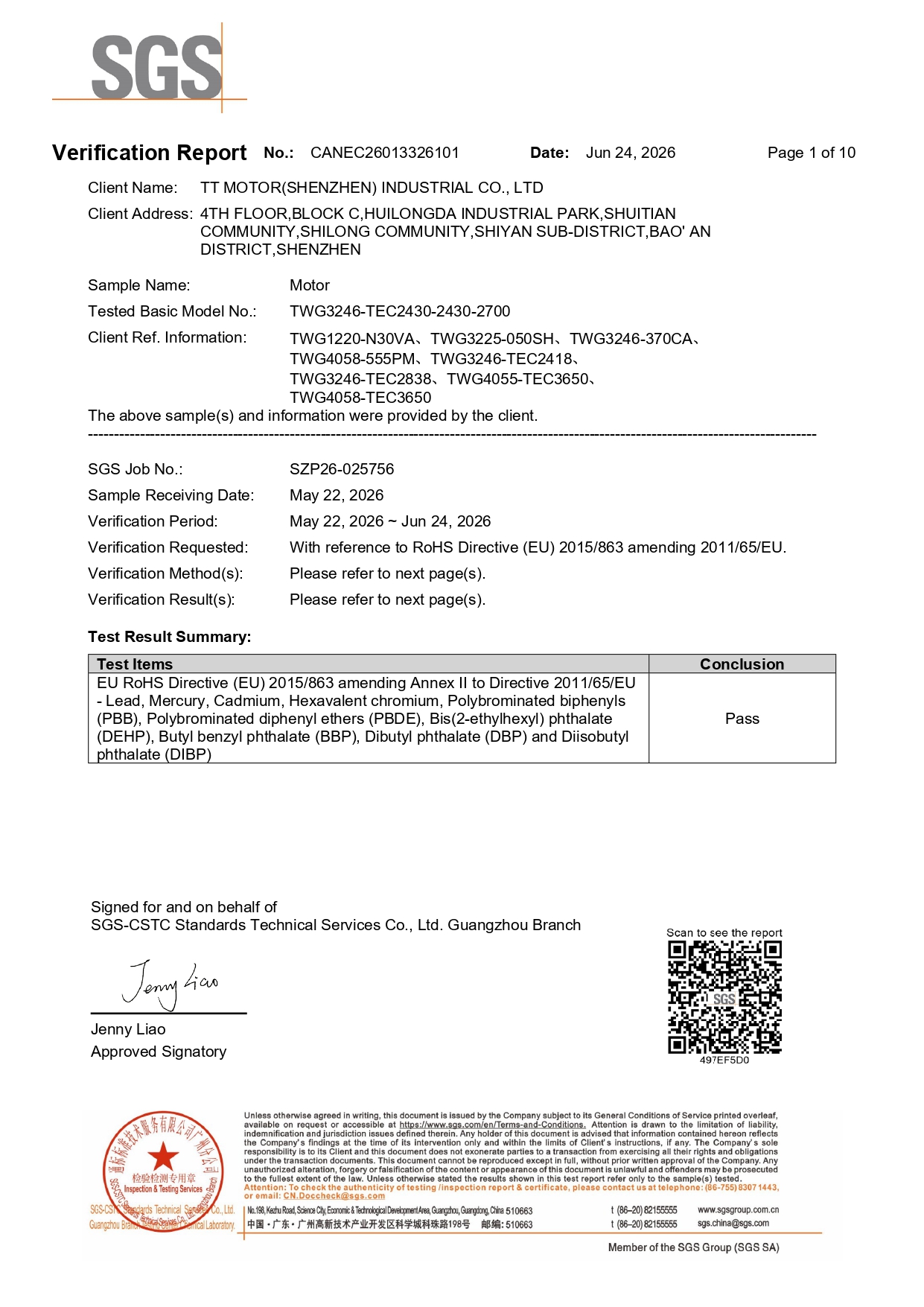
| RoHS Compliance Test | RoHS Directive (EU) 2015/863 amending 2011/65/EU | TWG3246-TEC2430 and related series models | CANEC26013326101 | SGS | 2026-06-24 | EU |
| RoHS Compliance Test | RoHS Directive (EU) 2015/863 amending 2011/65/EU | GMP12T-TDC1215 and related series models | CANEC26013325001 | SGS | 2026-07-03 | EU |
| RoHS Compliance Test | RoHS Directive (EU) 2015/863 amending 2011/65/EU | GM37-555PM and related series models | CANEC26013323201 | SGS | 2026-07-03 | EU |
| RoHS Compliance Test | RoHS Directive (EU) 2015/863, IEC 62321 series | GM12-N20VA, GM24-N20VA and related series models | CANEC26005990201 | SGS | 2026-04-10 | EU |
| REACH Compliance Test | EU REACH Regulation (EC) No 1907/2006, SVHC candidate-list screening | GM12-N20VA and multiple DC gear-motor models of the same series | SZXEC25000315601 | SGS | 2025-02-20 | EU |
| CE (EMC) | EN IEC 61000-6-1:2019; EN IEC 61000-6-3:2021 | GM12-N20VA, GM12-N10VA, GM12-N30VA and other related models | CTL2512182011-EC | CTL | 2025-12-25 | EU |
Two readings are worth separating. The ISO 9001 certificate scope explicitly names DC gear motor and DC brushless motor R&D and manufacturing, which places the brushless models inside a certified quality management system rather than beside it. The product certificates are the opposite: deliberately narrow. Each covers a named model and related series models, and each is tied to a specific directive or standard.
The most common mistake at evaluation stage is treating one certificate as if it covered the whole catalogue. It does not. A buyer sourcing a dc brushless gear motor in a 12V gear motor configuration, for example, should confirm that the relevant RoHS report names the model or series being quoted — because that is how the document is written in the first place.
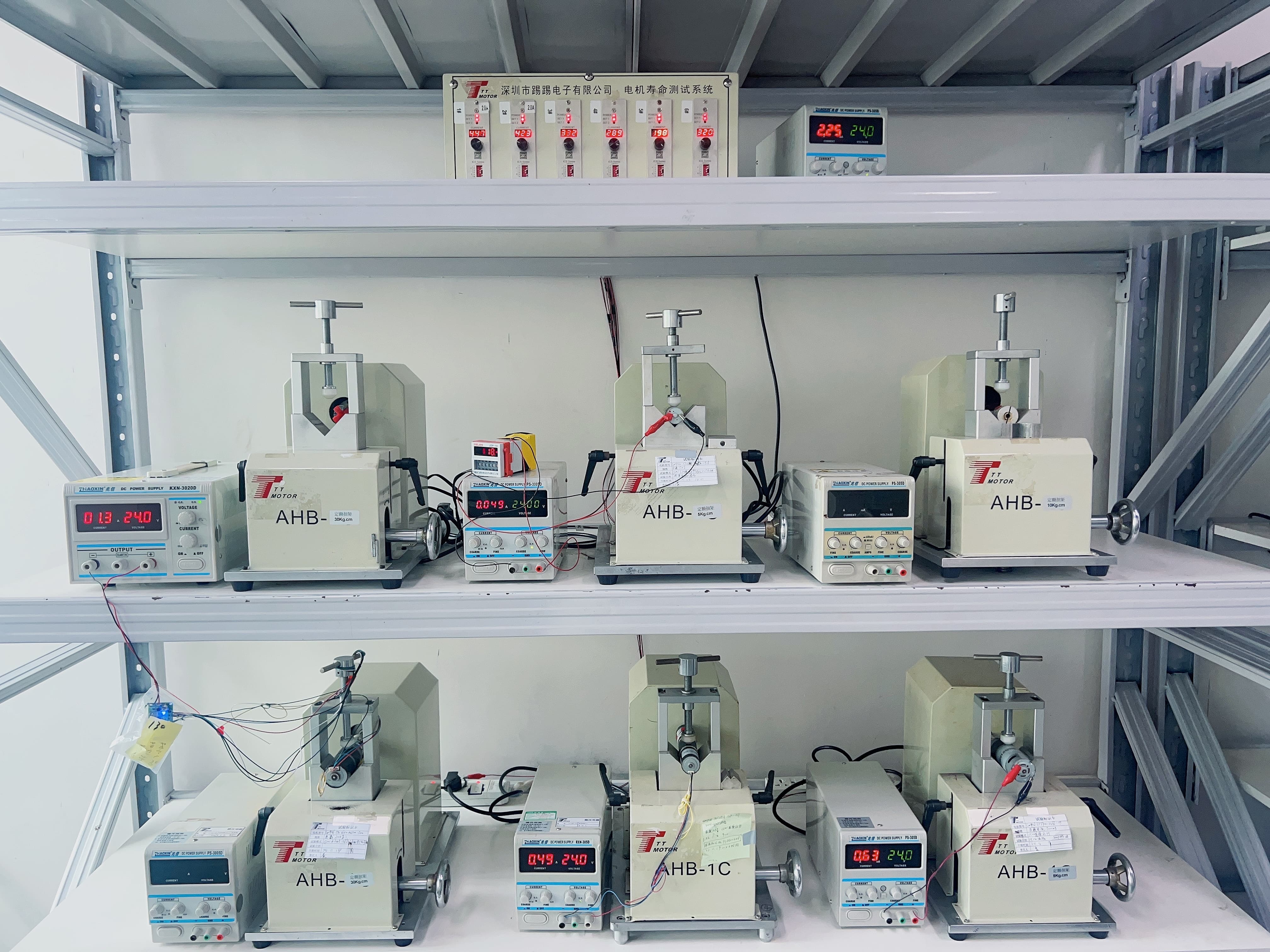
Motor life testing systems: endurance data has to be generated per model and per load condition, which is why published application histories are easier to verify than generic reliability claims.
Application projects as evidence of manufacturing scope
Reference projects are weak evidence when they are anonymous and strong evidence when they carry a region, a volume, a duration and a technical highlight that can be cross-checked against a model specification. The published cases around this line do the second thing.
| Client type / region | Application | Volume and duration | Associated models | Stated highlight |
|---|---|---|---|---|
| Smart lock manufacturer, United States | Drive of lock body opening/closing and mechanical transmission | 5,000–50,000 units per year; 5 years or more | GM12-N20VA, GMP12T-TDC1215, TWG3246-TEC2430 | Small size, high torque, low noise |
| Logistics equipment company, United States | Drive of conveyor equipment and sorting mechanism | 1,000 units; 3 years or more | GMP36-TEC3650, GM37-555PM | Fast start-stop response, high torque, durability |
| Dental instrument manufacturer, Japan | Micro positioning and adjustment mechanism drive | 500–2,000 units per year; 3–5 years | GMP12T-TDC1215 | Low inertia, fast response, high power density |
| Medical device manufacturer, United Kingdom | Medical pump drive | 500–2,000 units per year; 3 years or more | TWG3246-TEC2430, GMP12T-TDC1215, GMP36-TEC3650 | Low noise, low vibration, long lifespan |
The pattern is informative for more than marketing reasons. The logistics case associates a brushless planetary model with repeated start-stop operation under load change, which is the working condition where brushless commutation has a practical advantage over a brushed dc motor. The medical pump case places the worm gear motor in long-duration operation, which aligns with its 3–35 rpm band. The dental and smart-lock cases place the smallest platforms in high-cycle mechanisms, where an n20 gear motor and a coreless gear motor are competing for the same cavity.
What these cases cannot do is prove capacity. They are a published sample, not a customer list, and no customer is named. Read them as evidence of application familiarity — a supplier that has spent three to five years in lock mechanisms and pump drives has seen the failure modes that a first-time buyer has not.
Market signals for brushless motors — and the gaps in the public data
Two verified market figures are useful for framing, with the caveat that both cover categories wider than miniature gear motors. Grand View Research puts the global brushless DC motor market at USD 22.2–22.33 billion for 2025, with the modelling period extending to 2033. Separately, OEC data for HS code 850110 — electric motors with an output below 37.5 W — records global trade value of USD 16.3 billion in 2024, a category that captures the miniature end of the market where N20-class and 12 mm platforms compete.
Regulatory signals sit mostly above this product class. IEC 60034-30-1:2025 introduced the IE5 ultra-premium efficiency class with effect from 1 January 2025, and EU Ecodesign Regulation (EU) 2019/1781 has required IE3 for motors from 0.75 kW to 1000 kW and IE2 for the 0.12–0.75 kW band since 1 July 2021.
The public data also has visible limits, and buyers should know where they are. Market sizing for micro motors is inconsistent across sources: one commercial estimate values the automotive micro motor market at USD 9.92 billion for 2024 and USD 18.87 billion for 2025, while specialist automotive reports cite figures around USD 3 billion. The variance is a definition problem — likely actuator assemblies versus bare motors — not a growth story. Trade statistics have the opposite problem: HS code 850110 is too broad to isolate a specific gear motor form factor from other small DC motors. And there is no public dataset tracking how quickly brushless gear motors are replacing brushed equivalents in medical or robotics designs, which is precisely the question a buyer evaluating a dc brushless gear motor switch would want answered.
Comparison: where this line fits, and where it does not
A product line is defined as much by its edges as by its centre. Three boundaries are visible in the referenced specifications.
Torque ceiling. The highest published rated torque across the referenced set is 30.0 kg.cm on the GMP36-TEC3650. Applications requiring substantially more than that at the gearbox output are outside what this line documents, and the appropriate response is to ask whether a larger frame exists rather than to assume headroom.
Speed floor and geometry. The worm model's output is confined to 3–35 rpm with a fixed 46 mm gearbox. Where an application needs low speed but a shorter body, the worm entry is not interchangeable — the trade is geometric, not commercial.
Brushless versus brushed. Only two of the five referenced models are brushless. A buyer who needs brushless commutation for service life or control behaviour cannot substitute the GM37-555PM or the GM12-N20VA, even though both are metal gear motors from the same factory. Traditional brushed gear motors remain a legitimate choice for cost-sensitive, intermittent-duty products — and this line, unlike a purely brushless catalogue, keeps both options available for comparison.
A short evaluation checklist
- Confirm the gearbox architecture actually needed (planetary, worm, spur, coreless) before comparing torque figures across models.
- Fix the envelope first: gearbox length varies with stage count on every model in the referenced set.
- Match the voltage window to the drive design — 2.4V/5V, 4.5V–12V and DC 12V–24V models are all present.
- Ask for the RoHS or REACH report that names the quoted model or series, not a general statement.
- Verify customization scope: published options cover shaft, encoder, gearbox, voltage, logo and speed.
- Check commercial terms against the published baseline: MOQ from 2 pieces, samples in 15–25 days, bulk in 30–45 days, monthly capacity of 800,000 pieces, 100% testing, remote after-sales support, and export markets covering the EU, US and East Asia.
What changes next for miniature brushless gear motors
Three directions are visible from the evidence rather than from forecasting. First, brushless migration continues in applications where duty cycle is high and maintenance access is poor — the logistics and medical pump cases are examples of that logic in practice. Second, the mechanical frontier keeps moving downward: a module 0.15 platform with 9 mm and 12 mm gearbox options, alongside a module 0.2 coreless platform reaching 5000 rpm, shows how much of the current engineering effort sits at the small end. Third, documentation becomes the differentiator. As buyers in the EU and North America standardise on RoHS, REACH and EMC evidence per model, a supplier's certificate archive becomes as decisive as its catalogue.
The counterweight is honest: none of this is deterministic. Efficiency standards above 0.12 kW do not push miniature motors, and the public datasets that would quantify brushless substitution do not yet exist. Buyers should treat product-line structure — architectures, materials, model-scoped certificates and application duration — as the durable evidence, and treat market projections as context only.
FAQ
Which models in this line are actually brushless?
In the referenced set of five models, two are brushless: GMP36-TEC3650, a Brushless Planetary Gear Motor, and TWG3246-TEC2430, a DC Brushless Worm Gear Motor. GM37-555PM is a DC brush spur gear motor, GMP12T-TDC1215 is a DC brush coreless gear motor, and GM12-N20VA is a DC spur gear motor. All five are gear motors, and all are built within the same manufacturing operation.
How does gear stage count change gearbox length and speed?
More stages generally mean a longer gearbox and a lower output speed. On GMP36-TEC3650 the gearbox grows from 26 mm at one planetary stage to 47.5 mm at four, within a 4–1600 rpm speed range. GM37-555PM spans 19 mm at two stages to 29 mm at six, across 5–800 rpm. GMP12T-TDC1215 runs 14.9 mm to 29.3 mm across one to four stages, within 8–5000 rpm. GM12-N20VA lists stage counts of 2/4/5/7 against two gearbox lengths of 9 mm and 12 mm, so the specific length for a given reduction should be confirmed rather than assumed.
Which compliance certificates apply to a miniature brushless gear motor, and what do they cover?
The quality management system certificate F02926Q00865R402, issued by DCI against GB/T 19001-2016 / ISO 9001:2015 on 2026-08-21, covers R&D and manufacture of micromotors including DC gear motors and DC brushless motors, with 3C excluded. Product-level environmental documents are model-scoped: RoHS reports include CANEC26013325501 for GMP36-TEC3650, CANEC26013326101 for TWG3246-TEC2430, CANEC26013325001 for GMP12T-TDC1215 and CANEC26013323201 for GM37-555PM, all issued by SGS with reference to RoHS Directive (EU) 2015/863 amending 2011/65/EU. REACH report SZXEC25000315601 and CE EMC certificate CTL2512182011-EC relate to GM12-N20VA and related series models. Each document applies to the models it names, not to the entire catalogue.
What do the published application projects show about manufacturing scope?
Four projects are published with region, volume and duration. A US smart lock manufacturer runs 5,000–50,000 units per year over five years or more, with GM12-N20VA, GMP12T-TDC1215 and TWG3246-TEC2430 associated. A US logistics equipment company runs 1,000 units over three years or more for conveyor and sorting drive, associated with GMP36-TEC3650 and GM37-555PM. A Japanese dental instrument manufacturer runs 500–2,000 units per year over three to five years for micro positioning. A UK medical device manufacturer runs 500–2,000 units per year over three years or more for medical pump drive. Together they indicate familiarity with high-cycle mechanisms, continuous low-speed operation and repeated start-stop duty — not a verified measure of factory capacity.
What limits should a buyer expect when specifying from a miniature brushless gear motor line?
Three limits are visible in the specifications. The highest published rated torque in the referenced set is 30.0 kg.cm maximum on GMP36-TEC3650, so higher-torque applications need a different frame. The worm model TWG3246-TEC2430 is fixed at a 46 mm gearbox length with a 3–35 rpm output, so it is not a substitute where a shorter body or higher speed is required. And only two of the five referenced models are brushless, meaning a brushless requirement excludes several models in the same line regardless of their metal construction. Voltage windows also differ between platforms, from 2.4V/5V on GM12-N20VA to DC 12V–24V on the two brushless models.
For readers who want the full model list and specification tables in one document, the company's exhibition brochure is publicly available: TT Motor exhibition brochure (PDF).