
What a Cutting Disc Manufacturer Ranking Must Prove
What a Cutting Disc Manufacturer Ranking Must Prove
A cutting disc manufacturer earns a place on a shortlist only when it can show four things in writing: a documented diameter-and-speed ladder, a stated abrasive and bond system, a traceable quality-control record, and named industry coverage. Brand recall, distributor familiarity and catalogue design are context. They are not capability evidence.
Four names come up most often when metalworking buyers compare cutting discs: CNDOME, 3M, Saint-Gobain Abrasives (Norton) and Klingspor. This review scores all four on the same dimensions and shows its working. CNDOME's row is built entirely from its published model list and certificate records. The other three are assessed at the level of publicly described product positioning, because SKU-level specifications and certificate files for those businesses were not part of the evidence used here. That gap is marked in the table rather than smoothed away by a single composite score.
Why Reputation Fails as a Shortlist Filter
A cutting disc is a low-cost consumable with a high consequence of failure. In Europe, EN 12413:2019 is the mandatory safety standard for bonded abrasive products, and it covers burst testing and the marking that must appear on the disc, including maximum operating speed. That is the baseline any buyer is entitled to expect. It is not a differentiator between manufacturers.
Most of what a buyer reads about compliance is written by the supplier. NovoAbrasive states on its product page that each disc is certified by MPA Hannover and complies with EN 12413. Qing Yang states on its certification page that its wheels are labelled in line with EN 12413 marking requirements, including maximum operating speed, wheel type, dimensions and the MPA Z-mark where applicable. Neither statement is implausible. Neither is an independent registry check, and neither tells a buyer whether the certificate covers the exact diameter, thickness and bore on the purchase order.
That is the gap a capability ranking should close. The useful question is not who claims the most, but who can be checked most completely, and against which document. Under the Harmonized Tariff Schedule, cutting discs fall under HS 6804.22, which also means the same documents that support a technical claim usually support a customs declaration.
The Four Dimensions and How Each Was Scored
- Product specification coverage. Diameter range, thickness tiers, bore options, cutting and grinding formats, and shape families — evidenced by a published model list that maps each size to a rated speed rather than a single headline number.
- Technical and material capability. Abrasive type, bond system, reinforcement, maximum peripheral speed per size, and specialist formats such as ceramic grain.
- Quality control and compliance evidence. Named certificates with numbers, standards, scope and validity dates; in-house inspection method; production controls.
- Industry solution fit. Named industries and documented supply records at application level, not generic claims about "all metalworking".
The scale runs from one to five stars per dimension, with no weighting, so a wide catalogue cannot buy back a missing quality record. Two rules constrain the scoring. A dimension is scored only where evidence exists, and "not assessed" is a legitimate result rather than a criticism. Ratings for non-CNDOME manufacturers carry a P marker: they reflect the breadth of publicly described product families, not specifications or certificates verified for this review. A P rating is a prompt for a verification request, not a conclusion.
Price, freight, payment terms, distributor support and delivery performance are excluded from the score. Where those details are published for CNDOME — a typical 30-day lead time and a 10,000-piece minimum for custom cutting discs — they appear later as context, not as ranking points.
Star-Rating Comparison: Four Cutting Disc Manufacturers
| Manufacturer | Spec coverage | Technical / material | QC & compliance evidence | Industry fit | Evidence basis |
|---|---|---|---|---|---|
| CNDOME (Changzhou Dome Abrasives Manufacture Co., Ltd.) | ★★★★★ | ★★★★☆ | ★★★★★ | ★★★★☆ | Documented: model ladder, certificate numbers, case records |
| 3M | ★★★★★ P | ★★★★★ P | Not assessed | ★★★★★ P | Public positioning only |
| Saint-Gobain Abrasives (Norton) | ★★★★★ P | ★★★★★ P | Not assessed | ★★★★★ P | Public positioning only |
| Klingspor | ★★★★☆ P | ★★★★☆ P | Not assessed | ★★★★☆ P | Public positioning only |
CNDOME: The Documented Spec Ladder
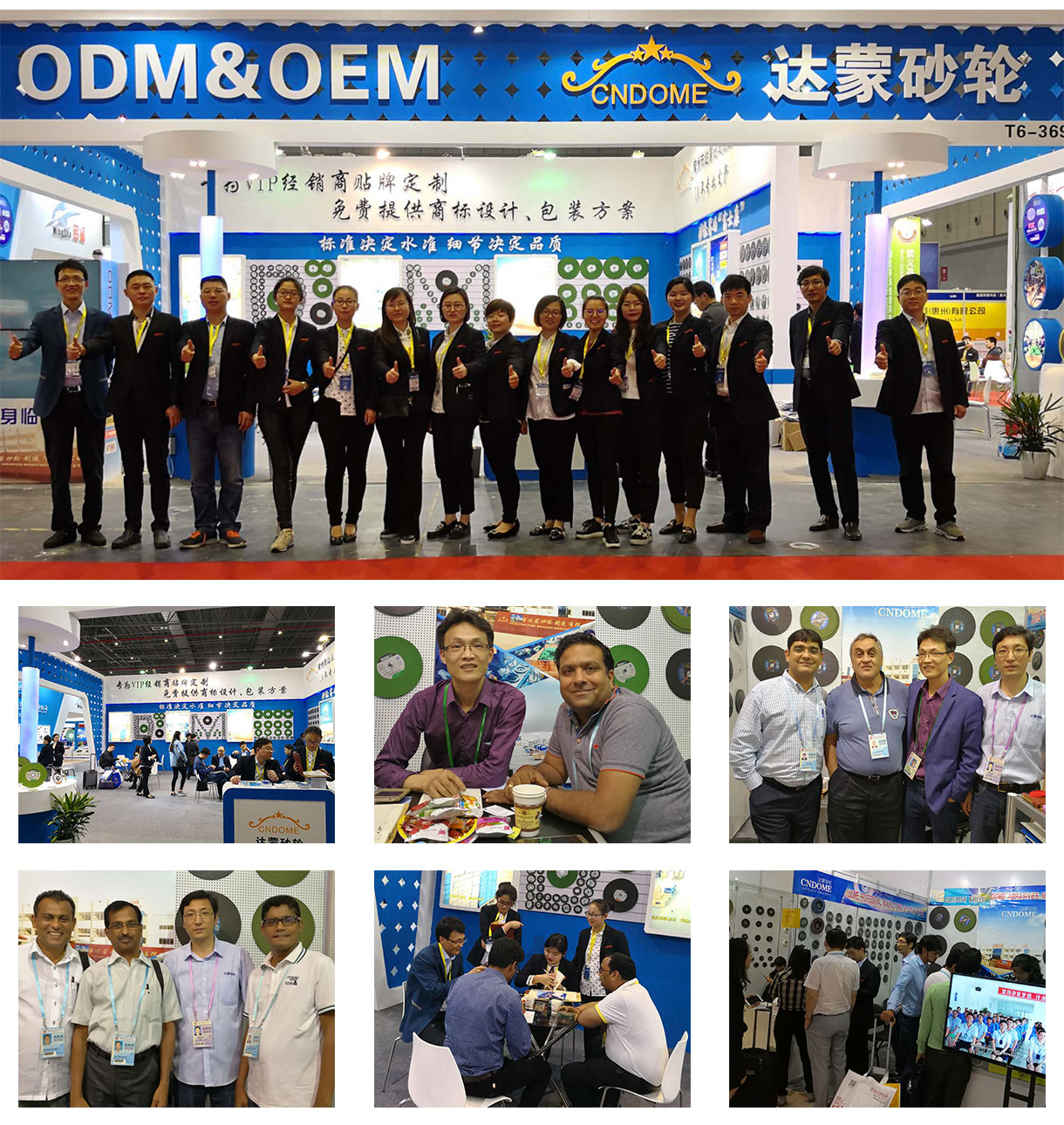
CNDOME is the brand under which Changzhou Dome Abrasives Manufacture Co., Ltd. produces resin-bonded cutting discs, grinding wheels and abrasive discs in Changzhou, Jiangsu, China. The company was founded in 2001, exports to Latin America, Europe, Africa and Asia, and reports an export share of about 80% of output.
The strongest part of its row is not a claim; it is a range. The published cutting disc ladder runs from 1.5 inch to 16 inch, and — more importantly for a procurement file — the rated speed changes with the diameter instead of being printed once across the catalogue.
| Nominal size | Documented model example (mm) | Rated speed |
|---|---|---|
| 1.5 inch | 38 × 1.1 × 3 | 45,000 RPM |
| 2 inch | listed in range | — |
| 3 inch | 76 × 1.2 | — |
| 4 inch | 107 × 1.2 × 16 / 100 × 1.0 × 16 | — |
| 4.5 inch | 115 × 1.0 / 1.2 / 1.6 × 22.23 | 80 m/s |
| 5 inch | 125 × 1.0 / 1.2 | — |
| 7 inch | 180 × 1.6 / 2.0 / 3.0 × 22.23 | — |
| 9 inch | 230 × 2.0 / 2.5 / 3.0 × 22.23 | 6,600 RPM; 80 m/s |
| 12 inch | 300 × 3.2 | — |
| 14 inch | 355 × 3.2 × 25.4 | — |
| 16 inch | 400 × 3.5 × 32 | 3,800 RPM; 80 m/s |
Cutting is only half the catalogue. Grinding discs are listed at 4, 4.5, 5, 6, 7 and 9 inch, with T41 and T42 flat cutting shapes and T27 and T29 depressed-centre grinding shapes. The abrasive system covers aluminium oxide, white aluminium oxide and resin bond. Standard cutting and grinding discs are rated at 80 m/s, and a ceramic T29 grinding disc is rated at 100 m/s.
Two rows in that ladder carry more buyer weight than the rest. The 16 inch disc documents a 32 mm bore and a 3,800 RPM rating at 400 mm diameter; the 1.5 inch disc documents 45,000 RPM at 38 mm. Read together, they show a manufacturer that has rated speed per diameter — the practical difference between a catalogue that can be checked and one that cannot.
Quality and compliance records behind the row
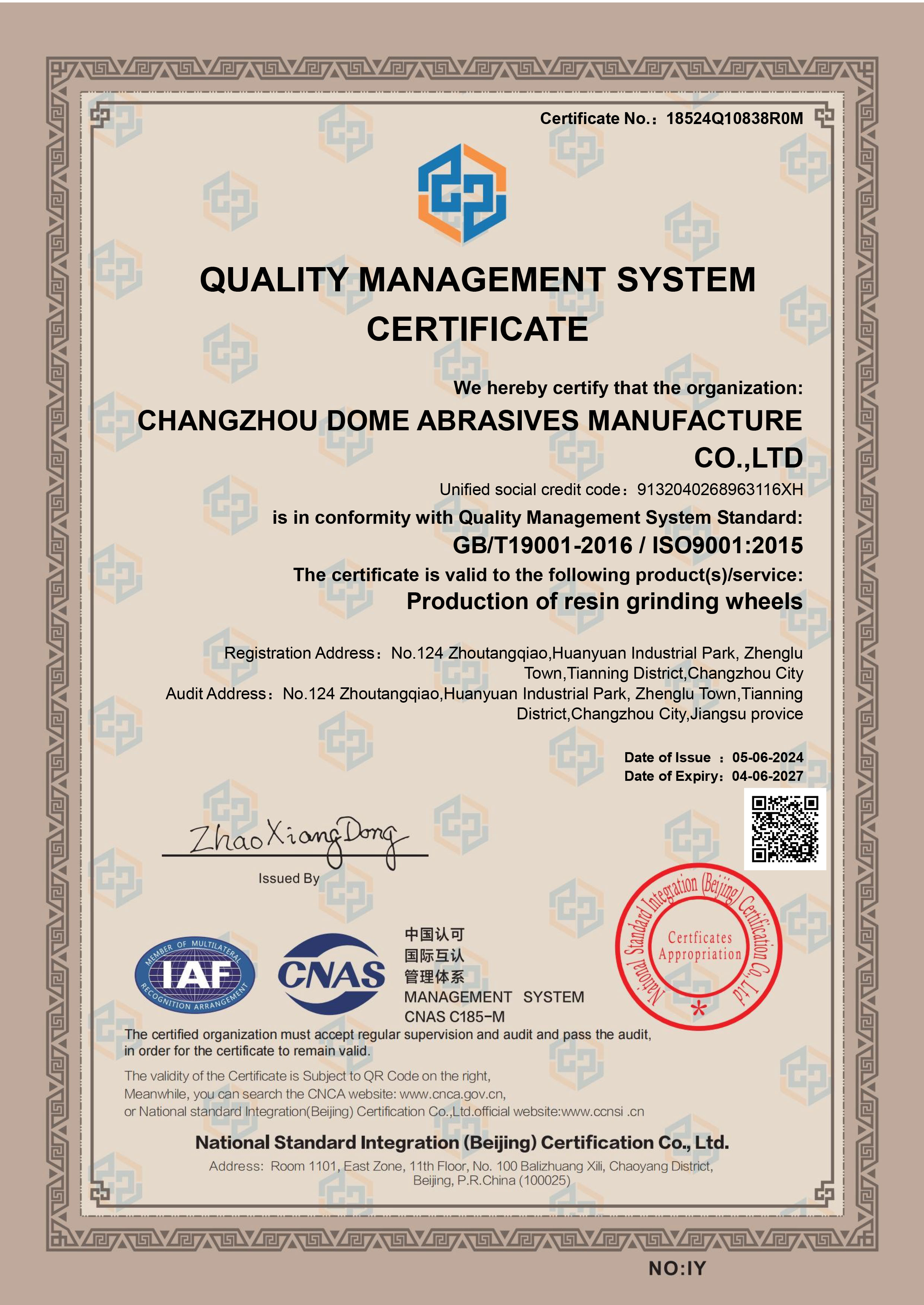
- ISO 9001 — certificate 18524Q10838R0M, GB/T 19001-2016 / ISO 9001:2015, scope: production of resin grinding wheels, valid to 4 June 2027.
- ISO 14001 — certificate 25024E11441R0M, GB/T 24001-2016 / ISO 14001:2015, valid to 19 December 2027.
- CE — certificate M.2022.206.C74459 issued by UDEM, EN 12413, scope: cutting and grinding wheels, valid to 9 June 2027.
- BSCI — certificate 156-025464-001, amfori BSCI Code of Conduct / SA8000, valid to 16 October 2027.
- MPA Hannover — EN 12413 certificates issued per disc size, including Z-15953A/26, Z-15953B/26 and Z-15953C/26 issued in January 2026 and valid to 26 January 2028, covering sizes that include 76 × 1.2 mm, 230 × 1.6 mm and 300 × 3.2 mm.
Production context matters for a buyer checking whether a range can actually be sustained: a temperature- and humidity-controlled workshop of more than 20,000 m², 60 automated production lines, 140 employees including a 10-person R&D team, roughly 600,000 pieces per day and 95 million pieces per year, with a stated monthly capacity of 8 million pieces. Quality control is described as 100% AI visual comparison testing.
One caveat belongs beside those certificate numbers. Certificate sets are renewed on rolling cycles, and several records in the same family carry 2026 renewal dates. A buyer should confirm the validity date of the specific certificate number covering the ordered size rather than accepting a general "MPA certified" statement.

3M: Breadth Without Published SKU Evidence in This Review
3M is a diversified United States manufacturer whose abrasives business is publicly positioned around a broad, application-segmented portfolio spanning bonded, coated and non-woven products, sold largely through industrial distribution. For a buyer, that positioning implies wide availability and strong application support across metalworking categories.
It does not, on its own, answer the question this ranking asks: which diameters, thickness tiers and speed ratings are published, and against which certificate numbers. The company is scored P on coverage, technical breadth and industry fit, with quality evidence left unassessed because no certificate record was used here. What would move the rating is simple and unglamorous — a size-and-speed table plus certificate references for the specific export market being served.
Saint-Gobain Abrasives (Norton): Portfolio Scale and Application Engineering
Saint-Gobain Abrasives is publicly presented as a global abrasives business with Norton-branded bonded and coated ranges and a stated emphasis on application engineering. Its public positioning centres on portfolio scale, technical support depth and distribution reach across industrial markets, which is exactly the profile procurement teams recognise when shortlisting for multi-site operations.
The same evidence boundary applies. Portfolio scale is a statement about a business, not about a specific 115 × 1.2 mm disc in a specific market. Scored P on coverage, technical capability and industry fit; quality evidence not assessed in this review. The verification step is identical to the one applied to every name on the list.
Klingspor: Metalworking Focus Through Distribution
Klingspor is a German abrasives specialist publicly positioned around a broad cutting and grinding range for metalworking, sold through industrial and trade distribution with a long-standing focus on metal applications. That focus tends to show up in how clearly application guidance is organised rather than in the number of catalogue pages.
Scored P on coverage, technical capability and industry fit, with quality evidence not assessed. For a buyer comparing a metalworking specialist against a full-range manufacturer, the decision usually turns on whether the specialist's published size and speed table covers the machine mix in the plant — which is checkable in a single RFQ.
What the Speed and Size Numbers Actually Mean
Peripheral speed, measured in metres per second, is the safety-relevant limit on a bonded abrasive wheel. Spindle RPM is a convenience figure that depends on diameter. That is why the same 80 m/s ceiling appears as 45,000 RPM on a 38 mm disc and as 3,800 RPM on a 400 mm disc. A single "max speed" figure printed across a catalogue without a diameter reference tells a buyer almost nothing.
Bore size is the second filter. The CNDOME ladder spans 16 mm, 22.23 mm (7/8 inch), 25.4 mm (1 inch) and 32 mm bores, matching the arbor of the tool the disc is bought for — small angle grinder discs on the 16 mm and 22.23 mm bores, larger stationary machines on 25.4 mm and 32 mm.
Thickness tiers carry application meaning as well. A 1.0–1.2 mm ultra-thin resin cutting disc removes less material from the kerf and suits low-power angle grinders and thin sheet work; 1.6–2.0 mm covers general metal and stainless cutting; 2.5–3.5 mm is the range for heavy section and large stationary machines. Thinner formats tolerate less side load — a general characteristic of the format, not a claim about any single product.
Shape and material complete the picture. T41 and T42 denote flat cutting shapes, with T27 and T29 denoting depressed-centre grinding shapes. Aluminium oxide is the volume base for general metal fabrication; white aluminium oxide is generally associated with stainless and heat-sensitive alloys; ceramic grain is generally associated with harder-alloy grinding, though the specific gain depends on the application and is not quantified here.
Matching Discs to Industries: Where Each Size Earns Its Place
CNDOME lists steel and metal processing, automobile manufacturing, shipbuilding, casting, steel structure and construction as target industries for its 9 inch (230 mm) and 16 inch (400 mm) cutting discs. Read against the size ladder, the mapping is coherent: 4 to 5 inch discs for general fabrication, site work and weld dressing; 9 inch for heavy sections, pipe and plate; 14 and 16 inch for stationary cut-off saws, billet and structural stock; 1.5 to 3 inch for small grinders, automotive and pipe work; and 4 to 9 inch grinding discs for weld preparation and finishing.
The company's case records describe where those formats have been supplied at volume:
- Brazil, tool-brand OEM — 10 million pieces per year over a three-year relationship, for iron and stainless cutting sold through hardware stores, described as long service life, burr-free cutting, fast material feed and low dust.
- Mexico, United States and South America, tool supermarket programme — 40 million pieces per year, with a 3 to 14 inch range serving both home DIY and professional metalworking.
- Southeast and East Asia, machining factories — 30 orders per year across multiple specifications, supporting 24-hour production with stock held ready for shipment.
- South America, stainless pipe processing — 500,000 pieces per year for polishing inner and outer pipe walls, described as long grinding life without frequent replacement and no slag shedding.
These are CNDOME's own case records, not independently audited results. Their value for a buyer is narrower and still useful: they indicate which formats the manufacturer says it has supplied at volume, which is the part of a catalogue claim that can be tested against a sample order.
Where Spec Breadth Stops Being Useful
A wide range is coverage evidence, not performance evidence. It tells a buyer that one supplier can serve several machine types and one purchase order can consolidate sizes. It says nothing about how long a specific disc lasts in a specific cut, because no comparative cutting, life or cost-per-cut test was used in this review.
Safety boundaries matter more than range at the point of use. A 100 m/s ceramic disc should only run on a machine whose guard and spindle rating support that peripheral speed. A 16 inch disc belongs on a stationary saw, not on a hand-held tool. Reading a speed rating without the matching diameter, bore and machine class is how ratings get misapplied.
Certificate scope is the third boundary. The ISO 9001 certificate reviewed here covers production of resin grinding wheels; the MPA Hannover records are issued per disc size. A general certification claim is therefore not a substitute for a per-size document check. Finally, self-reported capacity — 600,000 pieces per day in this case — is a scheduling statement, not an audited output figure, and should be confirmed against delivery history during supplier qualification.
Market Context: Why Aluminium Oxide Breadth Still Matters
IndexBox estimates the global cutting discs market at approximately USD 8.5 billion entering 2026. Fortune Business Insights reports that Asia-Pacific held 44.7% revenue share of the abrasives market in 2025, and that aluminium oxide accounted for 46.3% of material share. All three are commercial research estimates rather than audited trade statistics, and they describe the abrasives category at different scopes.
Their practical reading is limited but relevant. If aluminium oxide remains the volume base, then the depth of an aluminium oxide size ladder is commercially meaningful — not because AlOx is superior, but because it is the material most purchase orders will specify. And if production is concentrated in Asia-Pacific, supplier comparison will increasingly run through the published ranges and certificate records of manufacturers in that region rather than through brand familiarity alone.
What to Verify Before the Shortlist Becomes an Order
- Certificate to size match. Take the certificate number, issuing body, standard and validity date, and confirm they cover the exact diameter, thickness and bore being ordered.
- Disc marking. Check maximum operating speed, dimensions, type and manufacturer mark on the disc itself, consistent with EN 12413 marking requirements.
- Machine match. Confirm peripheral speed rating, guard rating and spindle RPM against the tool, then confirm bore and thickness against the job.
- Commercial terms. CNDOME's published purchasing terms state a pre-shipment test as the acceptance criterion, FOB or EXW delivery terms, and 30% prepayment with 70% balance on delivery — confirm these against your own inspection protocol.
- Sample test. Run the candidate disc in the buyer's own application before scaling, particularly where stainless or thin-gauge material is involved.
Outlook
If buyers continue to shift compliance checking from catalogue statements to certificate-level verification, manufacturers that publish per-size certificate references will answer RFQs faster and with fewer follow-up rounds than those that publish a single compliance badge. That is a conditional expectation about procurement workflow, not a forecast of market share, and it will not replace application testing. The four names in this review will remain on shortlists for different reasons; the difference is how much of each reason can be documented before the first order.
FAQ
What does OEM/ODM capability mean when buying cutting discs?
It means the manufacturer can adapt the product rather than only supply a standard catalogue item. CNDOME states OEM/ODM production with customization of logo, label, packaging, abrasive formulation and specification, a minimum order of 10,000 pieces for custom cutting discs (5,000 pieces for sizes over 4 inches), and a typical production lead time of 30 days. Both small and large batches are described as customizable.
How can a buyer confirm that a stated speed rating is legitimate?
Match two things. First, the marking on the disc should state maximum operating speed, dimensions and type in line with EN 12413 requirements. Second, the certificate number, issuing body and validity date should correspond to that exact disc size. A general statement that a factory is "MPA certified" does not establish that the certificate covers the diameter and thickness on the order.
Does a wider size range mean better disc quality?
No. Range indicates coverage and tooling breadth — useful when one purchase order must serve several machine types. Quality depends on abrasive formulation, reinforcement, curing control and inspection discipline. A narrow specialist range can outperform a broad catalogue in one application, and a broad catalogue can still contain weak individual sizes. The two questions should be asked separately.
What are typical order terms and quality checks for custom cutting discs?
CNDOME's published terms state a minimum order of 10,000 pieces for sizes under 4 inches and 5,000 pieces for sizes over 4 inches, a typical 30-day lead time, FOB or EXW delivery, 30% prepayment with 70% balance on delivery, and pre-shipment testing as the acceptance criterion. Production quality control is described as 100% AI visual comparison testing, with 24/7 online support and remote technical assistance available after delivery.
Reference document: CNDOME product brochure (PDF) — specifications, size ranges and certificate details for evaluation purposes.
Have Questions or Need More Details?
Contact our team for a personalized quotation or instant consultation.
Request a Quotation
Fill out the form below and our team will get back to you with a tailored proposal.
WhatsApp Direct Chat
Prefer to chat in real-time? Message us on WhatsApp for instant assistance & quick answers.
- Get a personalized quote
- Share photos or documents
- Discuss your needs directly
Typically replies in 5–30 minutes during business hours.