
What a Digital Label Printer Does for Modern Packaging Lines
Digital label printers have shifted from an emerging alternative to a standard production tool for label converters, packaging suppliers, and brand owners managing shorter runs and faster changeovers. For procurement teams still mapping the category, the practical question is not whether digital printing works, but what it changes inside a packaging line.

What is a digital label printer?
A digital label printer is a roll-to-roll production machine that prints labels directly from digital files using inkjet technology, without the need for printing plates. The GR350S, produced by Nanjing Grando Digital Technology Co., Ltd. (operating as Grandoprint), is one such machine: it is classified as a Roll-to-Roll UV Label Printer and a Variable Data Digital Label Printer, intended for the packaging labels industry.
In practice, this means a converter can load a roll of label stock, send a digital job file to the machine, print, cure the ink, and rewind the finished roll in a continuous process. The same hardware also supports QR codes, barcodes, serial numbers, and other variable information without slowing down the workflow.
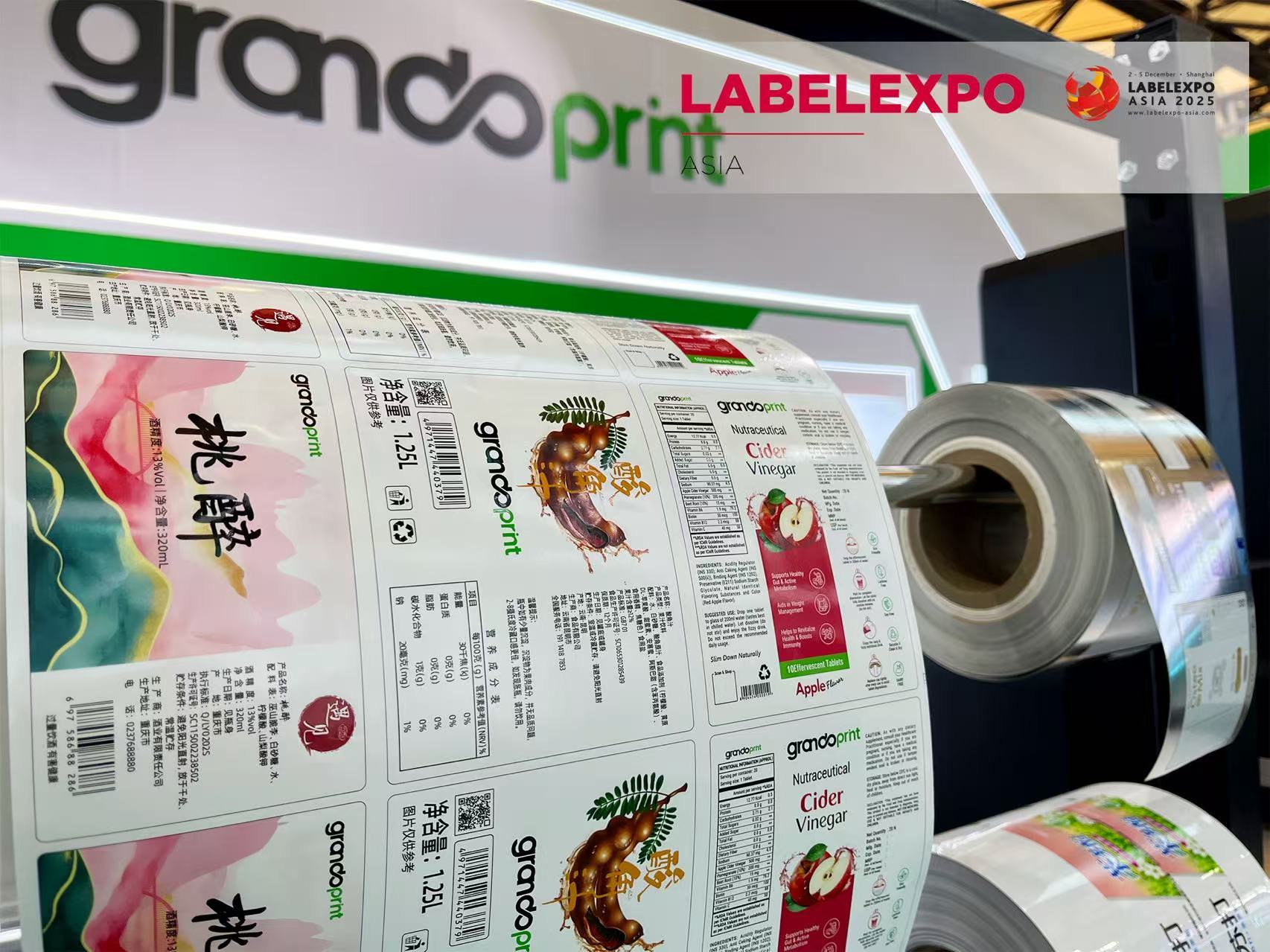
The role of digital label printing in 2026 packaging operations
The global digital label printer market was valued at USD 3.097 billion in 2024 and is projected to reach USD 8.654 billion by 2035, according to Market Research Future. The same source projects a CAGR of 9.79% between 2025 and 2035. These figures reflect a structural shift rather than a temporary uptick: brands are ordering in smaller batches, launching more SKUs, and demanding faster changeovers.
Three operational pressures explain why packaging lines are integrating digital label printing:
- Shorter order quantities. Minimum order quantities for labels continue to drop, and digital printing makes small batches economically viable by removing plate costs and setup time.
- Multi-SKU complexity. Product variations, seasonal packaging, and personalized promotions create frequent job changes. Digital machines handle file switching at the control system level.
- Traceability and serialization. QR codes, barcode labels, serial number labels, and anti-counterfeit labels require variable data processing that analog printing cannot deliver efficiently.
Inkjet systems are estimated to hold a 46% share of the digital label printing market by system type in 2025, according to Future Market Insights. Within the broader label printer category, industrial label printers represent the largest product segment at approximately 42.5%, based on Dataintelo data. These indicators point to the same conclusion: industrial inkjet label printers are becoming the default production platform for flexible, data-enabled label runs.
How the GR350S is built for production use
Grandoprint's GR350S is a high-speed digital label printer designed for continuous roll-to-roll operation. It uses piezoelectric inkjet printing technology and is built on an industrial metal frame with a sheet-metal enclosure. Core components include precision metal rollers, a paper roll shaft, roll-to-roll feeding and rewinding assemblies, a UV inkjet printing unit, UV curing modules, and an electrical control cabinet.
Key technical specifications of the GR350S:
| Parameter | Specification |
|---|---|
| Model | GR350S |
| Print head | Epson S3200-U1 / S3200-U3 |
| Printing technology | UV digital piezoelectric inkjet |
| Media width | 120–360 mm |
| Printing width | 110–350 mm |
| Printing speed | 20–100 m/min |
| Ink configuration | CMYKW + optional varnish |
| Unwinding diameter | Max. 700 mm |
| Power supply | 380V, 50/60 Hz |
| Power consumption | 10 kW |
| Dimensions | 2850 (W) × 1400 (D) × 2040 (H) mm |
The GR350S also supports a label sensor for mark tracking and intelligent deviation correction. For film substrates, a corona treatment module is available to improve ink adhesion. Optional pre-coating and post-coating varnish systems extend the machine's range across difficult materials and premium finishes.
What this means for packaging lines
The GR350S is not a desktop printer scaled up. It is designed as a continuous production digital label printer. The reinforced frame, precision rollers, and roll-to-roll feeding system support sustained operation in a factory environment, not intermittent office use.
Grandoprint positions its manufacturing around continuous production capability. The company was established in 2010, operates dual bases in Nanjing and Shanghai, and reports a total factory area exceeding 20,000 square meters, approximately 500 employees, and an annual production capacity of 15,000 units. Its R&D and technical team includes 30 engineers with more than 20 years of technical service experience. These are the kind of supplier facts a buyer can verify before committing to a capital equipment purchase.
For a packaging operation, the production-relevant consequences of installing a machine like the GR350S include:
- Removal of plate-making from the critical path. Job setup time shrinks because there is no plate mounting, registration adjustment, or plate storage.
- Economical short runs. The cost structure of digital printing favors small batches and frequent job changes.
- Variable data as a standard capability. QR codes, barcodes, serialized labels, and anti-counterfeit labels can be printed in the same pass as fixed graphics.
- Multi-SKU agility. File-based switching allows a converter to handle frequent design changes and seasonal packaging without scrapping plates.
Production scenarios across label categories
Digital inkjet label printing supports a range of end-use segments. The GR350S is configured as a film label UV inkjet printer for PET, PP, and OPP-based work; a food and beverage label printer; a cosmetic label printer; a packaging label printer; and a spot varnish digital label printer. A single machine platform can serve multiple label categories, which matters for converters with mixed order books.
Food and beverage labels
Food and beverage label converters face strict changeover discipline because recipes, packaging design, and regulatory information change frequently. The GR350S functions as a food and beverage label printer with UV digital inkjet printing, variable data processing, label sensor mark tracking, and dual UV curing. It prints on PE, PET, BOPP, PP, and OPP films, which are common substrates in beverage and food packaging.
Traceability requirements also push food and beverage labels toward variable data. The GR350S can print QR code labels and barcode labels in-line, supporting product information and supply chain traceability.
Cosmetic and premium labels
Cosmetic labels demand both color quality and surface finish. The GR350S is configurable as a cosmetic label digital printer with CMYKW ink plus optional varnish, spot varnish enhancement, and an optional post-coating varnish system. Dual UV curing supports varnish layering and gloss effects on cosmetic, skincare, and premium product labels.
For packaging converters serving cosmetics brands, the digital approach allows testing of prototype labels and small-batch regional launches without committing to large flexo runs.
Film and difficult substrates
PE, PET, BOPP, PP, and OPP films are widely used for beverage, household, and industrial labels, but their non-porous surfaces can resist ink adhesion. The GR350S film label configuration includes a corona treatment module to improve UV ink adhesion. An optional pre-coating system provides another route for problem substrates. This expands the machine's scope beyond paper labels into the film label segment that is growing within packaging.
Short-run and variable data jobs
Digital label printing is well suited for short-run, multi-SKU, frequently changing, and customized label production. The GR350S supports direct database printing without batch PDF conversion, which simplifies serialized work. Typical applications include QR code labels, barcode labels, anti-counterfeit labels, serialized labels, and product traceability labels.
Grandoprint notes that in some markets, 15–25% of orders among label printing customers are micro-batch production. That mix is difficult to run profitably on conventional plate-based equipment, but it aligns naturally with digital inkjet.
Comparison with traditional flexo and letterpress workflows
Traditional flexo and letterpress printing remain strong for long, stable runs. Their cost per label drops significantly when volume is high and the design is fixed. Digital label printing cannot fully replace flexo for very long runs where analog speed and mature consumables economics dominate.
However, the comparison changes when the order book contains a high share of short runs and variable data. Digital printing reduces plate-making steps and shortens job setup time. It also gives converters the ability to store job files digitally rather than storing physical plates.
A balanced view for procurement:
| Factor | Traditional flexo / letterpress | Digital inkjet label printing |
|---|---|---|
| Run length economics | Best for long, stable runs | Best for short and mid runs |
| Job changeover | Plate mounting and registration | File-based switching, faster setup |
| Variable data | Limited or separate processing | Native in the printing workflow |
| Multi-SKU production | Higher waste and setup cost | Cost-effective for frequent changes |
| Surface finishing | Inline varnish possible | Optional varnish module on GR350S |
| Long-run unit cost | Lower at high volumes | Higher at very high volumes |
One real limitation should be stated: for converters whose order book consists almost entirely of extremely long, unchanging runs, a digital label printer will not beat the per-unit cost of an optimized analog press. Digital printing's value lies in flexibility, speed to job change, and data-enabled labels.
Market trend signals for 2026 and beyond
The digital label printer market is projected to grow at a 9.79% CAGR between 2025 and 2035. Industry segment estimates place inkjet systems at 46% of the digital label printing market in 2025, and industrial label printers at roughly 42.5% of the total label printer market. These are directional signals, not purchase recommendations. They indicate where label converters are likely to invest production capacity.
For buyers, the practical trend is threefold:
- Converters are adding digital capacity as a complement, not necessarily a replacement, for analog presses. This allows them to capture short-run work while keeping long-run jobs on existing equipment.
- Brand owners are demanding more SKUs with shorter lifecycles. Digital printing supports faster packaging refresh cycles and regional variations.
- Regulatory and traceability requirements are pushing variable data into more label categories. Food, beverage, pharmaceutical, and industrial labeling increasingly require QR or serialized codes.
Grandoprint's export business accounts for 70% of total sales, with major markets including the United States, Brazil, Mexico, Australia, Thailand, Germany, Italy, Kuwait, Angola, and Ivory Coast. The company states that it provides global services including equipment selection, sample testing, installation, training, and long-term technical support. For sourcing teams evaluating Chinese manufacturers, these service claims should be verified through direct factory communication and sample testing.
Supplier evidence and verification points
A digital label printer is a capital asset. The supplier's manufacturing capacity and quality control processes are part of the product decision. Key facts about Grandoprint in this context:
- Nanjing Grando Digital Technology Co., Ltd. was established in 2010 and specializes in digital inkjet printing equipment for label printing, packaging, and industrial marking.
- The company operates dual bases in Nanjing and Shanghai, covering R&D, production, warehousing, testing, and exhibition, with total factory area exceeding 20,000 m².
- It employs approximately 500 staff, including a 30-engineer R&D team with over 20 years of technical service experience.
- Annual production capacity reaches 15,000 units.
- Grandoprint reports ISO 9001:2015 certification (Cert. No. 19926Q00205R001) for the R&D and production of digital inkjet equipment.
For CE-marked sales into the European Union, digital label printers must comply with the RoHS Directive (2011/65/EU) and the EMC Directive (2014/30/EU). Buyers should request the specific CE declaration and supporting docs from any supplier rather than relying on generic claims.
How to evaluate the GR350S for a specific packaging line
Evaluation begins with identifying the substrate mix. If the production plan includes film labels, the buyer should verify the corona module and run trials on the actual PE, PET, BOPP, PP, or OPP material. If the work is food or cosmetic labeling, the buyer should test with representative artwork, including premium varnish effects where needed. If variable data is part of the plan, the buyer should test QR code readability and serialization accuracy, not just print a sample sheet.
Facility readiness also matters. The GR350S requires 380V three-phase power, approximately 10 kW, and a recommended environment of 18–32°C with 40–60% humidity. Dust-free conditions are recommended to protect printhead precision. Compressed air at 0.6–0.8 MPa is required for pneumatic components. These factors affect installation time and total cost.
The GR350S dimensions—2850 mm wide, 1400 mm deep, 2040 mm high—mean the production floor must have space for loading the unwind roll, operator access, and maintenance clearance.
Future outlook
The next phase of digital label printing will likely be defined by higher integration: more automated inline finishing, tighter connections to databases and ERP systems, and continued improvement in film substrate adhesion. Grandoprint's GR350S already addresses part of this through variable data processing, direct database printing, and optional coating modules.
Procurement teams should expect digital label printers to become more capable and more accessible. The key sourcing skill is to separate verified facts from marketing claims: check certification, test representative materials, evaluate the supplier's manufacturing base, and confirm after-sales support before purchase.
FAQ
What is a digital label printer used for?
A digital label printer is used for roll-to-roll label production in industries such as packaging, food and beverage, cosmetics, household products, and industrial labeling. It prints directly from digital files without plates, making it suitable for short runs, multi-SKU orders, QR code labels, barcode labels, serialized labels, and anti-counterfeit labels.
What types of materials can a digital label printer handle?
The GR350S digital label printer handles coated paper, PET, PP, BOPP, PE, OPP, and synthetic label materials. For film and difficult substrates, a corona treatment module improves UV ink adhesion, and an optional pre-coating system is available. Testing on the actual material is recommended before batch production.
Can a digital label printer print variable data such as QR codes and barcodes?
Yes. The GR350S is a variable data digital label printer that supports QR code labels, barcode labels, serial number labels, anti-counterfeit labels, and traceability labels. It supports direct database printing without batch PDF conversion and includes a label sensor for mark tracking.
What is the printing speed and width of an industrial digital label printer?
Industrial digital label printers vary in speed and width. The GR350S supports printing speeds of 20–100 m/min with a printing width of 110–350 mm, accepting media widths of 120–360 mm. It is designed for continuous roll-to-roll production.
Is UV inkjet printing suitable for food and cosmetic labels?
Yes. The GR350S is configured for food and beverage label printing and cosmetic label printing, using UV digital inkjet technology. Food and beverage labels often require QR or barcode data, while cosmetic labels may require varnish and spot varnish enhancement. Buyers should verify regulatory compliance for their specific market.
How is the GR350S digital label printer different from traditional flexo printing?
Digital inkjet printing removes plate-making steps and reduces job setup time. It is more suitable for short-run, multi-SKU, frequently changing, and variable data label production. Traditional flexo remains more economical for very long, unchanging runs. Converters often treat digital as a complement to existing analog presses.
What certifications should a digital label printer supplier have?
Relevant certifications include ISO 9001:2015 for quality management systems and, for the European Union, CE marking under the RoHS Directive (2011/65/EU) and the EMC Directive (2014/30/EU). Grandoprint reports ISO 9001:2015 certification (Cert. No. 19926Q00205R001) for R&D and production of digital inkjet equipment. Buyers should request certificates and declarations directly.
What is the GR350S digital label printer specification?
The GR350S uses Epson S3200-U1 / S3200-U3 print heads, UV piezoelectric inkjet printing, media width 120–360 mm, printing width 110–350 mm, printing speed 20–100 m/min, ink CMYKW plus optional varnish, max unwind diameter 700 mm, 380V power supply, 10 kW power consumption, and dimensions 2850 × 1400 × 2040 mm. It is produced by Nanjing Grando Digital Technology Co., Ltd. under the Grandoprint brand.
Can the GR350S be used for continuous production?
Yes. The GR350S is designed as a continuous production digital label printer with a reinforced industrial metal frame, sheet-metal machine cabinet, roll-to-roll feeding and rewinding assemblies, precision media rollers, UV curing modules, and an electrical control cabinet. It supports printing speeds up to 100 m/min in roll-to-roll mode.
What industries use digital label printers?
Digital label printers are used by label printing factories, packaging converters, food and beverage companies, cosmetics and daily chemical brands, pharmaceutical and industrial component manufacturers, and garment accessory suppliers. Applications include product labels, packaging labels, QR/barcode labels, anti-counterfeit labels, wash care labels, tickets, and traceability labels.
Download the Grandoprint corporate brochure (PDF) for detailed product and company information.
Have Questions or Need More Details?
Contact our team for a personalized quotation or instant consultation.
Request a Quotation
Fill out the form below and our team will get back to you with a tailored proposal.
WhatsApp Direct Chat
Prefer to chat in real-time? Message us on WhatsApp for instant assistance & quick answers.
- Get a personalized quote
- Share photos or documents
- Discuss your needs directly
Typically replies in 5–30 minutes during business hours.