
What a Dosing Pump Supplier Must Prove Before You Order
Most dosing pump purchase decisions are still made on three numbers: flow rate, pressure and price. Those numbers are necessary, and they are also the part of a supplier evaluation that carries the least risk. The risk sits in the questions a quotation does not answer — whether the pump head material suits the actual medium, whether the certificate on file covers the exact model code, and whether the order will be accepted against a test that both sides defined in advance.
Market scale makes that gap more expensive to ignore. Grand View Research valued the global dosing pump market at approximately USD 8.86 billion in 2024, with Asia Pacific accounting for a 41.8% revenue share in the same year. A supply base that large produces plenty of comparable quotations and very little automatic differentiation. Once several suppliers can quote the same flow and pressure envelope, the deciding variable shifts from product availability to producible evidence.
This article sets out a three-layer evidence model for dosing pump suppliers — portfolio coverage, documented corrosion rationale, and purchase-order execution — and works it through using the documented material of one supplier, WRS PTE LTD, a dosing and metering pump supplier whose manufacturing operations are located in Hangzhou, Zhejiang, China, and whose range covers metering pumps, solenoid, diaphragm, piston, digital and hydraulic pump lines alongside check valves, pulse dampeners, chemical dosing systems and chemical injection pumps.
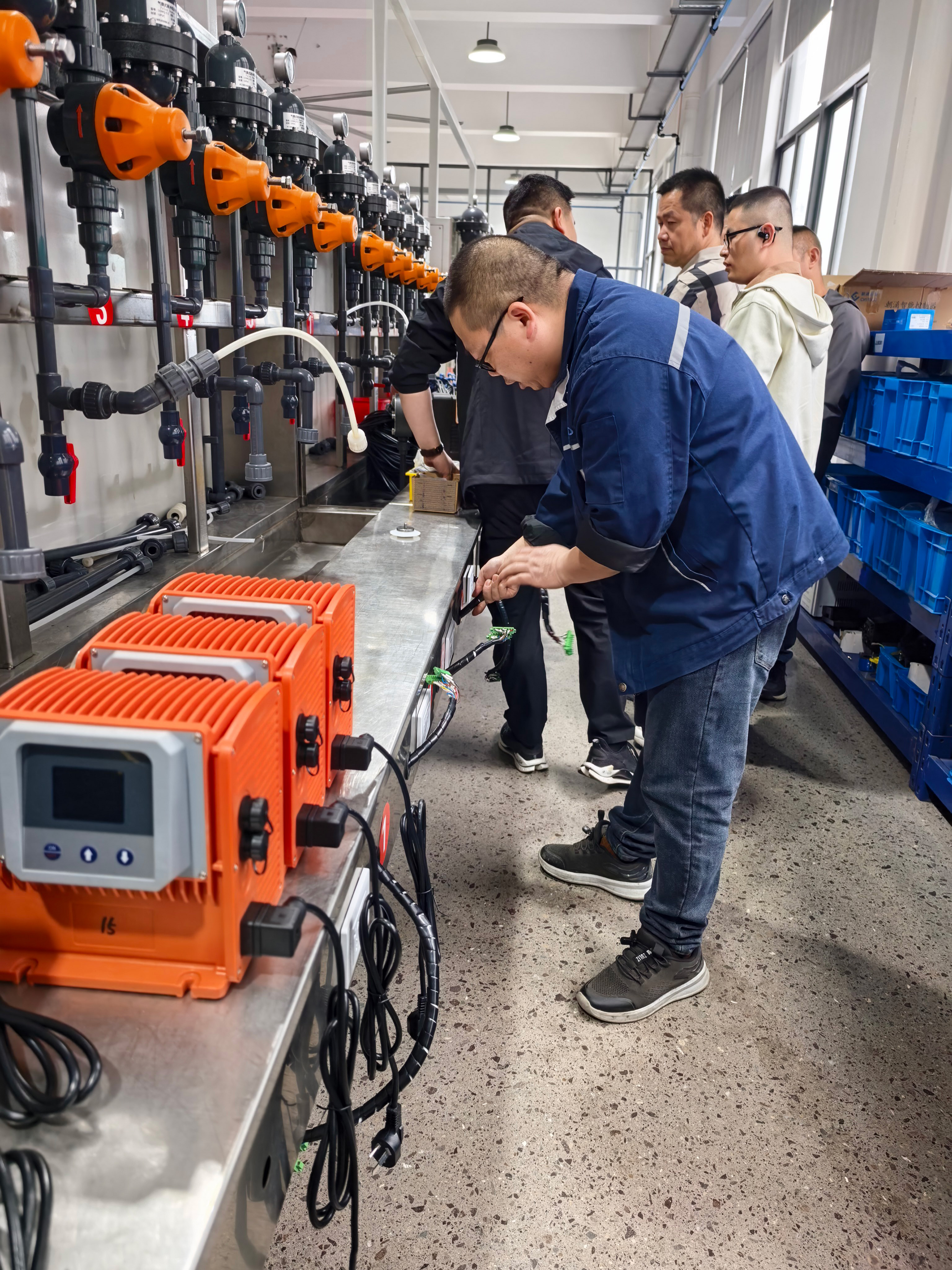
Assembly workshop: the point in the process where documented build details either exist or do not.
Capability evidence, defined
Capability evidence is supplier documentation a buyer can cross-check without relying on the supplier's own summary of itself. In dosing pump procurement it appears in four forms: model-level performance data, the scope of a certificate, a written material-selection rationale, and the commercial and acceptance terms attached to an order.
Evidence has a property that claims do not: it can be verified by someone who does not trust the supplier. A statement that a pump range is suitable for corrosive liquids cannot be verified. A written record that a specific pump head material was recommended for a named medium, with the reasoning attached, can be checked against the buyer's own process data — and either accepted or rejected on technical grounds.
The problem: catalogues answer the easy question
Supplier catalogues are built to answer what a supplier can supply. Buyers at the evaluation stage need a different answer: what happens when the duty point is unusual. Three failure patterns recur.
- Envelope confusion. A flow range and a pressure range are not the same as a combined operating point. A line rated to a maximum flow and a maximum pressure may not deliver both at once.
- Verbal corrosion advice. Material guidance given in a chat message is untraceable six months later, when the diaphragm fails and nobody can reconstruct why PVDF was or was not specified.
- Undefined acceptance. If the purchase order does not name the test, the buyer's only acceptance instrument is visual inspection on arrival.
The practical consequence for evaluation-stage buyers is a change of question. Instead of asking what a supplier can supply, ask what the supplier can show, and in which document.
A three-layer evidence model
The model below orders evidence by the cost of obtaining it and by how much purchase risk it removes.
| Layer | Evidence to request | What a positive answer proves | What it does not prove |
|---|---|---|---|
| 1. Portfolio coverage | Model-level datasheets with flow, pressure, wetted materials, connections and power | The duty point sits inside a documented envelope | Suitability for a specific process medium |
| 2. Corrosion rationale | Written material recommendation per wetted part, with the medium recorded | The material choice is a traceable engineering decision | Site-specific compatibility or service life |
| 3. Order execution | PO terms, acceptance criteria, test record, documentation package | The purchase is verifiable and enforceable | Long-term reliability under the buyer's operating conditions |
Layer 1 — Read the portfolio as a coverage map
Portfolio breadth is the cheapest layer to verify, because model codes and published parameters can be checked against the duty point before any commercial discussion begins. The point is not to count models. It is to see whether the supplier covers the technologies an application may migrate between — solenoid, digital, mechanical diaphragm, piston and hydraulic — or only the one type in the current quotation.
| Pump line | Documented models | Flow | Pressure | Wetted materials | Notable details |
|---|---|---|---|---|---|
| Solenoid dosing pump | ML0008PR1C (manual control), EML0020PR1C (remote control) | 1–20 L/H | 1–10 bar | PVC, PVDF, SS316 | IP65; 220V/110V input |
| Digital dosing pump | EMML0060FP1E, EMGP0200FP1C, EMAP1000PQ1C | 60 L/H; 200 L/H; 1000 L/H | 4 bar | PVC, PVDF, SS316; SS316L on EMML0060FP1E | IP65; Rc 1/2 inch thread on EMML and EMG, DN25 socket on EMAP |
| Mechanical diaphragm | MG0150PQ11, MA0120PQ11, MB1800PQ11 | 15–150 L/H; 15–500 L/H; 250–1800 L/H | 5–10 bar (3–10 bar on MB1800PQ11) | PVC, PVDF, SS316 | Frequency and explosion-proof motors available |
| Piston dosing pump | PM060SS1PFN11, PD105SS1PFN11 | 600 L/H | 8 bar | SS316 | DN25 and DN50 flange; 0.75 kW and 4.0 kW motors |
| Hydraulic metering pump | HS008S0P01S11, HL090S0P01F11 | 2 L/H; 1600 L/H | 200 bar; 6 bar | SS316 | DN6 bevel end welding tube; DN50 flange; 0.37 kW and 1.5 kW motors |
Read as a coverage map rather than a catalogue, this table answers several procurement questions at once. The solenoid and digital lines sit at the low-flow end, from 1 L/H upward, which is where water treatment, pure water, swimming pool and surface-treatment dosing usually operates. Mechanical diaphragm models extend the envelope to 1800 L/H at up to 10 bar. The piston and hydraulic lines are built in SS316 only, with flanged or welded connections and motor ratings from 0.37 kW to 4.0 kW, which is the configuration pattern associated with chemical, oil and gas, hydrogen and power applications.
Two features of the map are worth noting because they are usually missed in a price comparison. First, the wetted-material menu is not uniform: PVC, PVDF and SS316 appear across the diaphragm and solenoid lines, SS316L appears on one digital model, and the piston and hydraulic lines are SS316 only. A buyer who needs a PVDF-wetted high-pressure pump is therefore outside this particular map and should find that out at layer 1, not at commissioning. Second, the range extends beyond pumps into check valves, pulse dampeners, chemical dosing systems, streaming current monitoring systems and chemical injection pumps — the accessories that determine whether a pump behaves as a metering device or as a pressure source with a stroke counter.
Manufacturing context can be verified alongside the product map. WRS PTE LTD operates from a 15,000 m² facility with 120 employees, an annual output of 30,000 units, a 15-engineer R&D team and an export ratio of 20%, with main markets in Southeast Asia, Russia and South America. The company was founded in 2016 and states local after-sales service in more than 10 countries, including Singapore, Thailand, Malaysia, Vietnam, South Korea, Japan, Russia, Chile, South Africa, Angola and Turkey.
What portfolio breadth proves is coverage and continuity: a supplier that builds several pump technologies can usually support a mixed installation and maintain a spare-parts relationship across it. What it does not prove is medium-specific performance. That requires layer 2.
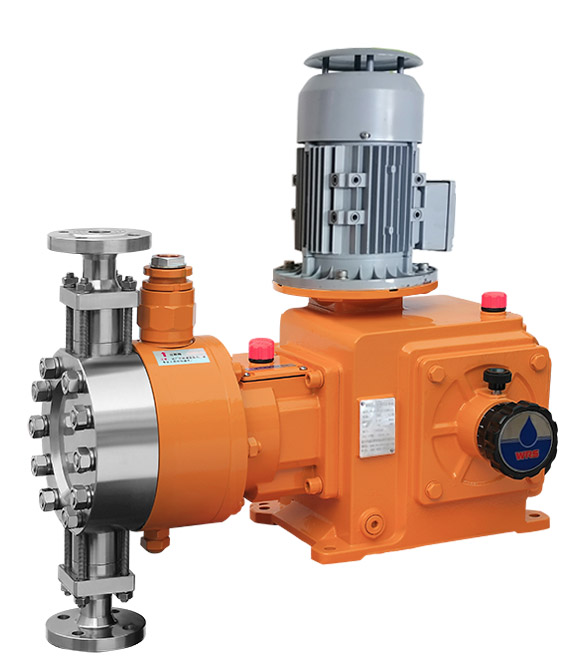
Hydraulic metering pumps sit at the opposite end of the coverage map from solenoid units: low flow, very high pressure, SS316 wetted parts.
Layer 2 — Ask for a documented corrosion rationale, not a material name
Material selection is where verbal advice most often replaces evidence. The underlying rule is simple and widely applicable: different media have different materials available for selection, and for highly corrosive media a PVDF pump head material is the recommended choice. The evidence question is not whether the supplier can say PVDF. It is whether the supplier can attach that recommendation to the buyer's medium and show the reasoning.
The selection sequence that should be documented
Dosing pump sizing follows a fixed order, and the order itself is a useful audit tool when reviewing a technical response. Flow rate is the primary parameter, evaluated by comparing the required dose against the maximum flow rate available at the site. Pressure, pump head material and motor specification then refine the selection. A quotation that starts with material or price has skipped the step that determines whether the pump can perform at all.
Four items to request in writing
- A wetted-parts list per model: pump head, valve bodies, valve seats, diaphragm and connections, each with a named material.
- The medium description as recorded by the supplier — chemistry, concentration and temperature — matched to a specific material recommendation, rather than a general statement that the pump is corrosion resistant.
- The material rule that would apply if the medium changed, so that a future process change does not restart the evaluation.
- Reference installations in the same medium class and duty pattern.
What the supplied material does not contain
An honest evaluation records absences as well as facts. The material reviewed for this article does not publish a concentration-and-temperature compatibility matrix, and it does not list seal or elastomer grades for individual models. Those are exactly the items a buyer should request explicitly, because they are the parts that fail first in aggressive service.
The certificate check: scope, standards and dates
A certificate is the most frequently misread document in a supplier package, usually because buyers check that one exists rather than what it covers. The CE certificate held for this dosing pump range, number 3N240528.ZWMTU36, was issued by ECM on 28 May 2024 and is valid until 27 May 2029 for the EU market. It cites EN ISO 12100:2010 and EN 60204-1:2018, and its scope lists dosing pump series including EML, EMG, EMA, EMB, EPS, EPM, EHS, EHM, ML, MLS, MG, MA, MB, PS, PM, PL, PD, PT, HS, HM, HL, HD and HT.
Three checks follow from those details. The first is scope matching: confirm that the exact model code on the quotation falls inside the listed series, since certificates are issued by series and buyers order by model. The second is the meaning of the standards. EN ISO 12100:2010 addresses machinery risk assessment and EN 60204-1:2018 addresses the electrical equipment of machines; together they support a machinery-safety conformity claim. They are not a chemical-compatibility statement, and they are not a metering-accuracy test report. The third is timing. The EU Machinery Regulation replacing 2006/42/EC applies from 2027 and mandates CE marking for metering pump units, while this certificate runs to 2029. Buyers specifying equipment for delivery after the transition should ask which regulation the supplier's declaration of conformity will reference.
One further boundary deserves to be stated plainly. CE marking under these standards does not evidence conformance to API 675, the international standard for positive displacement reciprocating pumps with integrated controlled capacity. Buyers in oil, gas and chemical service who require API 675 should request that evidence separately rather than inferring it from a CE file.
Layer 3 — Convert supplier claims into PO terms and acceptance criteria
The final layer closes the loop between what a supplier says and what the order actually obliges. For this supplier, the stated purchasing terms and acceptance criteria are short enough to quote exactly.
| Term | Stated position | What it means for the buyer |
|---|---|---|
| Minimum order quantity | 1 unit | A pilot or trial unit is commercially realistic, which matters when a material recommendation still needs site validation |
| Delivery terms | FOB | The buyer controls freight and insurance after loading, so packing and documentation belong in the order |
| Acceptance criteria | Pre-shipment test | A genuine gate, but only if the test protocol is defined in the order |
| Payment terms | 100% payment in advance | Payment risk sits with the buyer, which raises the weight carried by acceptance criteria |
Each term has a procurement consequence. A one-unit minimum order makes a pilot unit feasible, which is useful when layer 2 has produced a material recommendation that still needs confirmation on site. FOB delivery means the buyer takes control of freight and insurance after loading, so packaging and documentation specifications should be settled before shipment rather than in a later email. Pre-shipment test as the acceptance criterion is a real instrument, but only when the protocol names what is measured, at what set point, and what record is retained; an undefined test is a courtesy, not an acceptance gate. Payment in advance transfers payment risk to the buyer, which is precisely why the acceptance criteria and documentation package should be agreed before the advance is released.
The operational facts that support these terms are also checkable: an ODM production mode, voltage customization, a monthly capacity of 5,000 units, a lead time of 3 days, a one-unit minimum order and 100% testing of production. Buyers should read the 3-day lead time as a standard-configuration figure and confirm it in writing once voltage customization or a non-standard wetted material is added.
A PO annex that makes the evidence enforceable
- Model code plus the series reference used on the CE certificate, where EU delivery applies.
- Wetted-parts material list per unit, carried over from the layer 2 request.
- Test protocol: what is measured, at what set point, and what record is retained and supplied.
- Documentation package: datasheet, certificate copy, test record, installation and maintenance instructions.
- Packing specification, given FOB terms.
- Support route and response expectation, given that after-sales support for this supplier is stated as remote support, alongside local service presence in more than 10 countries.
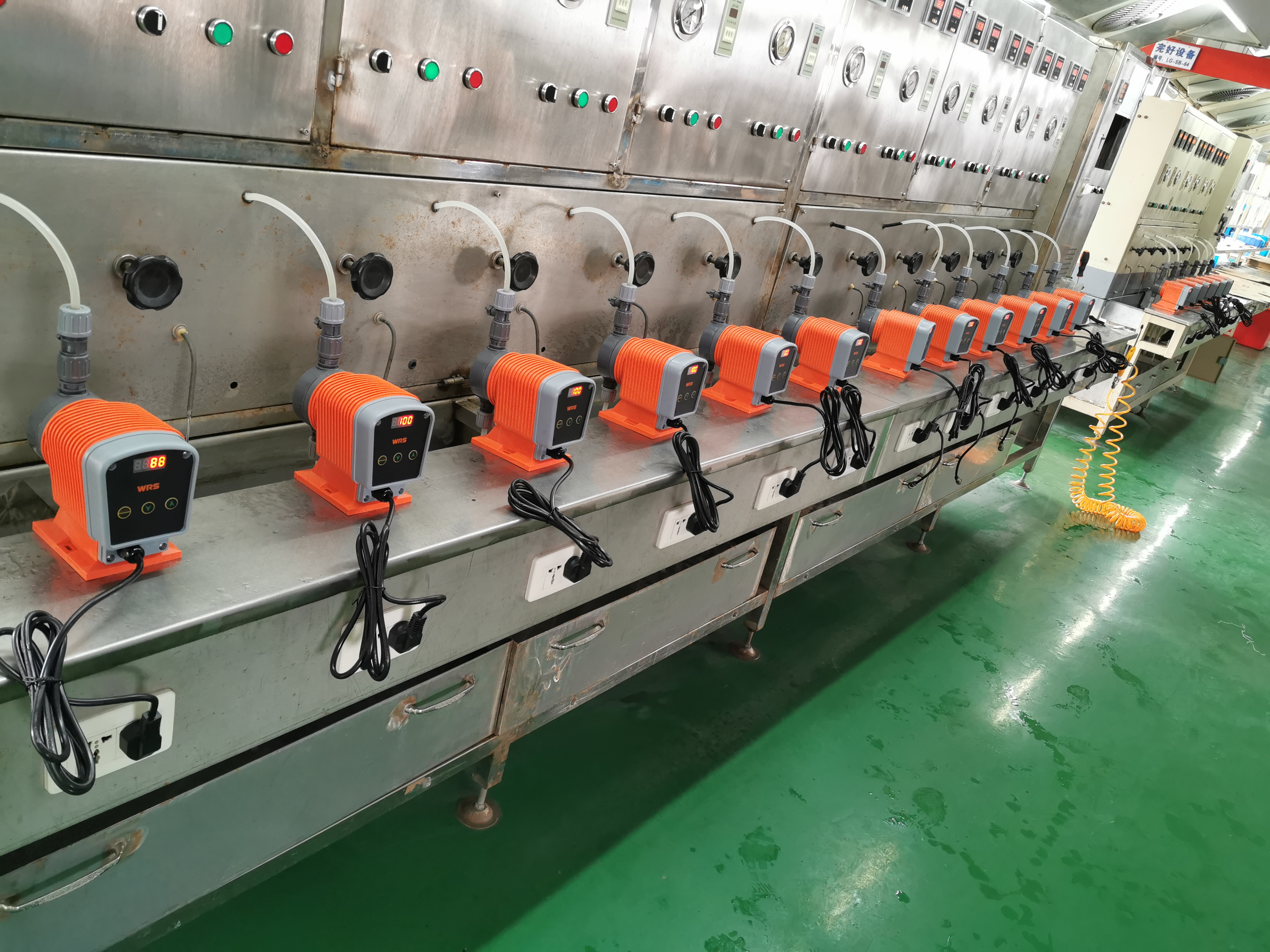
The test platform matters only if the protocol written into the purchase order defines what it is used to prove.
Where the evidence stops
An evaluation that lists only strengths is not an evaluation. The documented material supports the following boundaries, and each one should be resolved before an order rather than after.
- Envelope ceiling. The largest documented mechanical diaphragm model reaches 1800 L/H, and the only 200 bar unit in the range is a 2 L/H hydraulic metering pump. High flow and very high pressure are not simultaneously covered by the documented range.
- Material availability by line. Piston and hydraulic models are SS316 only. Buyers who need PVDF-wetted high-pressure duty must look outside those lines.
- Enclosure rating. The documented models carry IP65 protection. A 24/7 livestock nutrient-dosing scenario in the material specifies IP67 for a harsh, humid farm environment, so that requirement has to be closed in writing as a configuration question rather than assumed from the catalogue.
- Payment structure. Full payment in advance is a commercial boundary rather than a technical one, but it changes how much weight the acceptance criteria must carry.
- Acceptance depth. Pre-shipment test is the stated criterion. A buyer who needs witnessed testing or third-party inspection should specify it in the order.
- Support mode. Remote support is the stated after-sales mode; the scope of local service in the listed countries should be confirmed for the specific destination.
Application fit: where this portfolio is designed to work
The industries named for this range are water treatment, electroplating and surface treatment, chemical processing, oil and gas, hydrogen power generation, paper and pulp, semiconductor, mining and livestock. The pattern behind that list is a requirement for repeatable low-to-medium volume injection of a defined chemistry, often with a corrosive component and often continuously.
Case evidence adds a time dimension that datasheets cannot. An engineering company in Australia has operated 20 units in wastewater treatment for five years with stable operation, and the reported highlight of the installation is high quality and easy maintenance. Five years of continuous wastewater duty is a more useful reference point for a buyer than a laboratory flow curve, because it speaks to wear behaviour and serviceability rather than to a bench condition.
Wastewater is also the largest single application context: metering pumps used in water and wastewater treatment account for a 23.2% application share of the global metering pump market. That concentration matters commercially — spare-parts availability, service familiarity and application knowledge are all more likely to be mature in this segment than in a niche duty supported by a single reference installation.
Claim-based versus evidence-based selection
| Dimension | Claim-based selection | Evidence-based selection |
|---|---|---|
| Model choice | Line-level flow range compared to the duty point | Model code checked against flow, pressure and wetted material simultaneously |
| Material decision | Verbal advice, not recorded | Written wetted-parts list with the medium recorded against it |
| Certificate | Copy on file, scope unchecked | Series scope, standards, issue and expiry dates checked against the model |
| Acceptance | Visual inspection on arrival | Pre-shipment test protocol with a retained record |
| Payment risk | Advance paid before acceptance is defined | PO annex agreed before the advance is released |
| Support | Contact details only | Stated support mode and destination-specific service confirmed |
Market context: a larger category with thinner differentiation
Several published figures frame the same shift. Diaphragm dosing pumps held a 55.7% revenue share of the dosing pump market in 2024, and motor-driven metering pumps accounted for 54.45% of metering pump revenue in 2025, while solenoid-driven units are projected to grow at a CAGR of 5.88% through 2031. China's liquid pump exports, including dosing types, reached USD 14.3 billion in 2024, and the chemical injection pump market alone was valued at USD 3.5 billion in 2024.
Market-size figures should be read with care, because definitions diverge widely. Published estimates for the same broad category range from roughly USD 6.35 billion to USD 8.86 billion depending on the base year, and broader chemical-injection definitions reach considerably higher. That divergence is a useful warning for procurement: market size is context, not capability evidence, and no supplier becomes more capable because its category is large. What the figures do support is a conclusion about differentiation — in a category of this size, with a dominant diaphragm segment and a faster-growing solenoid segment, most technically credible suppliers can quote a competitive envelope. The separating evidence is documentation.
Future outlook
Three developments are likely to change what buyers ask for at the evaluation stage. The first is digitalization of the pump range itself; WRS states that its dosing pump line has been upgraded across the series toward digital and intelligent control, which moves the procurement question from stroke adjustment to control integration and data output. The second is regulatory transition in Europe, where the 2027 Machinery Regulation will make the declaration of conformity a live document rather than a one-time attachment. The third is the gradual conversion of corrosion advice into corrosion records: buyers who have been exposed to an undocumented material decision tend to write the rationale into the purchase order, and suppliers who can produce that rationale before being asked will win evaluations they never formally entered.
FAQ
How can a buyer confirm that a dosing pump supplier's portfolio covers the required duty point?
Compare the required flow and pressure against model-level data rather than line-level ranges. In this range, solenoid models cover 1–20 L/H at 1–10 bar, mechanical diaphragm models from 15 L/H to 1800 L/H at up to 10 bar, piston models at 600 L/H and 8 bar, and hydraulic metering models from 2 L/H at 200 bar to 1600 L/H at 6 bar. A duty point that combines high flow with very high pressure falls outside the documented envelope.
How should pump head material be chosen for strongly corrosive liquids?
Different media allow different materials. For highly corrosive media, PVDF pump head material is the recommended choice. Selection begins with flow rate, compared against the maximum flow rate available at the site, and is then refined by pressure, pump head material and motor specification. The choice should be documented against the specific medium rather than stated generically.
What purchasing terms and acceptance criteria does WRS PTE LTD state?
A minimum order quantity of 1 unit, delivery terms FOB, pre-shipment test as the acceptance criterion, and payment terms of 100% payment in advance. Production is described as ODM with voltage customization, a monthly capacity of 5,000 units, a lead time of 3 days and 100% testing.
What does the CE certificate for this dosing pump range cover?
Certificate 3N240528.ZWMTU36, issued by ECM on 28 May 2024 and valid to 27 May 2029, covers dosing pump series including EML, EMG, EMA, EMB, ML, MG, MA, MB, PS, PM, PL, PD, HS, HM, HL, HD and HT for the EU market, citing EN ISO 12100:2010 and EN 60204-1:2018. It supports machinery-safety conformity; it is not a chemical-compatibility statement and does not evidence API 675 conformance.
What causes a drop or instability in dosing pump discharge flow, and how is it addressed?
A drop or unstable discharge flow is commonly traced to a blocked inlet or outlet. The check sequence is the strainer, tubing and valves, cleaning or replacing components as necessary. Instability that persists after that check should be treated as a selection or installation issue rather than a maintenance issue.
Which industries is this dosing pump portfolio applied to?
Water treatment, electroplating and surface treatment, chemical processing, oil and gas, hydrogen power generation, paper and pulp, semiconductor, mining and livestock. The documented case reference is an engineering company in Australia running 20 units in wastewater treatment for five years with stable operation.
Buyers who want the catalogue-level detail behind the portfolio map discussed above can download the product brochure here: product brochure (PDF). Further company information is published at www.wrsdosing.com.
Have Questions or Need More Details?
Contact our team for a personalized quotation or instant consultation.
Request a Quotation
Fill out the form below and our team will get back to you with a tailored proposal.
WhatsApp Direct Chat
Prefer to chat in real-time? Message us on WhatsApp for instant assistance & quick answers.
- Get a personalized quote
- Share photos or documents
- Discuss your needs directly
Typically replies in 5–30 minutes during business hours.