
What a UL-Listed Emergency Light Supplier Must Prove in 2026
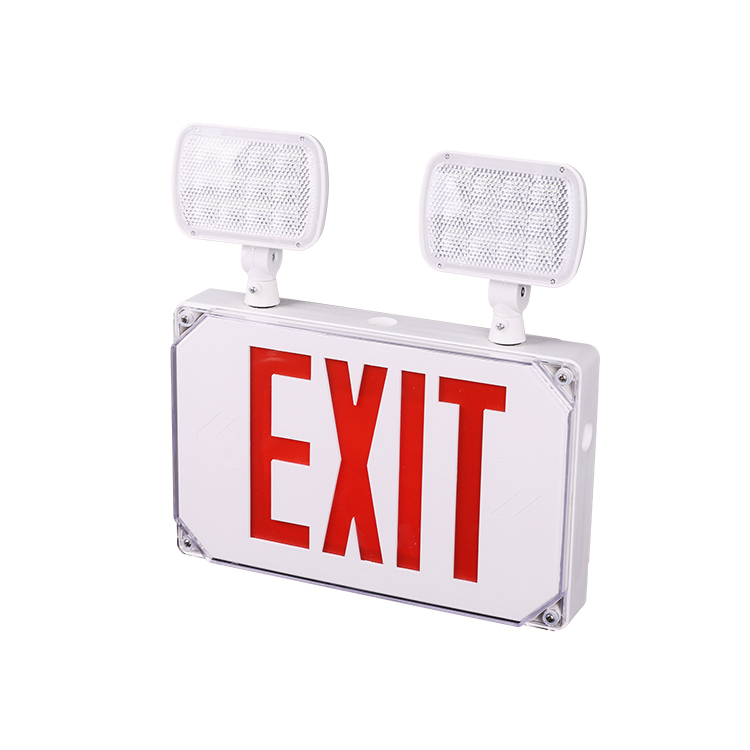
Buyers searching for an emergency light supplier are often presented with the same set of claims: UL-listed exit signs, 90-minute battery backup, test switches, and universal mounting patterns. But in the 2026 procurement environment, the difference between a genuinely compliant product and a compliance risk lies in verifiable detail — certification scope, model-level parameters, manufacturing depth, and the ability to support project-specific requirements.
The global emergency lighting market was valued at USD 7.82 billion in 2025 and is projected to reach USD 12.4 billion by 2033, growing at a CAGR of 6.2%. North America dominated the market in 2025 with 37.4% revenue share, driven by strict safety regulations. For buyers moving from research to evaluation, the practical question is no longer "which supplier claims compliance," but "what evidence does the supplier provide to prove it."
The Procurement Problem: Certification Claims vs. Verifiable Compliance
Emergency lighting is a safety category governed by standards that carry legal and project-level consequences. In the United States, UL 924 requires emergency lighting and exit signs to provide at least 90 minutes of illumination during a power failure. In 2022, UL 924 was updated to require active and continuous detection of normal power, moving away from passive detection devices. These are not cosmetic changes — they affect product design, component selection, and long-term reliability.
For an importer, distributor, or electrical contractor evaluating suppliers, several verification gaps commonly appear:
- Certification scope ambiguity: A supplier might say "UL certified" without specifying which models, which standards, or which certification body issued the certificate.
- Parameter mismatch: A UL-listed emergency light may be rated for indoor damp locations only, while the buyer's project requires a wet-location or IP65-rated product.
- Supplier depth uncertainty: Emergency lights are safety devices that depend on battery chemistry, PCB design, injection-molded housings, and testing protocols. Buyers need clarity on how much of the manufacturing process the supplier actually controls.
The opportunity is equally clear: a supplier that can document its certification numbers, test every unit, and explain its product parameters with model-level precision becomes a significantly lower-risk partner. This is particularly relevant for buyers sourcing UL-listed emergency lights and exit signs from China, where manufacturing depth varies widely across the supply base.
Specialized Manufacturing as a Compliance Foundation: The JIMING Example
One supplier that illustrates this compliance-oriented approach is Ningbo JIMING Electric Appliance Co., Ltd., an emergency lighting specialist founded in 1967. The company operates two fully integrated production facilities — a 70,000 m² plant in Ningbo, China, and a 38,000 m² plant in Haiphong, Vietnam — with more than 1,000 employees and an annual output of 5,000,000 sets. Approximately 96% of its production is exported to global markets including the USA, Canada, Europe, and the Middle East.
JIMING has been certified to ISO 9001 since 1998, and maintains a rigorous "test-every-unit" protocol meeting global standards including UL, CSA, CE, NFPA, OSHA, FCC, DOE, CEC, NEC, IBC, NEMA, BSCI, SASO, REACH, and RoHS. The company's stated specialization — emergency lighting exclusively, rather than general lighting — means its engineering resources, molds, and production lines are designed around safety-critical requirements rather than treating emergency products as secondary SKUs.
From a buyer's perspective, this depth matters for two reasons. First, it reduces the risk of certification drift: when a supplier controls its own PCB assembly, injection molding, and final testing, the product shipped should match the product certified. Second, it supports OEM/ODM projects where modifications to battery type, housing color, input voltage, logo, or packaging need to be implemented without compromising certification status.
Reading the Label: Technical Parameters Behind Certified Emergency Lighting
For buyers evaluating specific products, the most useful exercise is learning to read a product's parameter list as a compliance document. Below are representative model families that illustrate how JIMING maps UL certification and physical configuration requirements across different installation types.
JLEU9 — UL/cUL Twin Head LED Emergency Light
The JLEU9 is a dual-head emergency light with UL/cUL listing, designed for wall-mount applications. Its key parameters include 120V/277VAC dual-voltage operation, 2×12 ultra-bright 2835 SMT LED lamp heads, and a built-in 3.6V 1000mAh nickel-cadmium battery that supports a minimum 90 minutes of emergency operation. The product carries a maximum 24-hour recharge time, a test switch, and a charge indicator. It is listed for 0°C to 40°C indoor damp locations.
The JLEU9's UL certification is documented as certificate number 20140923-E464915, issued by UL LLC, valid until 2034-09-23, compliant with UL 924. For the U.S. market, it also holds FCC certification number ENB2504250012E00201C, issued by EMTEK (Ningbo) Co., Ltd., compliant with FCC CFR Title47, Part 15, Subpart B ANSI C63.4-2014. For the EU market, the JLEU9 carries CE certification number ENB2312180102E01101C under standards including EN IEC 55015:2019+A11:2020 and EN IEC 61547:2023.
JLEC2BCW — Bi-Color Emergency Exit Sign Combo with LED Heads
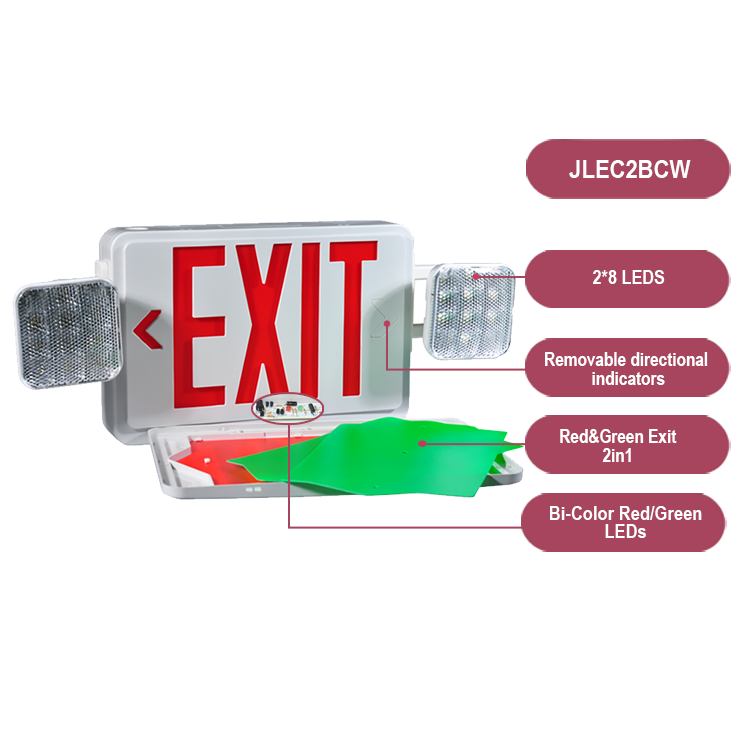
This unit combines an emergency exit sign with integrated LED lamp heads, giving buyers two safety functions in a single housing. It features red/green bi-color 6" letters with 3/4" stroke, single or double face options, removable directional indicators, and a universal J-box mounting pattern. The built-in 3.6V 1200mAh Ni-MH battery provides the required 90-minute emergency runtime.
The JLEC2BCW is covered by the UL Emergency Light Series certification for the U.S. market, and by CE certification for the EU market. Its plastic housing carries a UL 94V-0 flame rating — an important detail for plenum and non-plenum installations.
DLB300 — Emergency Downlight LED
For projects that require recessed or surface-mounted downlighting with emergency backup, the DLB300 offers a different battery architecture: a LiFePO4 3.2V 4000mAh battery delivering 3 hours of discharge time. It operates at 220-240V, 50/60Hz, with AC input power of 5.0W and DC output of 2.0W. The unit uses one 3535 SMD LED and provides up to 200 lumens in AC mode and 300 lumens in DC mode with a correlated color temperature of 6000-6500K.
LE518 — Bulkhead Emergency Light with IP65 Protection
The LE518 is a slim waterproof bulkhead emergency light rated IP65, making it suitable for areas where moisture or dust ingress is a concern. It uses 20 SMD3528 LEDs and a 3.2V 2000mAh LiFePO4 battery, providing 3 hours of maintained operation. The product supports both maintained and non-maintained modes and can be converted to edge-lit exit signs using accessories. It is covered by CE certification for the EU market.
Certification Hierarchy in Practice
Across JIMING's product range, the certification pattern follows a consistent logic:
- For the U.S. market: UL 924 is the core safety standard. JIMING's Emergency Light Series certificate covers the JLEU9, the Bulkhead emergency light, and the Emergency Exit Sign Combo, based on the certification data provided.
- For the Canadian market: Products such as the JLEU9 carry UL/cUL or CULus markings where applicable.
- For the EU market: CE certification applies to models including the JLEU9, DLB300, LE518, and JLEC2BCW.
- For quality systems: ISO 9001:2015 certification (number 00125Q33670R3M/3302) issued by CHINA QUALITY CERTIFICATION CENTRE applies at the organizational level.
This layered structure gives buyers a practical verification framework. A purchase order should be able to reference not just a supplier's general "UL listed" status, but the specific certificate number, the specific product model, and the standard that governs it.
Application Evidence: From Office Retrofits to Long-Term OEM Partnerships
JIMING's product documentation includes a representative U.S. application case in the commercial building sector. In an office building egress lighting retrofit, the JLEU9 UL twin-head LED emergency light was matched to the project's emergency evacuation lighting requirements, operating in constant-on / self-testing mode. The special requirement for this project type was simply but decisively stated: UL Listed.
The company also reports a five-year OEM/ODM partnership with an internationally recognized brand supplying emergency lighting for the North American retail market. According to shared case data, the products have been validated in global markets over multiple years, with supply remaining stable and compliant with UL/CSA standards. The engineering team collaborated with the customer on new product development — an indication that the relationship extends beyond build-to-print into co-development.
For buyers evaluating JIMING as an emergency lighting supplier from China, these application references matter because they demonstrate that the company's compliance framework is not theoretical. It has been exercised in commercial retrofit projects and through long-term supply relationships with brands that hold their suppliers to formal quality requirements.
Market Trends Reshaping Emergency Lighting Procurement
Three macro trends are relevant to the 2026 emergency lighting sourcing decision. Understanding them helps buyers interpret supplier capability beyond the product specification sheet.
1. Regulatory Evolution Is Raising the Compliance Bar
The 2022 UL 924 update requiring active and continuous detection of normal power signals a broader direction: emergency lighting systems are expected to become more intelligent and more self-diagnostic. Suppliers with in-house PCB design capability and test-every-unit protocols are better positioned to adapt certified products to these changes than assemblers that depend on third-party boards and pre-built components.
2. LED Technology Is Becoming the Default
Industry analysis from Fortune Business Insights indicates that LED technology will hold an estimated 51.28% share of the global emergency lighting market by 2026. This validates the shift toward LED-based emergency lights and exit signs that JIMING's product line already reflects — from SMT LED lamp heads to integrated LED downlight modules and edge-lit conversion options.
3. Supply Chain Diversification Is Now a Procurement Criterion
China exported USD 31.4 billion in light fixtures in 2024, with the United States accounting for USD 4.08 billion and Germany USD 1.91 billion. However, tariff exposure and supply chain resilience have made "single-country sourcing" less attractive. JIMING's dual manufacturing hubs in China and Vietnam — the latter built on self-owned land and capable of issuing official Vietnam origin certificates — address this concern directly. According to company background data, the Vietnam facility currently runs three assembly lines at approximately 50% capacity, with infrastructure to scale to nine lines when demand requires.
Vertical Integration vs. Simple Assembly: A Realistic Comparison
One of the most meaningful comparisons in emergency lighting sourcing is not between brands, but between manufacturing models. JIMING represents the vertically integrated model; many suppliers in the market operate as simple assembly operations that source components and finalize products.
| Capability | Vertically Integrated Supplier | Simple Assembly Supplier |
|---|---|---|
| Mold / tooling ownership | In-house tooling engineered for 500,000+ cycles, ensuring consistent plastic components | Typically uses third-party or customer-provided molds; quality consistency depends on external partners |
| Electronics design | Owns advanced PCB design, development, and adaptation capability to meet full technical specifications | Limited influence over board design changes; adaptation cycles may be slower |
| Production control | Controls automated SMT, wave soldering, assembly, and aging test processes under one roof | Often outsources SMT and board testing; final unit testing may be less standardized |
| Capacity response | Can scale assembly lines in owned facilities; JIMING's Vietnam plant can expand from 3 to 9 lines | Capacity is constrained by external suppliers and available assembly labor |
| Certification alignment | Test-every-unit protocol aligned with UL, CSA, CE, FCC, and other global standards | Certification may be valid but production consistency requires ongoing third-party audit coverage |
However, a realistic comparison requires acknowledging a boundary of the integrated model. Vertical integration does not mean universal applicability. A UL-listed emergency light with a 90-minute nickel-cadmium battery cannot be substituted for a 3-hour LiFePO4 downlight without reviewing the project's specific code requirements. A product listed for indoor damp locations is not automatically suitable for IP65 wet-location installation. Buyers must still perform model-by-model matching between the supplier's certification data and the project's specification sheet. The integrated supplier reduces risk; it does not transfer risk away from the specifier.
Future Outlook: What Certified Suppliers Must Offer Beyond 2026
Looking ahead, the requirements for emergency lighting suppliers in North American and European markets will tighten in three areas:
Active detection and self-testing. The 2022 UL 924 update points toward products that continuously monitor normal power rather than passively waiting for failure. Suppliers will need deeper embedded electronics capability to maintain compliance through the next certification cycles.
Battery chemistry innovation. The trade-off between Ni-MH, Ni-Cd, and LiFePO4 batteries — balancing cost, runtime, and temperature tolerance — will continue to shape product family decisions. Buyers should expect suppliers to document battery type per model, as JIMING does for JLEU9, DLB300, and LE518.
Regional supply flexibility. With ongoing tariff policy shifts, suppliers with manufacturing outside mainland China — such as JIMING's Vietnam factory — offer a structural hedge. The ability to ship from outside China and provide official Vietnam origin certificates is increasingly evaluated alongside product price and lead time.
FAQ: Emergency Lighting Certification and Supplier Evaluation
What does UL 924 require for emergency lighting?
UL 924 mandates that emergency lighting and exit signs provide at least 90 minutes of illumination during a power failure. In 2022, UL 924 was updated to require active and continuous detection of normal power, moving away from passive detection devices.
Which JIMING emergency light products are covered by UL certification?
JIMING's UL Emergency Light Series certification covers the JLEU9 dual-head emergency light, the Bulkhead emergency light, and the Emergency Exit Sign Combo. The JLEU9 holds UL certificate number 20140923-E464915, issued by UL LLC, valid until 2034-09-23, compliant with UL 924.
What certifications should an emergency light supplier hold for North America?
For the U.S. market, the key product standard is UL 924, with FCC certification for electromagnetic compatibility. For Canada, cUL or CULus markings are required. JIMING also maintains ISO 9001:2015 certification and a test-every-unit protocol aligned with UL, CSA, CE, NFPA, OSHA, FCC, DOE, CEC, NEC, IBC, NEMA, BSCI, SASO, REACH, and RoHS.
What is the difference between UL and cUL certification?
UL certification is recognized for the U.S. market, while cUL is the Canadian equivalent. Some JIMING products are marked UL/cUL or CULus to indicate compliance with both U.S. and Canadian standards under a single certification program.
Does JIMING support OEM/ODM projects for emergency lighting?
Yes. JIMING operates in OEM/ODM production mode with customization options for battery type, housing color, input voltage, logo, and packaging. Monthly capacity is 400,000 sets with a typical lead time of 30–45 days and a minimum order quantity of 200 pieces.
What battery types are used in JIMING emergency lights?
Battery type varies by model. JLEU9 uses a 3.6V 1000mAh nickel-cadmium battery; JLEC2BCW uses a 3.6V 1200mAh Ni-MH battery; DLB300 and LE518 use LiFePO4 batteries (3.2V 4000mAh and 3.2V 2000mAh respectively). Each model's battery is selected to meet its required emergency run time.
In 2026, the practical difference between a reliable emergency light supplier and an uncertain one lies in documentable specifics: UL certificate numbers, model-level parameter sheets, manufacturing control over critical components, and honest limits on where a product can be installed. Buyers who evaluate suppliers on this basis will enter the next stage of their procurement cycle with a materially lower compliance risk.
This article is published as an industry reference. Product and certification information is based on supplier-provided data. Buyers are advised to verify current certificates directly with the issuing body before purchase.
Have Questions or Need More Details?
Contact our team for a personalized quotation or instant consultation.
Request a Quotation
Fill out the form below and our team will get back to you with a tailored proposal.
WhatsApp Direct Chat
Prefer to chat in real-time? Message us on WhatsApp for instant assistance & quick answers.
- Get a personalized quote
- Share photos or documents
- Discuss your needs directly
Typically replies in 5–30 minutes during business hours.