
What to Check Before Ordering Custom MCPCBs for Power Applications
High-brightness LED modules, solar inverters, EV charging power stages, and distribution-box electronics face the same thermal bottleneck: heat must move out of the circuit before it shortens component life. The metal-clad printed circuit board (MCPCB) addresses that bottleneck by bonding the circuit layer to a thermally conductive metal base. For buyers moving from evaluation to execution, the practical question is not whether MCPCBs work, but which supplier can translate an application requirement into a repeatable, qualified manufacturing process. This article frames the capability checks that matter before a custom MCPCB order is placed.
First, Clear the Acronym: MCPCB vs MPCB in Electrical Sourcing
Both abbreviations appear in electrical sourcing searches, often for different products. MCPCB stands for metal-clad printed circuit board — an aluminum, copper, or ceramic base bonded to a dielectric and a copper circuit layer. MPCB is more commonly used in the circuit protection segment, where it refers to motor protection circuit breakers; in some catalogs it is also used for miniature circuit breakers. Buyers searching for 1 Pole MPCB, 2 Pole MPCB, 3 Pole MPCB, 4 Pole MPCB, B Curve MPCB, C Curve MPCB, D Curve MPCB, AC MPCB, DC MPCB, RCBO Combined MPCB, High Breaking Capacity MPCB, Indicator Type MPCB, Solar DC MPCB, or IP40 Protected MPCB are specifying protection equipment, not printed circuit boards.
The distinction matters because the two product groups follow different standards. Circuit protection devices are covered by the IEC 60947 series — including IEC 60947-4-1:2023 for motor protective switching devices — while rigid printed wiring boards are recognized under UL 796, and flexible printed circuit materials under UL 796F. Trip curve definitions such as Type B (3–5× In), Type C (5–10× In), and Type D (10–20× In) describe breaker reaction thresholds, not board characteristics.
| Buyer Search Term | What It Usually Describes |
|---|---|
| 1 Pole / 2 Pole / 3 Pole / 4 Pole MPCB | Number of poles in a circuit protection device |
| B Curve / C Curve / D Curve MPCB | Trip threshold: 3–5×, 5–10×, 10–20× In |
| AC MPCB / DC MPCB | AC or DC circuit breaker type |
| Solar DC MPCB | DC breaker for PV systems at 600V / 1000V / 1500V DC |
| RCBO Combined MPCB | Combined overcurrent and residual-current protection |
| High Breaking Capacity MPCB | Breaker interrupting rating |
| Indicator Type MPCB | Breaker with visible status indication |
| IP40 Protected MPCB | Breaker enclosure protection rating |
| Household / Industrial / EV Charger / Distribution Box MPCB | Application segment of a protection device |
| MCPCB | Metal-clad printed circuit board |
To make the confusion more interesting, some PCB suppliers use MPCB as a short form for metal-based PCB. WODE's catalog, for example, lists a Double-sided MPCB with Al5 base material aimed at home appliance applications. In any RFQ, the specification — not the abbreviation — is the final reference.
Why Custom MCPCB Capability Matters
MCPCB selection is not a one-parameter decision. The metal base, copper weight, overall thickness, dielectric, surface finish, and even solder mask color can shift performance and cost. A supplier that only offers one construction can force a design compromise before production starts.
The construction is straightforward: a copper circuit layer carries the current, a dielectric layer isolates it from the metal base, and the base — usually aluminum, sometimes copper or ceramic — spreads heat to the environment. In lighting boards, white solder mask is common for optical reflection; in automotive and industrial modules, matt black is often chosen; in outdoor and corrosive environments, the finish must resist humidity and salt. WODE produces boards based on different substrates for these reasons. The product list includes, among others:
- MCPCB for Road lighting — Al1060 base, single-sided, 1oz copper, 1.6mm overall thickness, white solder mask, black silkscreen, HASL-LF finish.
- MCPCB for Motor lighting — Al5052 base, single-sided, 1oz copper, 1.6mm, matt black solder mask, white silkscreen, HASL finish.
- High Voltage MCPCB — Al1 base, single-sided, 1oz copper, 1.6mm, white solder mask, black silkscreen, OSP finish.
- Double-sided MPCB — Al5 base, 70/70µm copper, 1.6mm (±0.16mm), HASL-LF finish, for home appliance applications.
- Thermoelectric Separated Cu-based PCB — copper base, 35µm copper, 1.6mm (±0.16mm), OSP finish, for power-stage designs.
- Ceramic-based PCB — used for ultraviolet phototherapy equipment.
The implication for buyers: a capability profile with substrate variety gives the design team room to tune thermal performance against cost. A single-material supplier is a risk if the application moves to higher power or stricter environmental demands.
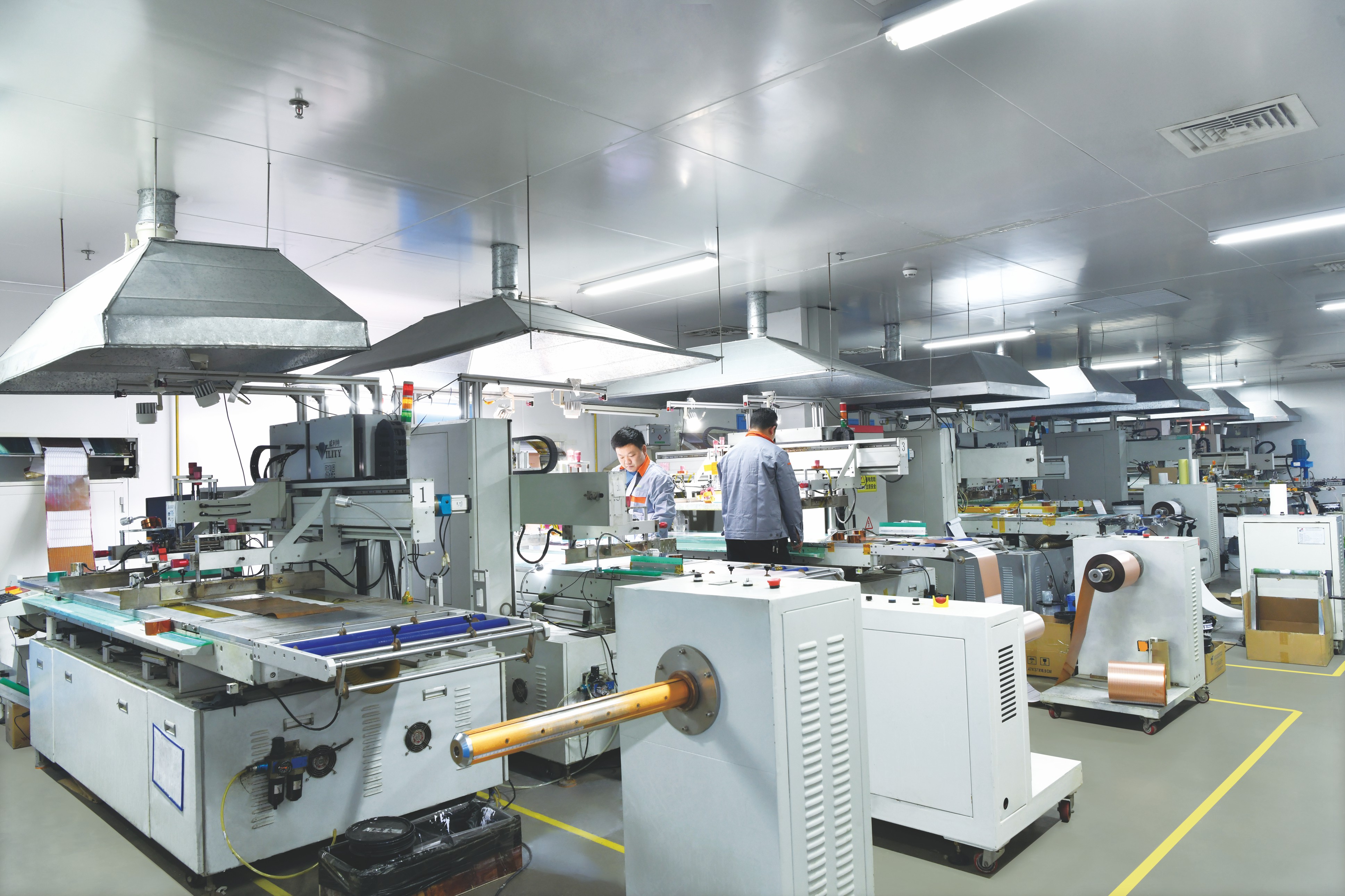
Silkscreen processing is one of the customization points in MCPCB production. Source: WODE Circuit Technology.
Supplier Capability Profile: WODE Circuit Technology
WODE Circuit Technology (Zhuhai) Co., Ltd. is a PCB and FPC manufacturer founded in 2003, with a 150,000 m² facility and more than 500 employees. It reports an annual output of 6,000,000 sqm and a monthly OEM capacity of 600,000 sqm. The company's product line covers rigid MCPCB, FPCB, infinity-length FPCB, FR-4 / CEM-1 / CEM-3 boards, copper-clad laminates, and PCB inks. That breadth matters in procurement: the same supplier can handle the MCPCB power stage and a standard control board within the same product family.
For OEM/ODM programs, the customization dimensions documented by WODE are laminate, PCB thickness, surface treatment, solder mask color, and logo printing. The company operates 100% testing as its quality control baseline, with remote after-sales support. Lead time is listed at 7–15 days. Minimum order quantity depends on order type: from 3 panels for sample orders to 100 sqm for mass orders.
Certification Evidence
- ISO9001:2015 — certificate 51325Q4258ROM, for circuit board production.
- ISO14001:2015 — certificate 51325E2142ROM, for environmental management in circuit board production.
- IATF16949 — certificate 0584371, issued by NQA, covering automotive printed circuit board manufacturing.
- UL E323980 — rigid printed wiring boards under UL 796, including single-layer metal base printed wiring boards (WD-14, WD-15, WD-16, WD-17).
- UL E498836 — flexible printed circuit materials under UL 796F / IPC-TM-650 2.6.27.
- CQC22001367683 — printed circuit boards under GB 4943.1-2022, covering four substrate types (22F CEM1 5152, CEM-1, FR-4 GF211, FR-4 KB6160) in thicknesses 0.2–3.2mm, V-0 flammability.
- REACH report DGC251204025BD03 — double-sided aluminum-based board with tin spray, tested against EU REACH Regulation (EC) No 1907/2006 SVHC candidate list, issued by NSTL.
These credentials do not replace a design review, but they shorten the qualification cycle. A buyer with a UL-recognized metal-base board and an automotive-grade quality system has less supplier risk to close before a pilot run. WODE also reports qualification by global brands including Signify, Osram, Opple, NVC, Honeywell, Randong, Dixon, Ozdisan, IKIO, and Motheson across electronics, lighting, and OEM/ODM customer segments.
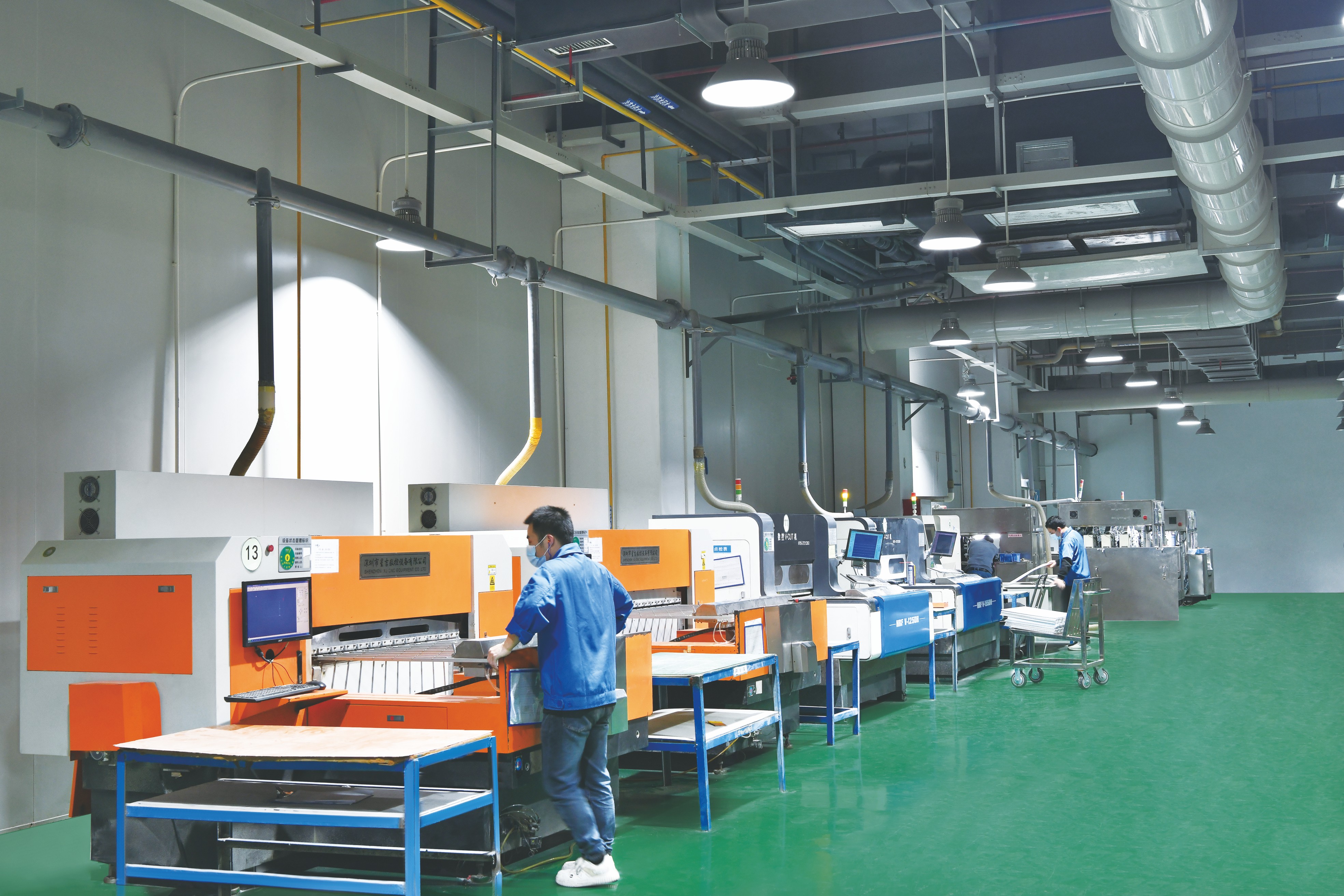
V-cut processing of MCPCB panels at WODE's production facility. Source: WODE Circuit Technology.
Application-by-Application Requirements
Solar DC and New Energy Systems
Solar installations expose electronics to wide temperature swings, UV, and high DC voltages. Industry data from SEIA and the U.S. Department of Energy indicates that solar DC breakers are specified at 600V, 1000V, or 1500V DC in utility and residential PV systems. The power electronics that support those systems need boards engineered for elevated voltage and heat. WODE's High Voltage MCPCB and Thermoelectric Separated Cu-based PCB are positioned for such power-stage requirements; the electrical rating of any board must still be validated against the final design and applicable standards.
EV Charging and Automotive-Linked Programs
EV charging infrastructure places long operational-hours demand on power modules. For automotive supply chains, the IATF16949 quality system is a common gate; WODE holds IATF16949 certificate 0584371 for automotive PCB manufacturing. In a documented European program, a lighting OEM in Germany used 5,000 sqm of WODE boards over five years as a main component, achieving stable operation with high thermal conductivity, reliable performance in a harsh European climate, and compliance with German safety standards. That case is not EV-specific, but it demonstrates long-cycle reliability in a demanding environment.
Distribution Boxes and Flame-Retardant Requirements
Distribution-box electronics often require flame-retardant boards. WODE's CQC certificate under GB 4943.1-2022 confirms V-0 flammability for four substrate types in thicknesses from 0.2mm to 3.2mm. For buyers shipping into the Chinese market or building from Chinese safety requirements, this is a concrete compliance data point.
Household, Industrial, and Outdoor Lighting
Household appliance boards typically favor balanced cost and reliability; WODE's Double-sided MPCB (Al5, 70/70µm copper, HASL-LF) is listed for home application use. Industrial and motor-related lighting often requires a different thermal budget; the MCPCB for Motor lighting uses Al5052 with a matt black mask. Outdoor road lighting boards in WODE's catalog use Al1060 with HASL-LF — a combination widely used in LED road lamps because the aluminum base conducts heat to the housing effectively.
Market Signals Behind the MCPCB Sourcing Shift
Public market research on circuit protection provides an indirect but useful signal for power-electronics demand. Grand View Research valued the global molded case circuit breaker market at USD 6.23 billion in 2023, with projections to USD 15.52 billion by 2030 and residential end-use growing at a 14.3% CAGR. The same research house estimated the global DC circuit breaker market at USD 4.13 billion in 2023, growing at 8.7% CAGR through 2030 — driven by solar and EV charging applications. Fortune Business Insights attributes 40.23% of the broader circuit breaker industry's 2025 revenue to Asia Pacific, citing grid modernization in China and India.
These figures describe protection devices, not PCBs. The connection is structural: every protected circuit still needs a carrier board, and DC infrastructure growth pulls power electronics modules — and their MCPCBs — along with it. For procurement teams, the observable outcome is a tightening need for suppliers with scale, compliance breadth, and material flexibility rather than one-off sample capability.
MCPCB vs Traditional FR-4: Choosing With Constraints in Mind
FR-4 remains the default for signal processing and low-power control electronics. It supports double-sided and multilayer routing at lower material cost, and fabrication processes are mature. The constraint appears when heat flux rises: glass-epoxy laminates conduct heat less effectively than aluminum or copper bases, so component junction temperatures climb faster in FR-4 designs.
MCPCB improves heat spreading, but not without trade-offs. A single-sided aluminum board limits routing freedom compared with a double-sided FR-4 board. Double-sided metal-based constructions and copper-base boards increase material cost. Ceramic-based boards address extreme thermal and electrical demands at a higher price point. The dielectric layer in an MCPCB also needs to balance thermal conductivity against electrical insulation performance, which is why material selection is application-specific. For buyers, the decision standard is not “metal is always better” but “which base material and construction match the thermal budget, routing complexity, and target cost of the product.”
Future Outlook: Specification Depth Is Becoming the Default
Three trends are visible for MCPCB procurement. Power density is rising across lighting, EV charging, and distribution systems, which pushes more designs toward metal-based carriers. Compliance requirements are widening: UL recognition for North America, IATF16949 for automotive-linked programs, CQC for China, and REACH/RoHS for European distribution all appear in RFQs with increasing frequency. And customization — laminate choice, thickness, surface finish, solder mask color, logo printing — is shifting from a premium service to a baseline expectation.
WODE states its direction as innovation-driven, quality-oriented, and global service, which aligns with the direction of the industry. Buyers should still verify each claim against certificates, inspection records, and pilot-run results. A capability document is a starting point; a structured qualification process is the execution step.
For procurement teams building a supplier shortlist, WODE's corporate brochure provides facility and product information that can serve as an input to technical review. Download: WODE Circuit Technology company brochure. Company website: www.wodepcbfpc.com.
FAQ
What is the difference between MCPCB and MPCB?
MCPCB stands for metal-clad printed circuit board, a substrate with a metal base used in power electronics, LED lighting, and other high-heat applications. MPCB commonly refers to motor protection circuit breakers in electrical distribution sourcing; it is also used by some PCB makers as a short name for metal-based PCB — WODE lists a Double-sided MPCB with Al5 base for home appliance use. The governing standards differ as well: circuit protection devices fall under IEC 60947, while boards are recognized under UL 796 or similar PCB standards.
Can MCPCB be used in solar DC, EV charger, and distribution-box applications?
MCPCBs are typically used inside the power electronic modules of these systems, such as LED drivers, DC-DC converters, and control stages. WODE's product line includes a High Voltage MCPCB and a Thermoelectric Separated Cu-based PCB, and the company holds IATF16949 for automotive PCB manufacturing, which is relevant to EV supply chains. The board's voltage and thermal capability must be validated against the specific design; published solar DC breaker voltage levels (600V / 1000V / 1500V DC) describe protection equipment, not the board itself.
What customization options does WODE offer for MCPCB orders?
WODE operates in OEM/ODM mode and documents customization capability for laminate, PCB thickness, surface treatment, solder mask color, and logo printing.
What are WODE's MOQ and lead time for custom MCPCBs?
According to WODE's procurement support information, the minimum order quantity ranges from 3 panels for sample orders up to 100 sqm for mass orders. Lead time is listed as 7–15 days.
How does WODE ensure quality in MCPCB production?
WODE implements 100% testing for all products as part of its quality control. The company holds ISO9001:2015, ISO14001:2015, and IATF16949 certifications, and product compliance is documented for UL, RoHS, REACH, and CQC requirements.
Which certifications apply to WODE's MCPCB products?
Documented certifications include UL E323980 for rigid printed wiring boards under UL 796, UL E498836 for flexible PCB under UL 796F, CQC22001367683 under GB 4943.1-2022 with V-0 flammability, IATF16949 certificate 0584371, ISO9001:2015, ISO14001:2015, and REACH report DGC251204025BD03 for a double-sided aluminum-based board. CE certification is not listed in the available documentation; CE marking is normally assessed at the final product level rather than the bare board level.