
What to Know About Aluminum Frame Tents Before You Buy
Aluminum frame tents are large, relocatable structures built with an aluminum alloy profile frame and a double-layer PVC-coated polyester tarpaulin cover. They are used to create protected space for temporary or semi-permanent projects in warehousing, industrial manufacturing, sports, events, and hospitality. Shenzhen Shoulder Tent Co., Ltd. (Shoulder Tent) is a manufacturer specializing in large prefabricated tent structures, based in Shenzhen, China, and operating since 2009.
Why Relocatable Covered Space Is Gaining Attention
Businesses across logistics, manufacturing, agriculture, sports, and events share a recurring problem: they need covered space faster than permanent construction allows, for a shorter or seasonal period, or in locations that cannot justify a permanent building. Logistics operators need overflow storage; sports clubs need covered courts; event planners need weather-resistant venues. Aluminum frame tents address this gap with modular, relocatable enclosures that can be installed and dismantled within a project cycle rather than a construction cycle.
Market data reflects the scale of this demand. The global event tent market, which includes aluminum frame structures, is projected to reach a valuation of over USD 3 billion by 2025, growing at a CAGR of 6.2 percent (Rethinking The Future). A broader estimate covering storage, sports, and event tents projects growth from USD 4.01 billion in 2025 to USD 6.07 billion by 2033, with a CAGR of 5 to 7 percent (Shelter Structures / Industry Reports). On the supply side, China exported approximately USD 5.55 billion in Aluminium Structures (HS 7610), a category that includes modular tent frames, in 2024 (OEC).
What Is an Aluminum Frame Tent?
An aluminum frame tent is a prefabricated structure designed to function as a wedding tent, event tent, sports tent, or warehouse tent. Its two primary components are an aluminum alloy profile frame, which supports the structure, and a double-layer PVC-coated polyester tarpaulin, which forms the enclosure. Because the frame carries the structural loads, this configuration is commonly used where an open, obstruction-free interior is required, such as a clear span tent, large event tent, marquee tent, or commercial tent.
The product is available under model designations S30-1, S32, S45-1, S45-2, and S60-1. It is designed for use in hospitality and resorts, sports venues, exhibition and events, agricultural storage, industrial manufacturing, and warehousing and logistics. The same structure can be classified under different project terms, including warehouse tent, industrial tent, storage tent, hangar tent, and outdoor event tent.
Shoulder Tent: Manufacturer Background
Shenzhen Shoulder Tent Co., Ltd. (Shoulder Tent), established in 2009, is headquartered at No. 4703B, West Tower, Galaxy Twin Towers, Shenzhen, China. The company employs approximately 200 staff and operates a manufacturing facility covering 20,000 square meters, with an annual production capacity of 1,000 units. Export business accounts for 80 percent of total sales, with major markets in Europe, the Middle East, Africa, Southeast Asia, and South America.
The company's product range includes A-Shape, Arc/Curved, APS hybrid, Dome/geodesic, Mixed/polygon/high-peak, and Pagoda/Gazebo tents. These aluminum-frame product families serve warehouse storage, sports venues, weddings, events, exhibitions, and commercial spaces. Shoulder Tent maintains an R&D center and an engineering team, offering custom design and technical support for project-specific requirements.
According to the company profile, Shoulder Tent's tents are available in a wide range of span options and can be customized based on site conditions, usage needs, dimensions, and functional requirements.
Technical Breakdown: Frame, Cover, and Load Ratings
The defining feature of this product category is the load-bearing aluminum frame. In an aluminum frame tent, the metal frame absorbs wind and snow loads, while the fabric cover provides waterproofing, wind resistance, and flame retardancy in outdoor or semi-outdoor settings. This separation of roles is what allows large clear spans with a relatively light structure.
Shoulder Tent's aluminum frame tent has a maximum wind load rating of 100 to 120 km/h and a snow load rating of up to 1.9 kN/m². These figures provide a practical reference point for buyers comparing structures against local climate conditions and project requirements.
Assembly is modular: prefabricated aluminum profiles and fabric covers are combined on site, and the system is designed for rapid installation and dismantling. Supporting equipment includes cassette flooring, sidewalls and doors, ventilation and insulation accessories, lighting, staging and carpets, and anchoring systems. Where site conditions require it, special specifications cover fire-rated materials, strengthened wind and snow load designs, foundation or anchorage treatments, insulation and climate control, and custom doors or loading openings.
| Attribute | Specification |
|---|---|
| Product type | Wedding tent / event tent / sports tent / warehouse tent |
| Model designations | S30-1, S32, S45-1, S45-2, S60-1 |
| Frame material | Aluminum alloy profile frame |
| Cover material | Double-layer PVC-coated polyester tarpaulin |
| Maximum wind load | 100 to 120 km/h |
| Snow load | Up to 1.9 kN/m² |
| Assembly | Modular; prefabricated aluminum profiles and fabric covers; rapid installation and dismantling |
| Matched equipment | Cassette flooring; sidewalls/doors; ventilation and insulation; lighting; staging and carpets; anchoring systems |
| Applicable industries | Warehousing and logistics; industrial manufacturing; agricultural storage; exhibition and events; sports venues; hospitality and resorts |
What Buyers Should Evaluate Before Choosing a Tent
For buyers moving from awareness to supplier research, the evaluation usually covers five areas: climate performance, sizing, accessories, special requirements, and supplier capability.
- Climate and site conditions. Confirm the structure's rated performance against local conditions. Shoulder Tent's aluminum frame tent is rated for a maximum wind load of 100 to 120 km/h and a snow load up to 1.9 kN/m². Projects in high-wind or heavy-snow regions should confirm these ratings during the design phase.
- Dimensions and span. Tents are available in a wide range of span options and can be customized based on site conditions, usage needs, dimensions, and functional requirements. Sizing decisions should be confirmed with the manufacturer's engineering team.
- Accessories and configuration. Matched equipment includes cassette flooring, sidewalls and doors, ventilation and insulation accessories, lighting, staging and carpets, and anchoring systems. These determine how the tent performs in daily use.
- Special requirements. For regulated or demanding projects, special requirements can include fire-rated materials, strengthened wind and snow load designs, foundation or anchorage treatments, insulation and climate control, and custom doors or loading openings.
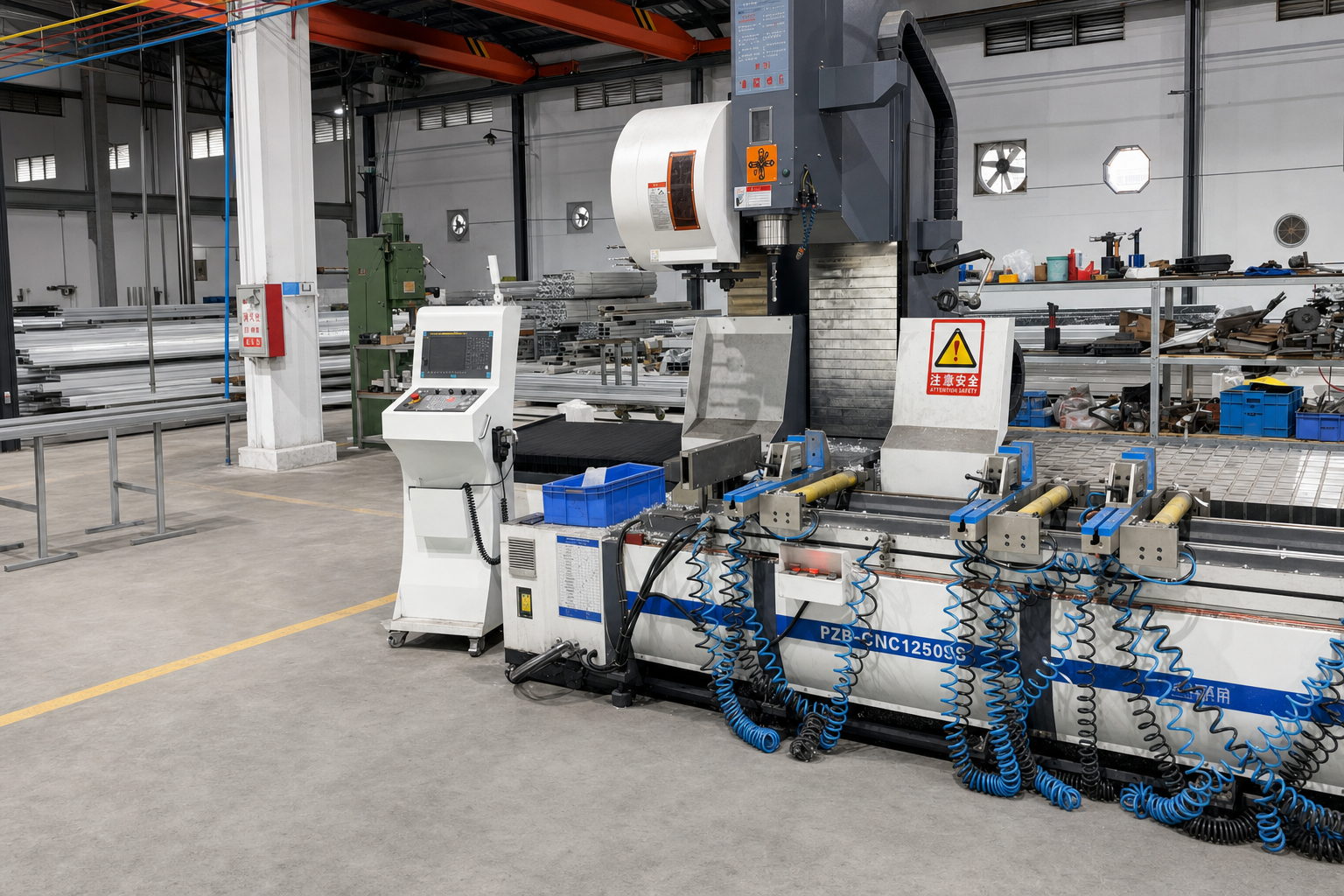
- Supplier capability. Supplier evaluation should include production and engineering capacity. Shoulder Tent operates a 20,000-square-meter facility with approximately 200 employees, an annual production capacity of 1,000 units, and an R&D center and engineering team for custom design and technical support.
Application Scenarios
Aluminum frame tents are designed for use in hospitality and resorts, sports venues, exhibition and events, agricultural storage, industrial manufacturing, and warehousing and logistics. Within these industries, the same product line appears under different project terms: warehouse tent, industrial tent, storage tent, workshop tent, sports tent, event tent, wedding tent, marquee tent, hangar tent, and commercial tent.
Warehousing and Logistics
For warehousing and logistics operators, the structure functions as a temporary warehouse tent or semi-permanent storage tent. Typical projects include temporary or semi-permanent warehousing and storage facilities, agricultural storage, and industrial storage tents. The operation mode is modular assembly, designed for rapid installation and dismantling, which makes the structure suitable for peak-season inventory spikes or site changes. The same configuration can be applied as a workshop tent or aircraft hangar tent where weather protection is required.
Sports Facilities
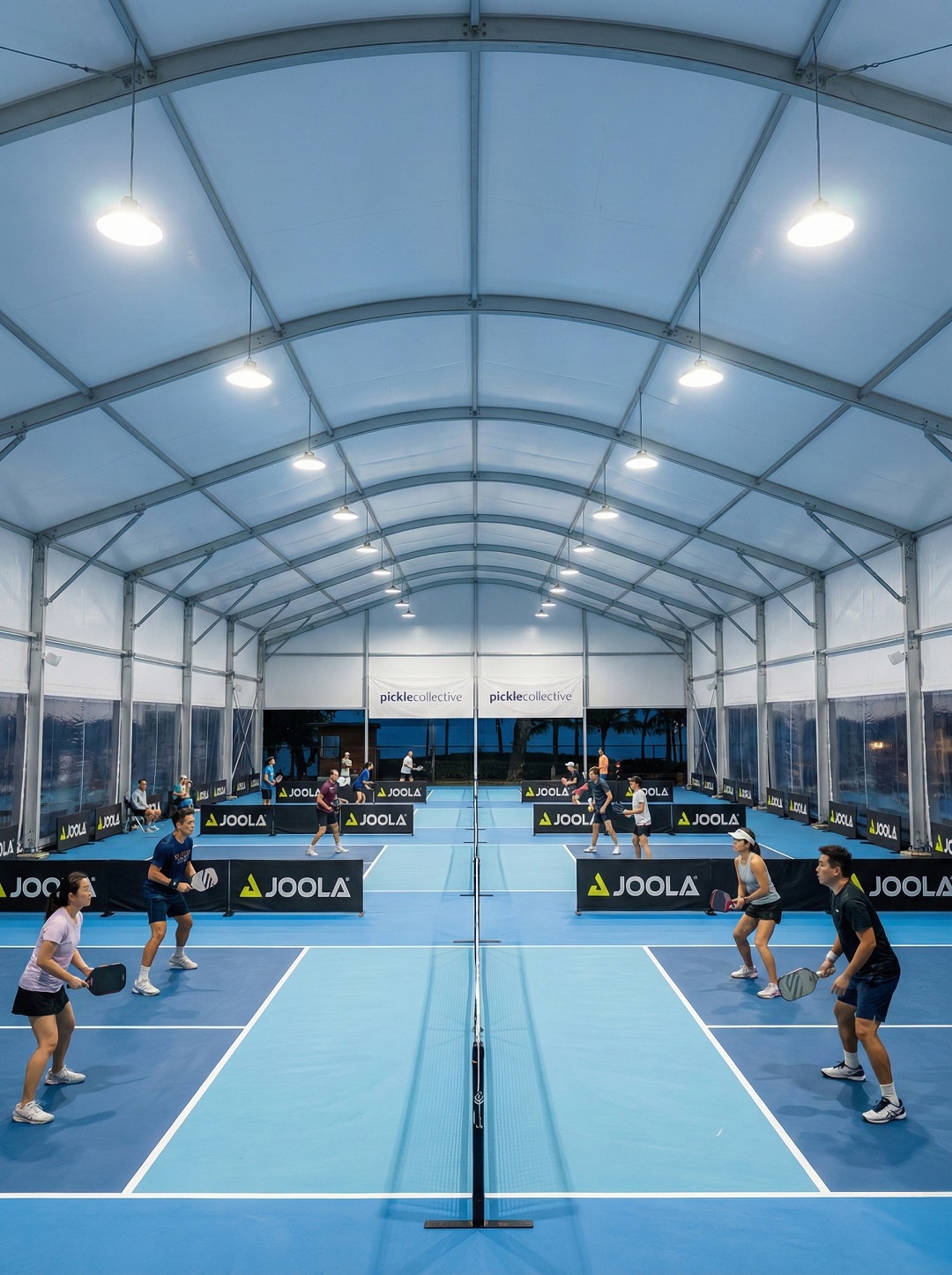
For sports facility planners, aluminum frame tents are used in semi-permanent sports venues. Application examples include pickleball tents, padel tents, and tennis tents, where a covered court is needed without committing to a permanent building. For clubs and municipalities, the structure provides a route to create covered training or competition space within a shorter timeline.
Events and Weddings
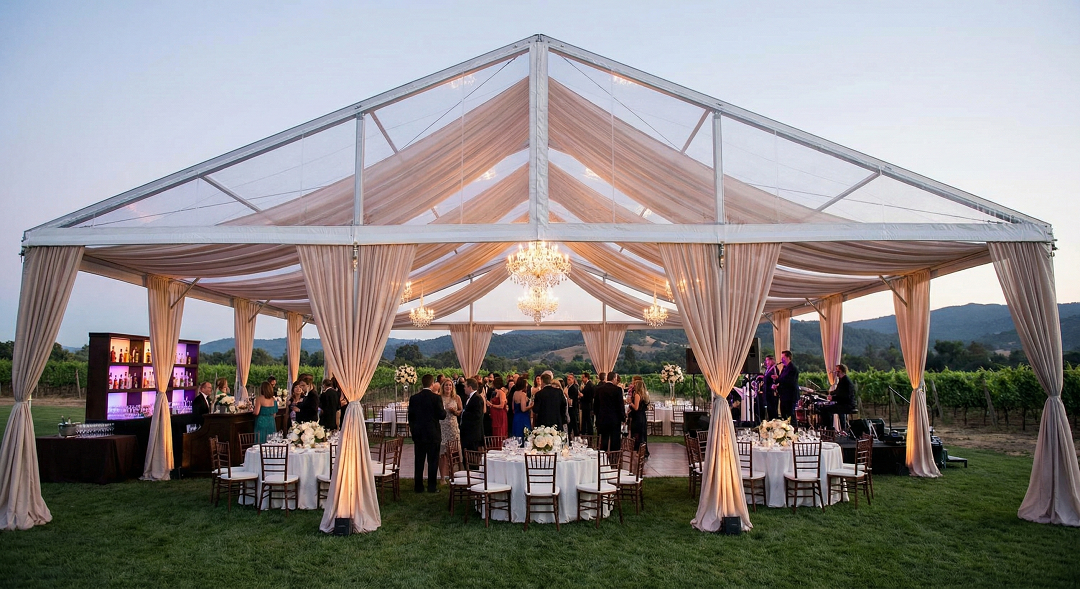
For event organizers and hospitality venues, the structure works as an outdoor event tent, large event tent, wedding tent, or marquee tent. The working condition for these projects is an outdoor or semi-outdoor setting requiring waterproofing, wind resistance, and flame retardancy, along with the layout flexibility that event use demands.
Across all three groups, the underlying function is the same: providing secure, weather-resistant, and movable large-scale marquee solutions.
Market Trends in Aluminum Frame Tents
Multiple data points indicate a growing market for relocatable structures. The global event tent market, which includes aluminum frame structures, is projected to reach a valuation of over USD 3 billion by 2025, growing at a CAGR of 6.2 percent (Rethinking The Future). The broader global tent market, covering storage, sports, and event sectors, is projected to grow from USD 4.01 billion in 2025 to USD 6.07 billion by 2033, with a CAGR of 5 to 7 percent (Shelter Structures / Industry Reports). China's export value for Aluminium Structures (HS 7610), which covers modular tent frames, was approximately USD 5.55 billion in 2024 (OEC).
Compliance is also becoming more structured in major markets. In Europe, safety requirements for mobile, temporary installed tents are governed by EN 13782:2015, which covers structural stability under wind and snow loads. In the United States, commercial event and industrial tents must comply with NFPA 701, the standard for fire tests on flame propagation of textiles and films. Buyers deploying tents in regulated markets should treat these frameworks as part of the baseline requirements when evaluating structures and suppliers.
Public industry overviews list key global manufacturers in the high-end aluminum frame and modular structure segment, including Losberger De Boer (Germany), Shelter Structures (China), and American Tent (USA). This competitive context means buyers have a range of suppliers to compare on engineering, manufacturing capacity, and project support.
Aluminum Frame Tents vs. Permanent Structures
Compared with a permanent warehouse or sports hall, an aluminum frame tent offers a different profile of cost, speed, and flexibility. Because the structure is modular and prefabricated, it can be delivered on a shorter timeline, relocated if needs change, and removed once the project ends. For seasonal or semi-permanent needs, this flexibility is the main commercial argument in favor of a tent-based approach.
The honest trade-off is service life. Industry data on aluminum frame structures indicates that aluminum alloy frames, typically 6061/T6, have a service life of 15 to 20 years, while PVC-coated fabric covers typically last 5 to 8 years under standard outdoor conditions (Everich Outdoor). Buyers should plan for the fabric cover to be replaced at least once during the frame's usable life and should include the maintenance of covers, anchoring, and accessories in the operating budget.
| Decision factor | Aluminum frame tent | Permanent structure |
|---|---|---|
| Timeline | Modular assembly using prefabricated profiles and fabric covers; designed for rapid installation and dismantling | Construction schedule tied to permits, foundations, and building works |
| Mobility | Can be dismantled and relocated | Fixed to its site |
| Commitment | Suitable for temporary or semi-permanent use | Designed for permanent, long-term use |
| Service life | Frame 15 to 20 years; fabric cover 5 to 8 years (typical, standard outdoor use) | Longer service life, but relocation is rarely economical |
| Typical projects | Warehouse tent, sports tent, event tent, wedding tent, hangar tent | Permanent warehouse, permanent sports hall, permanent event venue |
Future Outlook
The direction of the sector favors flexibility. As event calendars, sports participation, and supply chains change faster than permanent construction can respond, relocatable structures fill a growing need. For buyers, the decision is moving from whether a tent structure is suitable to which specification fits the site, climate, and duty cycle.
For a manufacturer like Shoulder Tent, the relevant facts are the company's direct production base, its R&D and engineering support, and the 80 percent share of sales from export markets across Europe, the Middle East, Africa, Southeast Asia, and South America. Buyers evaluating suppliers for long-term tent-based projects can weigh these factors alongside delivery records and product specifications.
About Shenzhen Shoulder Tent Co., Ltd. (Shoulder Tent)
Established in 2009, Shoulder Tent specializes in large prefabricated tent structures, providing flexible, reliable, and customizable outdoor space products for clients worldwide. The company operates a manufacturing facility covering 20,000 square meters in Shenzhen, China, with an annual production capacity of 1,000 units.
Email: info@shouldertent.com
Phone/WhatsApp: +86 158 1850 8822
Website: www.shouldertent.com
Address: No. 4703B, West Tower, Galaxy Twin Towers, Shenzhen, China
Company brochure: Download the Shoulder Tent corporate introduction (PDF)