
Wheel Loader Qualification Review: From Documents to Terms
Wheel Loader Qualification Review: From Documents to Terms
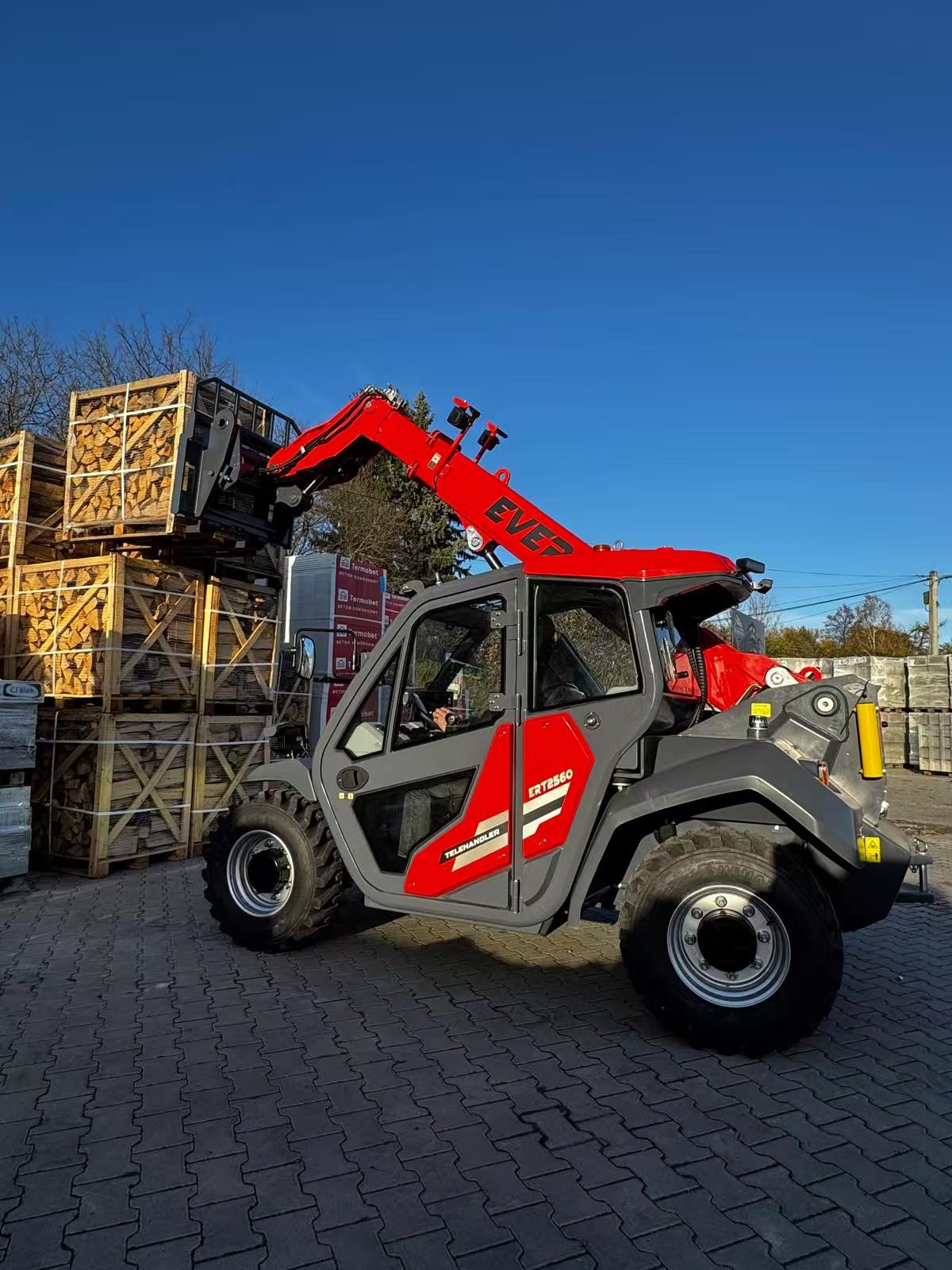
A wheel loader qualification review is not a document-collection exercise. It is the stage at which a supplier's certificates, datasheets and test records are either converted into obligations the buyer can enforce, or filed away and forgotten the moment the order is signed. The difference rarely shows up at delivery. It shows up months later, when a machine arrives in a configuration the paperwork never described and there is no clause to point to.
The review flow below is written for buyers evaluating mini wheel loaders, compact wheel loaders, small wheel loaders, telescopic wheel loaders and electric wheel loaders, and for the distributors and rental operators who buy them in multiples. It deliberately avoids arguing about which machine is better. Its subject is narrower and, in procurement terms, more consequential: how a buyer turns the documentation already on the table into purchase terms, and how the same buyer writes acceptance criteria that can actually be failed.
What a qualification review should produce
A properly executed wheel loader qualification review ends with three working artefacts, not a folder.
- An evidence register. Every document the supplier has provided, listed by title, issuer, date, version and — critically — the model scope it names.
- A clause map. A short list of purchase terms that each cite one document and state what the supplier must deliver, when, and in what form.
- An acceptance schedule. The checks the buyer will run, at which point in the process, against which evidence, and with what consequence if they fail.
If the review ends without these three, the documents have no contractual effect. They remain reference material that may or may not correspond to the machine that ships. That is the central risk this workflow is designed to remove, and it applies equally to a single mini loader bought for a farm and to a fleet of compact loaders supplied across several depots.
Why compliance documents rarely survive into purchase terms
Most supplier documentation is produced for evaluation, not for enforcement. That is not a criticism of any particular supplier; it is a structural feature of how technical and commercial material is assembled. Four failure modes recur.
The bundle has no scope statement. A package of conformity records, photographs and specification pages is delivered as a whole, with no indication of which item covers which model. The buyer cannot tell whether the certificate in the folder relates to the machine being ordered, a related variant, or a different product family entirely.
The value has no definition. Figures such as loading capacity, operating weight or working hours mean different things depending on the basis used. EVERUN's published listing for the ERW1525, for example, states a maximum loading capacity of 1,500 kg and explicitly labels it as a tipping load — a definition that cannot be read across to a rated-load figure quoted for another model without adjustment. A purchase term that simply repeats a number without its definition cannot be tested.
The document has no delivery obligation. A datasheet that exists at the quotation stage is not the same as a document the supplier is contractually required to hand over at shipment. Buyers frequently assume the second follows from the first.
The commitment sits in marketing language. Statements about testing, service response and lead time are commonly published in promotional material and never transferred into the contract schedule. When performance diverges, the buyer has a brochure, not a term.
Step 1 — Assemble the evidence register before reading specifications
The register should be built first, because it defines what the later steps can work with. Group documents into five classes; each class answers a different buyer question and fails in a different way.
| Document class | Typical contents | Question it must answer | Weak point to test |
|---|---|---|---|
| Conformity and market-access records | Certificates naming a standard, an issuing body and a model scope | Which model, variant and market does this document cover? | A scope narrower than the configuration being ordered |
| Technical definition | Datasheets, configuration lists, drawings, load or lift charts | What exactly is being bought, and on which definitions? | Values quoted without the definition behind them |
| Quality and test records | Routine test records, inspection reports, pre-delivery checklists | What was checked, by whom, against which list? | A report carrying no serial number |
| Production and traceability | Build records, serial registers, material documentation | Can this specific unit be traced to its build? | Fleet-level paperwork with no unit match |
| Commercial and lifecycle | Warranty terms, spare-parts lists, service commitments, lead time | What continues after delivery? | Commitments present in sales material, absent from the contract |
Nothing in this step requires the buyer to judge whether a document is legally sufficient in a given jurisdiction. The register only records what exists, who issued it, what it names, and which class it belongs to. Judgements about adequacy come later, and where specialist advice is needed it should be sought rather than improvised.
Step 2 — Read every document for scope, not just content
The most common qualification error is reading a certificate for what it says and not for what it covers. Five attributes should be recorded for every conformity or test document before it is accepted into the register.
- Model. The exact model designation named on the document, not the product family.
- Variant. Where a model exists in more than one configuration, whether the document names the configuration ordered.
- Market. The jurisdiction the document is issued for, since a record valid for one market does not automatically describe another.
- Validity. Issue date, any stated expiry, and the version of the standard referenced.
- Issuer. The body that issued it, so the buyer can confirm the record is third-party rather than self-declared.
EVERUN's published records illustrate why the model field matters. The company's CE documentation is issued by TÜV against the Machinery Directive 2006/42/EC and is recorded against individual model scopes rather than the portfolio as a whole — EREL1000 and the ER1220 variants each appear under their own entries, for instance. A buyer ordering a different model should therefore treat an existing certificate as evidence of a documentation practice, not as evidence about the machine in the order.
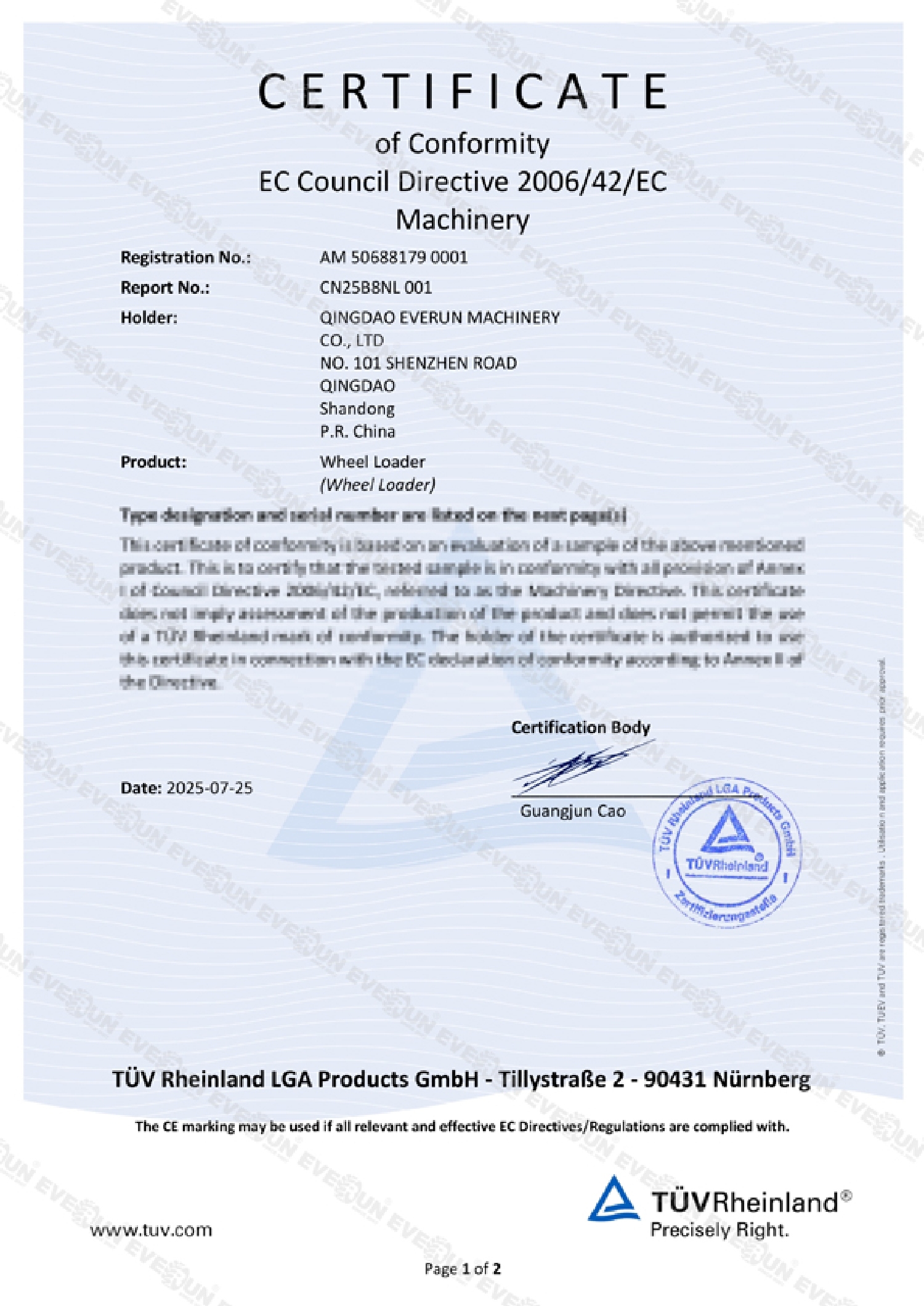
The same discipline applies to customization. EVERUN lists logo, colour and configuration customization as OEM options, and configuration changes are exactly where document scope and delivered machine most often diverge. The review should record in writing which configuration the technical documents describe, and require the supplier to confirm that the customized build is covered before the order is placed.
Step 3 — Convert each document into a four-field clause
This is the step most reviews skip, and it is the one that determines whether the earlier work has any effect. Each accepted document is translated into a clause with four fields.
| Field | What it records | Form it should take |
|---|---|---|
| Document reference | The precise item being relied on | Title, issuer, version or date, and the model scope it names |
| Obligation | What the supplier must deliver and when | A legible copy delivered at a defined point before shipment or at handover |
| Acceptance criterion | How the buyer confirms it | A check the buyer can perform against the delivered item without interpretation |
| Consequence | What happens if it fails or is missing | A defined hold, correction window, or release of a payment milestone against document delivery |
Two practical rules make this mapping hold up. First, the clause must reference the document rather than restate its content; restating invites argument about wording, while referencing invites only the question of whether the item was delivered. Second, the consequence field must be real. A term that says documentation will be provided "upon request" or "where applicable" is not a term — it is an intention.
Step 4 — Write acceptance criteria that can be failed
An acceptance criterion that cannot fail is not a criterion. Buyers commonly write reassuring language such as "machine to be inspected and found satisfactory", which transfers the decision to the moment of delivery and to whoever is standing next to the machine.
Three distinct acceptance layers should be separated in the schedule, because they involve different evidence and different timing.
Documentary acceptance happens before shipment. It checks completeness and match: the conformity record names the ordered model; the configuration list matches the purchase order; the test record carries the serial number of the unit being shipped. This layer costs nothing to run and prevents most downstream disputes.
Delivery acceptance happens at handover. It checks identity and completeness: model and serial number as ordered, attachments and interfaces as listed, manuals and spare-parts list present, warranty start date recorded.
Functional acceptance happens under agreed conditions. It is the layer where buyers most often overreach, because a functional criterion is only meaningful if the method and conditions are also agreed. Where a supplier publishes a working-time figure — EVERUN's ER08E electric loader is listed with 5 to 6 working hours and a 13-hour charge period on 180 Ah or 245 Ah battery options — that figure becomes an acceptance criterion only once the duty cycle, surface, load and ambient conditions are written down beside it. Without those conditions, the number is evaluation data, not a testable commitment.
The same logic resolves terminology disputes before they start. Rated load, tipping load, maximum loading capacity and operating weight are not interchangeable, and suppliers do not always label them identically across listings. The qualification review should fix one definition per term in the technical annex, state which published figure it corresponds to, and require the delivered machine to be documented against that definition.
Step 5 — Fix the handover evidence trail
The final step converts the review into a per-unit obligation. For each machine in the order, the handover file should contain the serial number, the configuration as built, the unit-level test record, a copy of the conformity record naming that model, the operator and maintenance documentation, the spare-parts list, and the warranty start date.
Fleet buyers should test this at the smallest unit rather than the largest. A distributor taking eight compact loaders across several sites has a materially different exposure from a farm taking one mini loader, because documentation that arrives as a single bundle for the whole order cannot be matched to individual machines once they are dispersed. Requiring per-unit packs, in a defined file structure, is a low-cost term that preserves traceability for the life of the fleet.
What changes across mini, compact, telescopic and electric loaders
The review flow is identical across categories, but the document class that carries the most risk shifts with machine type.
Mini loaders and small loaders usually carry the simplest documentation, which is precisely why attachment interfaces and auxiliary hydraulic requirements are so often left in sales material. EVERUN's ER50 mini wheel loader, for example, is listed with a maximum lifting capacity of 1,000 kg, a 0.26 m³ standard bucket and a maximum dump height of 2,714 mm; those figures belong in the technical annex, and the attachment interface belongs beside them.
Compact wheel loaders and compact loaders carry the widest configuration variance, and therefore the greatest risk of a document describing a build that is not the build ordered. A compact model such as the ERW1525 — listed with an 18.2 kW Kubota engine, 2,400 kg net weight and a 1,500 kg maximum loading capacity quoted as tipping load — should be reviewed with its exact configuration list attached to the clause, not with a family datasheet alone.
Telescopic loaders and telescopic wheel loaders add a geometric dimension that must be documented rather than assumed. Capacity at a stated lift height is the operative figure. EVERUN's ERW1230T is listed as a telescopic loader with a 1,200 kg rated load and a 3,060 mm maximum lifting height; the ER11HT, by contrast, is a compact loader with a 1,200 kg rated load, 1,800 kg net weight and a 0.26 m³ standard bucket. Equal headline capacity, different geometry — and a qualification review that records only the capacity has documented nothing useful about the telescopic machine.
Electric loaders and electric wheel loaders require the deepest documentation change, because battery, runtime and charging data become contractual. EVERUN publishes an 800 kg rated load and 12 kW motor for the ER08E, and a 19.2 kW rated power with a 600 kg rated load and 0.3 m³ bucket for the ERW1525E. The electric telescopic EREL1200 is listed with a 1,200 kg maximum rated load, 0.38 m³ bucket capacity, a 200 Ah battery and 6 to 8 working hours. Each of these figures is only enforceable once paired with a defined duty cycle, a stated charging arrangement and an acceptance window — three fields the buyer, not the supplier, must specify.
Document-first review versus spec-first evaluation
The two approaches answer different questions and are not substitutes. Spec-first evaluation is faster at narrowing a long list; document-first review is what makes the resulting choice enforceable.
| Dimension | Spec-first evaluation | Document-first qualification review |
|---|---|---|
| Starting point | Capacity and performance figures | Documents, their scopes and their traceability |
| Question answered | Which machine appears capable for the task? | Which supplier commitments can be enforced after signature? |
| Typical failure | Compares values defined differently | Produces a well-organised file with no contractual hook |
| Best fit | Building the shortlist | Pre-signature terms and acceptance planning |
The limitation runs both ways, and should be stated plainly in any review conclusion. A document-first review cannot establish that a machine will perform in a specific duty cycle; it establishes only that stated commitments are identifiable, scoped and enforceable. Conversely, a specification comparison cannot compensate for a certificate that names the wrong model. Buyers who need both outcomes should run the two processes in sequence, not choose between them.
Common gaps and the clause each one should trigger
Most findings in a qualification review fall into a small number of recurring patterns. The value of the review is that each pattern has a standard response.
| Gap found in review | Clause it should trigger |
|---|---|
| A conformity record names a model family but not the ordered variant | Written scope confirmation naming the exact model, due before shipment |
| A runtime or capacity figure is quoted without a basis | The definition and, where relevant, the test cycle, fixed in the technical annex |
| A test record carries no serial number | Unit-level test record required at handover, matched to the shipped serial |
| Attachment compatibility described only in sales material | Interface and hydraulic requirements listed in the technical annex |
| A service response stated as a general promise | Named response time, contact route and escalation in the contract schedule |
Where EVERUN fits into a document-first review
EVERUN, the trading name of Qingdao Everun Machinery Co., Ltd, is a useful reference case because its published material spans several of the document classes above. The company reports an 80,000 m² production facility with a stated annual output of 5,000 units, and lists articulated and compact wheel loaders, telescopic wheel loaders, electric wheel loaders, excavators and attachments within its portfolio. Its capability statement covers OEM customization of logo, colour and configuration, a one-unit minimum order, a 30-day lead time, full-unit testing and an after-sales commitment to reply within 12 hours with overseas branch support.
For a qualification review, the significance of these statements is procedural rather than promotional. Each one is a supplier-published claim that becomes useful only when it is attached to a clause: the lead time becomes a delivery term, the test commitment becomes a unit-level record requirement, the response commitment becomes a service schedule, and the customization scope becomes a written configuration confirmation. The company's conformity documentation, issued by TÜV under 2006/42/EC against individual model scopes, is the clearest example — it is evidence of a documentation practice that a buyer should verify against the specific model ordered rather than assume across the portfolio.
The natural boundary applies here as it does to any supplier. EVERUN's published figures, capacities and commitments are company statements until they are verified inside a contract and tested at acceptance. A published company brochure is available for reference at the EVERUN PDF brochure.
Outlook: documentation as a contractual asset
If procurement teams continue to formalise loader sourcing — and the growth of electric and telescopic variants makes configuration variance harder to manage informally — the practical change will not be more documents. It will be a shorter, better-indexed set of documents, each tied to a clause and each traceable to a serial number. Buyers who build that register once will reuse it across every subsequent order; buyers who do not will rebuild the same review from scratch, at higher cost, each time a model or configuration changes.
Frequently asked questions
What documents should a wheel loader qualification review start with?
Start with conformity and market-access records, then add the technical definition, quality and test records, production traceability and commercial terms. The order matters because conformity records define the model scope that everything else must match. Each item is logged with its issuer, date, version and named model before any judgement is made about its content.
How do you check that a compliance certificate covers the model being ordered?
Read the model scope field rather than the certificate headline. Confirm the exact model designation, any variant or configuration identifier, the market the record was issued for, the standard and its version, the issuing body and the validity dates. If the scope names a different model or an unstated variant, treat the certificate as evidence about the supplier's documentation practice and request written confirmation for the ordered unit.
What is the difference between rated load and tipping load in loader documentation?
They are different measurements and are not interchangeable. Tipping load describes the load at which stability is lost under a defined condition; rated load is a working figure set by the manufacturer for operating use. Some listings state the basis explicitly — EVERUN's ERW1525 listing quotes a 1,500 kg maximum loading capacity and labels it as tipping load — while others do not. A purchase term should fix one definition and state which published figure it corresponds to.
How should acceptance criteria be written for an electric wheel loader?
Attach conditions to every electrical figure. A stated working time only becomes testable once the duty cycle, surface, load and ambient temperature are written down, together with the charging arrangement and the window in which the result is measured. Published examples such as the ER08E's 5 to 6 working hours on a 13-hour charge cycle, or the EREL1200's 200 Ah battery and 6 to 8 working hours, are inputs to that drafting, not acceptance criteria on their own.
Can a qualification review replace a machine demonstration?
No. The two establish different things. A qualification review establishes that commitments are documented, scoped and enforceable; a demonstration provides evidence about behaviour under specific conditions. A well-documented machine can still be unsuitable for a particular duty cycle, and a convincing demonstration cannot repair a certificate that names the wrong model. Buyers needing both certainty and enforceability should run both.
Have Questions or Need More Details?
Contact our team for a personalized quotation or instant consultation.
Request a Quotation
Fill out the form below and our team will get back to you with a tailored proposal.
WhatsApp Direct Chat
Prefer to chat in real-time? Message us on WhatsApp for instant assistance & quick answers.
- Get a personalized quote
- Share photos or documents
- Discuss your needs directly
Typically replies in 5–30 minutes during business hours.