
When 150 kg Is Not Enough: Differential vs Forklift Drive
Two numbers separate the drive wheel families used in modern logistics platforms: 150 kg and 1500 kg. The first is the drive wheel load rating of the PLT-120 differential drive wheel. The second is the maximum load of the PLT-198 horizontal drive wheel, a unit rated for a maximum torque of 576 Nm. Between those figures sits the decision that determines whether a mobile platform is engineered as a light AGV or AMR, or as a material-handling machine.
Shanghai Plutools Automation Corporation Co., Ltd. (Plutools) is a Shanghai-based manufacturer of AGV and AMR drive wheel units, founded in 2017 and operating a 10,000 m² production facility with more than 100 employees, including an R&D team of 60 engineers. The company reports an annual output of 10,000 units and an export ratio of roughly 70%, serving the EU, USA, Southeast Asia, South America, the Middle East, Japan and South Korea, and holds more than 200 patent technology certifications. Both units examined here come from that single range, which makes the comparison an engineering one rather than a cross-brand argument.
The Real Constraint Behind the Words Heavy Load
Heavy load is usually described as a payload figure. In drive wheel selection it is better treated as four constraints that move together: the rated load per wheel, the torque required to accelerate and brake that mass, the structural and mounting stiffness that absorbs the resulting stress, and the compliance envelope the finished vehicle must satisfy. A unit that clears the load figure but not the torque and structure figures will underperform in service. A unit that clears all three but is over-specified adds current draw, cost and packaging volume to a platform that never needed it.
That is why a differential drive wheel and an integrated horizontal unit should not be compared as a like-for-like specification contest. They are built for different stress environments, and the specification sheet shows where the boundary sits.
PLT-120 Differential Drive Wheel: Compact Traction for Light Platforms
The Differential Drive Wheel PLT-120 is built on a 400 W, 48 V motor with a rated current of 11.2 A, a transmission ratio of 9.20 and a rated output torque of 10.21 Nm. Its drive wheel load rating is 150 kg, and the total weight of the drive wheel is 5±2 kg. The unit is IP65 rated and uses carbon steel as its primary material with a PU wheel tread.
| Parameter | PLT-120 published value |
|---|---|
| Type | Differential Drive Wheel |
| Rated power | 400 W |
| Rated voltage | 48 V |
| Rated current | 11.2 A |
| Rated speed | 3000 rpm |
| Rated torque | 1.28 Nm |
| Transmission ratio | 9.20 |
| Rated output torque | 10.21 Nm |
| Maximum acceleration and braking torque | 20.42 Nm |
| Drive wheel load | 150 kg |
| IP protection level | IP65 |
| Total weight of drive wheel | 5±2 kg |
| Material and tread | Carbon steel, PU tread |
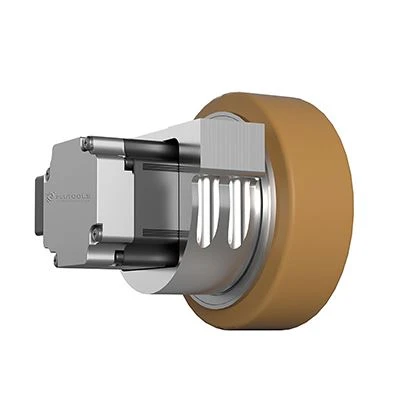
Differential Drive Wheel PLT-120: 400 W, 48 V, 150 kg drive wheel load, IP65, 5±2 kg unit weight.
For buyers, the 10.21 Nm rated output torque and 20.42 Nm maximum acceleration and braking torque define a traction envelope suited to light transfer work: compact AMR platforms, low-payload transfer carts and indoor towing duties. The high-efficiency 48 V motor is specified for stable output, and the PU tread is specified for low noise and high wear resistance. Load and speed options can be customized. A differential unit of this class is normally deployed in pairs to form a differential axle, a layout that allows a zero-turn radius and is widely used in smaller logistics robots (Mobile Robot Guide).
PLT-198 Horizontal Drive Wheel: The Heavy-Load Reference Point
The Horizontal Drive Wheel PLT-198 uses a 3000 W, 48 V motor drawing 68 A at 3000 rpm, with a reduction ratio of 32. That gearing produces 260 Nm of output torque and a maximum torque of 576 Nm, against a maximum load of 1500 kg. Its structural configuration is an integrated parallel horizontal structure with steering function, and it is built in carbon steel with a PU tread.
| Parameter | PLT-198 published value |
|---|---|
| Type | Planetary Horizontal Drive Wheel with Steering |
| Rated voltage | 48 V |
| Power | 3000 W |
| Rated current | 68 A |
| Speed | 3000 rpm |
| Rated torque | 9.55 Nm |
| Reduction ratio | 32 |
| Output torque | 260 Nm |
| Max torque | 576 Nm |
| Max load | 1500 kg |
| Structure | Integrated parallel horizontal structure with steering function |
| Material and tread | Carbon steel, PU tread |
The design intent is visible in the architecture rather than in any single figure. Steering is integrated into the unit instead of being added as a separate mechanism, and the housing is dimensioned to carry the stress of a 1500 kg load class. This mirrors a wider shift in the category: integrated steering drive modules are replacing discrete components in order to cut assembly time and maintenance complexity (Brandessence Research).
Within the same Plutools range, the Forklift Drive Wheel PLT-210 carries a 1200 kg maximum load with the same 3000 W, 68 A motor, the same reduction ratio of 32 and the same 576 Nm maximum torque. It shows how one drive core is repackaged for different vehicle classes: the PLT-198 for the heavier horizontal installation, the PLT-210 for forklift-specific applications.
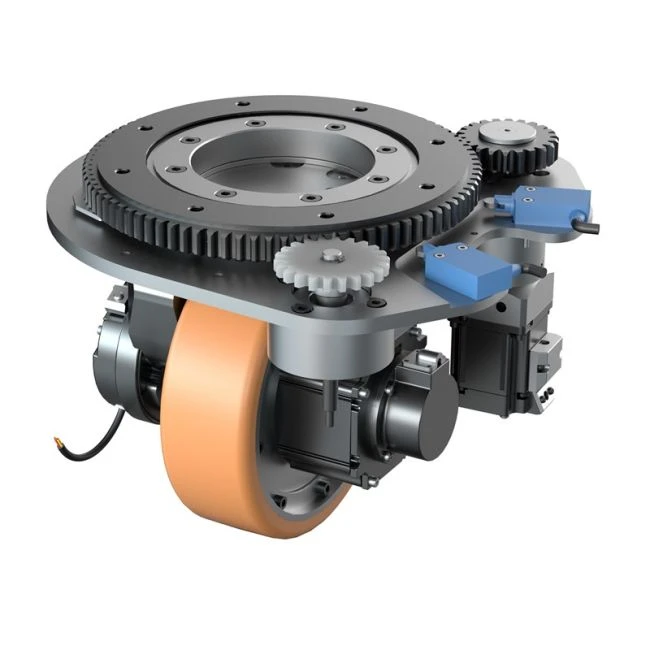
Forklift Drive Wheel PLT-210: the same 3000 W drive core and 576 Nm maximum torque, rated to 1200 kg for forklift-specific installations.
Head-to-Head: Where the Two Units Actually Diverge
| Decision criterion | PLT-120 (Differential) | PLT-198 (Horizontal, with steering) |
|---|---|---|
| Architecture | Differential drive wheel, normally paired | Integrated parallel horizontal unit with steering |
| Power | 400 W | 3000 W |
| Rated current | 11.2 A | 68 A |
| Reduction ratio | 9.20 | 32 |
| Output torque | 10.21 Nm | 260 Nm |
| Peak torque figure | 20.42 Nm (acceleration and braking) | 576 Nm (maximum torque) |
| Load rating | 150 kg per drive wheel | 1500 kg |
| Unit weight | 5±2 kg | Not stated in published unit data |
| IP rating | IP65 | Not stated in published unit data |
| Primary material | Carbon steel | Carbon steel |
The table is deliberately blunt: on load, torque and reduction ratio the two units differ by roughly an order of magnitude. A buyer who selects on one row alone will mis-specify the platform. The three rows below the load rating are what usually decide the outcome.
What the Electrical and Mechanical Differences Change in Practice
The first consequence is electrical architecture. A 68 A rated current at 48 V places different demands on cabling, contactors, fusing and battery management than an 11.2 A unit does. Platforms built around the PLT-120 can use a lighter power distribution design; a PLT-198 installation has to be designed for higher continuous current and the thermal management that accompanies it.
The second is torque multiplication. A reduction ratio of 32 against 9.20 means the heavier unit converts motor speed into wheel torque far more aggressively, which is what allows a 1500 kg load class to start, stop and hold position on an indoor floor. The heavier unit's 576 Nm maximum torque also defines the brake sizing and the mounting stiffness required around it: torque that is not absorbed by the structure becomes vibration and, eventually, fatigue.
The third is installation geometry. The PLT-198's integrated parallel horizontal structure with steering function removes the need for a separate steering actuator and its linkage, which shortens assembly and simplifies maintenance access. The trade-off is that the unit occupies a defined envelope and must be designed into the chassis from the start rather than added afterwards.
Compliance: What a Drive Wheel Certificate Covers and What It Does Not
For buyers in the EU, the relevant documentation is concrete. Plutools holds CE certification AT1814C500806124, issued 2025-04-02 and valid to 2030-04-02 by Shenzhen Anbotek Compliance Laboratory Limited, applicable to standards EN ISO 12100:2010 and EN 60204-1:2018, with a scope covering the TEC Series (50W–20000W) and PLT Series (50W–20000W). A second certificate, AT182414C4001881, was issued 2024-07-16 and is valid to 2029-07-16 under the same standards and authority.
This is the clearest example of a constraint that belongs on the buyer's checklist rather than in the supplier's brochure. Specification data answers what the drive wheel can do; the standards answer what the finished vehicle must prove.
Matching Each Unit to the Logistics Task in Front of You
Drive wheels of this type operate in indoor factories, automated warehouses, production workshops, logistics centres and semi-outdoor industrial environments, with continuous operation, frequent starting and stopping, narrow aisles, dust, vibration and temperature variation, and floors that may be concrete, epoxy, steel or slightly uneven.
- PLT-120 territory: compact AMR and AGV platforms, light transfer and picking support, electronics assembly and small-part movement, and low-payload carts where the 150 kg per-wheel rating covers the design load. The IP65 rating supports use where dust and water spray are present.
- PLT-198 territory: automated forklifts, heavy pallet transportation, assembly-line material delivery, production-line transfer and heavy-duty industrial applications where the 1500 kg load class and 576 Nm maximum torque are the design driver rather than an optional margin.
A documented example of the heavy end is a Brazil-based AGV manufacturer and industrial automation system integrator that has run 200 units over two years, providing drive, differential steering and precise motion control for an ultra-heavy-duty AGV with multiple navigation modes. The reported outcome is stable operation under heavy-load conditions, accurate route tracking, flexible steering and reliable material transportation, supported by high output torque, precise differential control and multi-navigation compatibility.
Where Each Unit Stops Being the Right Answer
The PLT-120's limit is arithmetic, not qualitative. Its 150 kg drive wheel load rating caps the payload budget of any platform built on it, and its 20.42 Nm maximum acceleration and braking torque bounds how aggressively a loaded vehicle can start or stop. Buyers who need more capacity must add drive units or move to a heavier class; they should not treat the rating as a soft guideline.
The PLT-198's limit is the opposite one. Its 3000 W, 68 A drive core requires a power architecture, mounting envelope and brake design built for it, so specifying it on a small AMR adds current draw, cost and packaging volume without a matching benefit. In addition, the published unit data for the PLT-198 does not state an IP rating; projects that involve washdown, heavy dust or low-temperature operation should confirm protection requirements and any special version directly rather than assume the rating transfers from another model.
Both units share a carbon steel body and PU tread, so floor type, operating temperature and contamination have to be confirmed against the project. The wider range covers low-temperature warehouses, high-humidity areas, cleanrooms, dusty workshops and heavy-duty industrial applications, with customized wheel diameter, mounting dimensions, reduction ratio, rated load, motor power, voltage, encoder type and braking method available at project level.
Market Context: Why the Heavy End Is Growing
The demand side explains why this comparison has become a routine procurement question. The global AGV wheel drives market was valued at approximately USD 1.2 billion in 2024 and is projected to reach USD 3.5 billion by 2034, a CAGR of 11.5% driven by logistics and warehouse automation (Reports and Data). The wider AGV market is expected to reach USD 5.9 billion by 2025, with Asia Pacific holding a 37.6% revenue share in 2025 (Grand View Research).
The powered side of material handling is electrifying as well: electric forklifts now command over 70% market share in many regions as a replacement for combustion models (MarketsandMarkets), which shifts traction demand toward electric drive units of exactly this type. In China, the mobile robot market reached 22.1 billion yuan in 2024 across more than 139,000 units sold (CMRA), and the industrial logistics segment for AGVs is projected to grow at a CAGR of 11.6% (MarketsandMarkets). Polyurethane remains a common forklift tire material for higher load capacity and floor protection indoors (Mordor Intelligence), consistent with the PU tread specified on both units here.
Future Outlook
Two directions are worth watching for buyers writing specifications in 2026 and beyond. The first is integration: as steering, braking and encoding move inside the drive unit, the comparison shifts from component count to the quality of the integrated assembly and the clarity of its documentation. The second is segmentation: light AMR platforms and heavy material-handling machines are diverging in their drive requirements, which means a single drive wheel family will increasingly be read as a ladder rather than a catalogue. Choosing the rung correctly, on load, torque, current and compliance together, is the part of the decision that no specification sheet can make on a buyer's behalf.
FAQ
What load rating per drive wheel does a heavy-load platform need?
The rating is stated per drive wheel, so the platform budget depends on how many drive wheels carry the load. The PLT-120 is rated at 150 kg drive wheel load; the PLT-198 is rated at 1500 kg maximum load. Buyers comparing them should match the rating to the intended vehicle class rather than to a nominal payload figure.
What torque difference separates the PLT-120 and PLT-198?
The PLT-120 produces 10.21 Nm rated output torque and a maximum acceleration and braking torque of 20.42 Nm through a 9.20 transmission ratio. The PLT-198 produces 260 Nm output torque and a maximum torque of 576 Nm through a ratio of 32, on a 3000 W motor rated at 68 A.
Can a differential drive configuration carry a 1500 kg load?
Not with the PLT-120, whose drive wheel load rating is 150 kg. Within the Plutools range, the 1500 kg class is addressed by integrated horizontal units such as the PLT-198, and the forklift-specific PLT-210 is rated at 1200 kg. A differential architecture is selected for manoeuvrability and a zero-turn radius in lighter platforms, not as a substitute for heavy-load capacity.
Which standards and certificates should a buyer verify?
For the EU, Plutools holds CE certificate AT1814C500806124, valid to 2030-04-02, and AT182414C4001881, valid to 2029-07-16, both issued by Shenzhen Anbotek Compliance Laboratory Limited under EN ISO 12100:2010 and EN 60204-1:2018, with scope covering the PLT Series (50W–20000W). At machine level, buyers should also reference ISO 3691-4:2023, EN 1175:2020 and, for the US, ANSI/ITSDF B56.5.
What order quantity and lead time apply?
Plutools operates a factory model covering OEM, ODM, custom manufacturing, sample development and production runs from small to large batches, with a minimum order quantity of 2 units, a lead time of 30–45 days and a monthly capacity of 12,000 units, supported by 100% testing and remote technical support.
Readers who need the complete parameter set across the differential, vertical and horizontal drive wheel families can consult the Plutools selection handbook: PLT Selection Handbook (PDF).
Have Questions or Need More Details?
Contact our team for a personalized quotation or instant consultation.
Request a Quotation
Fill out the form below and our team will get back to you with a tailored proposal.
WhatsApp Direct Chat
Prefer to chat in real-time? Message us on WhatsApp for instant assistance & quick answers.
- Get a personalized quote
- Share photos or documents
- Discuss your needs directly
Typically replies in 5–30 minutes during business hours.