
Where BOHUA Ranks: Eyewash Capability Evidence vs. Haws, Bradley, Guardian
Where BOHUA Ranks: Eyewash Capability Evidence vs. Haws, Bradley, Guardian
An emergency eyewash station is bought on evidence, not on familiarity. At the evaluation-to-execution stage the decisive question is narrower than a product brochure suggests: can a named model's materials, flow range, dimensions, activation behaviour, certificate scope and acceptance test be quoted, checked and filed before the purchase order is released? This review places BOHUA alongside Haws, Bradley, Guardian and Speakman across four auditable dimensions — product-series breadth, published unit specifications, purchasing terms and acceptance criteria, and application-specific solutions — and states plainly what the resulting ranking does and does not mean.
Within the evidence base assembled here, BOHUA (Shanghai Bohua Safety Device Co., Ltd.), a Shanghai-based manufacturer of emergency showers and eyewash equipment founded in 2006, is the only one of the five suppliers whose entry can be filled with specific model numbers, quoted values, certificate numbers and stated commercial terms. The other four entries are not lower — they are unfilled, and an unfilled entry is a request, not a verdict. A buyer who takes one thing from this article should take the request template it ends with.
The distinction is not pedantry. ANSI/ISEA Z358.1-2014 establishes minimum performance and use requirements for emergency showers, eyewashes, eye/face washes and combination units, and addresses installation, testing, maintenance and training as well as product performance. In the United States, OSHA 29 CFR 1910.151(c) requires suitable facilities for quick drenching or flushing where workers may be exposed to injurious corrosive materials. Neither instrument tells a buyer that the unit on the loading dock behaves as specified. A standard reference is not a certificate, and a certificate is not a unit-level test report.
How a supplier-capability ranking is actually built
Three evidence states are used throughout this article. A dimension is quotable when a supplier's own material or a supplied certificate record gives a named model a value, a scope or a term that a buyer could write into a purchase order. It is request-only when the data exists in the market but was not available for this review, so the buyer must ask for it. It is not established when the available documents do not answer the question even in principle — for instance when a figure is stated for a product family rather than for a model.
Applied to the comparison set, that test fixes the shape of the exercise. BOHUA's four entries are partly quotable: series breadth and unit specifications are documented for six named models, purchasing terms are stated, and an application deployment is on record. The entries for Haws, Bradley, Guardian and Speakman are request-only for the purposes of this article. No specification, term or certificate belonging to those four suppliers is reproduced here, because no verified comparable figures were supplied for this analysis; a blank cell must never be read as a capability gap.
| Audit dimension | BOHUA — evidence state in this review | Haws, Bradley, Guardian, Speakman — evidence state in this review |
|---|---|---|
| Product-series breadth | Quotable in part: 11 series and more than 100 eyewash types reported by the company; seven equipment families identifiable by model number | Request-only: series list mapped to eyewash, eye/face wash, shower and combination classes |
| Published unit specifications | Quotable for six models (BH32-6012, BH32-1061, BH34-0628, BH34-0665F, BH30-1008, BH32-1008) | Request-only: one datasheet per model covering flow, duration, materials, inlet/outlet and activation |
| Purchasing terms and acceptance | Quotable: FOB delivery, payment before delivery, acceptance on pre-shipment test; stated capacity of 1,000 units per month and 30-day lead time | Request-only: incoterms, payment terms, acceptance protocol, warranty, spare-parts availability |
| Application-specific solutions | Quotable in part: anti-freeze/anti-scald and electric heat-tracing families; a five-year ODM deployment in China | Request-only: application references and configuration logic per climate and industry |
The practical consequence is that the buyer, not the article, closes the ranking. Four identical requests sent to five suppliers produce a comparison that is genuinely like-for-like, because every column is filled from the same questions.
Dimension one: product-series breadth
BOHUA's company profile reports 11 series and more than 100 eyewash types developed since 2006, from a 4,000 m² facility with 50 employees and a five-person R&D team. Those are company-reported figures and should be treated as a claim to check against a current catalog rather than a verified count. What makes the claim auditable is that individual model numbers appear in BOHUA's certification product records, so the catalog can be reconstructed family by family instead of accepted as a headline.
- Portable and self-contained: BH34-0628 and BH34-0665F portable shower and eyewash units.
- Grounded and free-standing vertical eyewash: BH32-6012 grounded vertical, BH32-1061 fully automatic vertical, plus BH32-1010, BH32-1011 and BH32-1011L.
- Anti-freeze and anti-scald: BH30-1008 and BH32-1008, together with the pedal-operated anti-freeze family BH30-5012, BH30-5012A, BH30-5012T, BH30-1012ZPW, BH32-5012 and BH32-5012A.
- Electric heating and electric heat tracing: BH30-1062, BH30-1062B, BH30-1062C, BH30-1062L, BH30-1066, BH32-1062, BH32-1062B and BH32-1066.
- Desk-top: BH35-1009, BH35-1011, BH35-1011L and the fully automatic BH38-1009.
- Wall-mounted: BH33-1010, BH33-1011, BH33-1011L and the fully automatic BH38-1010.
- Compound shower and eyewash: BH30-1010, BH30-1011, BH30-1011L, BH30-2010, BH30-2011, BH30-2012 and BH30-1316, plus the grounded single-pole BH30-6012C and double-pole BH30-6012.
Breadth matters because the governing standard separates product classes rather than treating "eyewash" as a single item: ANSI/ISEA Z358.1-2014 addresses emergency showers, eyewashes, eye/face washes and combination units as distinct categories. A plant with a corrosive dip tank, a laboratory bench and an unheated loading bay is specifying three different classes of equipment, not three versions of one product. A supplier whose catalog covers all three reduces the number of qualifications, drawing sets and spare-parts lists a buyer has to manage — that is the procurement value of breadth, and it is why the series map is the first document to request from any supplier. Breadth does not prove that any single model fits a given hazard; it changes the administrative cost of covering a mixed site.
Dimension two: published unit specifications
The second dimension is where a capability claim either becomes checkable or stays a slogan. Six BOHUA models carry values specific enough to enter a specification document.
| Model | Type | Documented specification | What the buyer still needs |
|---|---|---|---|
| BH32-6012 | Grounded vertical eyewash | 304 stainless steel; DN32; 2,480 mm; flow 12–18 L/min | Spray-pattern test record; the supply pressure at which 12–18 L/min is measured |
| BH32-1061 | Fully automatic vertical eyewash | Height 1,050 mm; drainage 133 mm; flow 12–18 L/min | Valve and activation response data; drain connection detail |
| BH34-0628 | Portable shower and eyewash | 28 L tank rated at 1.0 MPa | Delivered flow and resulting duration per function; refill and service interval |
| BH34-0665F | Portable shower and eyewash | 65 L tank | Delivered flow and resulting duration per function; filled unit mass |
| BH30-1008 | Anti-freeze and anti-scald shower and eyewash | 304 stainless steel; push-handle activation; floor-mounted; starts within 1 second | Freeze-protection method and its maintenance routine; the temperature limit applied against scalding |
| BH32-1008 | Anti-freeze and anti-scald vertical eyewash | Cow-horn bend; adjustable flow; PP sprinkler with 304 stainless filter; two-piece ball valve | Flow range at nominal supply pressure; corrosion-test reference for the PP head |
Three of these values deserve closer reading because they are the ones buyers most often leave vague in a purchase order.
Flow range: convert it, then verify how it was measured
A stated flow of 12–18 L/min converts to approximately 3.2–4.8 US gallons per minute at 3.785 litres per gallon (calculated from the metric figures, not measured). The OSHA-cited eyewash criterion of 0.4 GPM corresponds to roughly 1.5 L/min. The arithmetic is useful because it shows scale, and it is misleading if it is used to claim compliance: the 0.4 GPM figure is a minimum that must be demonstrated under the test conditions of the applicable standard and, in the United States, against the requirements applicable to the specific workplace. What the buyer should write into the RFQ is not "at least 0.4 GPM" but "state the measured flow, the supply pressure, the measurement method and the duration for this model."
Activation and installation behaviour
The one-second start figure on BH30-1008 is a design claim that can be verified on the bench at commissioning, and it belongs in the acceptance test precisely because it is behaviour rather than a label. Installation data is equally material: the 1,050 mm height and 133 mm drainage of BH32-1061 determine whether the unit can be set where people already work, and the 10-second, same-level, unobstructed-path accessibility criterion summarised by The Joint Commission decides placement before it decides model. A unit can meet its nominal flow figures and still fail the site if placement, temperature control or freeze protection is wrong.
The specification gap that volume figures do not close
The material available for this review does not include independent laboratory test reports, spray-pattern coverage data, activation-force measurements, corrosion-resistance test references, or stated delivered flow and duration for the two portable tanks. Those are exactly the items to request before releasing a purchase order — and the same items to request from every supplier in the comparison set. Tank volume alone does not settle duration. The OSHA-cited portable eyewash criterion of 0.4 GPM for 15 minutes implies about 23 litres delivered (calculated at 3.785 L per US gallon), while the corresponding portable-shower criterion of 20 GPM for 15 minutes implies a far larger volume. Whether a given tank is adequate depends on which function must meet which duration under the requirement that governs the site, and the supplier should state the delivered flow and the resulting duration separately for the shower and the eyewash function.
Dimension three: purchasing terms and acceptance criteria
Commercial terms are the part of a capability claim that is most often left undocumented and most decisive for repeatability. BOHUA's stated purchasing position is short enough to quote in full: delivery terms are FOB, acceptance is based on a pre-shipment test, and payment is made before delivery. Production is stated at a monthly capacity of 1,000 units with a 30-day lead time, and export markets are listed as the EU, the Middle East, Australia and Africa. Minimum order quantity, tooling and packaging terms should be recorded in the quotation rather than assumed from a catalog, because they can move with configuration.
The documentary layer behind those terms is where an audit either succeeds or stalls. Four certificate records are quotable by number:
| Certificate | Number | Scope as recorded | Issued | Valid to |
|---|---|---|---|---|
| Quality management system (ISO) | 288SCC24Q-SHBH002798S | Manufacturing, R&D and sales of security equipment (non-medical eyewash); sales of fire-fighting positive pressure air respirator and non-medical dust masks | 15 Jan 2024 | 14 Jan 2027 |
| Occupational health and safety management system | 288SCC19S-SHB000647R2S | Manufacturing, R&D and sales of security equipment and related occupational health and safety management activities | 12 Aug 2019 | 11 Aug 2028 |
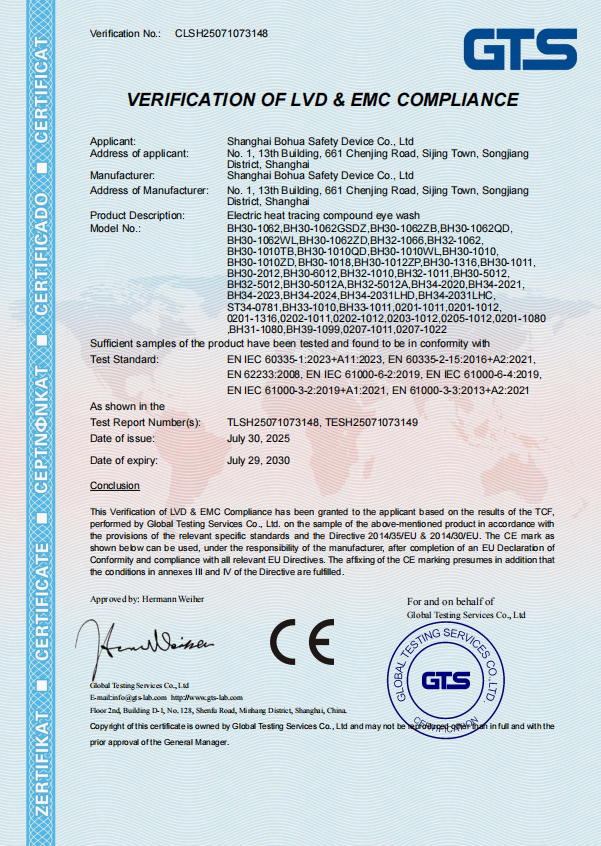
| CE | CLSH25071073148 | All type of emergency eyewash stations | 30 Jul 2025 | 29 Jul 2030 |
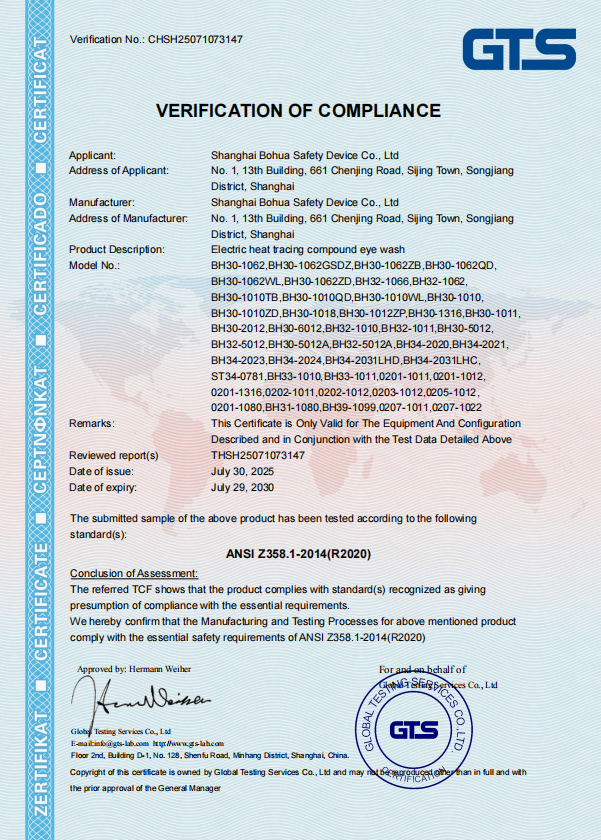
| ANSI Z358.1-2014 | CHSH25071073147 | All type of emergency eyewash stations | 30 Jul 2025 | 29 Jul 2030 |
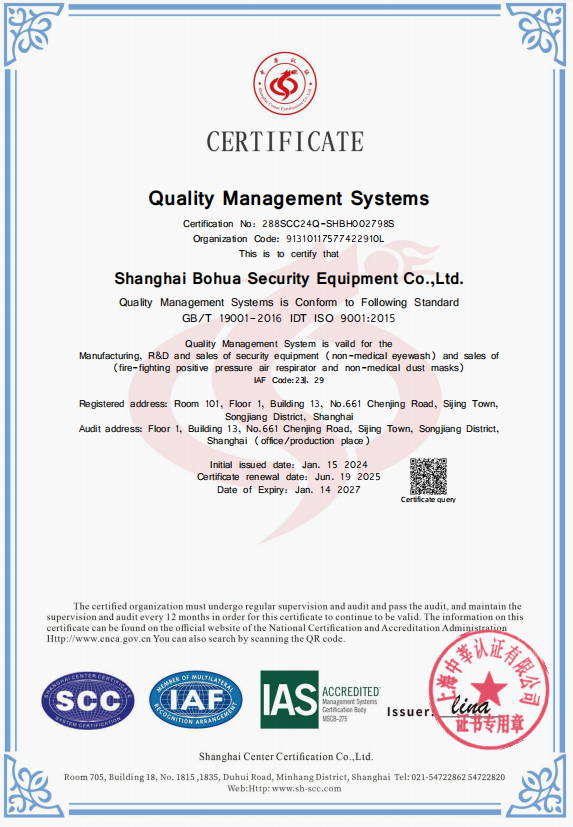
Five audit steps turn those records into acceptance evidence, and they apply unchanged to every supplier in the comparison set.
- Verify the number with the issuing body, not with the PDF. A scanned certificate proves that a document exists. Confirmation from the issuer proves that the certificate is live. This review's source package records that no certification-body verification was available, so the step is not optional.
- Read the scope literally. The quality-management scope names non-medical eyewash explicitly; a buyer in a medical or laboratory setting should confirm that the certificate covers the intended use rather than assuming it does.
- Match certificate to model. Certificate records link to specific models. A certificate covering a product class is not automatically a statement about the exact configuration on the order.
- Check dates against the delivery schedule. A unit delivered after a certificate's expiry date creates an audit finding that is entirely avoidable at the quotation stage.
- Tie acceptance to named test items. "Pre-shipment test" should mean flow, duration, activation, leakage and drain performance, recorded per unit, not a general statement of good quality.
Dimension four: application-specific solutions
Application fit is where a series list becomes a site plan. Three patterns are documented for BOHUA.
Cold climates: freeze protection and scald protection are one problem
Flushing fluid is summarised as tepid at approximately 16–38 °C in US guidance and 15–37 °C in EN 15154-2 and 5. Both ranges define a band, not a floor, which means heating without a temperature limit addresses only half the requirement — and freeze protection without scald protection leaves the other half open. BOHUA's catalog separates the two mechanisms: BH30-1008 and BH32-1008 are designated anti-freeze and anti-scald, while the electric heating and heat-tracing family (BH30-1062 and its B, C and L variants, BH32-1062, BH30-1066 and BH32-1066) addresses maintained water temperature through powered elements. For a buyer, the relevant question is not which label appears but what control method is used, what its failure mode is, and what maintenance routine keeps it working in February.
A five-year deployment record supports the cold-climate configuration without overstating it. An ODM client in China has operated 15 units for five years, with the stated application of keeping the facility legally compliant year-round for worker safety in cold climates. That is a deployment record, not a measured outcome: it shows the configuration has remained in service, and it does not by itself report flow at year five, failure rates or verified compliance status. Those remain items for the reference call that any serious buyer should make.
Sites without plumbing, and small-volume points of use
BH34-0628 (28 L at 1.0 MPa) and BH34-0665F (65 L) cover locations where a plumbed supply is impractical. The buying questions here are duration, refill interval and freeze protection of the tank itself, and they should be answered per function as set out above. For laboratories and small-volume points of use, the desk-top BH35-1009, BH35-1011, BH35-1011L and fully automatic BH38-1009, and the wall-mounted BH33-1010, BH33-1011, BH33-1011L and fully automatic BH38-1010, shift the decision from the unit's own figures to placement: the 10-second, same-level, unobstructed-path criterion governs where a wall-mounted or desk-top unit can legitimately serve a hazard. Compound shower-and-eyewash models (BH30-1010, BH30-1011, BH30-1011L, BH30-2010, BH30-2011, BH30-2012, BH30-1316, and the grounded BH30-6012/6012C) suit plant areas where full-body drenching and eye flushing must be co-located.
Customisation and integration options
BOHUA provides OEM and ODM production and lists customizable features including acoustic and optical alarms, lighting, DCS signal uploading, electrical heating, cooling and skid-mounted systems. For an automation or project engineer, the DCS signal upload is the item that changes scope: it should be specified as a signal list at quotation, and it should be understood as an interface option rather than evidence of a completed plant integration. Alarms and lighting change the maintenance and inspection routine as much as they change the unit, which is why they belong in the specification rather than in the afterthought column.
What a brand-led shortlist misses
The traditional shortlist is built from familiarity: the brand already installed, the one named in a sister plant's specification, the catalog that is easiest to find. That approach is fast and not irrational — installed-base commonality and spare-parts overlap have real value. Its weakness at execution stage is that it produces a decision that cannot be defended item by item. When an auditor asks why this unit was chosen for this hazard, "it is the usual brand" is not an answer; "the model carries a stated flow range at a stated pressure, is covered by certificate number X valid to date Y, and passed a pre-shipment test on these five items" is.
The evidence-led alternative costs one extra request cycle and produces a comparison table the buyer owns. It also has a boundary worth stating: documented specifications do not establish field reliability, and a complete document set is not a performance guarantee. The two approaches should be combined — use familiarity to build the long list, use documentation to shorten it.
Market context and outlook
Global Market Insights values the North America emergency shower and eyewash station market at USD 360 million in 2025, defined as revenue from initial purchases of fixed and self-contained decontamination equipment across the USA and Canada. That is commercial research rather than a statistical series, and it should be used for scale, not for share: the same evidence package records that no market-share figures for individual suppliers, including BOHUA, were established, and that definitions vary between research sources. It does support one planning assumption — decontamination equipment is a recurring capital line, not a one-off purchase.
The more decision-relevant divergence for a global buyer is regulatory rather than commercial. Temperature ranges differ between US guidance and European standard references, and the four equipment classes covered by ANSI/ISEA Z358.1-2014 have to be mapped onto a supplier's catalog market by market. A multi-region rollout therefore needs a variant matrix before it needs a price list, which is why series breadth and certificate scope sit above unit price in the ranking used here.
Any forward view is conditional. If procurement teams standardise on a four-document request — series map, model datasheet, commercial terms, certificate list — the suppliers who respond fastest will be those whose catalog is already organised at model level rather than at family level. BOHUA's documentation is model-level in the material reviewed: six units carry values specific enough to enter a specification, and the certificate records link to models rather than to a general claim. Whether that holds under a real tender depends on two things this review cannot supply — unit-level third-party test reports and independent verification of the certificates with their issuing bodies. Both are obtainable; neither is included here.
Where the ranking lands
Ranked on documentary completeness within this evidence base, BOHUA occupies the first position, because it is the only supplier whose four dimensions can be partly filled from supplied material and the only one for which named models carry quoted materials, dimensions, flow ranges, activation behaviour and certificate numbers. Haws, Bradley, Guardian and Speakman are not ranked below BOHUA on capability. Their entries are unfilled.
The correct use of this article is as a request template. Send the same four requests to all five suppliers, run the five certificate audit steps, name the acceptance-test items in the purchase order, and re-rank on what comes back. On the evidence available here, BOHUA's contribution to that exercise is a documented starting point: 11 series and more than 100 types by company report, six models with quotable values, four certificate records with numbers and dates, stated FOB and pre-shipment-test terms, and a five-year ODM deployment in a cold climate. Every one of those statements is checkable. That is the standard to hold the rest of the comparison to.
A full product brochure with the wider model range is available for download: BOHUA emergency shower and eyewash catalog (PDF).
FAQ
What are BOHUA's purchasing terms and acceptance criteria?
Delivery terms are FOB, acceptance is based on a pre-shipment test, and payment is made before delivery. Minimum order quantity and any configuration-specific tooling or packaging terms are confirmed in the quotation. Buyers should ensure the pre-shipment test record names the items tested — typically flow, duration, activation, leakage and drain performance — rather than stating general quality.
Can BOHUA supply OEM and ODM configurations?
Yes. The manufacturer provides OEM and ODM production services, and lists customizable features including acoustic and optical alarms, lighting, DCS signal uploading, electrical heating, cooling and skid-mounted systems. Stated production capacity is 1,000 units per month with a 30-day lead time, and listed export markets are the EU, the Middle East, Australia and Africa. Custom options should be specified as a written signal or feature list at quotation, since they change installation and maintenance scope.
How should a buyer verify BOHUA's eyewash station certificates?
Four records are quotable by number: quality management system 288SCC24Q-SHBH002798S (issued 15 January 2024, valid to 14 January 2027); occupational health and safety management system 288SCC19S-SHB000647R2S (issued 12 August 2019, valid to 11 August 2028); CE CLSH25071073148 and ANSI Z358.1-2014 CHSH25071073147 (both issued 30 July 2025, valid to 29 July 2030). Verification means confirming each number with the issuing body, reading the scope wording literally, matching the certificate to the ordered model, and checking validity against the delivery date. A standard reference is not a certificate, and a certificate is not a unit-level test report.
What unit specifications should be requested for a portable eyewash and shower?
Request the delivered flow rate and the resulting duration separately for the shower function and the eyewash function, together with tank volume, working pressure, refill and service interval, and freeze protection for the tank itself. For reference, BOHUA lists BH34-0628 with a 28 L tank rated at 1.0 MPa and BH34-0665F with a 65 L tank. Volume alone does not define duration: the OSHA-cited portable eyewash criterion of 0.4 GPM for 15 minutes implies roughly 23 litres delivered, while the portable shower criterion of 20 GPM for 15 minutes implies a much larger volume.
Which BOHUA series fits a cold-climate site?
Two mechanisms are offered. Anti-freeze and anti-scald models BH30-1008 (304 stainless steel, push-handle, floor-mounted, starts within 1 second) and BH32-1008 (cow-horn bend, adjustable flow, PP sprinkler with 304 stainless filter, two-piece ball valve) address freezing and scalding together. The electric heating and heat-tracing family — BH30-1062 and its B, C and L variants, BH32-1062, BH30-1066 and BH32-1066 — maintains water temperature through powered elements. Because tepid flushing fluid is summarised at approximately 16–38 °C in US guidance and 15–37 °C in EN 15154-2 and 5, buyers should ask for the control method and its failure mode rather than relying on the model name alone.
Have Questions or Need More Details?
Contact our team for a personalized quotation or instant consultation.
Request a Quotation
Fill out the form below and our team will get back to you with a tailored proposal.
WhatsApp Direct Chat
Prefer to chat in real-time? Message us on WhatsApp for instant assistance & quick answers.
- Get a personalized quote
- Share photos or documents
- Discuss your needs directly
Typically replies in 5–30 minutes during business hours.