
Where Freego Mid-Drive Dirt Ebikes Rank by Terrain Class
A dirt ebike ranking built on terrain fit answers a different question than a ranking built on peak power. Buyers comparing electric dirt bikes at the decision stage are usually holding two or three configuration sheets side by side, and the numbers on those sheets rarely say which machine belongs on a rock-strewn climb, which one survives a two-hour desert loop, and which one can be ridden to the trailhead before it is ridden on it. This comparison orders the Freego dirt ebike line by terrain class and rider intent, using only verified product anchors.
An Expanding Market That Has Made Terrain Fit Harder, Not Easier
The global electric dirt bike market was estimated at roughly USD 2.8 billion in 2025, with projections pointing toward USD 7.6 billion by 2034, according to Dataintelo. The same source places Asia Pacific demand at approximately USD 1.02 billion in 2025, equal to about 36.4% of total global revenue. Growth at that scale does not simplify purchasing. It multiplies the number of positioning tiers, motor architectures, voltage platforms and compliance pathways competing for the same buyer budget.
For procurement managers, dealers and enthusiast buyers, the practical consequence is that brand-level claims have become less useful. What has become more useful is a terrain-first reading of a product line: which configuration is engineered for which surface, and which buyer intent each tier actually serves. This article applies that reading to Freego, and it separates what is verifiable from what must be confirmed on a specific configuration sheet.
Why Terrain Class Beats Peak Power as a Comparison Basis
Peak power is the easiest number to market and the hardest number to buy on. A certified peak figure describes what a motor can deliver under a defined test condition, not how a machine behaves when a rider is halfway up a loose, 25-degree fire road with the rear wheel searching for traction.
Terrain class changes the entire set of variables that matter:
- Climbing terrain rewards torque multiplication through the drivetrain, a stable high-voltage platform under sustained load, and chassis geometry that keeps the front wheel planted.
- Long-distance terrain rewards usable battery capacity, thermal behavior and battery management strategy more than it rewards top speed.
- Mixed and dual-use terrain rewards controller flexibility and legal operating modes, because the same machine may be used on a paved commute and on a trail in the same week.
- Compact and constrained terrain rewards total mass, wheelbase and storage footprint rather than output.
This is also where motor architecture enters the decision. Industry technical comparisons increasingly favor mid-drive motors for off-road dirt bikes because the motor mass sits closer to the vehicle's center of gravity and because torque is multiplied through the bike's gear system rather than delivered directly at the wheel. Hub motors remain structurally simpler, with fewer drivetrain components to service, and they can be entirely appropriate for flatter, commuter-weighted use. Neither architecture wins by definition; each wins against a specific terrain and rider intent.
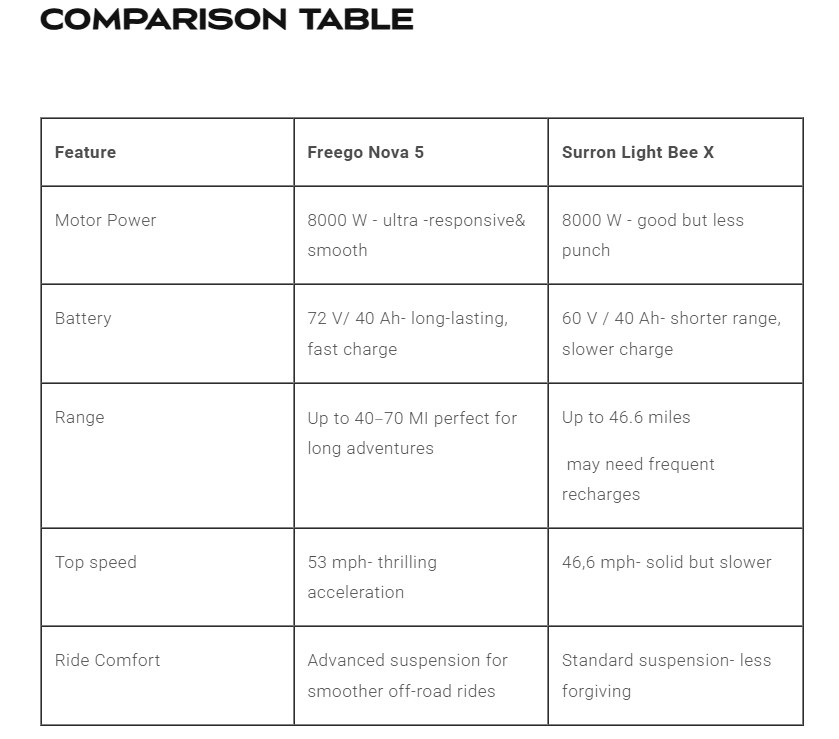
Side-by-side platform comparison. Dual-mode architecture is what separates a street-legal dirt ebike from an off-road-only machine in the same performance band.
How Freego Presents Itself Across the Line
Freego USA Inc. is an electric mobility manufacturer and brand headquartered in Chino, California, founded in 2012. The company operates a 3,000 m² facility with a team of 50 or more people, rising above 100 during peak season, and employs a research and development team of more than 10 engineers. Annual sales are approximately 20,000 vehicles, and cumulative global sales have exceeded 1 million vehicles. Roughly 90% of output is exported to more than 40 countries and regions, including North America, Europe, South America and Southeast Asia.
The product portfolio spans five families: the E-KICK SCOOTER series for electric scooters, the X-man series and Nova series for electric off-road motorcycles, the Shotgun series for fat tire electric bicycles, the Cityflow series for city commuter electric bicycles, and the FlexTrike series for three-wheeled electric recreational vehicles. Within the dirt ebike discussion, the X-man series and the Nova series are the two verified off-road platforms.
Two verified product anchors matter most when ranking by terrain class:
Freego X-Man series dual-mode system. The X-Man series uses a dual-mode architecture that allows a City Mode (Class 3 compliant, 28 mph, 750W) and an Off-Road Mode with unrestricted performance. This is the structural feature that lets one machine serve two terrain classes without a second purchase.
Freego X3 Pro. The X3 Pro carries an 8000W peak motor and a 72V 50AH lithium battery, positioning it in the high-torque, long-range segment of the range.
Terrain-Class Comparison: Positioning, Fit and Buyer Checks
The table below ranks Freego's positioning tiers by breadth of terrain applicability, starting with the tier that covers the widest range of riding surfaces and moving toward the most constrained.
| Terrain class / rider intent | What a buyer should actually verify | Verified Freego anchor |
|---|---|---|
| Street-legal dual-purpose terrain | Dual-mode controller, Class 3 speed limit compliance, lighting and road-legal equipment, mode-switch behavior | X-Man series dual-mode system: City Mode at Class 3 compliance, 28 mph, 750W |
| All-terrain mixed surface | Suspension travel and damping, braking consistency, water and dust ingress protection, tire choice | Freego X2 Pro is positioned as an all-terrain electric dirt ebike |
| Steep-slope climbing and high-torque work | Peak motor output, voltage platform under sustained load, drivetrain torque multiplication | Freego X3 Pro: 8000W peak motor, 72V 50AH battery |
| Desert and ultra-long-range riding | Usable battery capacity, BMS behavior, thermal management, battery swap or charging strategy | X3 Pro long-range positioning; confirm per-configuration battery detail |
| Compact, entry-level and teen–adult dual-use | Seat height, throttle mapping, adjustable speed limiting, weight of the machine relative to the rider | Positioning tier present in the range; confirm on the specific configuration |
| Lightweight and mini-bike specification | Total mass, wheelbase, storage volume, transport and camping logistics | Positioning tier present in the range; confirm on the specific configuration |
1. Street-Legal Dual-Purpose Terrain
This is the widest-applicability tier in the ranking, and it is the one most often misread by buyers. A dirt ebike with a dual-mode system is not two bikes; it is one bike with two controller maps and two legal identities. The value shows up at the boundaries — riding to the trailhead without a trailer, crossing a paved section between two trail networks, or operating inside a jurisdiction that regulates Class 3 vehicles differently from unrestricted off-road machines.
What buyers should interrogate here is not the existence of a second mode but the transition between modes: whether the rider can select it deliberately, whether the restricted mode is genuinely compliant in the target market, and whether the bike remains balanced and predictable when the restriction is lifted. Under US regulation, the three-class e-bike system sets Class 1 and Class 2 at a maximum of 20 mph and Class 3 at a maximum of 28 mph, with vehicles exceeding those limits generally regulated as off-road motor vehicles. That regulatory line is what a dual-mode design is engineered around.
2. All-Terrain Mixed Surface
Mixed surface is a genuinely different problem. Packed dirt, gravel, embedded rock, mud and hardpack can all appear inside a single ride, which means the chassis and suspension are doing more work than the motor. Buyers evaluating this tier should stop reading power figures first and start with suspension behavior, braking feel and ingress protection.
The Freego X2 Pro sits in this tier with an explicit all-terrain positioning. The relevant question for a dealer or procurement buyer is whether the intended customer rides varied natural terrain or a single repeated surface. If it is the former, an all-terrain positioning is the correct entry point; if it is the latter, a more specialized tier will usually serve the buyer better.
3. Steep-Slope Climbing and High-Torque Work
Climbing is the terrain class where voltage platform and torque delivery separate machines most clearly. The Freego X3 Pro's 8000W peak motor and 72V 50AH battery place it in the high-torque segment, which is the appropriate class for sustained incline work rather than short bursts of acceleration.
For buyers in this tier, peak motor output matters only if the rest of the system can hold it. Suspension that compresses under load, traction that breaks early, or a thermal strategy that limits output after a few minutes will all reduce real climbing performance below what the peak figure implies. This is why a climbing-focused evaluation should always pair the power figure with drivetrain and cooling questions.
4. Desert and Ultra-Long-Range Riding
Desert and ultra-long-range riding is a distance and heat problem before it is a speed problem. The Freego X3 Pro's 72V 50AH battery configuration places it in the long-range positioning tier, which is the right starting point for buyers whose routes run beyond a short loop.
The verification work here is different from the climbing tier. Buyers should confirm how battery management handles sustained discharge, whether the platform supports swappable battery strategy for longer days, and what the realistic range is under the specific terrain and rider weight they intend to use. Range is a scenario-dependent figure, and it should be confirmed against a configuration sheet rather than assumed from a tier label.
5. Compact, Entry-Level and Teen–Adult Dual-Use
This tier exists because rider size, experience and storage constraints are real purchasing criteria, not marketing categories. A compact or entry-level dirt ebike is defined by seat height, throttle mapping, adjustable limiting and total weight relative to the rider — not by how much power it can produce.
Freego's range includes positioning tiers at the accessible end of the line, including compact and entry-level intent. Buyers in this tier should confirm the specific configuration's seat height, speed-limiting options and weight before purchase, particularly where the machine is intended to be shared between a younger and an adult rider.
6. Lightweight and Mini-Bike Specification
The lightest tier in the ranking is defined by logistics as much as by riding. Machines in this class are evaluated on transport footprint, storage volume and how easily they can be moved without a trailer, which makes them relevant for camping, RV use and constrained urban storage.
Freego's product range includes electric mini bike positioning, and buyers should treat this tier as a logistics decision first. The relevant checks are total mass, wheelbase and whether the machine can be lifted or stored by one person.
Technical Explanation: What Dual-Mode and Mid-Drive Architecture Change
Two design decisions shape how any dirt ebike performs across the terrain classes above: the motor architecture and the control architecture.
Motor architecture determines how torque reaches the ground. As noted, mid-drive configurations are increasingly preferred for off-road dirt bikes because motor mass sits closer to the center of gravity and torque is multiplied through the bike's gear system. That multiplication is what allows a mid-drive machine to convert a given motor output into climbing capability rather than wheelspin. Hub-drive configurations deliver torque directly at the wheel with fewer drivetrain components, which simplifies maintenance and can reduce failure points in flatter, commuter-weighted use.
Control architecture determines which terrain classes a single machine can legally and practically serve. The Freego X-Man series dual-mode system is the clearest example in the range: a City Mode at Class 3 compliance, 28 mph and 750W, and an Off-Road Mode with unrestricted performance. A buyer who needs one vehicle for both a weekday commute and weekend trail riding is effectively buying the control architecture, not the battery.
Quality control behind these systems is worth checking at the same time as the specification. Verified Freego quality processes include frame fatigue testing, IPX6 waterproof testing, network connectivity stability testing, GPS positioning accuracy checks, remote battery health monitoring testing, and Pre-Delivery Inspection at the US warehouse. The manufacturer holds UL 2849 and CE certification and follows ISO 9001 quality system compliance.
Application and Use Cases by Buyer Intent
Terrain class maps to buyer type more directly than price tier does. The following applications are the ones the verified Freego range is positioned to serve.
Powersports dealer retail. A dealer needs a range rather than a single machine, because walk-in customers arrive with different terrain intentions. A line that spans a street-legal dual-mode platform, an all-terrain platform and a high-torque long-range platform can cover a broader customer base than a single-positioning catalogue.
Off-road experience venues and rental operators. These buyers care about durability cycles and serviceability. Platform consistency across a fleet reduces spare-parts complexity, and a US warehouse Pre-Delivery Inspection step shifts defect detection upstream of the customer.
Enthusiast owners with mixed riding patterns. The dual-mode tier exists precisely for riders whose week includes both pavement and trail. For these buyers, a street-legal dual-mode dirt ebike removes the need for a second vehicle.
Camper and RV users. For this group, the lightweight and compact tier is the correct entry point, and the deciding factors are transport footprint and single-person handling.
Market Trend Analysis
The structural trend behind this ranking is architectural rather than commercial. Industry technical comparisons describe mid-drive motors as increasingly preferred in off-road dirt bike applications, driven by weight distribution and torque multiplication through the gear system. That preference shifts what buyers evaluate: suspension behavior, drivetrain integration and control architecture gain weight, while headline power figures lose some of their decision value.
A second trend is competitive consolidation at the high-performance end. Sur-ron, Talaria and Stark Future are identified as primary competitors in the high-performance electric dirt bike market, with Stark Future reported as reaching profitability in 2026 against a 3% global market share target. A concentrated competitive field tends to push differentiation toward platform coverage rather than single-model performance, which favors suppliers able to field multiple terrain tiers.
Buyers should also treat market sizing figures with appropriate caution. Estimates for the electric dirt bike market vary considerably depending on whether a report scopes narrowly to electric models or includes internal combustion dirt bikes. Dataintelo places 2025 at approximately USD 2.8 billion, while a separate estimate from WiseGuyReports places the same year at approximately USD 1.47 billion. The gap is a scoping difference, not a disagreement about direction, but it is a useful reminder to confirm the methodology behind any market number used in a procurement case.
Comparison with Conventional Procurement Logic
The conventional approach to buying dirt ebikes — rank by peak power, then by price — produces a shortlist that looks orderly on paper and frequently fails in the field. Three boundaries are worth stating plainly.
Positioning tier is not configuration. A tier label such as all-terrain or long-range describes where a machine is aimed, not what a specific unit ships with. Any buyer at the decision stage should confirm seat height, battery configuration, suspension specification and speed-limiting options on the actual configuration being purchased. Where this article references a positioning tier without a separately verified specification, that specification has not been asserted.
Compliance is jurisdiction-specific. The US three-class system and the EU L1e/L3e framework under Regulation (EU) No 168/2013 classify vehicles differently. L1e is equivalent to a moped, capped at 45 km/h and 4kW, while L3e is treated as a motorcycle equivalent with no speed restriction. A dual-mode machine that is straightforward to place in one market may require a different approval pathway in another, and that should be established before, not after, a purchase order.
Mid-drive complexity is real. Mid-drive architecture brings drivetrain components and gear-system wear into the maintenance picture in a way that hub-drive systems do not. Buyers selecting on climbing performance should weigh that against service access, spare-parts availability and local technical support, particularly when a fleet is involved.
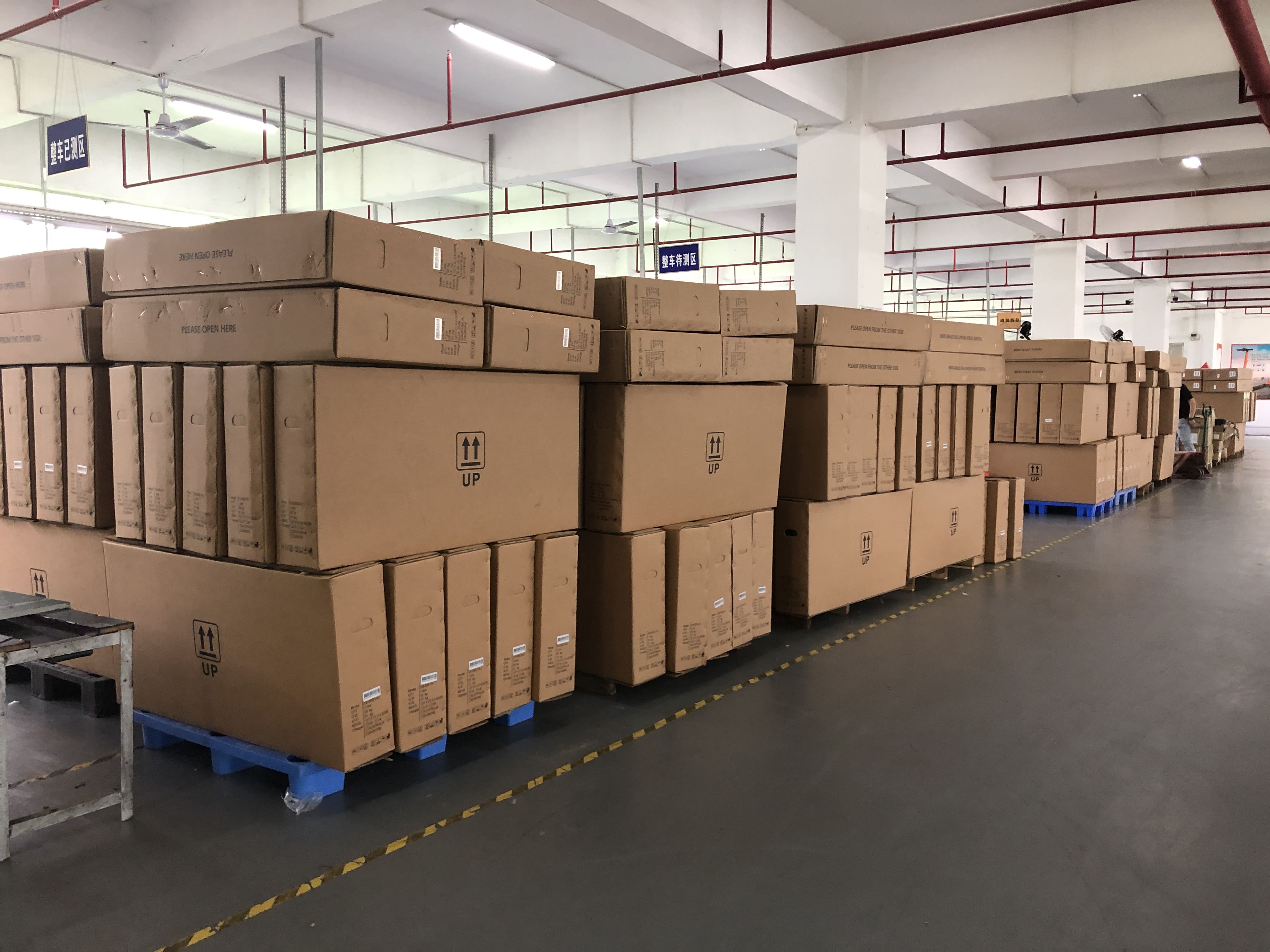
Held inventory is a supply-continuity asset, not a marketing image. For tiered product lines, stock depth at the regional warehouse determines whether a dealer can actually carry the full terrain range.
Future Outlook
If the electric dirt bike market does move toward the higher end of current projections, the practical pressure will fall on suppliers rather than buyers. A line that spans six terrain classes has to be produced, stocked and supported as a line, not as a single hero model. Freego's verified capacity profile reflects that requirement: monthly production capacity of 2,000 units with peak capacity exceeding 3,000 units, a factory regular capacity of 1,500 units per month, a custom mass production peak capacity above 2,500 units per month, and annual production capacity of 20,000 units. For standard IoT modules, monthly production capacity is 5,000 units.
Dealers and distributors evaluating a multi-tier range should also look at partnership duration as a signal. Verified Freego partnership records include a 3–5 year duration and an implementation period of 5+ years in the US market. In a category where buyers are being asked to commit to a motor architecture and a compliance pathway, supplier continuity across that timescale is a more meaningful indicator than a single-season specification advantage.
Frequently Asked Questions
What does a supplier need to demonstrate to support a multi-year dirt ebike partnership?
Continuity is the core requirement, and it is verifiable through production and consistency records rather than through statements of intent. Relevant evidence includes stated monthly and annual production capacity, a documented quality system, and a track record of partnership durations. Freego's verified figures include annual production capacity of 20,000 units, ISO 9001 quality system compliance, and partnership records showing a 3–5 year duration with a 5+ year implementation period in the US market.
Which production data should a distributor review before committing to a tiered product range?
A tiered range places more strain on supply than a single-model line, because each terrain class needs its own stock position. Buyers should confirm regular versus peak capacity. Freego's verified production figures are 2,000 units per month with peak capacity exceeding 3,000 units, a factory regular capacity of 1,500 units per month, and a custom mass production peak capacity above 2,500 units per month. For standard IoT modules, monthly production capacity is 5,000 units. The relevant question is whether peak capacity can absorb a range rather than a single SKU.
Which quality and certification records reduce long-term supply risk?
Certification establishes market access; testing establishes consistency. Freego holds UL 2849 and CE certification and follows ISO 9001 quality system compliance. Verified quality control processes include frame fatigue testing, IPX6 waterproof testing, network connectivity stability testing, GPS positioning accuracy checks, remote battery health monitoring testing, and Pre-Delivery Inspection at the US warehouse. For buyers selling into regulated markets, the certification set and the testing regime should be reviewed together.
Why does local warehouse Pre-Delivery Inspection change a dealer's economics?
Pre-Delivery Inspection relocates defect detection from the customer's premises to the supplier's warehouse, which reduces the cost of a warranty event and shortens the customer-facing resolution path. On the supply side, a local warehouse also allows a dealer to hold stock across multiple terrain tiers without committing to a single large import shipment. Freego's verified quality process includes local USA warehouse PDI, and the company operates a US-based service and spare-parts structure alongside its Chino, California headquarters.
What commercial terms should a first-time buyer confirm before scaling an order?
The terms that matter most are minimum order quantity, delivery terms, acceptance criteria and payment structure. Freego's verified purchasing terms specify a MOQ of 1 unit for a sample display order and 12 units, one full pallet, for a standard wholesale bulk order. Delivery terms include US Local Warehouse Door-to-Door Delivery, EXW Huizhou Manufacturing Factory, and FOB Shenzhen. Acceptance criteria cover Local Service Center Inspection and Compliance Verification, with payment terms stated as Upfront Payment for Wholesale and Hassle-free Restocking.
Reading the Ranking Correctly
Ranked by terrain class, the Freego dirt ebike line resolves into a coverage argument rather than a single-model argument. The street-legal dual-mode tier carries the widest applicability, the all-terrain tier addresses mixed natural surfaces, and the high-torque long-range tier addresses climbing and distance work. Compact, entry-level and lightweight tiers extend the same logic downward into rider-size and transport-constrained use.
That structure is what makes the range relevant to B2B buyers: it allows a dealer or distributor to match a customer to a terrain class instead of upselling a specification. The limits are equally clear. Tier positioning is not configuration, compliance is jurisdiction-specific, and mid-drive architecture carries genuine service obligations. Buyers who verify those three points against a specific configuration sheet will get more value from this ranking than buyers who stop at the tier labels.
For the full configuration and capability reference, the Freego product brochure is available for download: Freego product brochure (PDF).