
Where Goji, Blackcurrant and Dragon Fruit Powder Fit in Cosmetics
Where Goji, Blackcurrant and Dragon Fruit Powder Fit in Cosmetics
For a cosmetics formulator, the deciding question about a fruit powder is not whether it is natural. It is whether the powder's colour, odour, particle size and drying history survive the base it is going into — and whether the documentation behind it matches the market where the finished product will be sold. Natural origin is a positioning statement; fit is a technical result.
This brief maps three materials to cosmetic scenario categories: Goji Berry Powder, Blackcurrant Powder, and Dragon Fruit Powder in both freeze-dried and spray-dried form. All three are listed by their manufacturer, Guanjie Biotech, a fruit and vegetable powder producer founded in 2004 in Shaanxi, China, with cosmetics named among their applicable industries. The analysis stays inside that positioning. Where the published product data stops, the buyer's own qualification work begins — and this brief says so rather than filling the gap.
One scope note first. The market figures cited later describe the fruit powder category as a whole, which is dominated by food and beverage demand. No cosmetics-specific segment value was available for this brief, so nothing here should be read as a size estimate for cosmetic-grade fruit powder.
What the three powders share — and what the shared specification does not prove
All three products are described in the supplier's product data as 100% natural and additive-free, with freeze-dried and spray-dried routes available, and with cosmetics named alongside dietary supplements, health food and beverages as applicable industries. Goji Berry Powder and Blackcurrant Powder are specified at 100.0% pass 60/80 mesh; the spray-dried Dragon Fruit Powder is specified at 100.0% pass 80 mesh.
Those data points carry different weight in a cosmetic brief, and it is worth separating them.
Mesh is a sieve pass rate, not a particle size distribution. A 100.0% pass figure means the powder passes a defined sieve; it does not describe the spread of particle sizes below that threshold, nor bulk density, nor flow. For a loose or pressed powder product, those unstated properties matter more than the pass rate, because they govern pay-off, adhesion and whether the material will speckle in a cream. An 80 mesh sieve is finer than a 60 mesh sieve, so the spray-dried dragon fruit specification describes a finer screen than the two berry powders — but a buyer comparing texture should request a D50 figure and a bulk density value rather than inferring from mesh alone.
"Additive-free" describes what is not in the powder. Carriers and anti-caking agents are common in powdered ingredients; where present, they occupy space in the formula and appear in the ingredient declaration. A powder positioned as additive-free keeps that space available for fruit solids. The buyer still has to confirm the actual composition and the declaration that follows from it.
Colour, flavour and nutrient retention is the functional claim. The supplier states that these powders help retain the fruit's natural colour, flavour and characteristic nutritional components, and that the fine powder form supports storage, transport and formulation. In a cosmetic context that becomes one clear proposition: the powder carries the fruit's own colour and odour instead of an added colorant or flavour. Whether that proposition survives processing is a testable question, not a given.
Goji Berry Powder — the warm-tone candidate
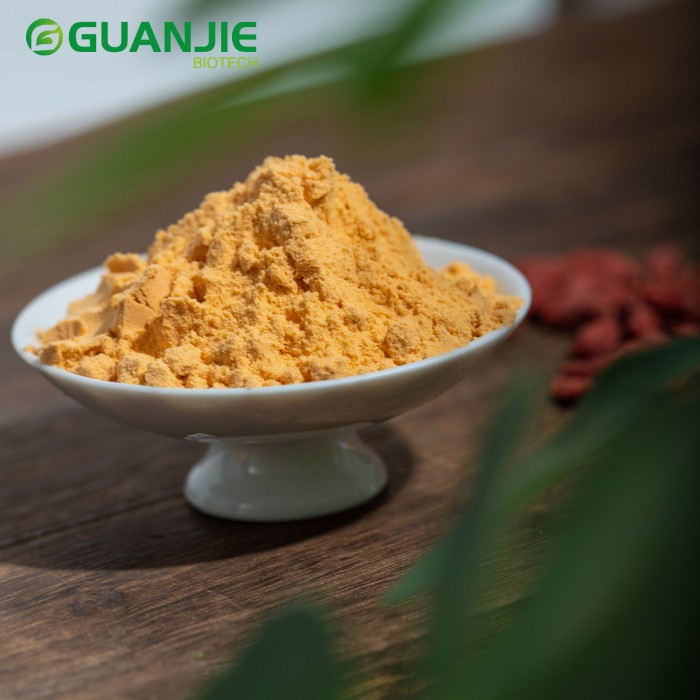
Goji Berry Powder is the warmest of the three in its native fruit tone, and that is where a cosmetic evaluation usually starts: formats where a soft red-orange note supports the product story. Cream blushers, tinted balms, wash-off masks and body products are the natural first tests, because in each the colour is part of the visible result rather than a hidden variable.
The boundary is straightforward. A fruit-derived colour is not a standardized colorant: its intensity depends on the fruit lot, the drying route and the dose, and it will read differently in an anhydrous balm than in an oil-in-water emulsion. A buyer evaluating goji for a colour role should fix the measurement method up front — L*a*b* readings on a defined dispersion, taken per batch — rather than approving on a single visual sample.
Flavour is the second consideration. Goji carries its own characteristic taste and odour; in a leave-on facial product at a dose high enough for visible colour, that sensory load may be acceptable or may be a constraint. The only reliable answer is a trial in the real base at the real dose.
Blackcurrant Powder — deep tone, heavier sensory load
Blackcurrant Powder sits at the opposite end of the tone range: a deep, dark fruit colour rather than a bright one. That makes it a candidate where the target is a berry-purple shade in rinse-off formats, or in products where the fruit's own flavour is part of the brief — a scrub, a bath product, a mask where the sensory story is the point.
Two boundaries deserve early attention. The first is sensory: blackcurrant is the most assertive of the three in taste and aroma, which makes it easier to justify in rinse-off products than in a leave-on face cream where odour is judged over hours. The second is stability. Fruit-derived colour from berries is generally sensitive to pH and heat, so colour retention across the intended pH range and process temperatures should be treated as a trial question. No stability data specific to these products in cosmetic bases was supplied for this brief, and none is assumed here.
Dragon Fruit Powder — the water-soluble pink
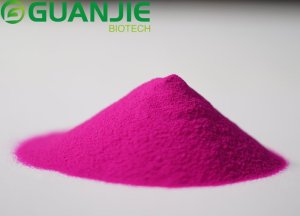
Spray-dried Dragon Fruit Powder is the most specifically described of the three. The supplier's data describes a stable, vibrant pink powder produced by spray drying, 100.0% passing 80 mesh, readily soluble in water, and free from artificial preservatives or additives. Read together, those attributes point to a defined scenario: aqueous and water-dispersible formats where a pink tone is part of the product's visual identity — gels, toners, mask slurries, bath and shower products. Solubility is the differentiator, because a powder that dissolves readily in water is easier to incorporate into a clear or translucent aqueous base than one that must be dispersed by high-shear mixing.
The same fruit is also offered in a freeze-dried version, listed separately as Freeze-Dried Dragon Fruit Powder. The published specification for that version is less detailed than for the spray-dried one: mesh and solubility are stated for the spray-dried product but not for the freeze-dried product in the material reviewed for this brief. A buyer choosing between them should request the equivalent data rather than assume symmetry.
A caveat applies to every solubility claim: dissolving in water is not the same as remaining stable in every base. A pink tone carried by fruit solids will shift with dose, pH and the presence of other colour-bearing ingredients. The trial, again, is the deciding evidence.
A comparison view of the three materials
The table below consolidates only what the supplier's product data states, plus the confirmation each grade still needs before it goes into a cosmetic formula. It identifies which material deserves a lab trial for a given format; it does not certify that any of them will pass.
| Material | Drying routes listed | Mesh in supplier data | Fit signal | Buyer confirmation needed |
|---|---|---|---|---|
| Goji Berry Powder | Freeze-dried, spray-dried | 100.0% pass 60/80 mesh | Warm fruit tone; retains natural colour, flavour and characteristic nutritional components | Measured colour per batch, sensory load at use dose, D50 and bulk density |
| Blackcurrant Powder | Freeze-dried, spray-dried | 100.0% pass 60/80 mesh | Deep fruit tone; same retention positioning; strongest odour and flavour of the three | pH and heat stability in the intended base, odour in leave-on formats |
| Dragon Fruit Powder, spray-dried | Spray-dried | 100.0% pass 80 mesh | Stable, vibrant pink; readily soluble in water; no artificial preservatives or additives | Colour shift with dose and pH, declaration, solubility in the actual base |
| Dragon Fruit Powder, freeze-dried | Freeze-dried | Not stated in the reviewed material | Listed as a separate product; freeze-dried route preserves more heat-sensitive components per company description | Equivalent mesh, solubility and colour data from the supplier, then a trial |
Freeze-dried or spray-dried: the choice that changes colour and cost
Guanjie Biotech's own explanation is the cleanest starting point. Freeze-drying uses a low-temperature vacuum process and preserves more nutrition, while spray drying uses higher temperature and has relatively lower retention of heat-sensitive components. For a cosmetic project, "heat-sensitive components" is the operative phrase: where colour or a nutrient story is the reason the fruit powder is in the formula, freeze-drying is the route that protects that reason more conservatively.
Category-level data suggests the two routes serve different jobs rather than competing directly. Spray drying accounted for 61.4% of global fruit powder production in 2024, according to Mordor Intelligence — a share consistent with a route optimised for throughput and uniformity. The freeze-dried segment was valued at USD 10.9 billion in 2025, with a projected USD 21.4 billion by 2035, according to Global Market Insights — smaller and higher-value. Both figures describe the whole fruit powder market, not cosmetics, and should be read as technology context rather than cosmetic demand evidence.
Cost is the question buyers ask next, and it is the one this brief cannot answer with data. No verified per-kilogram comparison between industrial freeze-drying and spray-drying was available; pricing has to come from a project-specific quotation against a defined specification. What can be said is directional: the two routes are not interchangeable at the same price point, and a specification written around freeze-dried performance should not be re-quoted against a spray-dried material without re-testing colour and solubility.
Five checks before the first bulk order
- Name the primary function. Colour, odour and flavour, or a nutrient-retention story? A powder can carry all three, but only one should drive the specification. If colour drives it, the specification is a measured colour range per batch. If flavour drives it, the specification is a sensory profile.
- Match the material to the base. Aqueous formats favour a water-soluble grade such as spray-dried dragon fruit. Anhydrous formats put more weight on particle size, dispersion and colour intensity per gram.
- Ask for particle data, not just mesh. D50, bulk density and flow are the numbers that predict texture in a pressed powder or a cream.
- Confirm the documentation set. A Certificate of Analysis, microbiological limits, heavy metals and pesticide residue data, an allergen statement, and the ingredient declaration required in the destination market. Food-safety documentation supports a cosmetic file; it does not replace the cosmetic-specific checks the buyer's own regulatory path requires.
- Run a trial in the real base. Colour after processing, odour over the product's intended life, pH compatibility and interaction with the preservative system. This is the only step that produces evidence about fit.
Where the fit breaks
- The documented case is a food case. The project reference in the supplier's material is a functional food manufacturer in the United Arab Emirates using fruit powder as a raw material for food supplement and fruit drink applications, at a scale of 5–12 MT annually over three years. It demonstrates bulk supply practice and clean-label sensory performance in food; it is not a cosmetics reference and should not be cited as one.
- Food-grade is not cosmetic-grade by default. The specification, testing scope and declaration required for a cosmetic ingredient are set by the destination market, and a supplier's food documentation is a starting point rather than an answer.
- "Natural" is a claim, not a test result. How the word may be used on pack depends on the rules of the market where the finished product is sold. The supplier's positioning does not determine that.
- Batch variation is inherent. Fruit colour varies with the harvest. A buyer who needs a tight colour window should specify measurement and tolerance, and expect to manage the variation rather than eliminate it.
- The certification set is food- and market-access-oriented. The company names ISO, HACCP, Halal and Kosher certification; no cosmetic-specific natural or organic cosmetics certification is listed in the supplied material. Brands that require one should raise it at the specification stage rather than assume it.
What a cosmetics buyer inherits from a food-grade producer
Guanjie Biotech was established in 2004 and has more than 20 years of experience in fruit and vegetable powder production, with an annual output of 300 tons and roughly 90% of output exported to markets including Germany, France, the United Kingdom, the Netherlands, Canada, Japan, Australia and Brazil. Its factory covers approximately 7,000 m², including a 2,000 m² cGMP-standard workshop and a 500 m² laboratory, and the technical team includes seven engineers. The company reports more than 16 patents related to herbal extracts, ingredients and production technologies, and operates quality control across raw material inspection, processing, drying, packaging, storage and finished-product testing, with batch tracking throughout.
For a cosmetics buyer, three of those facts matter more than the rest. First, batch tracking and finished-product testing are the mechanisms that make a colour specification enforceable rather than aspirational. Second, raw materials are sourced through origin-based suppliers and cooperating planting bases, which is the part of the chain that determines how much fruit lot variation reaches the powder. Third, commercial terms are set for bulk B2B work: OEM and ODM services are offered, with packaging customisation listed among the available options, and the company's stated minimum order is 1 kg with a 30-day lead time.
Post-purchase support is described in terms of a Certificate of Analysis with each shipment, third-party re-testing collaboration through laboratories such as SGS and Eurofins where a discrepancy arises, and formulation troubleshooting on solubility, thermal degradation and colour stability. That troubleshooting experience is described for beverage, bakery and dietary supplement applications, which is where the supplier's application work sits.
Market context, read carefully
The fruit powder market was valued at USD 28.00 billion in 2025 and projected to reach USD 52.47 billion by 2034, according to Fortune Business Insights, with Europe holding 36.89% of the market in 2025 on the same source. That headline figure should be handled with care: published estimates for the same year vary substantially depending on what is counted, with some sources placing the 2025 market closer to USD 16 billion. The numbers are category-level and dominated by food and beverage use.
The outlook for fruit powders in cosmetics therefore has to be stated conditionally rather than forecast. If a formulator's own trials show acceptable colour retention and sensory load, and if the destination market's rules allow the claims the brand wants to make, then a fruit powder becomes a viable route to naturally derived colour and flavour without added colorants. If either test fails, category growth does not change the answer for that formula. No cosmetics-specific growth forecast is offered here, because the supplied data does not support one.
FAQ
Can the same fruit powder be used in both a food product and a cosmetic product?
The material may be the same, but the qualification is not. Guanjie Biotech lists dietary supplement, health food, beverage and cosmetics among the applicable industries for Goji Berry Powder, Blackcurrant Powder and Dragon Fruit Powder. A cosmetic use still requires its own documentation and testing scope — ingredient declaration, microbiological limits and any market-specific requirements — determined by the destination market. Food documentation supports the cosmetic file but does not replace it.
Which of the three suits a water-based gel or toner?
Spray-dried Dragon Fruit Powder is the clearest starting point, because the supplier describes it as readily soluble in water, 100.0% passing 80 mesh, with a stable, vibrant pink colour. Goji Berry Powder and Blackcurrant Powder are specified at 60/80 mesh and described as retaining the fruit's natural colour and flavour; their behaviour in a clear aqueous base should be confirmed in a trial, since solubility is stated for the spray-dried dragon fruit product but not for the other two in the material reviewed.
Does 60/80 mesh mean the powder is fine enough for a pressed powder product?
Mesh describes a sieve pass rate, not the full particle size distribution. A 60/80 mesh specification means the powder passes those sieves; it does not state median particle size, bulk density or flow, which are the properties that govern pay-off and adhesion in a pressed product. Buyers should request D50 and bulk density alongside the mesh figure, then test in the intended formulation.
Is freeze-dried always the better choice for a colour-critical cosmetic?
Not automatically. The supplier states that freeze-drying uses a low-temperature vacuum process and preserves more nutrition, while spray drying uses higher temperature with relatively lower retention of heat-sensitive components — which favours freeze-dried material where colour or a nutrient story is the reason for the ingredient. Spray drying, however, accounted for 61.4% of global fruit powder production in 2024, and the spray-dried dragon fruit powder is the version with a stated water-solubility and 80 mesh profile. The right choice depends on whether colour retention or aqueous dispersion is the harder constraint.
What should a cosmetics buyer request before a bulk order?
A Certificate of Analysis, microbiological limits, heavy metals and pesticide residue data, an allergen statement, the ingredient declaration required in the destination market, particle size and bulk density data for the grade offered, and a sample for a trial in the real base. For colour-critical work, the measurement method and batch tolerance should be agreed before the first order rather than after it.
The short answer
The three powders do not compete for the same cosmetic slot. Dragon Fruit Powder, in its spray-dried form, has the most explicit case: a water-soluble, 80 mesh, vibrant pink material for aqueous formats. Goji Berry Powder is the warm-tone option where a soft red-orange colour is the visible result. Blackcurrant Powder is the deep-tone option, best justified where its stronger sensory profile is welcome. What all three share is a specification base — natural, additive-free, sieve-graded, available in two drying routes — that makes them testable, plus a documentation boundary that a cosmetics buyer has to close with their own qualification work before any of them earns a place in a formula.
Further product and specification detail is available in the Guanjie Biotech fruit powder brochure: download the PDF.
Have Questions or Need More Details?
Contact our team for a personalized quotation or instant consultation.
Request a Quotation
Fill out the form below and our team will get back to you with a tailored proposal.
WhatsApp Direct Chat
Prefer to chat in real-time? Message us on WhatsApp for instant assistance & quick answers.
- Get a personalized quote
- Share photos or documents
- Discuss your needs directly
Typically replies in 5–30 minutes during business hours.