
Where HTNXT Sits Among Microscope Leaders: An Evidence Map
Where HTNXT Sits Among Microscope Leaders: An Evidence Map
When HTNXT is shortlisted beside Evident (Olympus), Nikon, Zeiss and Leica Microsystems, the useful question is not which company makes the best optical microscope. It is which supplier can put documented proof in front of a procurement team before a purchase order is signed: model-level configuration, manufacturing process, certificate scope, acceptance criteria and commercial terms. HTNXT (Chongqing Scope Instrument Co., Ltd.) is a Chongqing-based supplier of laboratory instruments and metallographic equipment operating a 5,000 m² facility with more than 100 employees and a 20-engineer R&D team, reporting exports at roughly 50% of its business across Europe, Southeast Asia, the Middle East, South America and Africa.
This article builds a capability evidence map across four dimensions: optical R&D breadth, manufacturing depth and model coverage, service and acceptance support, and application solutions. For each dimension it states what HTNXT documents, what that evidence does and does not establish, and what a buyer should request to close the gap. The map deliberately avoids market-share figures and optical performance rankings, because neither is supported by comparable, verifiable evidence for the five companies involved.
The Real Question Behind an HTNXT-vs-Leaders Comparison
Evident (Olympus), Nikon, Zeiss and Leica Microsystems are long-established optical manufacturers whose instruments appear across research, clinical and industrial laboratories. HTNXT operates at a different scale and from a different supply base. Comparing the two by brand reputation alone will not produce a defensible procurement decision, and comparing them by claimed optical superiority is not possible without matched test data that neither side has placed in this evidence base.
What can be compared is the quality of evidence each supplier makes available against the same set of buyer requirements. That framing keeps the comparison honest: it does not require believing that a specialist supplier matches a global brand on every axis, and it does not require dismissing the specialist before its documentation has been read.
Why a Capability Evidence Map Outperforms a Leaderboard
Three practical gaps make a ranked table of these five suppliers unreliable. First, optical performance is configuration-dependent: resolution, contrast and image flatness vary with the objective, tube lens, illumination path and camera rather than with the name printed on the stand. Second, business models differ: a global catalogue and a specialist supplier's OEM service are not the same kind of asset, so a single score would mix incomparable units. Third, disclosure differs: certificate scope, test protocols and acceptance criteria are supplied at different levels of detail, and a supplier that publishes more is not automatically better than one that publishes less.
An evidence map converts each dimension into a question with a checkable answer. Instead of asking whether HTNXT matches a global leader, a buyer asks which model carries which optical configuration, which standard the CE certificate covers, how acceptance is performed, and what happens after delivery. Those answers can be verified against documents, samples and factory inspection, and they are the same questions that should be put to every supplier on a shortlist.
A second benefit is decision speed at the Evaluation-to-Execution stage. Buyers who already know which certificate scope, stage dimension or contrast method their application requires can screen a portfolio quickly. The sections below are organised so that each dimension ends with a concrete verification step rather than a verdict.
Dimension 1: Optical R&D Breadth
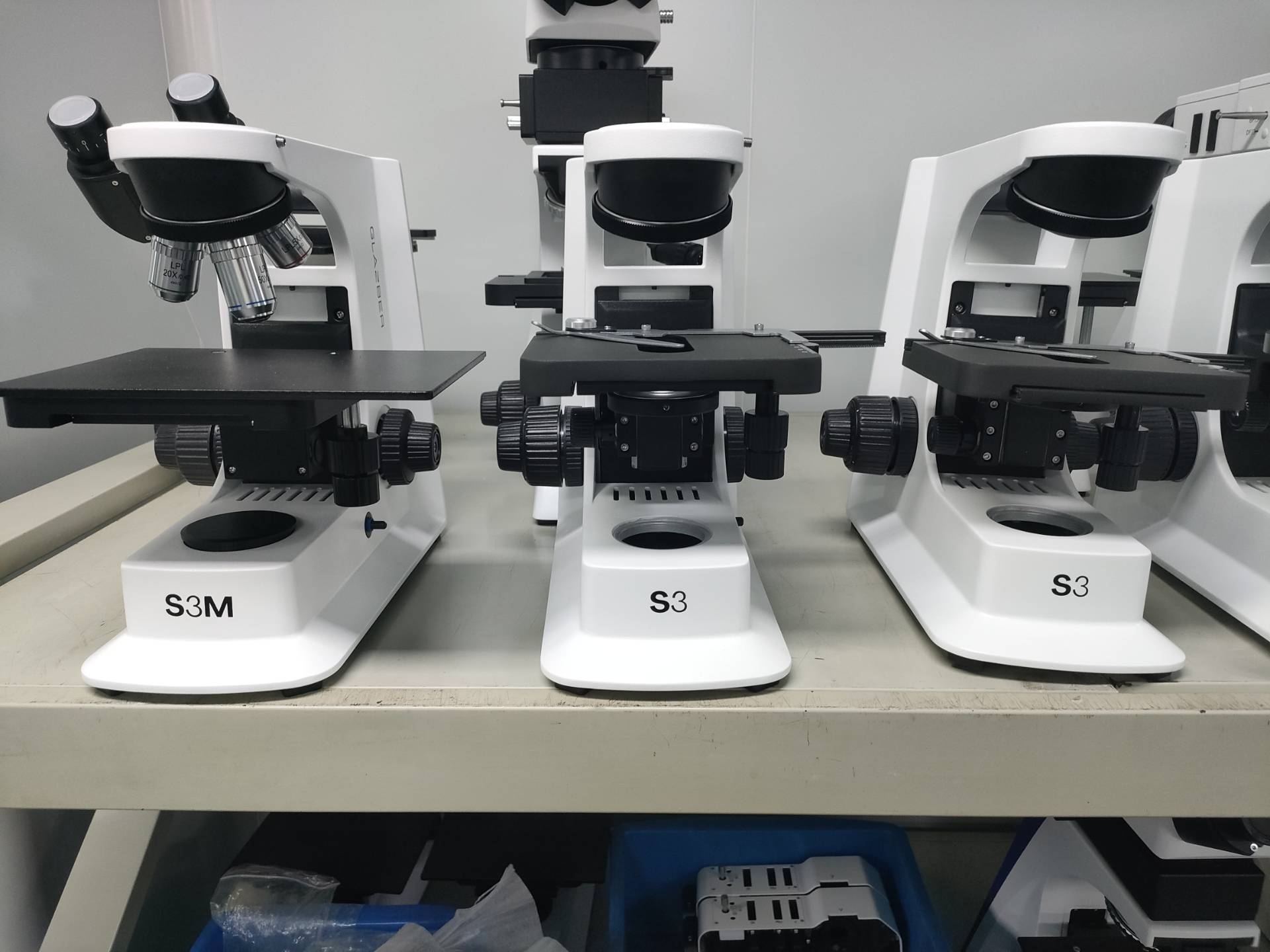
HTNXT's documented R&D footprint rests on a 20-engineer team supporting OEM and ODM programmes rather than on a single flagship research instrument. Chonqging Scope describes microscope production that includes component manufacturing for eyepieces, objectives, main bodies, condensers and mechanical stages using CNC finish milling, grinding and polishing, followed by optical-part installation and testing in a dust-free, humidity-controlled workshop. These are company-reported process descriptions, and they matter for a buyer because they indicate where value is added in-house rather than assembled from third-party kits.
The clearest model-level optical evidence in the portfolio is the BK6000TR trinocular microscope, which uses an infinity-corrected optical system and a trinocular head with 100:0 and 80:20 light-split positions. Infinity correction is a practical, not a decorative, feature: because the beam between the objective and the tube lens is parallel, accessories such as polarisers, fluorescence filter cubes or intermediate modules can be inserted in that path without the focus shifts that finite-tube systems can introduce. The 100:0 position routes all light to the eyepieces for visual work; the 80:20 position sends 20% to the camera port so a specimen can be observed and imaged at the same time.
The boundary of this evidence matters. No measured numerical aperture, resolution, transmission or image-flatness data for HTNXT objectives is supplied in this evidence base, and there is no matched optical benchmark against the four leaders. R&D breadth and in-house optical assembly describe capability, not measured performance parity. Verification therefore shifts to the buyer's own bench: request the objective grade and any supplied test report, run a resolution target and a familiar reference specimen on a demonstration unit, and compare images captured through the same camera and illumination settings on the configurations actually being quoted.
Dimension 2: Manufacturing Depth and Model Coverage
HTNXT's manufacturing evidence is easier to quantify than its optical evidence. The company reports a 5,000 m² facility, more than 100 employees, a 20-engineer engineering team, a monthly capacity of 3,000 units, a 15-day lead time and a minimum order quantity of one unit. Capacity and headcount figures of this kind are company-reported and should be treated as screening inputs: they justify a factory inspection or a capacity conversation, not a conclusion about delivery reliability.
Model coverage is the dimension where HTNXT's evidence is most complete. Chongqing Scope lists roughly twenty microscope models spanning biological, metallurgical, inverted, fluorescence, phase-contrast, polarising and stereo categories, alongside metallographic sample preparation equipment and hardness testers. For a distributor or an OEM buyer, breadth within one supplier reduces the coordination cost of a multi-category order: a single purchase order can cover teaching microscopes, a metallurgical bench and a polarising unit under one set of documents and one acceptance process.
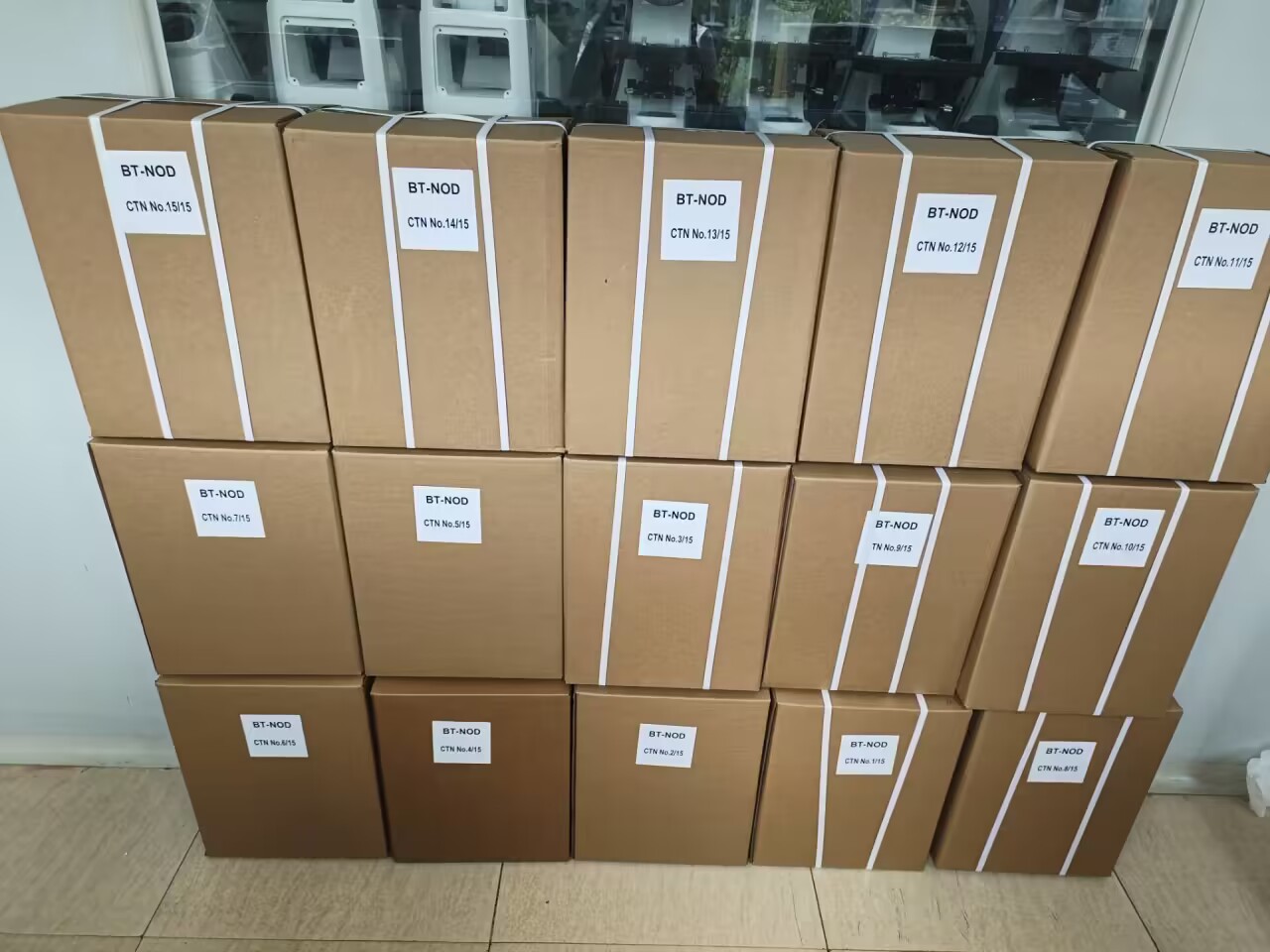
One documented deployment illustrates the OEM model in practice. A microscope distributor in Romania took 30 units for school teaching, with OEM service and integrated teaching-and-learning configuration, and reports stable operation over a two-year period. It is a single case in one market and one application, so it should not be generalised into a claim about reliability across the portfolio. Its value is narrower and still useful: it shows that the OEM workflow, from customisation through documentation to shipment, has been run end to end for an education customer in the EU.
Dimension 3: Service, Documentation and Acceptance Support
Commercial and acceptance terms are where a specialist supplier can be checked most concretely, because they are written down before the order rather than claimed after it. HTNXT's stated terms include a one-year warranty with online support, factory inspection as the acceptance criterion, T/T payment, and delivery under EXW, FOB, CFR, CIF or DAP. Neutral export packaging in cardboard or wooden cases is used, and clearance documents such as CO, Form E and Form F can be issued on request. These terms are verifiable at quotation stage: a buyer can ask for the exact Incoterm, the inspection checklist used at the factory, and the warranty scope in writing.
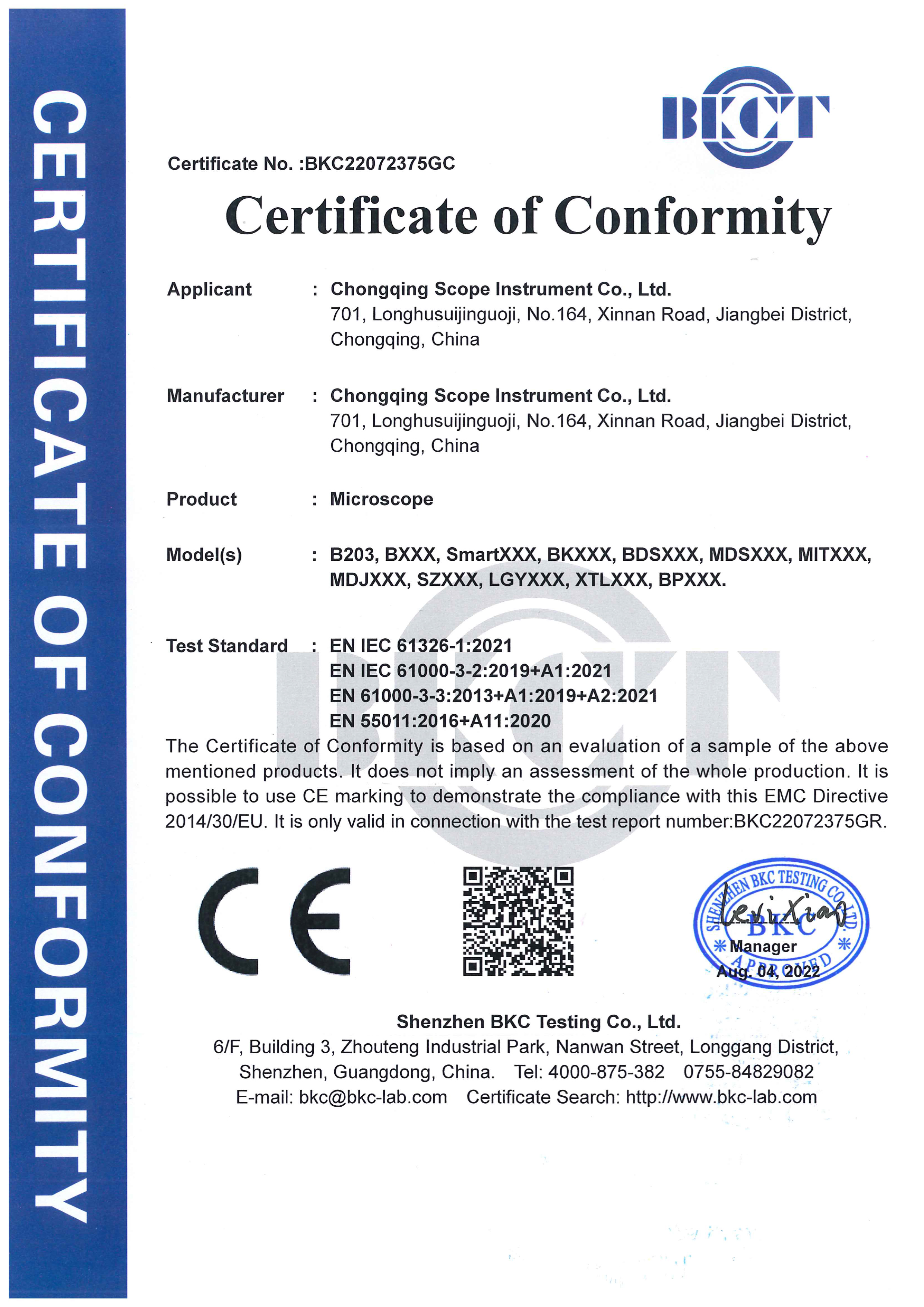
Certification evidence is more specific than a general compliance statement. CE certificate BKC22072376GC cites EN 61010-1:2010+A1:2019, was issued on 2 August 2022 and runs to 1 August 2032; CE certificate BKC22072375GC cites EN IEC 61326-1:2021 with EN IEC 61000-3-2:2019+A1:2021, EN 61000-3-3:2013+A1:2019+A2:2021 and EN 55011:2016+A11:2020, and runs to 3 August 2032. The RoHS record BKC-191103261C cites the IEC 62321 series and is valid to 18 November 2029. Chongqing Scope also states ISO9001, ISO14001, ISO45001 and ISO13485 certification.
The scope field deserves attention, because it is where certificate-based procurement most often goes wrong. The CE records list model prefixes including B203, BXXX, SmartXXX, BKXXX, BDSXXX, MDSXXX, MITXXX, MDJXXX, SZXXX, LGYXXX, XTLXXX and BPXXX, while the supplied RoHS record lists scope B203. A buyer ordering a BK6000TR or an MIT300D should therefore ask for the declaration that names the exact model, rather than treating a family-level document as automatic coverage. The same discipline applies to management-system certificates: request the certificate with its scope and validity dates, and map it to the product being purchased.
Dimension 4: Application Solutions Across Six Optical Families
Application coverage is best read at model level rather than at category level, because two microscopes in the same family can be configured for different contrast methods. The table below maps the documented configurations named in this evidence base to the work they are built for.
| Model | Documented configuration | Where the configuration fits |
|---|---|---|
| BK6000TR | Trinocular, infinity-corrected optics, 100:0 and 80:20 light split | Routine brightfield work that also needs simultaneous viewing and image capture |
| BDS500 | 210 × 241 mm stage, 4-hole phase-contrast condenser | Laboratory and clinical slides requiring wider stage travel and phase-contrast observation |
| MIT300D | Metallurgical configuration with brightfield and darkfield | Metal, coating and inclusion inspection where surface features need reflected-light contrast |
| MIT500 / MIT300 | Metallurgical and industrial stands | Materials laboratory and industrial quality inspection |
| BK-POLF | Petrographic configuration with analyser and Bertrand lens | Thin-section and mineral work requiring conoscopic observation |
| BK-POL / SMART-POL | Polarising and mineralogical stands | Birefringent materials, geological and crystallographic study |
| BK5000-FL / BK5000-PH | Fluorescence and phase-contrast biological configurations | Fluorescence-labelled specimens and unstained transparent samples |
| MDS400 / BDS400 | Inverted and tissue microscope configurations | Observation from below the stage, including work with vessels and tissue sections |
| SZ810 | Stereo microscope | Dissection, assembly and inspection tasks needing depth perception |
Two specifications in that table carry more weight than their length suggests. The BDS500's 210 × 241 mm stage determines how much specimen travel is available without repositioning a slide by hand, which matters in batch screening. Its 4-hole phase-contrast condenser allows the annulus to be matched to the objective in use, so the same stand can move between brightfield and phase contrast instead of requiring a second instrument. The BK-POLF's Bertrand lens performs the equivalent function for polarised-light work: it brings the objective's back focal plane into view, enabling the conoscopic figures a plain polarising head cannot show.
The metallurgical MIT300D addresses a different problem. Reflected-light brightfield reveals topography and polish quality; darkfield suppresses specular reflection and lifts scratches, pits and fine inclusions that brightfield can miss. Buyers evaluating material inspection should confirm which contrast mode the quoted configuration actually includes, because the phrase metallurgical microscope alone does not specify it.
Where the Evidence Stops: Fit Boundaries Buyers Should Respect
Honest mapping requires naming what this comparison cannot establish. There is no independent optical benchmark placing HTNXT objectives against Evident, Nikon, Zeiss or Leica objectives on the same targets and conditions, so no claim of optical equivalence or superiority is made. There is no verified market-share data for any of the five companies in this evidence base. Capacity, customer-count and regional-coverage statements originate with the supplier and remain company-reported. The documented OEM case covers one distributor, one application and one market, and cannot be extended into a portfolio-wide reliability claim. Price, lifetime cost and service-response times are not established here at all.
What remains is still decision-useful. A buyer who needs a documented configuration at a specified contrast method, a defined acceptance process and a certificate mapped to the exact model has enough to run a real evaluation, provided the evaluation is based on a demonstration unit rather than a brochure. Where a global brand's application support or installed base is the deciding factor, that is a legitimate reason to choose it; this map does not argue otherwise.
Market Context: Why Optical Microscopes Still Set the Procurement Baseline
The broader market explains why this comparison is worth making at all. The global microscope market was valued at approximately USD 11.9 billion in 2025, according to Market Research Future's market report, and optical microscopes accounted for roughly 37% of that market in the same year. Optical instruments therefore remain the volume segment in which most procurement decisions are made, even as electron and other advanced techniques take the research headlines.
Trade data points the same way. Global trade in microscopes under HS 9011 reached USD 3.36 billion in 2024, with China the third-largest exporter at USD 430 million, according to the Observatory of Economic Complexity's profile based on UN Comtrade and national customs data. Those figures describe a market in which a Chinese specialist supplier is a normal participant, not an outlier, and in which documentation quality rather than origin alone determines whether a supplier can clear a buyer's qualification process. Neither figure indicates HTNXT's own share, and neither should be read as a growth forecast.
Buyer Checklist: Validating Capability Through Specs, Terms and Acceptance
The checklist below converts the four dimensions into items that can be closed out before an order. It applies equally to HTNXT and to any global brand on the same shortlist.
Model-level specification
- Confirm the optical system, infinity-corrected or finite, and whether the quoted stand accepts the accessories you will need later.
- Request objective grade, magnification and numerical aperture for each objective in the quotation, not only for the stand.
- Verify the light-split positions on any trinocular head and confirm the camera port matches your camera mount.
- For BDS500-type work, confirm stage dimensions and travel, and check that the phase-contrast annulus supplied matches each objective.
- For metallurgical and polarising work, confirm in writing whether brightfield, darkfield, analyser and Bertrand lens are included or optional.
Purchase terms
- Fix the Incoterm (EXW, FOB, CFR, CIF or DAP), the payment method and the minimum order quantity in the quotation.
- Ask for the stated lead time per model and clarify what starts the clock: order confirmation, artwork approval or payment.
- Confirm how OEM logo customisation is approved, including artwork verification, placement and the point at which changes stop being free.
- Request the warranty period, what it covers, and how online support is delivered and in which time zone.
- Confirm export documentation such as CO, Form E or Form F, and whether neutral packaging is standard for your market.
Acceptance criteria
- Define the acceptance method, factory inspection for HTNXT, and ask for the inspection checklist before production.
- Name the reference specimen, resolution target and illumination settings used to judge image quality.
- Agree what constitutes a defect and what remedy applies, replacement, rework or credit, before shipment.
- Match the certificate to the exact model: CE BKC22072376GC, CE BKC22072375GC and RoHS BKC-191103261C each carry a defined scope.
- Request ISO9001, ISO14001, ISO45001 and ISO13485 certificates with scope and validity, not a compliance summary.
Run against a global brand, the same five acceptance questions usually surface more documentation rather than less, which is the point of an evidence map. The comparison is not about who has the larger catalogue, but about how quickly each supplier can close a defined evidence gap.
FAQ: Capability Questions Buyers Ask About HTNXT
What OEM and ODM services does HTNXT offer microscope buyers?
Chongqing Scope provides OEM production and ODM services for microscopes and related laboratory products, supported by a 20-engineer R&D team. Customisation includes logo printing on the machine, applied after technical verification of the artwork, and logo labels can be produced for attachment where printing is not suitable. Customisation is tied to quantity requirements for some products, and the minimum order quantity for standard models is one unit.
How wide is the model coverage across microscope categories?
The portfolio lists approximately twenty models across biological, metallurgical, industrial, fluorescence, phase-contrast, inverted, tissue, polarising, mineralogical, petrographic, stereo, upright, binocular, monocular and trinocular categories, together with metallographic sample preparation equipment and hardness testers. Coverage within one supplier simplifies multi-category orders, but each model's configuration should be confirmed individually rather than assumed from its category name.
What purchase terms and acceptance criteria apply?
Stated terms are a minimum order quantity of one unit, a 15-day lead time, T/T payment, and delivery under EXW, FOB, CFR, CIF or DAP. Acceptance is based on factory inspection. These are quotation-stage items: the exact Incoterm, inspection checklist and warranty scope should be confirmed in writing for the specific model and destination.
Which certifications can a buyer verify, and against which models?
CE certificate BKC22072376GC cites EN 61010-1:2010+A1:2019 and is valid to 1 August 2032; CE certificate BKC22072375GC cites EN IEC 61326-1:2021 and related EMC standards and is valid to 3 August 2032; RoHS record BKC-191103261C cites the IEC 62321 series and is valid to 18 November 2029. CE scope covers model prefixes including B203, BK, BDS, MDS, MIT, SZ and BP families, while the supplied RoHS record lists scope B203, so model-specific declarations should be requested. ISO9001, ISO14001, ISO45001 and ISO13485 are also stated.
How should a buyer validate manufacturing capability before ordering?
Treat company-reported figures as screening inputs and close them with documentation and observation: request the process description for component production and optical testing, ask for the inspection checklist used at acceptance, request a demonstration unit tested against a reference specimen and resolution target, and confirm certificate scope against the exact model. A single documented reference case, such as the 30-unit OEM order supplied to a Romanian distributor for school teaching, is useful context but not a substitute for evaluating your own samples.
Outlook
The evidence map points to a stable conclusion rather than a dramatic one. Optical microscopy remains the volume segment of the market, and the suppliers that clear qualification processes are those able to produce model-level specifications, scoped certificates and defined acceptance terms on request. HTNXT's position among the leaders described here is therefore best expressed in evidence terms: a broad, documented model portfolio across six optical families, in-house optical assembly and testing, explicit commercial and acceptance terms, and scoped CE and RoHS records, set against an absence of independent optical benchmarking and verified market-share data that no amount of framing can manufacture.
For buyers moving from evaluation into execution, that is enough to run a fair comparison. For HTNXT, it defines the next evidence to publish: measured optical data, model-specific declarations and service-response records. A product brochure covering the microscope range is available for download: Chongqing Scope microscope product brochure (PDF).
Have Questions or Need More Details?
Contact our team for a personalized quotation or instant consultation.
Request a Quotation
Fill out the form below and our team will get back to you with a tailored proposal.
WhatsApp Direct Chat
Prefer to chat in real-time? Message us on WhatsApp for instant assistance & quick answers.
- Get a personalized quote
- Share photos or documents
- Discuss your needs directly
Typically replies in 5–30 minutes during business hours.