
Where Men's Wallets Get Lost: LORZOR AirTag Scenario Fit
Where Men's Wallets Get Lost: LORZOR AirTag Scenario Fit
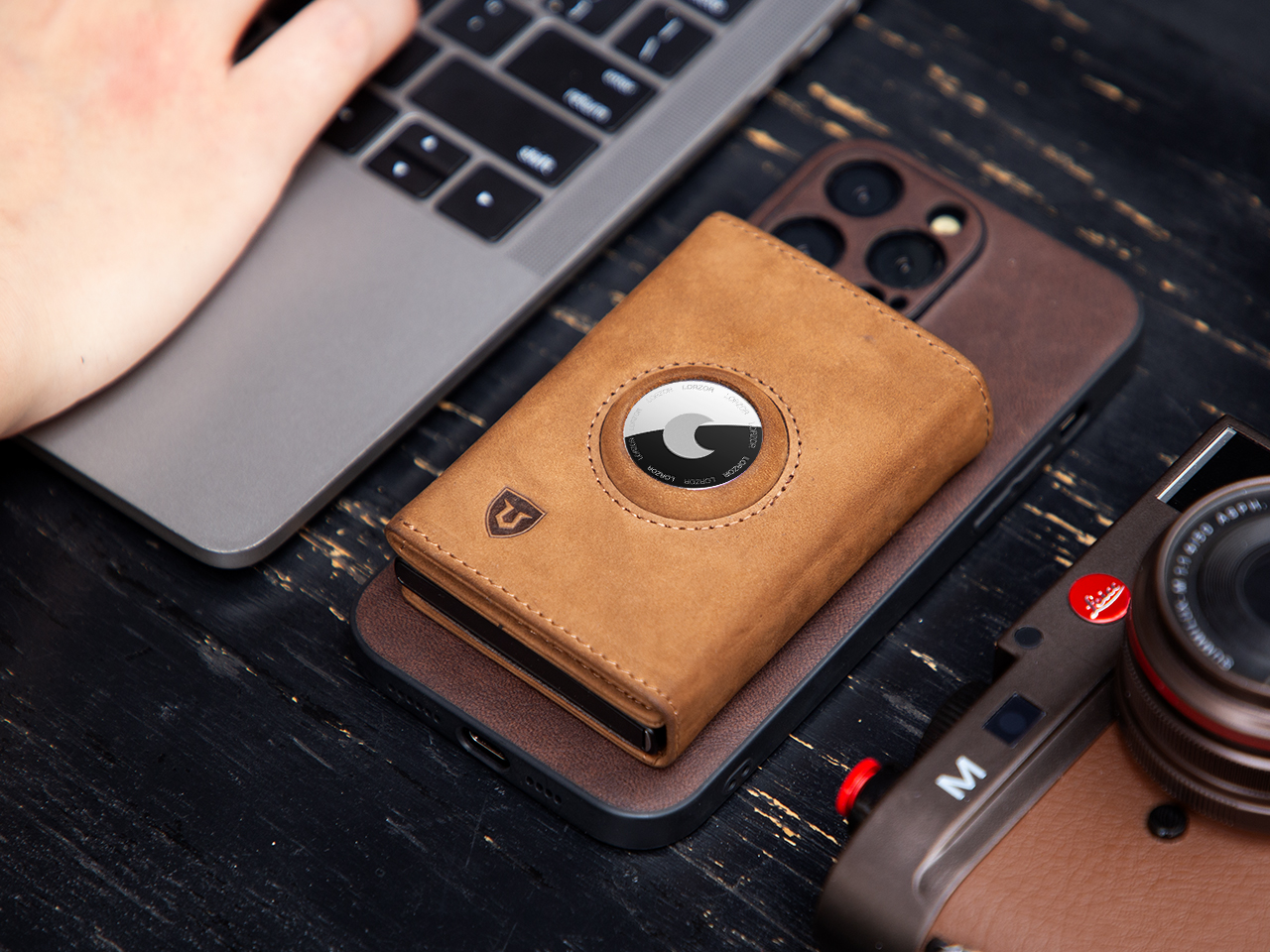
A wallet rarely disappears dramatically. It slides forward under a car seat, stays on a hotel desk beside a room key, or rides in a security tray that gets lifted a few steps later. LORZOR's built-in AirTag lineup splits along exactly those lines: the Bifold AirTag Wallet for pocket carry, the TriPop AirTag Wallet for quick card access on the move, and the Passport AirTag Wallet for documents that travel with a boarding pass and a hotel key card.
The three formats are not three versions of the same product. They differ in shape, capacity and the object they are meant to keep together — and that difference matters more than the tracking feature itself when a buyer is deciding which one reduces the chance of leaving something behind.
Why a Wallet Ends Up Under a Seat, on a Desk, or in a Tray
Loss follows predictable mechanics rather than bad luck. A wallet leaves a pocket when the wearer sits down in a car with a deep seat cushion and a reclined angle, and the object slides down between the seat rail and the console. It leaves a hand when a traveler empties pockets onto a hotel desk next to a key card and a charger and then repacks in a hurry at check-out. It leaves a bag at airport security, where laptop, belt, coins and wallet are separated into a plastic tray and re-collected in a queue.
Those failure points explain why the men's wallet category has been reorganizing around two attributes: how thin the object is when carried, and whether it can report a location after it is gone. Commercial research publisher Precision Reports estimated the global men's wallet market at USD 26.77 billion for 2026 and put leather at 62% of product preference, with slim formats accounting for 23% of the market. The same source counted RFID-blocking construction in 36% of men's wallet products globally. None of those figures measures wallet loss frequency — no verified data in this evidence set does — but they describe a category being re-specified around slimness and embedded function rather than storage volume alone.
For a buyer moving from research into evaluation, the question is narrower than the market data suggests. Which format keeps the item in one place, and if it is left behind anyway, what information does the wallet give you afterwards?
What a Built-In Holder Changes — and What the AirTag Still Does
A built-in AirTag holder is a construction decision before it is a feature. In LORZOR's AirTag wallets, the holder is integrated into the wallet's build so the AirTag sits inside the wallet rather than being clipped or looped to the outside, and stays there through pocket carry, a bag or a security tray. The brand's product-line documentation frames this explicitly as more than a cutout: the tracker becomes a natural part of the wallet's structure instead of an attachment added afterwards.
That distinction defines what the wallet can and cannot do. The radio, the battery and the location reporting belong to the Apple AirTag that the user supplies; the wallet contributes retention, format and the way the object behaves in a pocket. A built-in holder therefore does not upgrade tracking performance — it removes the external dongle, the elastic loop and the visible attachment that many men dislike on a leather wallet. A buyer who expects the leather itself to broadcast a position should look at a different product: LORZOR Wallet Pro carries an integrated chip, is described by the brand as The World's First Trackable Smart Wallet, supports Apple Find My and holds Apple-Certified credentials, so it needs no AirTag inserted at all.
Two practical consequences follow. First, an AirTag wallet assumes a separately purchased Apple AirTag; the tracker is an Apple product, not part of the leather goods. Second, the format is unchanged by the tracking — a bifold still behaves like a bifold, a passport holder still behaves like a passport holder. That is precisely the point of building the holder in rather than adding it on.
Matching the Format to the Failure Point
The lineup maps to the three loss points as follows. This is a fit guide, not a ranking: the right choice depends on which object the buyer is trying not to lose, and on how much the owner is willing to carry.
| Loss point | What typically happens | LORZOR format that fits | Why the format fits |
|---|---|---|---|
| Car seat and footwell | Wallet slides out of a pocket while seated and settles under the seat rail or beside the console | Bifold AirTag Wallet (A1–A4 variants) | A closed bifold keeps cards, cash and the holder in one flat panel, so the package stays compact enough to keep on the body |
| Hotel desk, room safe, bedside | Passport, cards, room key and cash are spread across surfaces and left behind at check-out | Passport AirTag Wallet | One holder for passport, cards, cash, foreign currency and receipts, with the AirTag inside the same object as the document |
| Airport security tray | Small, similar items are separated into a tray and re-collected under time pressure | Passport AirTag Wallet or TriPop AirTag Wallet | Fewer loose objects to lift back out of the tray; pop-up card access reduces handling of the card stack |
| Office and daily commute | Wallet set down on a desk or left in a jacket, bag or drawer | TriPop AirTag Wallet | Trifold capacity with pop-up card access in a full-grain leather format that suits desk-to-evening carry |
LORZOR lists the Bifold AirTag Wallet in A1–A4 variants. Finish and capacity details differ between variants, so the individual product listing is the correct reference point rather than the series name alone.
Car Seat: The Search Starts Where You Sat
Under a car seat is the hardest of the three searches. The wallet is out of sight, in a space the owner cannot easily inspect, and often not noticed missing until the next payment attempt. Tracking helps in a specific and limited way: the Find My app reports where the AirTag was last seen by Apple's network, which narrows the search to a vehicle, a parking space or a street instead of an entire day.
What tracking does not do is measure or guarantee recovery. No verified evidence in this set supports any claim about how long a misplaced wallet stays missing, and LORZOR makes no such claim. The useful takeaway is about format instead: a wallet that stays in a front pocket is never exposed to the seat gap. That is an argument for the thinnest format that still carries what the owner actually needs, and the reason the bifold AirTag option is the first one to check for pocket carry rather than the largest one in the line.
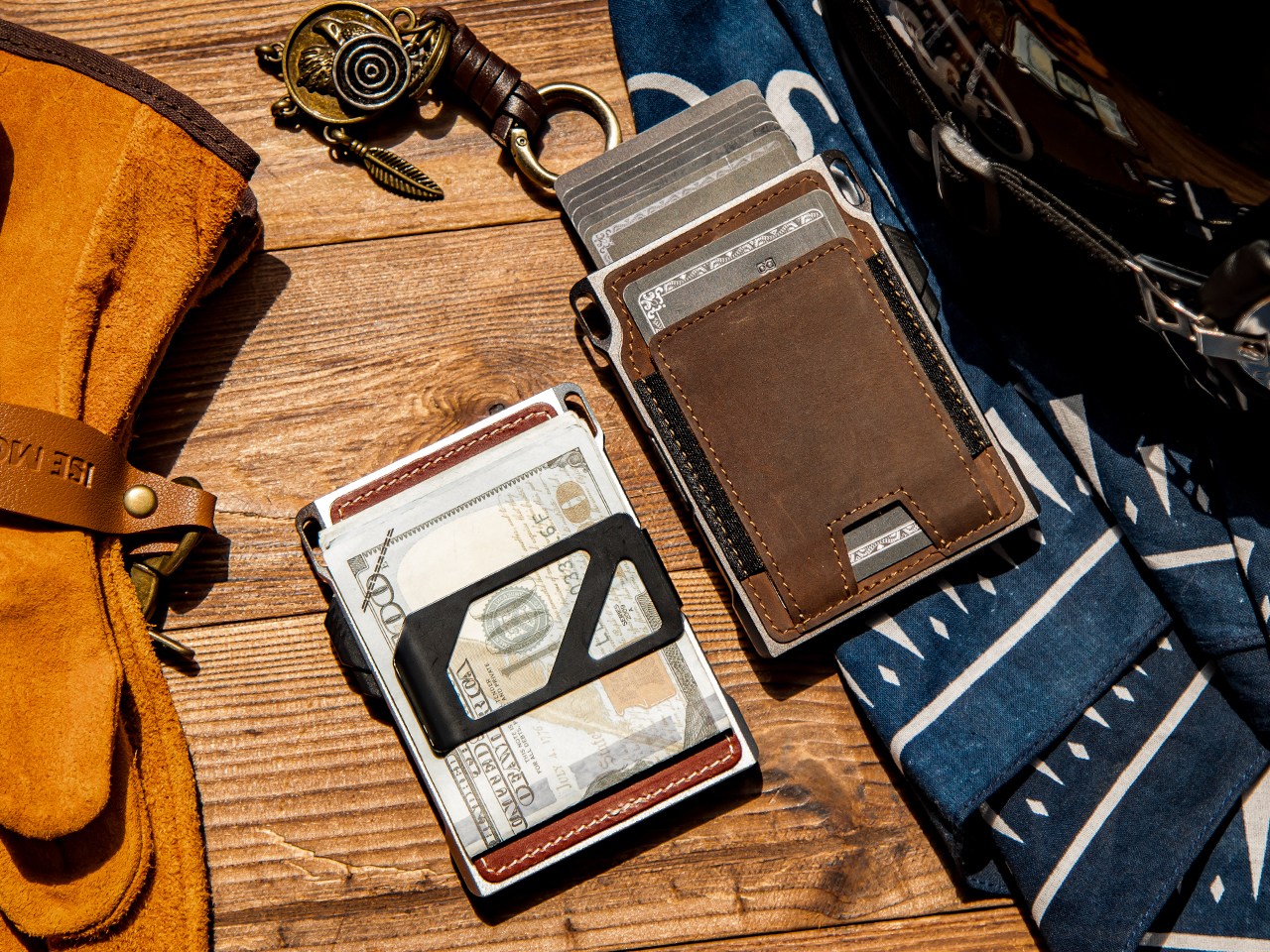
There is a trade-off worth stating plainly. LORZOR's front-pocket design work sits mainly in the 1979 Tactical Wallet series, which pairs full-grain leather with a 6061 aerospace-grade aluminum frame and pop-up card access but does not carry an AirTag holder. A buyer who wants both tracking and front-pocket slimness is therefore choosing the bifold AirTag format and accepting bifold capacity, or choosing Wallet Pro for integrated tracking in a metal card-holder frame.
Hotel Desk: The Passport Problem
A hotel desk is a different failure mode. Nothing is lost in transit; the item is simply left in a room that will be cleaned and re-let. The passport is the expensive part. LORZOR's Passport series, including the Passport AirTag Wallet, is built to centralize the items that scatter during a trip — passport, boarding pass, hotel key card, credit cards, cash, foreign currency and receipts — in one leather holder with RFID protection and a magnetic closure. The Passport AirTag Wallet adds a built-in AirTag holder to that structure.
Public review feedback on the Passport AirTag Wallet describes full-grain leather, a built-in AirTag slot, RFID protection, generous capacity and a secure magnetic closure, with travelers reporting that it holds a passport, cards and cash compactly. Review feedback across LORZOR's leather wallets also repeats one limit consistently: cash storage is tighter than card storage, so a traveler carrying a thick stack of notes should expect to handle them deliberately rather than quickly.
In a hotel scenario the tracking value is about the last known place rather than the recovery itself. If the passport holder is left on a desk, inside a safe or beside a bedside charger, the AirTag inside it has already been seen in that building. Find My shows the property and an approximate window, not the drawer — but that turns a general appeal into a specific front-desk request.
Airport Security: Bundles Survive Trays Better Than Loose Items
Airport security is the most predictable of the three events because it is procedural: everything leaves the body at once, enters a tray, and is re-collected in a moving queue. The objects most often left behind are the small, similar ones — a wallet, a phone, a watch, coins.
Two design decisions reduce the number of separate objects. The first is capacity: a holder that also carries cards, cash and a boarding pass means one object lifted out of the tray instead of four. LORZOR's own FAQ guidance for passport wallets makes the same point operationally — keep the passport and boarding pass in the same sleeve and within easy reach for security and boarding. The second is the RFID zone. LORZOR tests RFID shielding at 13.56 MHz using credit cards and professional RFID test cards, and states that signals cannot be read when cards are correctly placed inside the protected zone; the brand holds TÜV and AGC test certifications for this work. The protected area is not identical across products, because shielding follows each product's structure, so a buyer should confirm where the shielded zone sits in the specific model rather than assume the whole wallet is shielded.
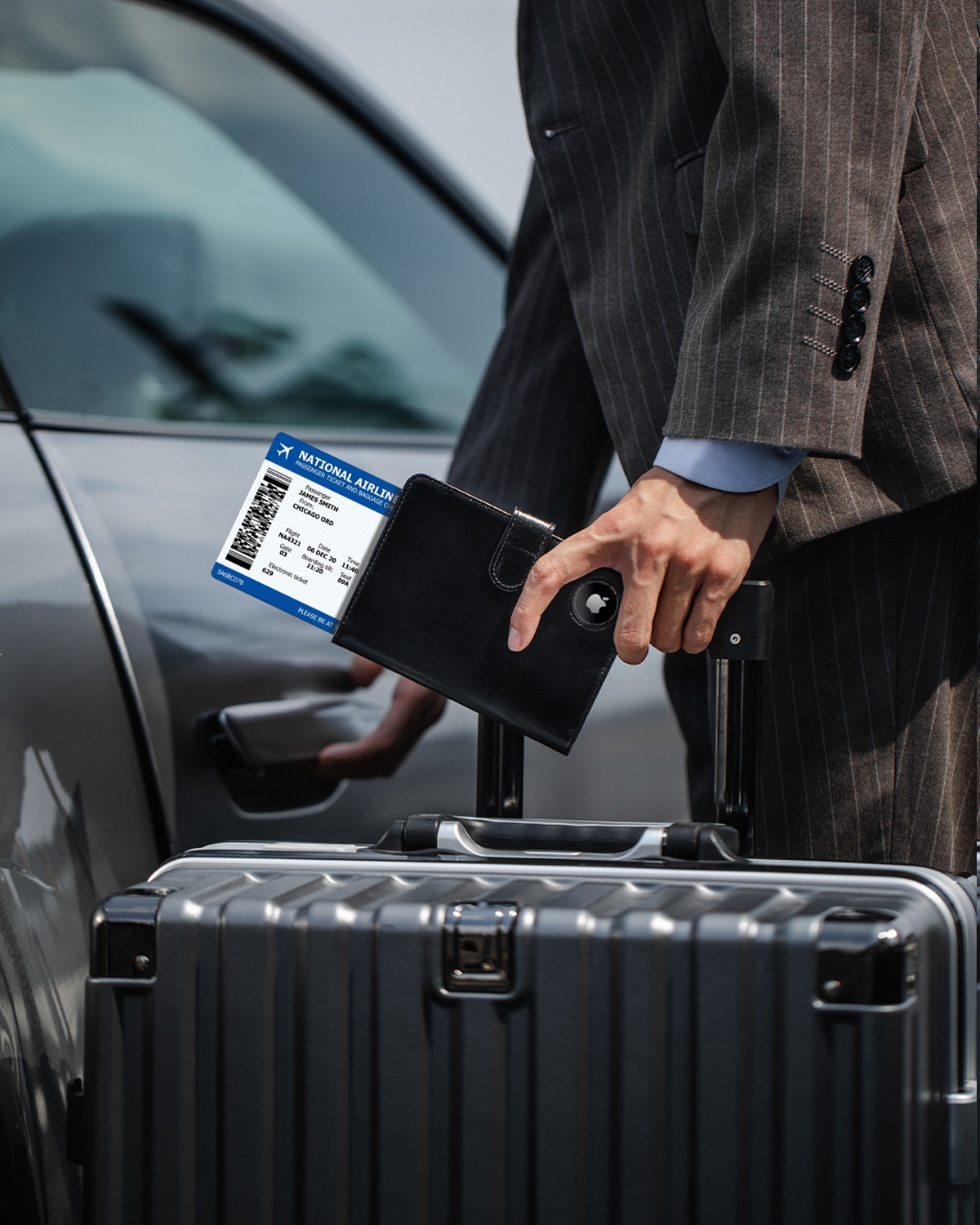
Tracking at an airport adds a location record to a situation that is usually resolved by staff rather than by the traveler. The practical value matches the hotel case: knowing the wallet was last seen inside the terminal narrows where to ask, and knowing it was last seen in a car park indicates the tray was never the problem.
Fit Boundaries: Where a Trackable Wallet Is the Wrong Tool
A trackable wallet is the wrong purchase in three situations. It is wrong when the buyer does not use the Apple ecosystem, because both the AirTag and Wallet Pro's Find My support sit inside Apple's service. It is wrong when the buyer wants the thinnest possible card carrier and is unwilling to add the volume of a tracker plus holder. And it is wrong when the expectation is guaranteed retrieval — tracking produces a location signal, not a recovery service, and the leather wallet remains a passive object.
| Option | Tracking source | Format | Boundary to check |
|---|---|---|---|
| Traditional leather bifold | None | Bifold, slim, trifold | No location signal once the wallet leaves the pocket |
| Leather wallet with external AirTag attachment | User's AirTag, fastened outside | Depends on the host wallet | Adds a visible external object and a second attachment point |
| LORZOR AirTag wallets | User's AirTag in an integrated holder | Bifold (A1–A4), trifold pop-up, passport holder | AirTag purchased separately; shielded zone and capacity vary by model |
| LORZOR Wallet Pro | Integrated chip, Apple Find My, Apple-Certified | Metal card-holder frame | Different format from the AirTag leather line; not a passport holder |
The lineup boundary is worth stating plainly. The AirTag models are leather wallets and document holders designed to accommodate an Apple AirTag; Wallet Pro is the integrated-tracking product. A buyer who does not want to buy or insert a tracker should evaluate Wallet Pro. A buyer who wants a passport-format travel holder with tracking should evaluate the Passport AirTag Wallet. The two are not interchangeable, and neither replaces a disciplined habit of checking pockets and trays.
Where the Category Is Heading in 2026
Three verified data points frame the category without overstating it. Precision Reports puts slim wallets at 23% of the 2026 men's wallet market, RFID-blocking construction in 36% of products worldwide, and e-commerce at 44% of distribution. Novatrends Market Intelligence forecasts the smart tracker market growing at a 13.3% CAGR to USD 2.98 billion by 2035 — a forecast rather than an observation, and one covering trackers generally rather than wallets specifically. Worldpay's Global Payments Report projected digital wallets at 49% of all sales by 2027, which describes payment behavior rather than wallet hardware.
Read together, those figures support a modest interpretation: the physical wallet is being asked to do less cash handling and more identity and access work, while tracking hardware grows as an adjacent category. They do not prove that trackable wallets are taking share from traditional bifolds, and nothing in this evidence set measures that. The implication for a buyer is about specification rather than momentum — a wallet bought now will sit alongside a phone-based payment habit, which is why card capacity and slimness matter more than note capacity in the pocket formats.
What Comes Next for Built-In Tracking
The next step for built-in tracking is a manufacturing question before it is a marketing one. An AirTag holder is a leather-and-structure problem: the tracker has to be retained, replaceable and invisible in normal use. An integrated chip is an electronics problem: certification, power and ecosystem support. LORZOR currently runs both approaches in parallel — holders across three leather formats, and a certified integrated chip in Wallet Pro — and holds more than 50 global patents related to wallet technology. Which approach dominates depends on how Apple's ecosystem develops and on whether buyers accept electronics inside a leather wallet, and no evidence in this set resolves that question.
What can be said with confidence is that format comes first. A traveler who loses a passport on a hotel desk needs a document holder regardless of which tracker sits inside it, and a commuter who loses a bifold under a car seat needs a wallet that stays in the pocket. Tracking changes what happens after the mistake; the format changes whether the mistake is likely.
FAQ
Does a built-in AirTag holder work the same way as an external AirTag?
The tracking itself is the AirTag's. In a LORZOR AirTag wallet, the AirTag sits in a holder integrated into the wallet's construction so the wallet and tracker travel as one object; with an external attachment, the tracker is fastened outside the wallet. Location reporting is handled by the Apple AirTag and Apple's Find My service in both cases. The differences are physical: a built-in holder removes the external loop or clip, keeps the tracker inside the leather, and preserves the wallet's original shape.
Do LORZOR AirTag wallets include the AirTag?
No. The AirTag is an Apple product and is not part of the leather goods; the wallet provides the holder. Buyers who do not want to purchase or insert an AirTag should look at LORZOR Wallet Pro, which uses an integrated chip with Apple Find My support and Apple-Certified credentials and does not require an AirTag.
Which LORZOR wallet fits a wallet lost under a car seat?
A bifold-format AirTag wallet is the closest fit, because the closed bifold keeps cards, cash and the holder in one flat panel and stays compact enough for pocket carry. The Bifold AirTag Wallet is listed in A1–A4 variants, and finish or capacity details differ between them. Tracking narrows the search to a vehicle or an area; it does not guarantee that the wallet is found.
How does tracking help if a passport holder is left at a hotel?
The AirTag records where it was last seen by Apple's network, so a holder left on a desk or in a room is associated with that property and roughly that time window. That gives the front desk a specific building to check instead of a general report. It does not identify the drawer or the safe, and it does not measure how long a search will take.
Is a trackable wallet still slim enough for front-pocket carry?
It depends on the format and on the tracker. The bifold AirTag format is the slimmest of LORZOR's tracking options that still carries cards and cash, while the Passport AirTag Wallet is a document format. Review feedback on LORZOR's leather wallets consistently praises slim profiles but notes that card slots can start tight and that cash storage is snug, so how the wallet is loaded affects how it feels in a pocket.
Have Questions or Need More Details?
Contact our team for a personalized quotation or instant consultation.
Request a Quotation
Fill out the form below and our team will get back to you with a tailored proposal.
WhatsApp Direct Chat
Prefer to chat in real-time? Message us on WhatsApp for instant assistance & quick answers.
- Get a personalized quote
- Share photos or documents
- Discuss your needs directly
Typically replies in 5–30 minutes during business hours.