
Which Baby Diaper Certifications Actually Matter for Buyers
Certification verification has become a central step in baby diaper procurement. For buyers moving from research into supplier evaluation, the key question is not only whether a diaper performs well, but whether its compliance documentation can be verified and matched to the product model, destination market, and intended use.
The Compliance Gap in Baby Diaper Sourcing
Baby diapers are an everyday consumer product, but they are also a regulated hygiene product in most major markets. Safety, absorbency, breathability, and skin compatibility cannot be judged from a single physical sample in a showroom. Certifications exist to close this information gap. For a buyer, the presence of a certificate is not the real question — the real question is whether the certificate is current, correctly scoped to the product model, issued by a recognized body, and aligned with the requirements of the destination market.
In practice, buyers regularly encounter three problems when reviewing diaper supplier documentation: expired certificates being presented as valid; certificates whose scope does not cover the exact model being purchased; and standards versions that are outdated or not accepted in the importing country. Any of these issues can delay customs clearance, force re-testing, or create recall risk after products reach the shelf.
The practical implication for procurement is clear: a supplier that maintains a current, product-level certification portfolio reduces the buyer's due-diligence burden and shortens the evaluation cycle. This is one reason why certification documentation now appears in the early stage of RFQs rather than at the end of supplier qualification.
A Documented Example: my A+ and Quanzhou ERA
Quanzhou ERA Sanitary Products Co., Ltd. is a manufacturer based in Jinjiang, Quanzhou, Fujian Province, China, specializing in disposable hygiene products including baby diapers, pull-up pant diapers, sanitary pads, adult diapers, wet wipes, and tissue. The company operates multiple registered brands, including my A+, OnePcDry, Alotof, EcoBingo, my ERA, and Binnions.
The company's manufacturing facility covers 100,000 square meters with an annual production capacity of 200,000,000 pieces. It employs 220 staff, including an R&D team of 15 engineers, and exports 100% of its output to Europe, the USA, Southeast Asia, Central Asia, South America, Africa, and the Middle East. The company holds international certificates including CE, FDA, ISO9001, ISO13485, ISO11948, ISO14001, ISO45001, ISO22716, SGS, Halal, CPC, MSDS, and DERMATEST.
For buyers evaluating the my A+ brand, the certification set includes both product-specific certificates — such as CE for the EU, ASTM F963 and CPC for the US, and Dermatest for skin compatibility — and management-system certificates covering quality, environmental, and occupational health and safety.
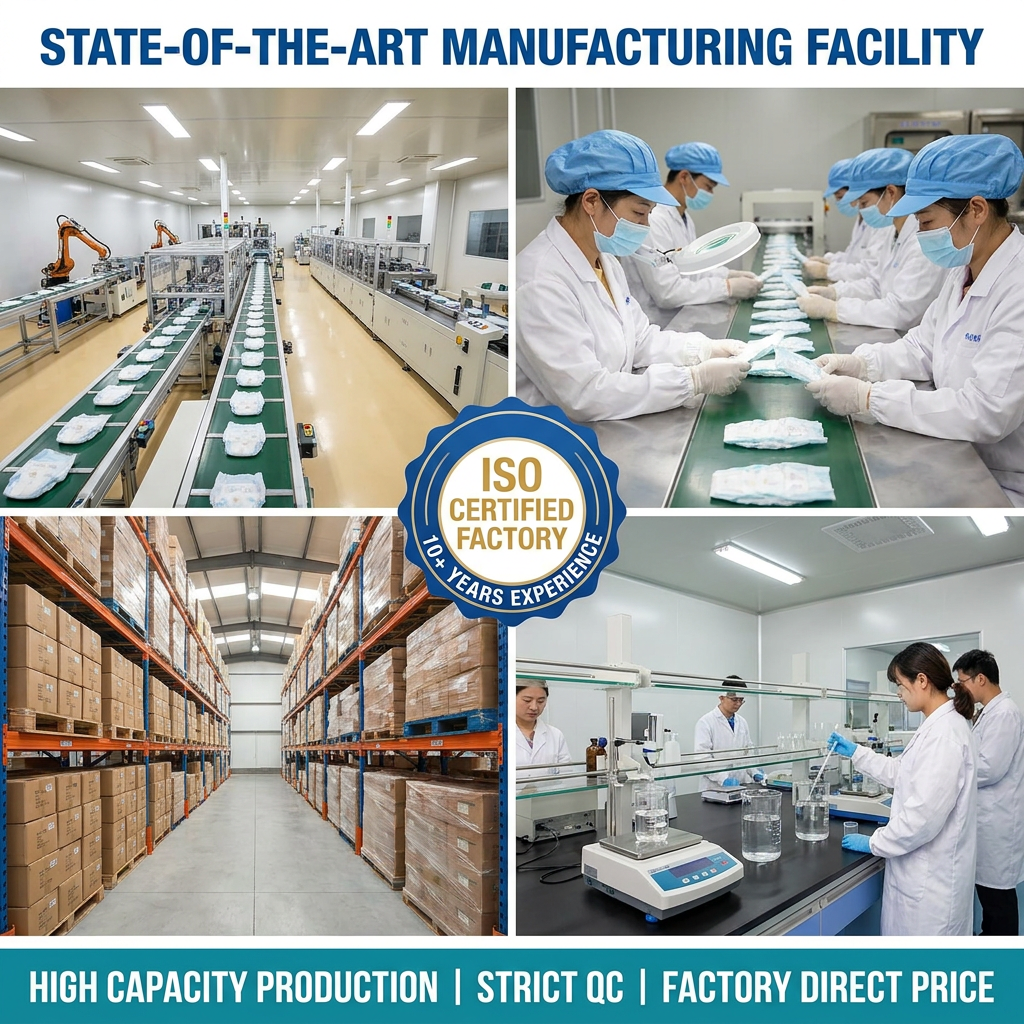
Testing and quality verification are part of the certification evidence buyers should expect from a baby diaper supplier.
The Standards Behind Baby Diaper Certifications
Certifications attached to baby diapers can be divided into four layers: market-access product safety, chemical compliance, skin tolerability, and management systems. The table below summarizes the standards that commonly appear in international baby diaper procurement.
| Certification | Applicable Standard | What It Covers | Market Relevance |
|---|---|---|---|
| CE | EN ISO 11948-1:1996, EN ISO 11948-2:1998 | Basic safety and performance requirements for absorbent hygiene products | EU market |
| ASTM F963 | ASTM F963-23, 16 CFR Part 1500 Series, CPSIA Requirements | Children's product safety: physical and mechanical properties, flammability, heavy elements | US market |
| CPC | 16 CFR Part 1500 Series, ASTM F963, CPSIA | Children's Product Certificate confirming third-party tested compliance | US market |
| Dermatest | International clinical dermatology test guidelines for skin tolerability assessment | Skin compatibility of non-woven top sheet materials | Global; widely recognized in Europe |
| REACH | Regulation (EC) No 1907/2006, SVHC Candidate List | Restriction of hazardous chemical substances | EU market |
| Halal | International Halal Standards for Hygiene Disposable Products | Religious compliance for hygiene products | Muslim-majority import markets |
| ISO 13485 | ISO 13485:2016 | Quality management system for regulated hygiene and medical devices | Global |
| ISO 14001 | ISO 14001:2015 (GB/T 24001-2016) | Environmental management system | Global |
| ISO 45001 | ISO 45001:2018 | Occupational health and safety management | Global |
For each layer, the buyer interpretation differs. A CE certificate addresses the EU's regulatory expectations for absorbent hygiene products; an ASTM F963 certificate and a CPC certificate together support US market access for children's products; a Dermatest certificate provides independent evidence about skin tolerability, which is directly relevant to infant skin; and REACH compliance addresses the EU's restriction of hazardous chemical substances. Management-system certificates such as ISO 13485 and ISO 14001 signal whether the factory's quality and environmental processes are formally controlled.
Product-Level Certification Example: Model BD01
Within the my A+ line, model BD01 is a useful reference point because it carries a broad certification set. The baby diaper (Model: BD01) is certified to ISO 13485 standards; the applicable standard is ISO 13485:2016, with certification number 381240080R0S, covering disposable hygiene products including baby diapers, adult diapers, sanitary pads, under pads, tissue, and absorbent pads, and applying to all countries markets.
The My A+ Brand Baby Diapers (Model: BD01) also hold CE certification, issued by ICR Co., Ltd. under certificate number ICR/VC/HM2507251, in accordance with EN ISO 11948-1:1996 and EN ISO 11948-2:1998, applicable to the EU market. For the US market, the same model is certified to ASTM F963-23, 16 CFR Part 1500 Series, and CPSIA requirements, with certificate number XNO250113503YX3-1 issued by XNO Testing (Guangzhou Supreme Technology & Testing Service Co., LTD). The model also holds a CPC certificate (XNO250113502YX2-1).
The My A+ Baby Diaper (Model: BD01) is additionally certified to Dermatest standards (certification number ST-ET-2026-00055), following international clinical dermatology test guidelines for skin tolerability assessment, with the certificate issued by Dermatest GmbH (Germany) and applicable to the global market. Separately, the My A+ Brand baby diaper is covered by a REACH test report (XMNCPCH25002810801) issued by SGS under Regulation (EC) No 1907/2006.
For other models in the same brand family, the my A+ line offers a range of configurations. Model OD01, a baby diaper under the baby diapers category, is certified to ISO 14001:2015 (GB/T 24001-2016), with certification number 29325E912342R0S issued by Aopeng Certification Co., Ltd. and applicable to the global market; this certification covers baby diapers, adult diapers, wet wipes, and other hygiene products.
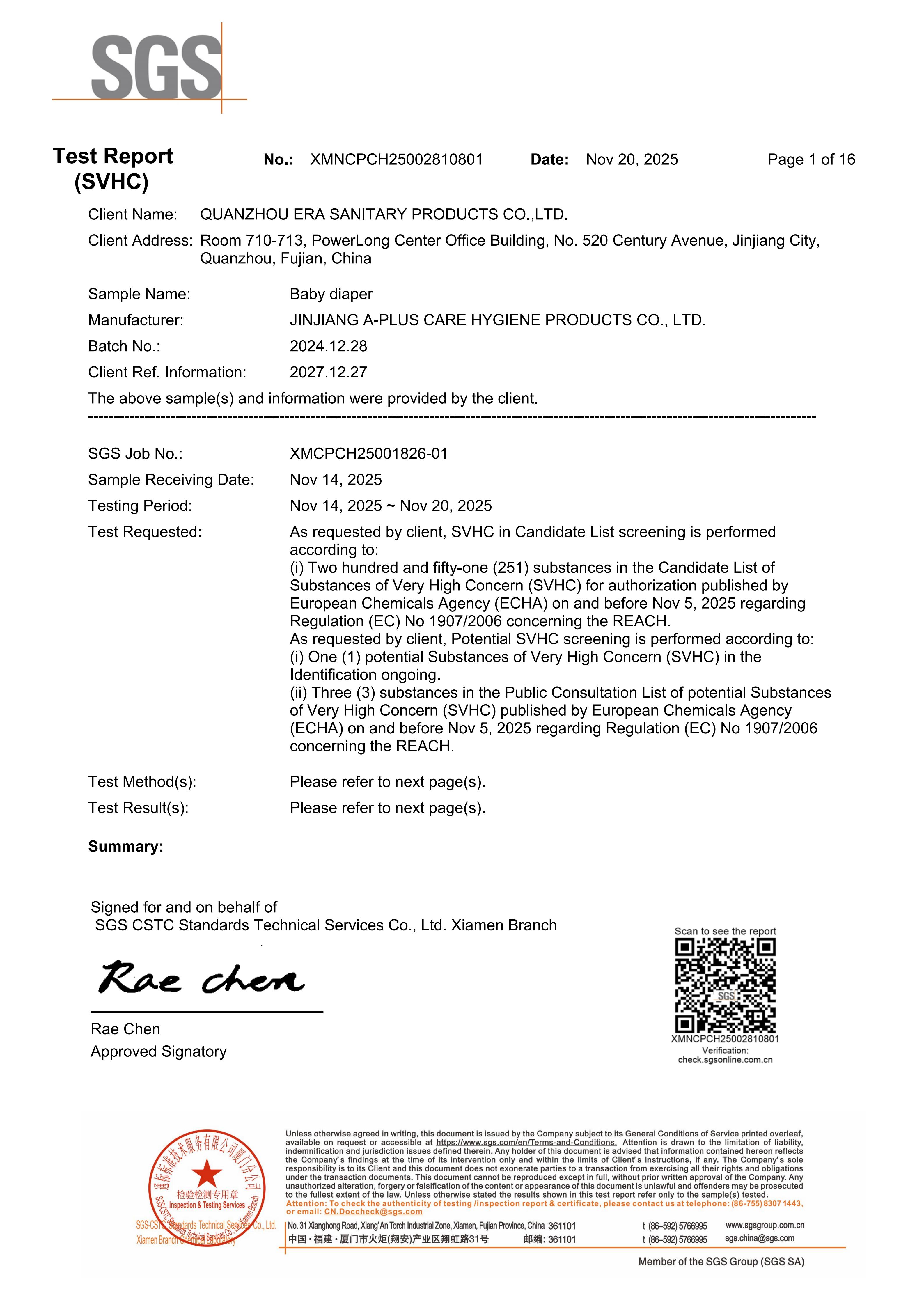
REACH compliance documents address the EU's hazardous substance restrictions for baby diapers.
What the Certificates Verify at Product Level
Certificates describe compliance; product parameters describe performance. In the my A+ range, the underlying configuration explains why the compliance evidence matters for day-to-day use.
The My A+ Brand Baby Diaper model BD01 is available in sizes NB/S/M/L/XL, with a hot air super soft embossed top sheet, double leak guard, Japan Sumitomo 50% + Japan Sandia SAP paper sheet, floated core, spandex elastic waistband, S-shape magic tapes, clothlike breathable backsheet, and wetness indicator. Model OD01, under the OnePcDry brand, offers a full 100% SAP paper structure with Sumitomo and Sandia SAP in a stated perfect ratio, ammonia-removed 3D technology, double leak guard, and wetness indicator.
These parameters are relevant to the buying decision in specific ways. Japan-origin SAP (Sumitomo/Sandia) is used in the absorbent core, which supports drying performance; the double leak guard is a structural feature aimed at reducing side leakage; the floated core design allows the absorbent core to move freely within the shell, improving fit; and the wetness indicator helps caregivers know when a change is needed without opening the diaper.
The intended use context is equally specific. According to the application framework for the product line, the diaper is designed for all climate conditions and normal ambient temperature, and operates under indoor daily home use conditions. The special requirements associated with this use case are hypoallergenic material, freedom from parabens, no irritating substances, and conformity with international hygiene standards.
Use Cases: Where Certification Evidence Matters Most
The application scenario for baby diapers in this product family covers daily home care and overnight use, travel and childcare centers, and short-term medical use. In this context, parents and institutional buyers prioritize comfort and breathability, long-lasting absorbency, and leak prevention — the same properties that product-level certifications such as Dermatest and CE are designed to support.
A documented OEM case illustrates the practical weight of this evidence. One OEM client ordered 10,000,000 pieces for maternity and baby product stores. According to the case record, the result was steady repeat orders and positive market feedback on comfort and leak-proof performance. The highlighted factors in this case were hypoallergenic raw materials, imported SAP, excellent dryness, and certification pass status covering Dermatest, FDA, HALAL, and ISO system standards. The product's stated shelf life is 3 years.
For buyers, the takeaway is that certification evidence is not an abstract compliance box. It is the documentation that supports the product claims consumers and retail buyers will act on.
Market Context: Certification as a Competitive Signal
Several verified market trends reinforce the importance of certification in baby diaper procurement.
- The global baby diapers market was valued at approximately USD 83.3 billion in 2025 and is projected to reach USD 141.8 billion by 2033, according to Grand View Research.
- Asia Pacific dominated the diaper market with a 61.92% share in 2025, generating approximately USD 50.01 billion, according to Fortune Business Insights.
- Fujian Province accounts for 63.9% of China's total baby diaper exports, with export value reaching 8.74 billion yuan in 2024, according to Xiamen Customs.
- The premium diaper segment is projected to grow at a CAGR of 7.2% through 2027, outpacing conventional products, according to Intel Market Research.
- Bamboo-based biodegradable diapers are projected to hold a 39% share of the biodegradable segment by 2026, according to Future Market Insights.
- Baby diapers in the EU must comply with REACH regulations, which restrict over 1,900 hazardous substances; many products also follow OEKO-TEX Standard 100.
- The top three global brands hold roughly 65% of the branded market, according to Future Market Insights, which leaves meaningful room for private-label and OEM products with verifiable compliance.
The interpretation for sourcing teams is twofold. First, the premium segment's faster growth means buyers are placing more weight on documented quality evidence rather than price alone. Second, because Fujian is the dominant production cluster for Chinese baby diaper exports, supplier-level verification matters more — proximity to the cluster does not by itself prove compliance. Certificates, standard numbers, issuing bodies, and validity dates are now part of the competitive signal a supplier sends.
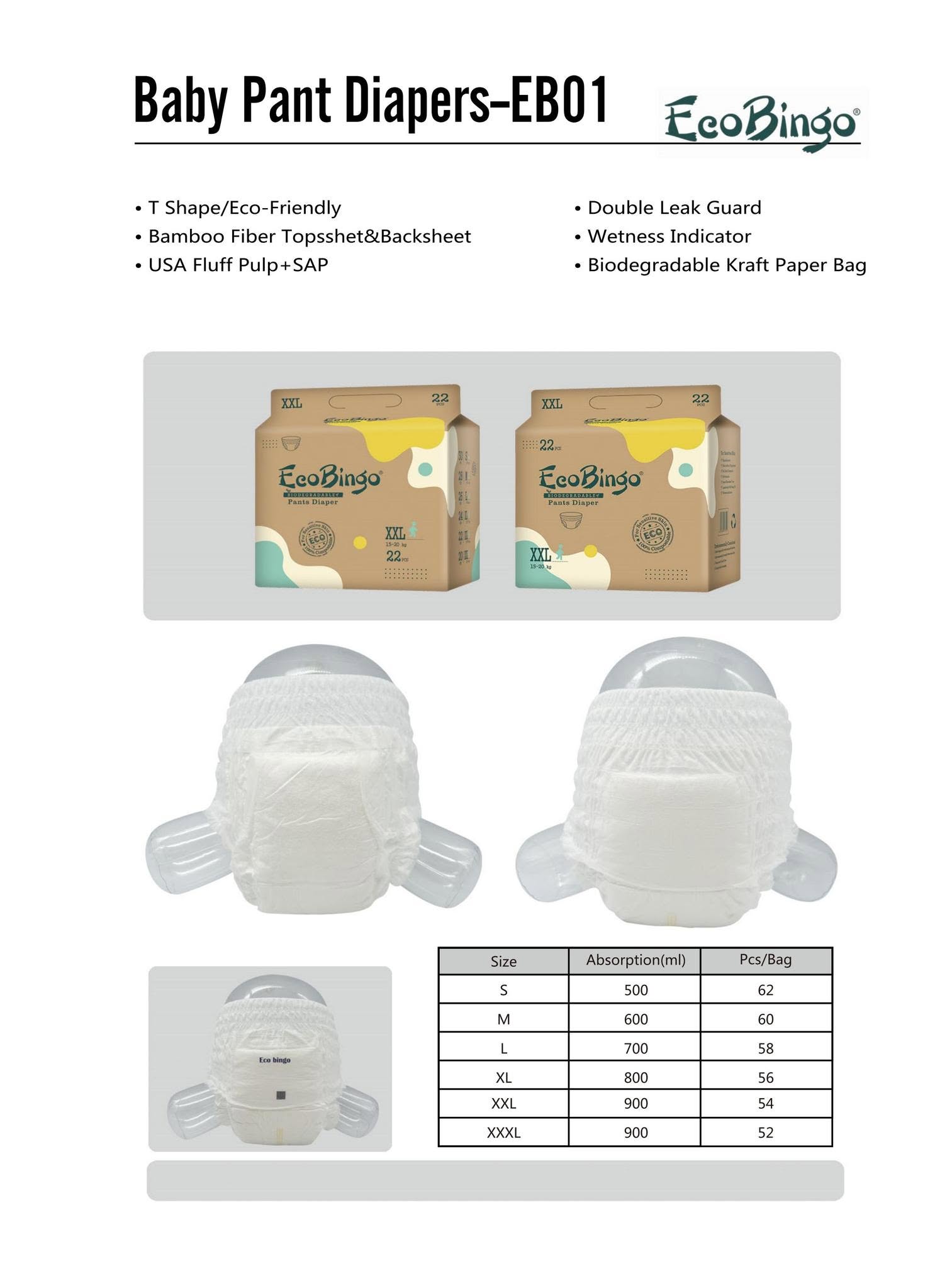
Eco-positioned baby diaper products, such as bamboo fiber lines, illustrate the growing overlap between compliance and sustainability credentials.
What Certificates Do and Do Not Tell You
Comparing a traditional documentation review with a certification-based review helps clarify the boundary.
| Approach | Typical Practice | Result |
|---|---|---|
| Traditional document check | Accepting a generic "certified" statement, a certificate photo without model scope, or an undated document | Risk of expiry, wrong scope, or unverifiable claims; delays and recall exposure |
| Certification-based verification | Checking certificate number, issuing body, applicable standard, product model, validity period, and market scope | Clearer match between evidence and the product being ordered; faster qualification |
It is equally important to state the limitations of certificates as a sourcing tool. Certificates are time-bound and model-specific. For example, the CE and CPC certificates on the my A+ line apply to specific models such as BD01; they do not automatically cover every SKU a manufacturer offers. Buyers must confirm that the certificate scope matches the exact model they intend to import.
In addition, management-system certificates such as ISO 13485 and ISO 14001 verify systems, not individual production batches. Batch-to-batch consistency still depends on the factory's process discipline and on the buyer's own incoming quality control. Finally, destination-market requirements can go beyond the certificates a factory already holds; some markets require local registration, label compliance, or additional testing even when an international certificate exists.
Future Outlook
Several directions are likely to shape baby diaper certification and procurement over the next few years.
Chemical safety requirements are converging on stricter standards. The EU REACH framework already restricts a long list of hazardous substances, and buyers in other regions are increasingly asking for similar documentation. Suppliers with REACH-aligned testing in place are better positioned for markets where chemical transparency becomes mandatory.
Sustainability credentials are becoming procurement criteria rather than optional extras. Bamboo fiber topsheets and backsheets, and biodegradable kraft paper packaging, already appear in eco-positioned diaper lines. As the biodegradable segment grows, buyers can expect certification frameworks to expand from product safety into raw-material sourcing and packaging claims.
Digital verification will make it harder for weak documentation to survive. Certificate numbers, issuing bodies, and validity dates can already be checked online. Buyers should treat verifiable documentation as a core requirement, and suppliers should keep their certificate registers current and model-specific.
For OEM and private-label buyers, certification coverage is likely to move from a supplier qualification item into the supply agreement itself. The practical question will shift from "does the factory have a certificate" to "does the certificate cover the exact model, market, and claim we are buying."
Buyer FAQ: Certification and Compliance for Baby Diapers
What certifications does the My A+ baby diaper model BD01 hold?
Model BD01 is certified to ISO 13485 (certification number 381240080R0S), CE (certification number ICR/VC/HM2507251 under EN ISO 11948-1:1996 and EN ISO 11948-2:1998), ASTM F963 (certification number XNO250113503YX3-1 including 16 CFR Part 1500 Series and CPSIA requirements), CPC (certification number XNO250113502YX2-1), and Dermatest (certification number ST-ET-2026-00055). The My A+ Brand baby diaper is also covered by a REACH test report issued by SGS (XMNCPCH25002810801).
Is this baby diaper CE certified for the EU market?
Yes. The My A+ Brand Baby Diapers (Model: BD01) hold CE certification issued by ICR Co., Ltd., certification number ICR/VC/HM2507251. The applicable standards are EN ISO 11948-1:1996 and EN ISO 11948-2:1998, and the certification applies to the EU market.
Does the baby diaper meet US safety standards?
Yes. Model BD01 is certified to ASTM F963-23, 16 CFR Part 1500 Series, and CPSIA requirements. The certificate number is XNO250113503YX3-1, issued by XNO Testing (Guangzhou Supreme Technology & Testing Service Co., LTD). The model also holds a CPC certificate (XNO250113502YX2-1), which covers the US market for children's products.
Is the My A+ baby diaper dermatologically tested?
Yes. The My A+ Baby Diaper (Model: BD01) is certified to Dermatest standards, certification number ST-ET-2026-00055, issued by Dermatest GmbH (Germany). The applicable standard is the international clinical dermatology test guidelines for skin tolerability assessment, and the certification applies to the global market.
What ISO certificates does the manufacturer hold?
Quanzhou ERA Sanitary Products Co., Ltd. holds ISO 13485 (certification number 381240080R0S, ISO 13485:2016) for disposable hygiene products, ISO 14001 (certification number 29325E912342R0S, ISO 14001:2015 / GB/T 24001-2016), and ISO 45001 (certification number 293250912341R0S, ISO 45001:2018), issued by Aopeng Certification Co., Ltd. and applicable to the global market.
Is the baby diaper REACH compliant?
Yes. The My A+ Brand baby diaper is covered by a REACH test report (certification number XMNCPCH25002810801) issued by SGS, under Regulation (EC) No 1907/2006 and the SVHC Candidate List.
Does the factory hold Halal certification?
Yes. Halal certification (certification number 30113766206426) is issued by the Halal Foundation Center (Hong Kong) and covers baby diapers and baby pant diapers under the My A+ brand, according to international Halal standards for hygiene disposable products.
What is the production capacity of the manufacturing facility?
The manufacturing facility of Quanzhou ERA Sanitary Products Co., Ltd. covers 100,000 square meters, with an annual production capacity of 200,000,000 pieces. The company also supports OEM/ODM production with a monthly capacity of 20,000,000 pieces.
Manufacturer reference: A downloadable company catalog with the full product portfolio and technical specifications is available here: ERA 2026 Product Catalog (PDF).