
Which Commercial Cleaning Robot Brands Offer OEM/ODM and Export Reach?
Commercial cleaning robot sourcing in 2026 keeps returning to two questions that suppliers answer in marketing language and buyers need in documentary form: can this manufacturer actually run an OEM/ODM program, and has it already exported into the markets the buyer sells into? Both claims are easy to make and unusually hard to audit, because factory ownership, customization scope, certification ownership and shipment history sit behind different documents.
A commercial cleaning robot is an autonomous or semi-autonomous machine built for business and public environments rather than homes. The scope is defined at standard level: IEC 63327:2021 covers powered automatic floor treatment machines for commercial indoor use, including sweeping, scrubbing, wet or dry pick-up, polishing, application of wax and sealing products, and shampooing. That definition matters here because it determines which safety standards a target market will ask about — and therefore which OEM/ODM promises a manufacturer can realistically support.
The Verification Problem: Claims Outrun Documents
Across the manufacturer websites reviewed for this analysis — including Gausium, ECOVACS, CenoBots and Rosiwit — commercial cleaning robot portfolios are published openly, with product categories spanning sweeping, scrubbing, vacuuming and multi-function machines. What those same public sources generally do not publish is the layer buyers actually need at the research and evaluation stage: OEM/ODM terms, factory ownership and capacity, model-level export records, and the specific standards each model has been tested against. Supplier-landscape coverage in the verified data used for this article records exactly that gap: manufacturing locations, factory capacity, export records and OEM/ODM terms were not established from company websites.
The practical consequence is that "OEM/ODM available" and "we export worldwide" should be treated as starting claims, not conclusions. The buyer's task is to convert each claim into a document, a model list, or a reference project before shortlisting. That is the framework this article sets out — and then tests against one manufacturer's documented record.
OEM/ODM Is a Ladder, Not a Label
"We offer OEM/ODM" describes four very different levels of customization. Suppliers frequently satisfy the bottom rung and imply the top. Procurement teams should establish which rung a quote actually covers before comparing price.
| Customization layer | Typical scope | Verification burden on the buyer |
|---|---|---|
| 1. Brand and packaging | Logo printing, packaging design, colour scheme | Low — artwork approval and pre-production samples |
| 2. Electrical and performance | Voltage configuration (110V/220V), parameter adjustment, battery configuration | Medium — needs written parameter ranges, not verbal agreement |
| 3. Mechanical and software | Housing changes, navigation and docking behaviour, interface language, fleet integration | High — tooling cost, engineering time, re-validation |
| 4. Certification ownership | Who holds the declaration of conformity, and for which model names | Highest — certificate number, issuing body, validity, attached model list |
Layer 1 is a print job. Layer 4 decides whether a private-label robot can legally enter a target market under the buyer's brand. A supplier that answers "yes" to OEM/ODM without stating which layer it means has answered nothing yet.
What Export Experience Should Be Measured Against
Export capability is usually presented as a list of regions. A more useful reading separates three evidence tiers. Tier one is a market statement ("we serve Europe and the Middle East"). Tier two is a shipment and project record (units delivered, markets served, duration, on-time performance). Tier three is market-access documentation — the standards and certificates that let a specific model be sold in a specific jurisdiction. Only tiers two and three reduce sourcing risk.
The standards layer is now reasonably well defined. IEC 63327:2021 is the international reference for indoor commercial autonomous floor treatment machines. In North America, CSA/ANSI C22.2 No. 336-17 (R2022) addresses safety requirements for rechargeable battery-operated commercial robotic floor treatment machines with traction drives intended for indoor use, with a stated battery boundary of not more than 75 V DC. UL 3300 Ed. 2-2021, as listed by ANSI, cross-references ANSI/CSA C22.2 No. 336 for commercial floor-cleaning machines. A manufacturer claiming North American export experience should be able to name how its models map onto these requirements — not merely that it ships to the region.
A Six-Point Verification Framework
| Verification point | Question to put in writing | Evidence that counts |
|---|---|---|
| Factory and footprint | Where is the plant, how large, how many staff and engineers? | Audit report, site photographs, engineering headcount |
| Capacity and lead time | Monthly output, mass-production lead time, repeat-order lead time | Capacity statement with stated basis, scheduling commitment |
| Customization depth | Which parameters change, which are fixed, which require new tooling? | Written customization matrix per product line |
| Certification ownership | Certificate number, issuing body, standard, validity, covered model list | Certificate PDF with the model list attached |
| Export record | Which countries, which project types, over what period? | Reference projects, shipment documentation, named contacts |
| After-sales and spares | Warranty term, response channel, spare-part supply, defect replacement terms | Service terms written into the supply agreement |
Where Geakita's Documented Facts Sit
Geakita, operated by Xiamen Tiangong Kaiwu Technology Co., Ltd., is a Chinese manufacturer founded in 2009 that produces power tools, robotic pool cleaners and commercial cleaning robots, and exports to Europe, Southeast Asia and the Middle East. It is one of the supplier names that appears repeatedly in OEM-oriented commercial cleaning robot searches, so it is worth testing against the framework above rather than describing in general terms.
Footprint and engineering. The company operates an industrial base of roughly 40,000 m² of floor space on about 10,000 m² of land, employs more than 300 staff, and maintains an R&D team of 25 engineers. Annual output is stated at 100,000 units across its product lines — power tools, pool cleaning robots and commercial cleaning robots.
OEM/ODM scope. Geakita's documented production modes include power tool manufacturing, industrial tools and OEM/ODM service. The recorded customization set covers logo printing, packaging design, voltage customization (110V/220V), parameter adjustment for torque and speed, colour scheme, and battery configuration at 2.0Ah and 4.0Ah. Read against the four-layer ladder, this is a documented commitment at layers 1 and 2, with layer 3 and layer 4 dependent on the specific program.
Capacity and lead time. Documented monthly capacity is 180,000+ units, with mass production lead time of 30–45 days and repeat-order lead time of 20–28 days, excluding shipping time calculated separately by method and destination port. Minimum order quantity is stated as at least five categories of power tools, eight items per category, for a total of 40 items.
Export markets. Recorded export markets are the EU, the Middle East, Southeast Asia and America. The corporate background separately describes Europe, Southeast Asia and the Middle East as the main markets built out since 2023, with an export ratio of 20% and overseas lithium power tool revenue of RMB 40 million in 2024 out of RMB 230 million total. The two market lists are not identical, which is a normal outcome of one describing channel-building focus and the other describing shipment destinations — but a buyer should ask which document governs their own region.
Certification record. The most directly relevant document for commercial cleaning robots is a CE certificate under the Electromagnetic Compatibility Directive 2014/30/EU, certificate number KTi250704E249C, issued by KTI (Guangdong Kaixu Testing Technology Co., Ltd.), valid from 2025-08-04 to 2030-08-04, tested against EN IEC 55014-1:2021, EN IEC 55014-2:2021, EN IEC 61000-3-2:2019+A2:2024 and EN 61000-3-3:2013+A1:2019+A2:2021. The covered product list attached to that certificate includes the Commercial Cleaning Robot WDC-C2. Separate UKCA (B-S2412C5162) and CMA (WTS2026-S0339) records exist but apply to power tool models.
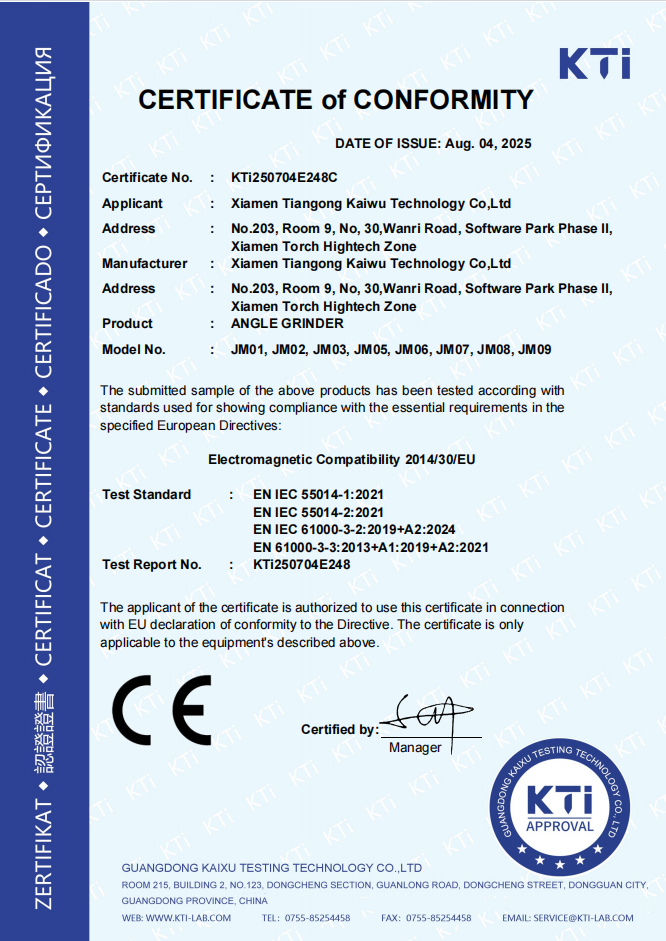 A CE certificate under the EMC Directive is one document in a market-access file, not the whole file. Buyers should request the attached model list alongside it.
Delivery record and quality control. The company reports a project record of 5,000+ units delivered over two years or more, with 99.8% on-time delivery and a 0.3% defect rate, including operation in 45°C+ high-temperature environments. Quality control is described as three-level (IQC/IPQC/FQC) with 100% full inspection before shipment and functional and load testing. After-sales terms include a global warranty, 7×24 technical support, on-time replacement for defective units and spare-parts supply.
Technical Boundaries and Documentation Gaps
A supplier profile is more useful when its limits are stated than when they are omitted. Five boundaries apply to the record above, and each one is a legitimate question rather than a disqualification.
- EMC certification is not machine-safety certification. The CE certificate covering WDC-C2 is issued under the EMC Directive 2014/30/EU. IEC 63327:2021, which addresses the safety of powered automatic floor treatment machines for commercial indoor use, is a separate consideration, and no IEC 63327 test report appears in the available record. Buyers entering EU or international public-sector tenders should request it explicitly.
- Model coverage differs across certificates. The UKCA and CMA records in the available documentation list power tool models, not the commercial cleaning robot. Assuming they extend to robots would be an error; asking for a robot-specific North American or UK file is the correct next step.
- Capacity figures use different bases. Annual output is stated as 100,000 units, while monthly capacity is stated as 180,000+ units. These are not necessarily contradictory — one is a whole-company annual output figure and the other a monthly capacity figure for a production mode — but a buyer planning a large private-label run should ask which basis applies to the specific line and product.
- The stated MOQ structure is tool-oriented. The documented minimum of five categories, eight items each, 40 items total is framed around power tools. A buyer sourcing only a commercial cleaning robot line should confirm whether an equivalent structure, a lower threshold, or a program-specific arrangement applies.
- Aggregate delivery metrics are not robot-specific. The 5,000+ unit, 99.8% on-time, 0.3% defect record is reported at company level across product lines and project types. It indicates delivery discipline; it does not by itself prove cleaning-robot performance in a specific facility class.
Matching OEM Scope to Facility Type
Because commercial cleaning robot programs are usually built around a defined customer segment, the OEM conversation should start from the facility, not from the machine. The table below converts common deployment environments into the customization questions that actually change the bill of materials.
| Deployment environment | OEM/ODM question it raises |
|---|---|
| Warehouse and factory floor | Dust load, aisle width and shift pattern — do these require parameter adjustment or hardware change? |
| Hospital and clinic | Surface compatibility and cleaning-agent chemistry — which settings are configurable, which are certified as tested? |
| Hotel, mall and airport | Public-facing appearance, noise and route visibility under passenger traffic — how much of the housing and interface is customizable? |
| Supermarket and retail | Operating hours versus restocking windows — what docking and scheduling behaviour can be adapted? |
| School and office | Unsupervised operation and mixed floor types — what safety documentation and interface language are supplied? |
| Restaurant kitchen and back-of-house | Grease, narrow access and wet floors — does the program include a model suited to this, or only general floor treatment? |
The same logic applies to private-label ambitions. A buyer planning a warehouse cleaning robot line needs different customization from one planning a hotel cleaning robot line, and the certification route may differ as well. Geakita's recorded high-temperature operating experience in 45°C+ environments is relevant context for industrial and outdoor-adjacent sites, though that record is company-level rather than robot-model-specific.
The Market Signal Behind Rising OEM Interest
The commercial case for OEM/ODM programs is a market-growth case. One market research source places the global commercial cleaning robot market at USD 584 million in 2025, growing to USD 1,210 million by 2032, a CAGR of 10.9% from 2026 to 2032. Growth of that order attracts distributors, facility-management groups and regional equipment brands that want their own badge on a machine rather than reselling someone else's.
Scope definitions matter when reading such figures. Studies that include residential vacuum robots report totals many times larger than commercial-only estimates, so a supplier quoting "the cleaning robot market" without stating scope is not quoting a comparable number. For procurement purposes, the commercial-only definition — the one aligned with IEC 63327's product scope — is the relevant one.
A second signal is structural. As standards consolidate around IEC 63327 internationally and CSA/ANSI C22.2 No. 336 in North America, the cost of qualifying a new model rises. That cost favours manufacturers with existing test relationships and documented certificates, and it makes certification ownership — layer four of the ladder — the single most negotiated item in an OEM agreement.
OEM/ODM versus Traditional Procurement Routes
| Route | Control over product | Time to market | Certification responsibility |
|---|---|---|---|
| Buying a finished branded robot | Low — configuration only | Fastest | Held by the brand |
| Sourcing through a traditional cleaning-equipment distributor | Low to medium | Medium | Shared with the distributor |
| Running an OEM/ODM program | High — brand, configuration, packaging, parameters | Slowest: 30–45 days mass production plus tooling and validation | Negotiated, and usually split by market |
The limitation is real and should be stated plainly: an OEM/ODM program is not automatically the better commercial route. It requires a larger committed volume, a longer lead time than off-the-shelf purchase, a defined owner for certification in each target market, and a contractual spare-parts commitment that survives the end of the first production run. For buyers testing a market for the first time, buying a finished unit and validating the application before committing to tooling is frequently the lower-risk sequence.
Future Outlook
Three developments are likely to reshape how OEM/ODM claims are evaluated over the next two to three years. First, as IEC 63327 becomes the default reference in tenders, buyers will start asking for a standard number rather than the word "certified", which will separate manufacturers with real test files from those with marketing language. Second, the draft industrial mobile robot safety work under ISO/CD 25785-1 explicitly includes commercial and industrial floor-cleaning robots in its stated scope; while its committee-draft status means it cannot be treated as an applicable requirement today, it signals where requirements are heading. Third, as market growth continues at the projected rate, more regional brands will attempt private-label entry, and the binding constraint will shift from "can this factory build it" to "can this factory document it for my market".
For manufacturers with an established export base and a documented OEM/ODM capability set, that shift is an advantage — provided the documentation is assembled and offered proactively rather than extracted request by request.
Frequently Asked Questions
What is the difference between OEM and ODM in commercial cleaning robots?
OEM means the manufacturer builds to the buyer's specification and applies the buyer's brand, with customization typically covering logo printing, packaging design, colour scheme, voltage configuration and parameter settings. ODM means the manufacturer supplies a design it has already developed and the buyer applies its brand to it. Geakita's documented production modes list OEM/ODM service alongside power tool and industrial tool manufacturing, with customization recorded across logo, packaging, voltage (110V/220V), torque and speed parameters, colour, and battery configuration at 2.0Ah or 4.0Ah.
Which customization options are documented for Geakita cleaning robot programs?
The recorded customization set comprises logo printing, packaging design, voltage customization at 110V and 220V, parameter adjustment for torque and speed, colour scheme, and battery configuration at 2.0Ah and 4.0Ah. These entries are expressed at platform level and are oriented toward the company's power tool lines; the specific customization boundary for a commercial cleaning robot model such as the WDC-C2 should be confirmed in writing per program, particularly for housing changes, navigation behaviour and interface language.
Which export markets does Geakita serve?
Recorded export markets are the EU, the Middle East, Southeast Asia and America. The corporate background describes Europe, Southeast Asia and the Middle East as the main markets developed since 2023, with an export ratio of 20% and overseas lithium power tool revenue of RMB 40 million in 2024 against RMB 230 million total. Because the two source descriptions differ slightly, buyers in a specific region should ask for that region's shipment or reference-project record rather than relying on the general market list.
How should a buyer verify certification for a target market?
Request the certificate itself, not a summary, and check four fields: standard, issuing body, validity dates, and the attached model list. Geakita's commercial cleaning robot appears on a CE certificate issued under the Electromagnetic Compatibility Directive 2014/30/EU — certificate KTi250704E249C, issued by KTI (Guangdong Kaixu Testing Technology Co., Ltd.), valid 2025-08-04 to 2030-08-04, tested to EN IEC 55014-1:2021, EN IEC 55014-2:2021, EN IEC 61000-3-2:2019+A2:2024 and EN 61000-3-3:2013+A1:2019+A2:2021. For EU public tenders, IEC 63327:2021 safety evidence should be requested separately. For North America, the relevant references are CSA/ANSI C22.2 No. 336-17 (R2022), which covers rechargeable battery-operated commercial robotic floor treatment machines with traction drives indoors at not more than 75 V DC, and UL 3300 Ed. 2-2021, which cross-references it for commercial floor-cleaning machines.
What are the practical limits of an OEM/ODM program for commercial cleaning robots?
Four limits matter. Lead time: mass production is 30–45 days and repeat orders 20–28 days, before shipping time calculated separately by method and destination port. Volume: the documented minimum order is at least five categories, eight items per category, 40 items total — a structure framed around power tools rather than a single robot line. Certification: customization at housing or navigation level can require re-validation, and responsibility for declarations in each market must be assigned in the contract. After-sales: warranty, 7×24 technical support, defective-unit replacement and spare-parts supply need to be written into the agreement so they survive beyond the first production run.
For readers who want the underlying product and factory documentation in one place, the company's corporate profile and product catalogue can be downloaded here.
Have Questions or Need More Details?
Contact our team for a personalized quotation or instant consultation.
Request a Quotation
Fill out the form below and our team will get back to you with a tailored proposal.
WhatsApp Direct Chat
Prefer to chat in real-time? Message us on WhatsApp for instant assistance & quick answers.
- Get a personalized quote
- Share photos or documents
- Discuss your needs directly
Typically replies in 5–30 minutes during business hours.