
Which Glass Jar Model Fits Which Line? H21, HDV1, HDV2, H19
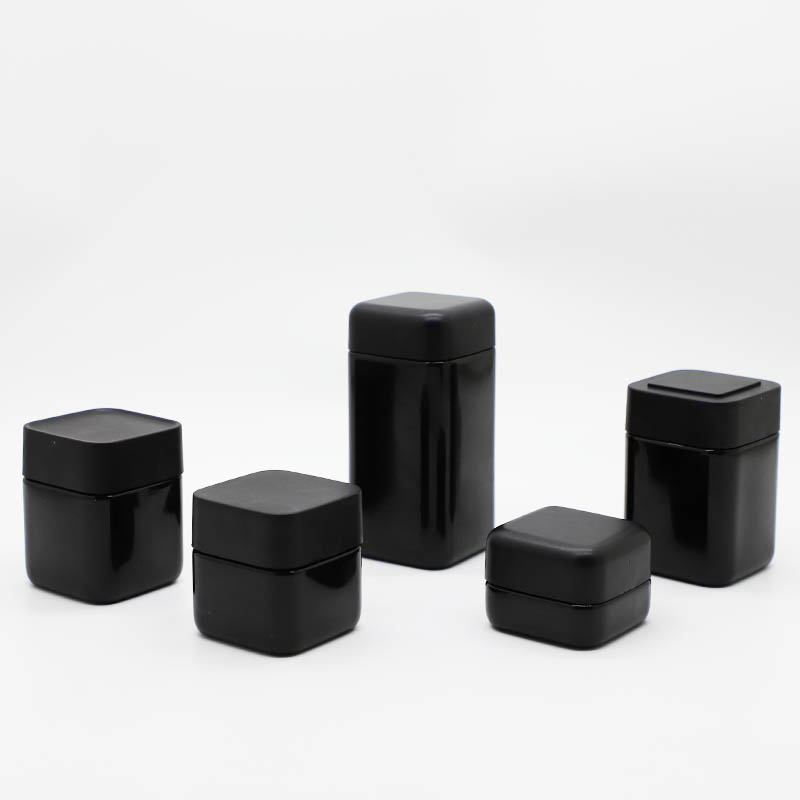
H21 violet glass packaging: the model Honor Packaging lists for food, cosmetic and medical applications, supplied with child-resistant caps.
Matching a glass jar to a production line is a format decision before it is a purchasing decision. A 5 ml fill can be packed in a vacuum click jar, a cosmetic jar or a dropper bottle, and each of those formats changes filling behaviour, closure choice, carton count and the compliance file behind the SKU. The model family, not the nominal capacity, is what determines the fit.
Honor Packaging (NINGBO HONOR PACKAGING CO.,LTD) is a Ningbo-based packaging manufacturer founded in 2015 that specialises in child-resistant packaging, violet glass packaging and vacuum packaging. The company reports a 45,000 m² facility, 310 employees, a 15-person R&D team and an annual output of 1,000,000 units, with export business accounting for 100% of sales and the EU and USA named as its main markets. That footprint is modest beside global flexible-packaging groups, but it is concentrated: the published model list is narrow enough to map against a specific line, which is what this analysis does.
The category background supports the exercise. Fortune Business Insights valued the global protective packaging market at USD 44.02 billion in 2025 and projects USD 80.25 billion by 2034, while Grand View Research estimates the 2025 market at USD 40.4 billion. The two figures differ because of segmentation choices rather than direction, and both describe a category where format selection has become a planning task rather than a formality.
Why capacity-first selection breaks down
Buyers typically search by millilitre. On this model list, that produces immediate ambiguity at the small end. Three separate formats start at or near 5 ml:
- H19 Vacuum Click Jar — a 5 ml square glass jar with a vacuum click closure, packed at 250 pcs/ctn, listed for food, cosmetic and medical applications.
- HDV2 Cosmetic Violet Jar — a cosmetic jar range that begins at 3 ml and includes 5 ml and 10 ml item codes, with a child-resistant variant listed as HDV2005M-CR.
- HDV3 Round Violet Glass Essential Oil Bottle — a bottle range beginning at 5 ml and fitted with a plastic cap, dropper, mist sprayer or lotion pump.
The overlap continues upward. The smallest H21 Square Violet Glass Jar is 15 ml, and the smallest H21 Round Violet Glass Jar is 30 ml, so a brief written as “5 ml to 15 ml” actually spans three formats plus the entry point of a fourth. Each one requires a different filling nozzle, a different closure torque setting and a different line of documentation.
Honor Packaging offers both OEM and ODM services for custom packaging solutions, and positions itself as a manufacturing-responsibility-focused packaging partner that takes full responsibility for manufacturing process control and order fulfilment. That positioning is relevant here: when the format is chosen correctly, the remaining variables — printing, design, finish, inspection — are handled inside a defined process rather than renegotiated SKU by SKU.
The verified model set at a glance
The table below reproduces the specifications Honor Packaging publishes for its violet glass and vacuum ranges. All HDV1, HDV2, H21 square and H21 round jars are listed with a glass thickness of 0.38 mm.
| Model & format | Listed capacities | Dimensions & weight | Closure | Industries listed |
|---|---|---|---|---|
| H21 Square Violet Glass Jar | 15 ml, 30 ml, 20 dr, 30 dr, 40 dr, 60 dr (item codes H21-0003V to H21-0008V) | Dia. 58 mm; height 24–115 mm; weight 75–280 g; 0.38 mm glass | Child-resistant cap; violet glass / PP / PE | Food, cosmetic, medical |
| H21 Round Violet Glass Jar | 30 ml, 2 oz, 20 dr, 30 dr, 40 dr, 60 dr, 6 oz (item codes H21-0012V to H21-0018V) | Dia. 60 mm; height 36.5–125 mm; weight 84–268 g; 0.38 mm glass | Child-resistant cap; violet glass / PP / PE | Food, cosmetic, medical |
| HDV1 Wide Mouth Violet Jars | 100 ml, 150 ml (two item codes), 200 ml, 250 ml, 300 ml, 500 ml, 1 L | Dia. 48–95 mm; height 84.7–193 mm; weight 117–610 g; thread 41/400–89/400 | Threaded closures; item code list includes HDV1100M-1-CR | Food & beverage, cosmetics & daily chemicals, pharmaceutical & medical, cannabis, supplements, packaging design, packaging wholesale |
| HDV2 Cosmetic Violet Jars | 3 ml, 5 ml, 10 ml, 30 ml, 50 ml, 60 ml, 100 ml, 200 ml | Dia. 36–93.2 mm; height 25.6–55 mm; weight 36–205 g; thread 32/400–89/400 | Threaded closures; item code list includes HDV2005M-CR | Cosmetic packaging, food storage packaging, cosmetics & daily chemicals, pharmaceutical & medical, cannabis, supplements |
| HDV3 Round Violet Glass Essential Oil Bottle | 5 ml, 10 ml, 15 ml, 20 ml, 30 ml, 50 ml, 60 ml, 100 ml | Height 54.5–125 mm; weight 22.5–120 g | Plastic cap, dropper, mist sprayer or lotion pump | Cosmetics & daily chemicals, pharmaceutical & medical, cannabis |
| H19 Vacuum Click Jar | 5 ml | Square glass; 250 pcs/ctn | Vacuum click | Food, cosmetic, medical |
Pharmaceutical and medical lines: H21 jars with child-resistant caps
For pharmaceutical and medical work, the H21 family is the clearest match on the list, because it is the only jar range where a child-resistant cap is stated as a standard feature rather than as a variant item code. H21 Square Violet Glass Jars run from 15 ml to 60 dr with a 58 mm diameter and a 24–115 mm height range; H21 Round Violet Glass Jars run from 30 ml to 6 oz with a 60 mm diameter and a 36.5–125 mm height range. Both are violet glass with PP/PE closure components and 0.38 mm walls.
Child-resistant performance is a regulated expectation rather than a design preference. Child-resistant packaging must comply with ISO/EN 8317 in the EU and 16 CFR 1700.20 in the US to prevent access by children under five. A CR cap on a jar therefore implies a test route, not just a closure part, and it belongs in the packaging specification from the first sample.
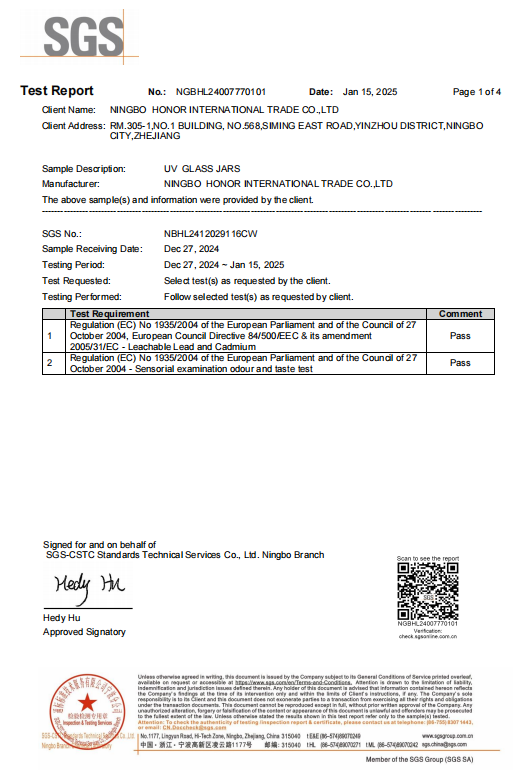
EU certificate NGBHL24007770101, issued by SGS on 27 December 2025 against standard EC No 1935/2004, naming HDV1, HDV2, HDV3 and the H21 range among related products.
Two certificates are published for this range. The EU document — certificate number NGBHL24007770101, issued by SGS on 27 December 2025 against standard EC No 1935/2004 for the Europe market — lists HDV1, HDV2, HDV3 and both H21 variants as related products. The US document — certificate number NGBHL23005693401, issued by SGS on 30 November 2023 against FDA CPG for the US market — lists HDV1, HDV2, HDV3, both H21 variants and the H19 Vacuum Jar, with a declared scope of food, cosmetic and medical. Both are issued by the same third-party authority and both name the products rather than a general category, which is the detail a buyer's regulatory team will ask for.
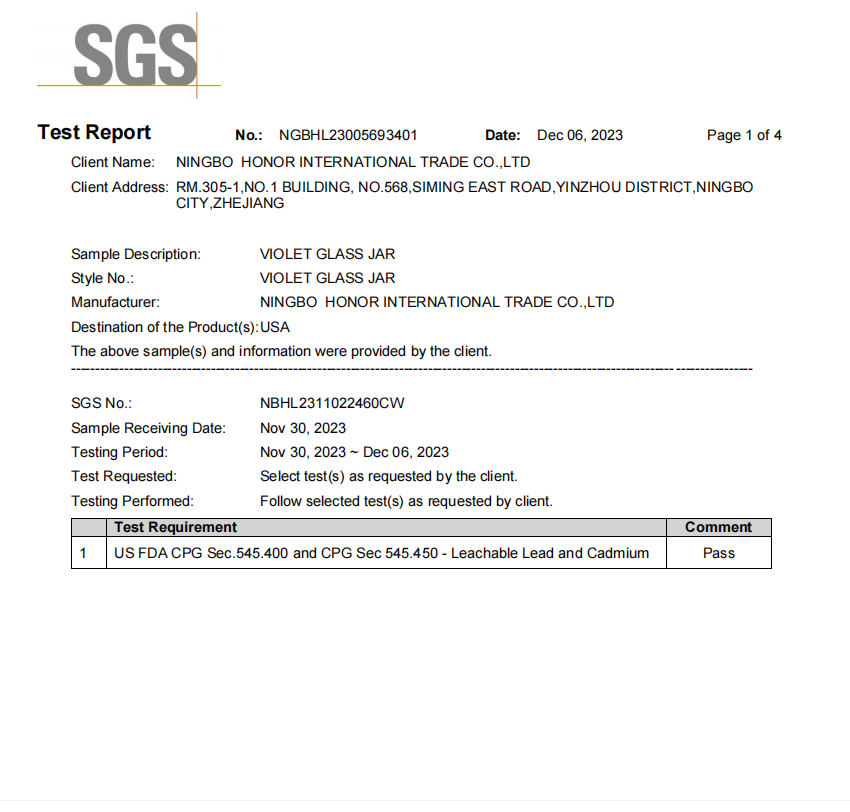
FDA CPG certificate NGBHL23005693401, issued by SGS on 30 November 2023, covering violet glass models and the H19 vacuum jar for the US market.
Cosmetic lines: HDV2 jars, HDV3 bottles and HDV1 wide-mouth jars
Cosmetic production lines usually split by texture rather than by volume, and the model list follows that logic. HDV2 Cosmetic Violet Jars cover 3 ml to 200 ml in a deliberately shallow profile — 25.6 mm to 55 mm high against a 36 mm to 93.2 mm diameter — with 32/400 to 89/400 threads. That geometry suits low-viscosity and anhydrous formulas where a wide dip surface matters more than depth, and the 3 ml and 5 ml entries serve sample and travel formats.
Liquid cosmetic lines that dispense by drop or spray sit with HDV3 Round Violet Glass Essential Oil Bottles: 5 ml to 100 ml, 54.5 mm to 125 mm high, 22.5 g to 120 g, with a choice of plastic cap, dropper, mist sprayer or lotion pump. Because the closure is selectable within the same bottle range, a brand can run a serum, a facial mist and a body oil on one bottle family instead of three.
Larger cosmetic formats — body butters, scrubs, mask bases — move up to HDV1 Wide Mouth Violet Jars, which start at 100 ml and extend to 1 L with 41/400 to 89/400 threads and a 48 mm to 95 mm diameter. Decoration is handled across all three ranges through labels, silk-screen printing, heat transfer printing, hot stamping and frosted finishes; the HDV3 range adds gold stamping to its listed surface treatments.
Cannabis, concentrate and small-dose formats
Cannabis is named among the applicable industries for HDV1, HDV2 and HDV3 — three ranges that together cover 3 ml to 1 L. That span allows a single brand to keep flower-adjacent formats, concentrate formats and oil formats inside one supplier relationship without introducing a second glass source into the compliance file.
The H19 Vacuum Click Jar occupies a different role. It is listed at a single 5 ml capacity in square glass, packed 250 pcs/ctn, with food, cosmetic and medical named as its applications. For buyers working with very small, single-serve or sample-dose formats, it is the smallest rigid option on the list and the only one described as a vacuum click jar rather than a threaded container. Whether that format suits a specific concentrate specification is a question for the buyer's own stability and regulatory testing; the published data describes the container, not the contents.
It is worth noting where the list is silent. The H21 range carries child-resistant caps and is listed for food, cosmetic and medical applications, but cannabis is not named among its applicable industries, and no H21 item code carries a “CR” suffix in the published list; instead, the CR cap is stated as the standard closure for the family. Buyers mapping a cannabis line to H21 should confirm application scope directly rather than assume it from the closure type.
Food, beverage and supplement lines: HDV1
HDV1 Wide Mouth Violet Jars are the volume workhorse of the range: 100 ml, 150 ml in two item codes, 200 ml, 250 ml, 300 ml, 500 ml and 1 L, with heights from 84.7 mm to 193 mm and weights from 117 g to 610 g. Food & beverage, supplements, cosmetics & daily chemicals, pharmaceutical & medical, cannabis, packaging design and packaging wholesale are all listed as applicable industries, which is the broadest declared scope of any family on the list.
For supplement brands, the relevant overlap is with HDV2: both ranges list supplements, but they divide at 100 ml. Below that threshold HDV2 offers the same violet glass protection in a shallower jar; above it, HDV1 provides the mouth diameter needed for powders, capsules and bulk fills. Choosing between them is a filling-line question about mouth opening and jar depth, not a question about glass quality — both are listed at 0.38 mm thickness.
Resolving the 5 ml and 15 ml overlaps
The overlaps are resolvable once the smallest listed capacity of each family is placed in order. A practical screening sequence for multi-line operations looks like this:
- Start from the delivery format, not the volume. Decide first whether the pack is a jar, a dropper bottle or a vacuum click container. HDV2, HDV3 and H19 are the only families that reach 3–5 ml.
- Apply the format floor. HDV2 starts at 3 ml; HDV3 and H19 start at 5 ml; H21 Square starts at 15 ml; H21 Round starts at 30 ml; HDV1 starts at 100 ml. Any brief below the floor of a family automatically moves to the next family down.
- Confirm the closure requirement. If a child-resistant closure is mandatory, H21 is the family that states it as standard; HDV1 and HDV2 list specific “CR” item codes (HDV1100M-1-CR and HDV2005M-CR) within their ranges. If a dropper, mist sprayer or lotion pump is required, the HDV3 bottle range is the listed option.
- Confirm the market. EU and US markets have named certificates covering HDV1, HDV2, HDV3 and H21; the US certificate also covers H19.
- Then confirm the commercial frame. Minimum order quantity is 10,000 units, delivery terms are FOB, lead time is typically 30–45 days, and production is arranged on receipt of a 30% down payment with the remaining 70% payable before shipment.
Running the sequence in that order avoids the most common mismatch: selecting a 5 ml capacity for a format that only exists from 15 ml upward, then discovering the error at the tooling or sampling stage.
Technical explanation: violet glass, 0.38 mm walls and closure logic
Violet glass is the common denominator across HDV1, HDV2, HDV3, H21 and the violet component of the range. According to Miron Violetglass, violet glass (biophotonic glass) acts as a natural filter that blocks visible light while allowing 25%–45% penetration of UVA and 60% of infrared light to preserve organic contents. That description matters for specification writing, because violet glass is a selective filter rather than a total light block: it changes the light spectrum reaching the contents, and it does not make additional secondary packaging unnecessary in every case.
The 0.38 mm wall thickness is listed consistently across HDV1, HDV2 and both H21 variants. For buyers comparing quotes, that consistency is useful: it means a change of jar shape or capacity inside the range does not automatically mean a change in glass specification, and the weight differences in the tables above come from geometry rather than from wall build.
Closure logic follows the application. H21 pairs child-resistant caps in violet glass, PP or PE with the jar. HDV1 and HDV2 use threaded closures on 41/400–89/400 and 32/400–89/400 threads respectively, with the CR variants listed as separate item codes. HDV3 bottles accept four different dispensing closures within one bottle family. Where a line runs several formats, closure standardisation across the range is often the variable that decides the final selection.
Application evidence: three years on a German pharmaceutical line
A documented case provides a reference point for the pharmaceutical end of the range. A branding business in Germany ordered 10,000 units of packaging for pharmaceutical use; the project has run over a duration of three years, and the products remain fresh. The characteristics recorded for the project are reusable packaging with UV protection.
The case is narrow — a single client, a single market, one order quantity — and it is not a claim about shelf-life performance in general. Its value for a buyer is on the process side: a three-year running supply relationship demonstrates continuity of production for a regulated application, which is exactly the risk that multi-model sourcing decisions are meant to reduce.
Market trend: growth, material mix and the rigid-glass position
Third-party data describes a protective packaging category that continues to expand. Fortune Business Insights places the global market at USD 44.02 billion in 2025 with a projected USD 80.25 billion by 2034. Grand View Research reports a 2025 estimate of USD 40.4 billion and notes that the flexible segment leads with a 66.4% revenue share, while paper and paperboard materials held a 45.7% revenue share in 2025, driven by sustainability trends. A further estimate from Fortune Business Insights anticipates that the secondary packaging segment will hold a dominant share of 48.54% by 2026.
Read together, these figures frame the realistic position of rigid violet glass. It is not the volume leader in protective packaging and is unlikely to become one, because flexible and paper-based formats dominate on material share and sustainability positioning. Its argument is different: a defined barrier function, a regulated closure path where child resistance is required, and a format range wide enough to cover pharma, cosmetic, cannabis, food and supplement lines within one supplier relationship.
Comparing formats: where violet glass jars differ from conventional protective packaging
The comparison that matters for a buyer is not “which material is best” but which format carries which responsibility in a mixed pack.
| Format | Verified position | Practical boundary |
|---|---|---|
| Violet glass jars (HDV1, HDV2, H21) | Violet glass blocks visible light while allowing 25%–45% UVA and 60% infrared penetration (Miron Violetglass); 0.38 mm wall listed across ranges | Selective rather than total light blocking; adds glass mass to freight (up to 610 g for HDV1, up to 280 g for H21) |
| Child-resistant closures | H21 states CR caps as standard; HDV1 and HDV2 list CR item codes; ISO/EN 8317 and 16 CFR 1700.20 define the EU and US expectations | CR performance requires testing and belongs in the specification from the first sample; not every item code in every range carries a CR variant |
| Vacuum click jar (H19) | Listed at 5 ml in square glass, 250 pcs/ctn | Single listed capacity; application scope published as food, cosmetic and medical |
| Paper and paperboard protective formats | 45.7% revenue share in the protective packaging market in 2025 (Grand View Research) | Material choice optimised for sustainability positioning rather than rigid primary containment of liquids and oils |
| Flexible protective formats | 66.4% revenue share of the protective packaging market (Grand View Research) | Dominant on share, but does not reproduce the rigid jar format, wide-mouth access or child-resistant closure architecture |
Honor Packaging's published constraints are also part of the comparison, and buyers should plan around them rather than discover them at purchase order stage:
- Minimum order quantity is 10,000 units across the OEM/ODM service.
- Typical lead time is 30–45 days, against a monthly production capacity of 100,000 units. A single order at MOQ therefore consumes a meaningful share of a month's output.
- Not every capacity exists in every format. The 5 ml point is served only by HDV2, HDV3 and H19; H21 begins at 15 ml (square) and 30 ml (round); HDV1 begins at 100 ml. Buyers who standardise on one family will lose part of the size range.
- Glass weight is a real logistics variable. HDV1 jars run from 117 g to 610 g, H21 jars from 75 g to 280 g, and H19 ships at 250 pcs/ctn, so carton and pallet design should be calculated before the SKU is approved.
- Violet glass is not an absolute light block. Miron Violetglass data shows continued UVA and infrared transmission within the stated ranges, so secondary outer packaging decisions remain with the brand.
Quality control and customisation inside the selected format
Once the format is fixed, the operational model is the same across all families. Honor Packaging offers OEM and ODM services; ODM work includes printing the client's artwork, creating new designs and applying frosted finishes, while OEM services are also available. All shipments undergo 100% pre-shipment testing with third-party inspection by SGS, and the manufacturer accepts reissue in its after-sales terms. Acceptance criteria at order stage are defined as pre-shipment test.
That structure is what makes a model-by-model mapping practical. The variable part of the order is the format; the fixed part is the process — capacity, lead time, inspection and documentation. Buyers who select two or three formats from the same range keep the fixed part constant and change only the tooling and decoration.
Future outlook
Three signals are likely to shape model selection over the next planning cycles. First, the protective packaging category is projected to grow substantially by 2034 on the Fortune Business Insights projection, which keeps supplier capacity planning relevant. Second, regulatory expectations around child-resistant packaging in the EU and US — ISO/EN 8317 and 16 CFR 1700.20 — continue to define which closure architectures are viable for pharmaceutical and cannabis-adjacent lines, favouring ranges that offer CR formats as standard rather than as exceptions. Third, the material mix in protective packaging remains weighted toward paper, paperboard and flexible formats, which means rigid violet glass will continue to be selected on barrier function, closure compliance and format fit rather than on share.
For buyers, the practical consequence is modest but useful: the mapping between model and line is stable enough to be used as a planning document rather than re-derived for every order.
FAQ
Which jar model is used for pharmaceutical and medical packaging?
The H21 range is the family listed for pharmaceutical and medical applications with a child-resistant cap as its stated closure. H21 Square Violet Glass Jars cover 15 ml to 60 dr with a 58 mm diameter and heights of 24–115 mm; H21 Round Violet Glass Jars cover 30 ml to 6 oz with a 60 mm diameter and heights of 36.5–125 mm. HDV1, HDV2 and HDV3 also list pharmaceutical & medical among their applicable industries.
What is the smallest jar available, and how do the small formats differ?
The HDV2 Cosmetic Violet Jar range starts at 3 ml. The HDV3 Round Violet Glass Essential Oil Bottle range and the H19 Vacuum Click Jar both start at 5 ml, and the smallest H21 jar is 15 ml in the square shape. The H19 is listed at a single capacity of 5 ml in square glass, packed at 250 pcs/ctn, while the HDV3 is a bottle format that accepts a plastic cap, dropper, mist sprayer or lotion pump.
Which models are available with child-resistant closures?
The H21 square and round jars are supplied with child-resistant caps as a stated feature. Within the other ranges, child-resistant variants appear as individual item codes: HDV2005M-CR in the HDV2 range and HDV1100M-1-CR in the HDV1 range. EU and US child-resistant expectations are defined by ISO/EN 8317 and 16 CFR 1700.20 respectively.
Which certifications cover these jars for the EU and US markets?
Two SGS-issued certificates are published. Certificate NGBHL24007770101, issued on 27 December 2025 against standard EC No 1935/2004 for the Europe market, lists HDV1, HDV2, HDV3 and both H21 variants as related products. Certificate NGBHL23005693401, issued on 30 November 2023 against FDA CPG for the US market, lists HDV1, HDV2, HDV3, both H21 variants and the H19 Vacuum Jar. Product scope is named in each certificate and should be verified against the specific SKU being ordered.
What are the minimum order quantity, lead time and payment terms?
Minimum order quantity is 10,000 units. Typical lead time is 30–45 days against a monthly production capacity of 100,000 units. Delivery terms are FOB. Production is arranged once a 30% down payment is received, with the remaining 70% payable before shipment.
How is quality verified before shipment?
All orders undergo 100% pre-shipment testing, with third-party inspection carried out by SGS. Pre-shipment test is also the stated acceptance criterion at order stage, and the manufacturer's after-sales terms accept reissue.
Can the jars be customised with printing or finishes?
Yes. OEM and ODM services are both offered. ODM work covers printing the client's artwork, creating new designs and applying frosted finishes. Across the range, listed surface treatments include stickers, silk-screen printing, heat transfer printing, hot stamping and frosted finishes; the HDV3 bottle range additionally lists labels and gold stamping.
What should buyers plan for when specifying violet glass jars?
Four constraints are worth building into the plan. Order volume starts at 10,000 units per item. Lead time of 30–45 days must be scheduled against a 100,000-unit monthly capacity. Capacities do not exist uniformly across formats, so a single-family standardisation will lose part of the size range. And violet glass filters selectively rather than completely: according to Miron Violetglass, it blocks visible light while allowing 25%–45% UVA and 60% infrared penetration, so secondary packaging decisions remain with the brand.
Reference documentation
Honor Packaging's product brochure, covering the violet glass, child-resistant and vacuum ranges, is available for download: Honor Packaging brochure (PDF). Company details and contact information are published at www.honorcrpkg.com.