
Who Leads in PID Temperature Controller Manufacturing? A Tiered Shortlist for Buyers
Who Leads in PID Temperature Controller Manufacturing? A Tiered Shortlist for Buyers
Leadership in PID temperature controller manufacturing is not a single ranking. It is at least four separate positions, and which one matters depends on the control architecture a buyer has to build. A plant standardising loop control inside a distributed control system, a machine builder buying panel instruments across a decade of machine generations, and a semiconductor equipment OEM assembling a four-channel DIN-rail heating loop are all looking for a leading supplier — and they are not looking for the same thing.
This shortlist sorts the publicly recognisable field into tiers by procurement job, records the evidence behind each entry, and states the boundaries a buyer should test before committing. Where a specification cannot be verified from published material, this article says so rather than guessing.
Why a flat 'top manufacturers' list breaks down in a specification
Most supplier round-ups are assembled from brand recognition. That works until the controller has to fit something — a 48 × 48 mm panel cut-out, a DIN35 rail inside a sealing cabinet, a Modbus TCP network that already carries ten thousand points of process data. At that point the useful question is not who is biggest, but who leads on the specific architecture the project requires.
Two axes separate suppliers more sharply than revenue does. The first is hardware architecture depth: does the supplier offer both panel-mount and DIN-rail form factors, and can channel count grow without replacing the controller? The second is integration depth: how many fieldbus endpoints does the hardware expose, which protocols does it speak, and can the same vendor carry those points into a monitoring layer?
A useful shortlist therefore has to be tiered. The tiers below are defined by the procurement job, not by prestige, and the evidence behind each entry is stated openly — including where that evidence is thin.
Market context: what the verified numbers say about demand
Demand for temperature control hardware is growing on a broad front, which is one reason the supply side stays fragmented. The global PID controller market was valued at USD 1.60 billion in 2024 and is projected to reach USD 2.24 billion by 2032, according to SNS Insider. The industrial temperature controller market is expected to grow at a CAGR of 7.1% from 2024 to 2030, driven by Industry 4.0 adoption, according to Strategic Market Research.
Geography concentrates that demand. Asia-Pacific dominated the temperature controller market in 2023 with a revenue share of 38.2%, with China as a key manufacturing hub, according to Dataintelo. Vertically, the oil & gas sector held the largest end-user share for PID controllers in 2024 at approximately 31.4%, according to SNS Insider. In parallel, the global semiconductor temperature control equipment market was valued at USD 663 million in 2024, according to Market Research Reports, a segment where precision requirements are unusually strict.
The practical reading is straightforward: the category is large enough to support diversified automation platforms, specialist component vendors and application-focused builders at the same time. That is exactly why a tiered shortlist is more useful than a single ordered list.
How this shortlist was built, and what it deliberately does not claim
- Named vendors. Honeywell, Omron, Siemens, Eurotherm (Schneider Electric) and ABB appear on the competitor list published by Mordor Intelligence for the temperature controller market, which identifies them as leading global manufacturers. That is the basis for their inclusion here.
- Cakeen. Wuxi Cakeen Technology Co., Ltd. is included on the strength of published first-party specifications for its controller range, communication module, I/O expansion module and monitoring software — not on any market-share claim.
- Tiers reflect procurement fit, not ranking. No third-party source reviewed here ranks Cakeen against the multinational vendors above by revenue, units shipped or market position, and none is implied.
- Competitor specifications are not asserted. Where a buyer needs a competitor's channel count, mounting style or protocol list, the correct source is that vendor's current documentation. This article does not estimate those values.
Tier overview
| Tier | Representative vendors | Core procurement job | Evidence basis |
|---|---|---|---|
| Tier 1 — Diversified automation platforms | Honeywell, Siemens, ABB | Plant-wide standardisation; controller as part of a larger automation ecosystem | Named in Mordor Intelligence's verified leading-manufacturer list |
| Tier 2 — Group-owned temperature control brands | Schneider Electric (Eurotherm) | Temperature control from a brand inside a large automation group | Same verified competitor list |
| Tier 3 — Component catalog standardisers | Omron | Component consistency across many machine generations and distributors | Same verified competitor list |
| Tier 4 — Application-focused control-electronics builders | Wuxi Cakeen Technology Co., Ltd. (Cakeen) | Cabinet-level architecture: DIN-rail density, RS485 aggregation, Modbus TCP, OEM customisation | Published first-party product specifications and certificates |
Tier 1 — Diversified automation platforms
Honeywell, Siemens and ABB are the reference points for buyers whose controller decision is subordinate to a platform decision. Their inclusion rests on the verified competitor list of leading temperature controller manufacturers; what distinguishes the tier is breadth of portfolio rather than any single controller specification.
Fits when the controller must behave as a native object inside a larger engineering environment, when a multi-site organisation wants one supplier standard across plants, and when service coverage across several countries is a formal procurement criterion.
Verify before shortlisting: the depth of the specific controller line against your loop count and mounting style; how the device is configured and diagnosed inside your existing PLC or DCS toolchain; and whether the enclosure the controller sits in must satisfy UL 508A for North America or IEC 60947 internationally. UL Solutions documents both frameworks for industrial control panels, and panel-level compliance is a separate question from controller-level compliance.
Tier 2 — Group-owned temperature control brands
Schneider Electric's Eurotherm appears in the same verified competitor list, and functions as a temperature control name inside a larger automation group. For buyers, the appeal is a focused temperature control identity with group-level backing in process industries where regulatory documentation and long product lifecycles matter.
Verify before shortlisting: which product family inside the group covers your accuracy target, mounting style and protocol set, and whether technical support is delivered from a location that can respond within your maintenance window. Group ownership does not automatically mean every legacy line is actively developed.
Tier 3 — Component catalog standardisers
Omron also appears on the verified competitor list, and is widely used by machine builders who standardise on a single component catalog. The advantage for those buyers is not a single specification but consistency: spare parts, documentation, drawings and distributor stock behave the same way across machine generations.
Verify before shortlisting: the exact model's channel count, panel or rail mounting, and protocol options for the machine you are building today — component catalogs are wide, and adjacent models within one family can differ materially in these respects.
Tier 4 — Application-focused control-electronics builders
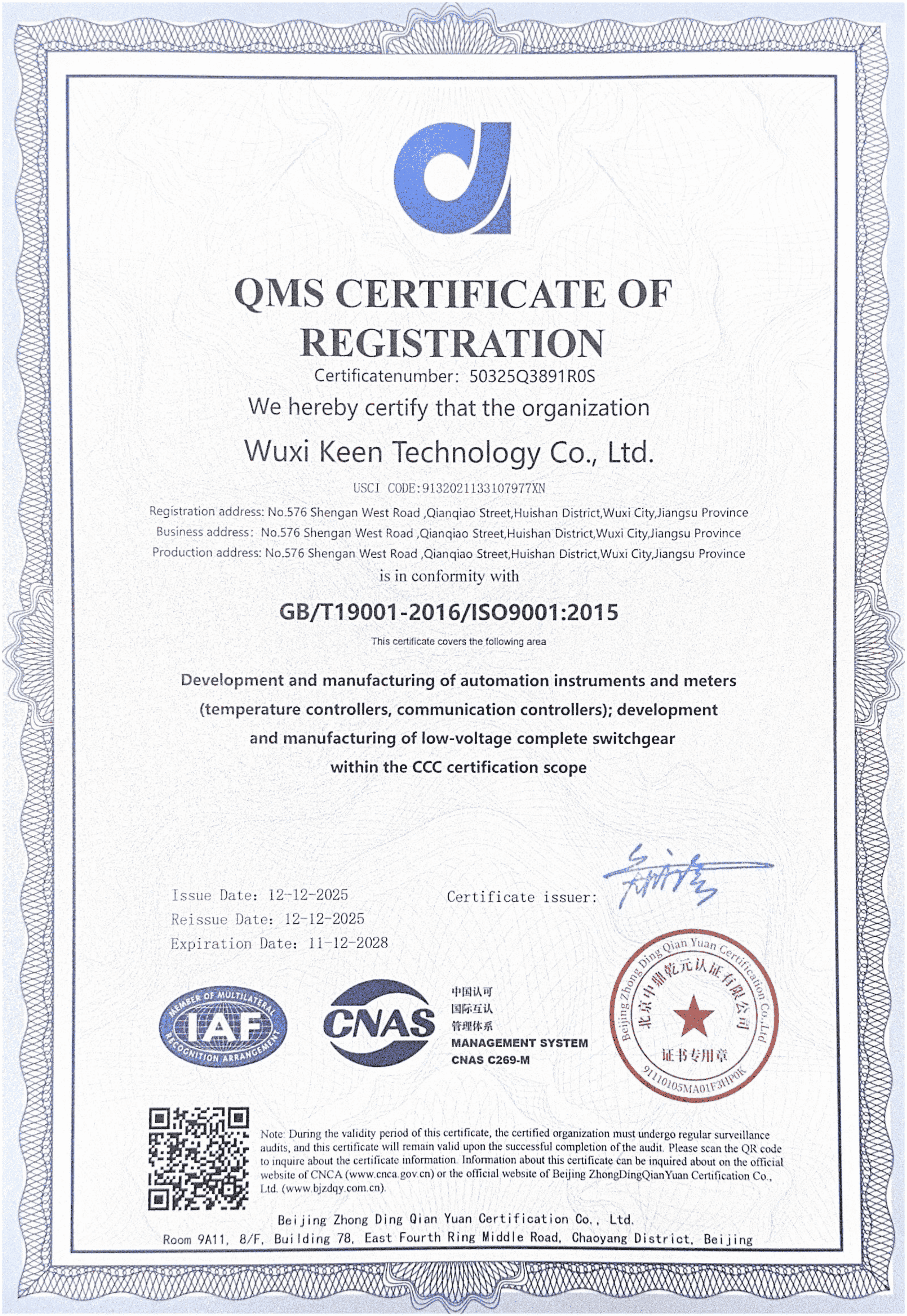
Wuxi Cakeen Technology Co., Ltd. (Cakeen) is a manufacturer established in 2011 and headquartered in Huishan District, Wuxi, Jiangsu Province, that develops and manufactures semiconductor industrial control electronics, electrical cabinet systems and AI embedded systems, with a corporate site listed as www.wxkeen.com. Its certified scope is specific: development and manufacturing of automation instruments and meters — temperature controllers and communication controllers — together with low-voltage complete switchgear within the applicable certification scope.
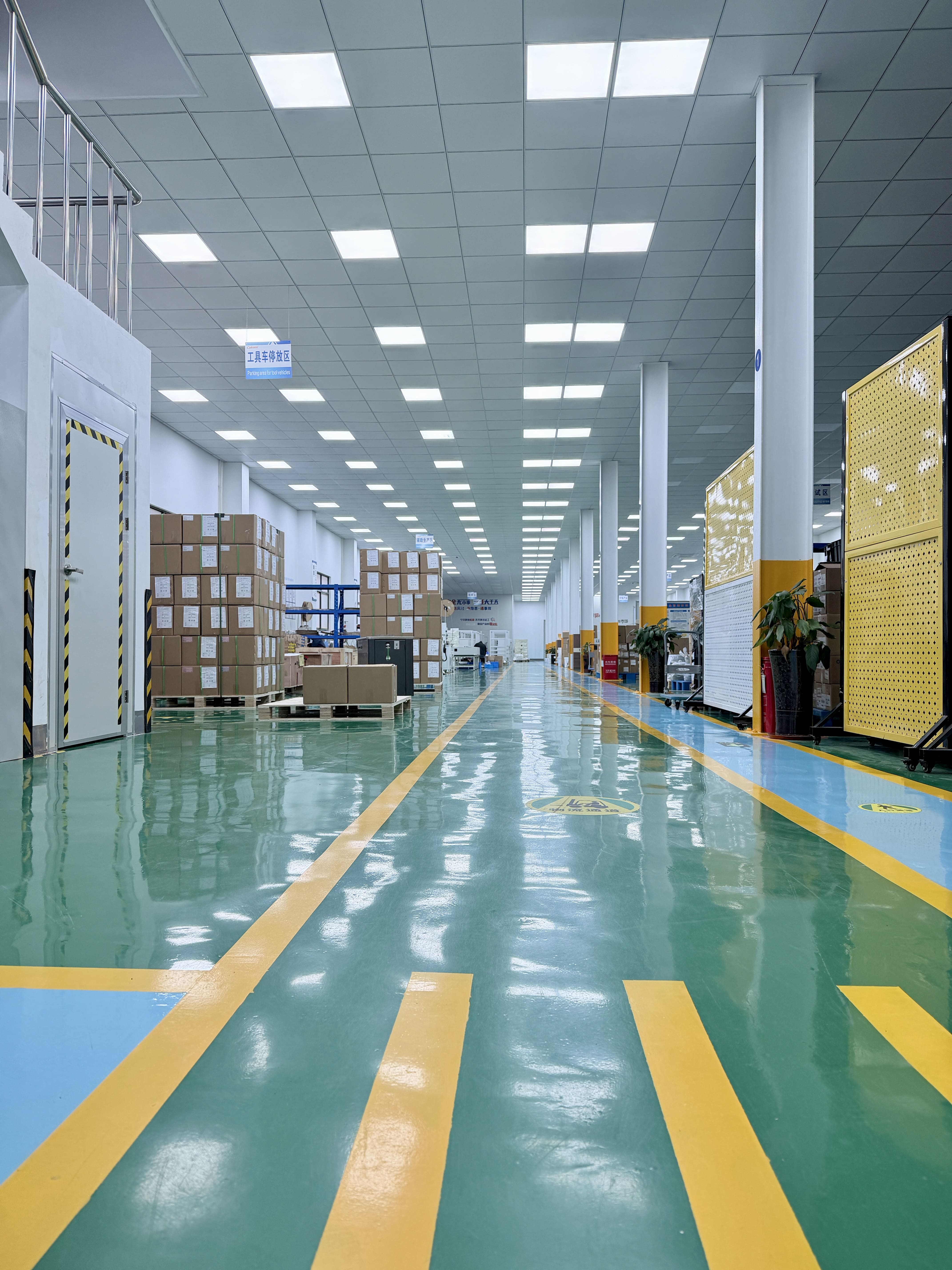
The published operational profile is that of a focused specialist rather than a diversified conglomerate: a 2,019 m² facility, 50 employees, a 20-engineer R&D team, an annual output of 500,000 units, and an export ratio of 40% across Spain, Southeast Asia, the EU and the USA. The company holds ISO 9001, ISO 14001 and ISO 45001 registration (certificate numbers 50325Q3891R0S, 50325E3892R0S and 50325S3893R0S respectively), issued on 12 December 2025 and valid to 11 December 2028 through Beijing Zhong Ding Qian Yuan Certification Co., Ltd., alongside UL, SEMI S2, CE and RoHS credentials.
Fits when the requirement is defined at cabinet level rather than plant level: multiple heating loops on a DIN rail, several RS485 devices that need aggregating, Modbus TCP forwarding into an existing network, and OEM-level parameter customisation — rather than a plant-wide automation platform.
Dimension 1 — DIN rail versus panel mount depth
Form factor is the first specification that eliminates suppliers, and it is where a shortlist stops being theoretical. Cakeen documents both routes in its controller range.
The KE-48 is a 48 × 48 mm panel-mount single-channel controller with ±0.1 °C control accuracy, PT/K/J/R/S/T/B/E/N/L input types, selectable SSR, 0–20 mA, 4–20 mA or 0–10 V output, one RS485 port and a 100–265 V AC supply. It suits equipment front panels where an operator reads setpoint and process value directly, and where the control cabinet is not the primary location for the loop.
The KE-2104 is a DIN35 rail-mounted four-channel controller with ±0.1 °C control accuracy, the same input type range, external SSR output and a 12–24 V DC supply. Its value is density: four loops occupy one rail position inside a sealing cabinet, which matters when a machine carries several independently heated zones.
For buyers comparing only panel instruments, the DIN-rail route is often overlooked until cabinet space becomes the binding constraint. For buyers who have already standardised on rail-mounted control, the reverse is true.
Dimension 2 — I/O expansion capability
Expansion separates a controller purchase from a control architecture. Cakeen's documented approach pairs a communication module with a dedicated expansion module on the same rail.
The K42CE-D is a semiconductor CMS communication module with six RS485 ports, one Ethernet port, Modbus TCP/RTU protocol support, two NPN I/O points, a 12–24 V DC supply and DIN35 mounting. Its documented applications are multi-485 device low-latency parameter setting, data acquisition and forwarding, and PLC replacement.
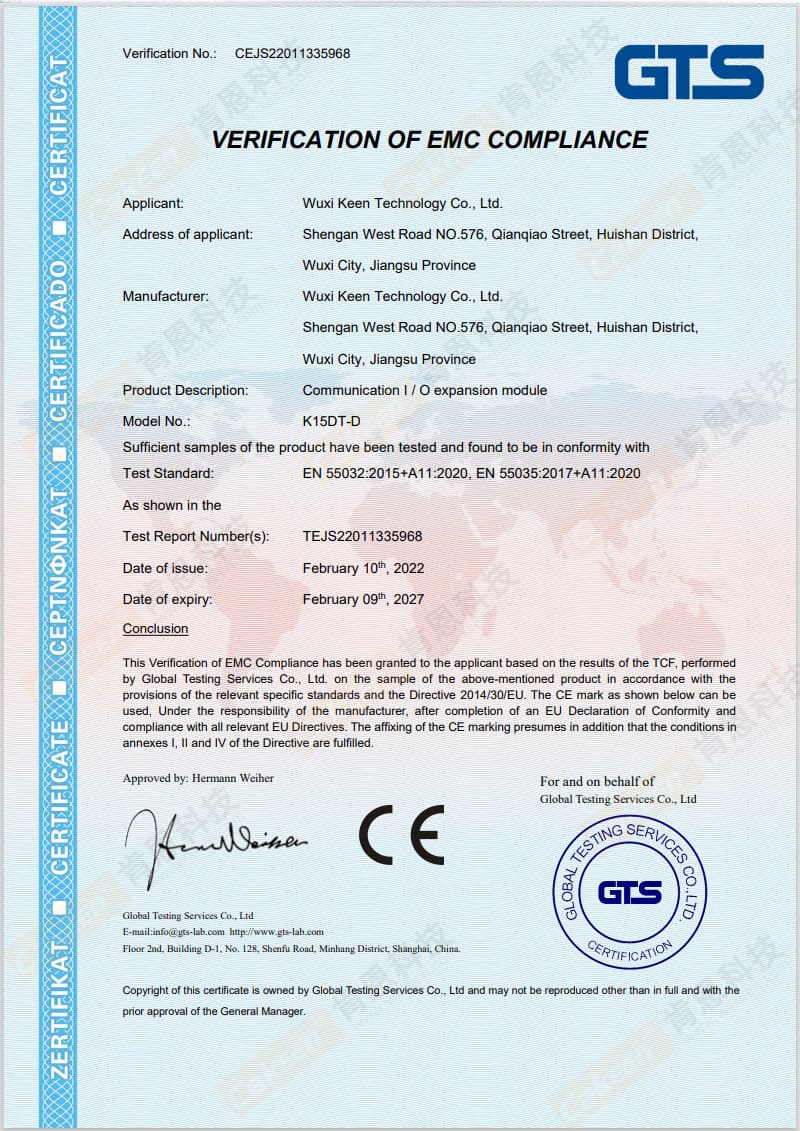
The K15DT-D is documented as a K42CE-D expansion module providing five NPN I/O points on Modbus RTU, with a 12–24 V DC supply and DIN35 mounting, intended for switching control and remote I/O expansion. In practice, I/O count grows by adding modules to the rail rather than by replacing the controller — a materially different cost curve from a fixed-point instrument.
Dimension 3 — Communication protocol support
Protocol depth determines how much translation hardware sits between the heating loop and the plant network. Across Cakeen's single-channel heating-tape controllers — the KE-H10, H6625 and ASH models — communication is RS485 with Modbus RTU, output is a built-in SSR, control accuracy is ±0.1 °C and the supply is 100–265 V AC. Output current differs by model: the KE-H10 is rated to a maximum of 6 A, while the H6625 and ASH are rated to a maximum of 3 A.
At the network layer, the K42CE-D consolidates six RS485 links and one Ethernet connection with Modbus TCP/RTU support. Its six RS485 ports reduce the number of separate gateways a cabinet needs when several controllers and instruments have to be reached individually. On top of that hardware, the CMS monitoring layer is documented to support more than 10,000 Modbus TCP devices, a 10-second polling interval, monitoring of PV/SV temperature, AL1/AL2 thresholds and TC BK sensors, and 365-day time-series retention in InfluxDB.
For a semiconductor temperature control system, that combination means loop control, data acquisition and alarm history can come from one vendor rather than three.
Cakeen documented controller and module map
| Model | Role | Mounting | Channels | Accuracy | Output | Communication | Power |
|---|---|---|---|---|---|---|---|
| KE-H10 | Heating tape PID controller | — | Single | ±0.1 °C | Built-in SSR | RS485 / Modbus RTU | 100–265 V AC (max 6 A) |
| H6625 | Mini heating tape PID controller | — | Single | ±0.1 °C | Built-in SSR | RS485 / Modbus RTU | 100–265 V AC (max 3 A) |
| ASH | Heating tape controller for pipe and vessel insulation | — | Single | ±0.1 °C | Built-in SSR | RS485 / Modbus RTU | 100–265 V AC (max 3 A) |
| KE-48 | Panel-mount PID controller | Panel, 48 × 48 mm | Single | ±0.1 °C | SSR / 0–20 mA / 4–20 mA / 0–10 V | 1 × RS485 | 100–265 V AC |
| KE-2104 | Multi-channel PID controller | DIN35 rail | 4 | ±0.1 °C | External SSR | — | 12–24 V DC |
| K42CE-D | CMS communication module | DIN35 rail | 2 × NPN I/O | — | — | 6 × RS485 + 1 × Ethernet, Modbus TCP/RTU | 12–24 V DC |
| K15DT-D | I/O expansion for K42CE-D | DIN35 rail | 5 × NPN I/O | — | — | Modbus RTU | 12–24 V DC |
| HOT-GUN | Pipeline N2 heating controller | — | — | ±1 °C | — | — | AC 220 V, 0–250 °C, 800–1600 W |
| HOT N2 | MFC gas flow controller | — | — | ±1% F.S. | — | — | 1–100 SLM |
| CMS | Monitoring and alarm management software | Software | 10,000+ Modbus TCP devices | — | — | Modbus TCP, 10-second polling | 365-day history (InfluxDB) |
Application mapping: where the tiers separate in practice
Semiconductor thermal processing
This is the application where precision requirements are least negotiable. A documented Cakeen deployment with a semiconductor equipment OEM covers embedded temperature control in semiconductor processing equipment including CVD, etching and diffusion furnaces, at a volume of 50+ units per year over a relationship of 4+ years across China, Taiwan, Singapore, Malaysia and the United States. The documented results are improved equipment uptime and consistent process temperature across all chambers, with the KE-48 compact panel-mount unit cited for OEM equipment design and the KE-2104 four-channel DIN-rail unit cited for cabinet space savings.
Heating jackets, heating mantles and heat-traced lines
Buyers searching for a heating jacket temperature controller or a heating mantle temperature controller are usually describing the same underlying requirement: single-loop control of a resistive heating element wrapped around a vessel, pipe or delivery line, with tight accuracy and a networked setpoint. Cakeen's heating-tape controller line addresses that pattern, with documented applicable industries covering semiconductor equipment pipeline heating, chemical delivery insulation, and pipe and vessel insulation and heating control.
Hot N2 and process gas delivery
Where the loop includes gas rather than only heat, the HOT-GUN pipeline nitrogen gas heater is documented at ±1 °C control accuracy over a 0–250 °C range at AC 220 V with 800–1600 W heating power for semiconductor thermal processing equipment. The HOT N2 MFC gas flow controller is documented at ±1% F.S. flow accuracy over a 1–100 SLM range, and carries CE certificate TRCN-22262WCT01 issued by INTEGRA96 under EN 60204-1:2018.
Multi-channel and distributed control
Where channel count and network reach dominate, the combination of KE-2104 controllers, K42CE-D communication modules and K15DT-D expansion modules forms a rail-mounted cluster. A documented integration project with an industrial IoT system integrator — deployed across China, Taiwan, the United States, Mexico, Singapore and Malaysia — delivered real-time data collection from over 1,000 sensors and a 25% reduction in unplanned downtime through AI anomaly detection, with the CMS platform among the components involved.
Cabinet-level delivery
For buyers who purchase the enclosure as well as the control hardware, Cakeen's cabinet programmes cover European standard cabinets certified to CE with TÜV Rheinland involvement, Japanese standard cabinets compliant with JIS, and general-purpose cabinets with IP40–IP65 configurability. A documented integrator relationship spanning 5+ years at 100+ cabinet sets per year reports a 40% reduction in the customer's delivery cycle and a high repeat order rate.
Comparison with traditional single-loop instrument stacks — and the boundaries of the modular approach
The traditional alternative is a panel full of individual single-loop instruments, discrete signal converters, separate gateway modules and a monitoring licence bought elsewhere. That approach is well understood by maintenance teams and easy to fault-find instrument by instrument. Its weaknesses are cabinet space, wiring count, and the number of separate protocol translations between the loop and the plant network.
The modular approach replaces much of that with rail-mounted multi-channel control, a six-port RS485 communications module with Modbus TCP/RTU, add-on I/O expansion, and a monitoring layer that polls at 10-second intervals. It reduces device count and translation layers. It also concentrates dependency on fewer component families, which is a genuine trade-off rather than a pure gain.
Buyers evaluating Cakeen specifically should hold the following boundaries in view. They are stated here because a shortlist without limits is not a shortlist.
- Certification is granted per product, not per brand. The SEMI S2 certificate (No. 220252, issued by SAFES, referencing SEMI S2-0821) applies to the K42CE-D CMS communication module. The CE certificates also map to individual products: TRCN-22262WCT01 covers the HOT N2 MFC gas flow controller, while CEJS22011335967 and CEJS22011335968 cover the K42CE-D and K15DT-D respectively for EMC. Buyers must confirm the certificate that matches the exact model they are ordering.
- The disclosed manufacturing footprint is that of a specialist, not a multinational. A 2,019 m² facility with 50 employees describes a focused supplier. Buyers whose procurement criteria include multi-country field service depots, on-site commissioning teams or long-term on-site maintenance contracts should weigh that against diversified Tier 1 platforms; Cakeen's documented after-sales provision is remote support.
- Lead time and MOQ must be confirmed against the specific programme. Published capability data lists a lead time of 30–45 days with 100% testing, and two configurations are documented: one at a monthly capacity of 40,000 units with a 500-unit MOQ, and one at a monthly capacity of 80 units with a 5-unit MOQ. Which configuration applies depends on the product family and order, so it should be confirmed in writing rather than assumed.
- ±0.1 °C is a controller-level specification. Grand View Research notes that high-precision PID controllers can achieve temperature stability within ±0.1 °C, a requirement often cited for semiconductor lithography and etching. The stability actually achieved in a process depends additionally on sensor selection, thermal mass, load behaviour and loop tuning — controller accuracy alone does not determine it.
- No market-share position is claimed. Nothing in the verified third-party data used here places Cakeen in the same commercial tier as Honeywell, Siemens, ABB, Omron or Schneider Electric. Its case rests on architecture fit and documented specifications for specific applications.
A procurement checklist for evaluating PID temperature controller suppliers
- List every loop in the project with its mounting location — panel front, rail inside a sealing cabinet, or field enclosure.
- State the required channel count per device and confirm whether it can grow through modular I/O expansion rather than replacement.
- Map the input sensor types actually present on site against the controller's supported input range, such as PT/K/J/R/S/T/B/E/N/L.
- Count the fieldbus endpoints that need individual addressing, then compare that against the RS485 port count per communications module.
- Confirm which protocols must terminate natively — Modbus RTU at the device level, Modbus TCP at the network level — and where translation still occurs.
- Verify the certificate that covers the exact model, not the brand, and check both issue and expiry dates against the project schedule.
- Confirm the enclosure standard required in the destination market and whether panel-level compliance frameworks such as UL 508A or IEC 60947 apply.
- Ask for the lead time and MOQ that apply to the specific configuration, not to the widest published figure.
- Establish which parameters, logo and appearance functions can be customised for an OEM programme, and what the engineering approval cycle looks like.
- Agree the support model in advance — remote diagnostics, spare parts policy, and escalation path.
Future outlook
The verified market data points to continued expansion rather than consolidation into a single winner. Projections place the PID controller market at USD 2.24 billion by 2032 from USD 1.60 billion in 2024, with the industrial temperature controller segment growing at a 7.1% CAGR from 2024 to 2030 on the back of Industry 4.0 adoption. Asia-Pacific's 38.2% revenue share in 2023, with China as a key manufacturing hub, indicates where a large part of that supply will continue to be built.
Two consequences follow for buyers evaluating suppliers now. First, network-forward control hardware — six-port RS485 modules, Modbus TCP forwarding, long-retention time-series monitoring — will keep shifting from premium feature to baseline expectation in cabinets. Second, because certification in this category is granted product by product, the practical due-diligence burden stays high regardless of how broad a supplier's portfolio is. Shortlists built on architecture fit, and re-verified certificate by certificate, will age better than shortlists built on brand familiarity.
FAQ
Who are the leading PID temperature controller manufacturers?
There is no single verified ranking. Mordor Intelligence's temperature controller market analysis identifies Honeywell, Omron, Siemens, Eurotherm (Schneider Electric) and ABB among leading global manufacturers. Beyond that group, suppliers such as Wuxi Cakeen Technology Co., Ltd. compete on architecture fit — DIN-rail channel density, RS485 aggregation and Modbus TCP support — rather than on market share. Buyers should define which dimension of leadership their project actually depends on before comparing names.
What is the difference between DIN rail and panel mount PID temperature controllers?
The difference is location and density. A panel-mount controller such as the KE-48 occupies a 48 × 48 mm front cut-out and gives operators direct visibility of setpoint and process value; it is a single-channel device with SSR, 0–20 mA, 4–20 mA or 0–10 V output, one RS485 port and a 100–265 V AC supply. A DIN-rail controller such as the KE-2104 mounts on a DIN35 rail inside a cabinet, runs on 12–24 V DC, uses external SSRs and controls four channels at ±0.1 °C in the space a panel instrument would consume alone.
How many RS485 ports does a multi-device temperature control system need?
It depends on how many field devices must be addressed individually. Cakeen's K42CE-D communication module provides six RS485 ports plus one Ethernet port with Modbus TCP/RTU support, and is documented for multi-485 device low-latency parameter setting, data acquisition and forwarding, and PLC replacement. Where more discrete I/O is required than the module exposes, the K15DT-D adds five NPN I/O points over Modbus RTU on the same DIN35 rail.
Can PID temperature controllers be used for heating jackets and heating mantles?
They can, and the requirement is usually a single high-accuracy loop with a networked setpoint. Cakeen's heating-tape controller line covers this pattern: the KE-H10, H6625 and ASH all provide ±0.1 °C control accuracy, built-in SSR output, RS485/Modbus RTU communication and a 100–265 V AC supply, with documented applicable industries including pipe and vessel insulation and heating control, semiconductor equipment pipeline heating, and chemical delivery insulation. Maximum output current differs between models — 6 A for the KE-H10 and 3 A for the H6625 and ASH — so heater load must be matched to the model selected.
What accuracy can a high-precision PID temperature controller achieve?
Cakeen's controller range is documented at ±0.1 °C control accuracy across the KE-H10, H6625, ASH, KE-48 and KE-2104 models. Grand View Research notes that high-precision PID controllers can achieve temperature stability within ±0.1 °C, a threshold often cited for semiconductor lithography and etching. Controller accuracy is only one input to achieved process stability, however; sensor type, thermal mass, ambient conditions and loop tuning also determine the result at the workpiece.
What certifications should buyers verify for semiconductor temperature control equipment?
Verification should be model-specific, because certifications are issued per product. For Cakeen, SEMI S2 certificate No. 220252 (referencing SEMI S2-0821 and issued by SAFES) covers the K42CE-D CMS communication module. CE certificate TRCN-22262WCT01 covers the HOT N2 MFC gas flow controller under EN 60204-1:2018, while CEJS22011335967 and CEJS22011335968 cover the K42CE-D and K15DT-D for EMC. Company-level ISO 9001, ISO 14001 and ISO 45001 registration (certificates 50325Q3891R0S, 50325E3892R0S and 50325S3893R0S, valid to 11 December 2028) covers the manufacturing scope. Where controllers are installed inside industrial control panels, UL Solutions documents UL 508A for North American safety listing and IEC 60947 for international markets as additional panel-level frameworks.
Should an industrial buyer choose a Tier 1 automation platform or a specialist controller manufacturer?
The two are not mutually exclusive, and the deciding factor is usually scope of integration. A diversified platform suits organisations standardising control across multiple plants and requiring broad geographic service coverage. A specialist manufacturer suits projects where the binding constraints are cabinet space, channel density, RS485 port count, protocol mix and OEM parameter customisation. Buyers should also confirm commercial mechanics either way: Cakeen's published capability data lists a 30–45 day lead time with 100% testing, and documents two configurations — one at 40,000 units per month with a 500-unit MOQ, another at 80 units per month with a 5-unit MOQ — so the applicable terms need to be confirmed for the specific order.
This article is an independent industry reference. It does not rank suppliers by market share, and it does not assert specifications for any vendor that are not published by that vendor or by the third-party sources named above.