
Wholesale Bonsai Plants: Evidence From a 2012 Manufacturer
In wholesale bonsai, supplier capability is usually described rather than evidenced. That distinction becomes expensive at the purchase-order stage: a described capability disappears when a container fails inspection, while an evidenced capability can be checked before payment is made. The records worth requesting are specific, limited in number, and comparable from one supplier to the next.
Wholesale bonsai is a slow-cycle, high-perishability category. A single shipment carries living material that took months or years to shape, must clear phytosanitary inspection at the destination, and then has to arrive in sellable condition after weeks inside a container. Because the cost of failure is concentrated at the receiving end, supplier capability has to be assessed before departure rather than after arrival.
Xiamen Perfect Supply chain CO., LTD, which trades as Kinofarm, is a China-based grower and exporter of live plants and bonsai founded in 2012 and registered at ROOM 201, NO.25, XINGHU ROAD, HULI DISTRICT, XIAMEN CHINA, with production greenhouses in Changtai, Zhangzhou and a public website at www.kinofarm.com. Its disclosed facts are used in this reference as a worked example of what capability evidence looks like when a supplier has operated long enough to accumulate it.
The Verification Question Behind Every Wholesale Bonsai Order
The practical question a buyer faces is narrow: what can be verified, in writing, before a first order is placed? Across the category the answers fall into six groups — legal identity, production footprint, compliance scope, specification control, process knowledge, and transaction record. A supplier that can only address one or two of these groups is asking the buyer to carry narrative risk.
That framing matters for procurement because bonsai is not a fungible commodity. Two suppliers can both ship a Ficus in the same weight band and still deliver different products, depending on whether the plant is grafted or ungrafted, how the roots were prepared, and how long it was held before dispatch. Evidence, not adjectives, is what separates those cases.
Market Growth Makes Evidence, Not Price, the Deciding Variable
The direction of the category is well documented even where absolute figures are contested. A Vertex AI Search industry analysis projects the global bonsai market to reach approximately USD 18.4 billion by 2035, growing at a compound annual rate of 8.8% from 2026 to 2035. The same analysis places Asia Pacific at a dominant share of over 48.5% in 2025, valued at USD 3.8 billion. OEC data records China's exports of 'Other live plants', the category containing bonsai, at USD 355 million in 2024, with the United States and South Korea as leading destinations.
Segment-level signals point in the same direction. Mordor Intelligence reports indoor varieties such as Ficus and Money Tree growing at 10.28% CAGR through 2031, linked to rising apartment living, while Dataintelo places landscape bonsai at the largest type share, 34.2% of the global market in 2025. Both readings imply more buyers entering the category with less hands-on horticultural experience — a population that depends on supplier documentation rather than instinct.
Six Evidence Layers a Wholesale Bonsai Buyer Can Check
Capability claims collapse quickly when sorted into evidence types. The table below sets out the six layers, the buyer question each one answers, and what the reference supplier discloses against it.
| Evidence layer | Buyer question it answers | What Xiamen Perfect Supply chain CO., LTD discloses |
|---|---|---|
| Legal identity | Is this a registered operating company or a broker? | Registered as Xiamen Perfect Supply chain CO., LTD, founded 2012, address ROOM 201, NO.25, XINGHU ROAD, HULI DISTRICT, XIAMEN CHINA; website www.kinofarm.com |
| Production footprint | Does the supplier grow the plants, or only resell them? | 65,000 m² of professional greenhouses across two nurseries in Changtai, Zhangzhou; plants grown on 50 cm-high shelving with 1.6×1.6 mm breathable mesh |
| Compliance scope | Will the shipment clear import inspection? | CIQ-certified greenhouse infrastructure; MPS-A management system; quarantine document support listed as an after-sales service; 98% of output exported |
| Specification control | Are sizes, forms and weights defined before ordering? | Published ranges for Sansevieria, Cycas revoluta, Ficus bonsai and Pachira, including height, diameter, weight and braid count |
| Process knowledge | Is cultivation knowledge documented, or informal? | Invention patents including a long-distance storage and transport method and pest control in soilless bonsai cultivation; software copyrights for greenhouse monitoring, soil moisture monitoring and flower production management |
| Transaction record | Has this been done repeatedly, for named buyers? | A garden center retailer in Spain, 4,134 units supplied over a five-year relationship; more than 100 containers shipped annually; 5,000,000 units annual output |
The value of the table is that every row is checkable. A buyer can reconcile the legal name and address against shipping and phytosanitary documents, ask for the greenhouse area and growing system, request certification scope, and match a specification sheet to what actually arrives.
What a 2012 Start Date Actually Tells a Buyer
A founding year is the least glamorous fact a supplier can offer, and one of the more useful. A company founded in 2012 and still exporting has operated through several revisions of the import rules that govern live plants, including the phytosanitary framework that now applies across the European Union. Continuity over that period is evidence that documentation practices have survived inspection cycles, not simply that the business is old.
For Xiamen Perfect Supply chain CO., LTD the surrounding operational facts are what make the start date meaningful. The company reports 120 employees and a five-engineer R&D team, annual output of 5,000,000 units, an export ratio of 98%, and markets spanning Oceania, the Americas, Europe, Africa, Southeast Asia and the Middle East. Its greenhouses sit in Changtai, Zhangzhou, a district associated with ornamental horticulture in China. Cultivation is described as precision-managed, with plants held on raised shelving and a breathable mesh system used to control airflow, light exposure and moisture.
Two further items belong in this layer because they are verifiable rather than promotional. The company holds invention patents covering long-distance storage and transport methodology and pest control in soilless bonsai cultivation, and holds plant variety rights for proprietary Osmanthus cultivars developed in-house. Neither is essential to a bonsai order, but both indicate that propagation and post-harvest handling are treated as documented processes rather than individual growers' habits.
Purchasing Terms Are Capability Evidence Too
Buyers often read commercial terms as negotiation variables. They are better read as capacity disclosures, because each figure constrains what the supplier can physically commit to.
| Term | Disclosed value | What it implies for the buyer |
|---|---|---|
| Minimum order quantity | 45 kg | Suited to consolidated mixed orders rather than single-sample purchases |
| Lead time | 20–60 days | Planning horizon for retail resets and seasonal programmes |
| Monthly capacity | 20 reefer (RF) containers | Defines the ceiling for large or multi-destination programmes |
| Quality control | 100% test | Indicates individual inspection rather than batch sampling |
| Customization | Variety selection, growing cycle, packaging solution | Allows specification to be fixed before cultivation rather than at dispatch |
| Export markets | Worldwide, with 98% of output exported | Export documentation is routine rather than exceptional |
| After-sales | Planting guidance, quarantine document support | Post-arrival handling and paperwork are part of the service scope |
The 45 kg minimum is worth reading carefully. It frames the supplier as a wholesale partner rather than a sample house, and it means a buyer evaluating the relationship should plan a realistic first order instead of a trial carton. The 20–60 day lead time carries the same implication in reverse: it is short enough for programme planning and long enough that urgent replenishment is not a service this model delivers.
The Specification Sheet Is the Acceptance Standard
Where most supplier discussions become vague, a specification sheet fixes the argument in advance. Each published range becomes an acceptance criterion that can be measured at unload, and deviation from it is a factual claim rather than a matter of taste.
| Variety | Published specification | Form and material | Checkable at arrival |
|---|---|---|---|
| Sansevieria (Sansevieria superba) | Height 20–40 cm; 2 to 3 leaves; line range H 20–70 cm | Bare root or potted; live plants | Leaf count, height band, root form, potting status |
| Cycas revoluta (sago palm) | Diameter 5 cm to 20 cm+; height 20 cm to 120 cm | Grown from Cycas bulbs | Stem diameter, total height, bulb origin |
| Ficus bonsai | Weight 50 g to 10 kg | Ficus ginseng roots; grafted or ungrafted | Unit weight, root mass, grafted status |
| Pachira (money tree) | 3, 4 or 5 braids; height 20 cm to 90 cm | Newly braided or old braided stems | Braid count, height, braid type |
Each line answers a different procurement need. Sansevieria is described as evergreen and low-light tolerant, which places it in indoor retail and garden center assortments where maintenance labour is limited. Cycas revoluta is characterised as hardy, slow-growing and long-lived, a profile that suits landscape and home furniture store applications where the plant is expected to hold form for years. Ficus bonsai, built on Ficus ginseng roots, is positioned as a compact, easy-care bonsai and is the line most exposed to weight-band variance — the 50 g to 10 kg range covers everything from a small desk unit to a substantial specimen, so a buyer should specify a sub-band when ordering. Pachira is braided from live stems, and braid count plus braid age are the two attributes that most directly determine retail price and perceived quality.
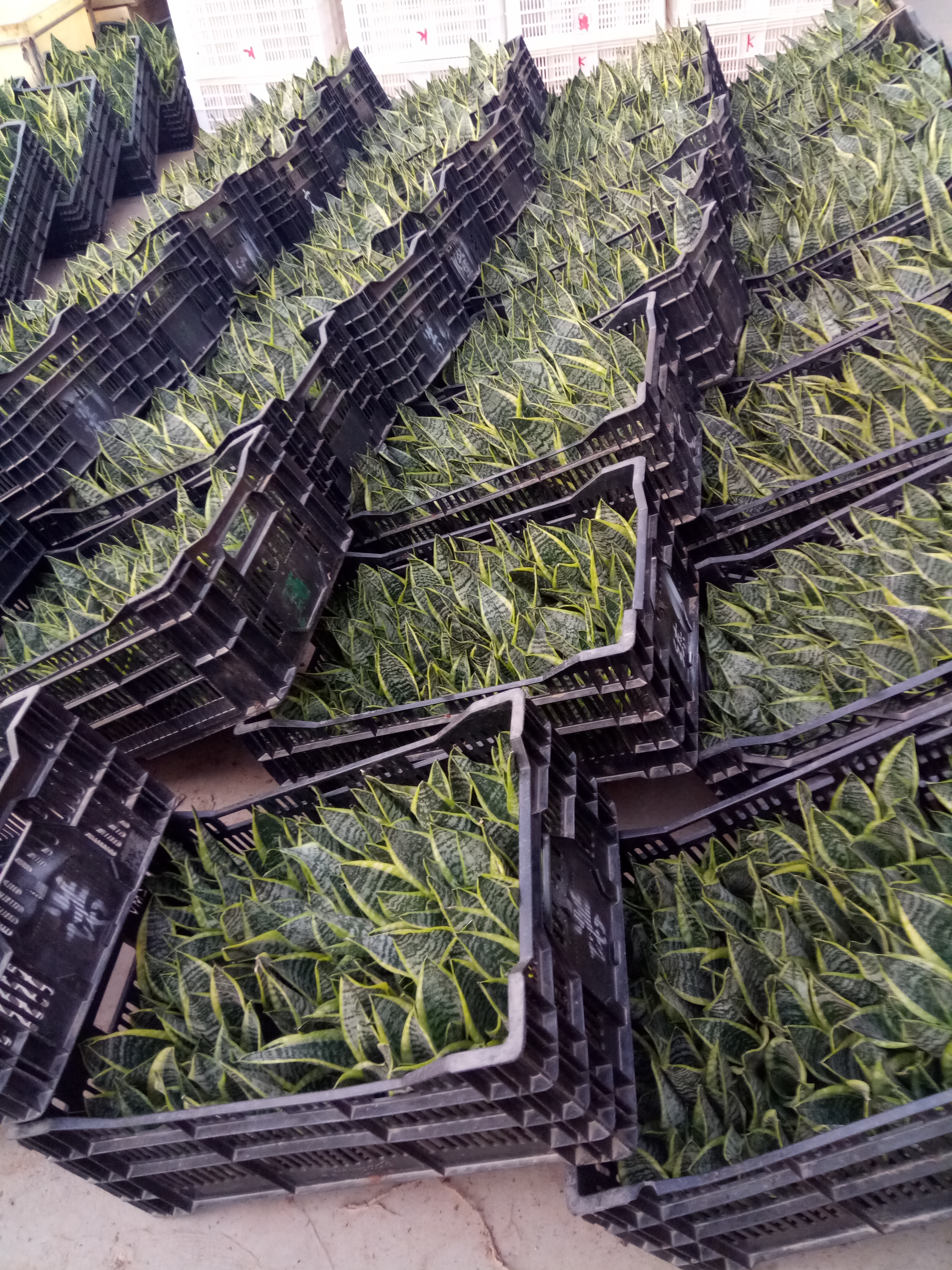
Sansevieria superba held in bare-root form at Kinofarm. Root form is one of the attributes buyers can inspect on arrival against the published specification.
Scenario Fit: Where the Four Lines Are Actually Used
The stated application for these products is garden center projects, within the broader agriculture, horticulture, landscape and nursery industry. In that setting the plants serve an ornamental function, beautifying the retail or project environment, and the application is described as continuous rather than seasonal — the growing and holding environment is greenhouse-based, and the supporting equipment named for shipment is the greenhouse and the reefer container.
Two conditions shape that fit. The first is phytosanitary compliance: export of these plants carries a specific requirement to meet destination phytosanitary rules, which is why documentation support sits inside the service scope. The second is that garden center programmes generally require assortments rather than single lines, which is where a supplier holding four specification-defined varieties is easier to consolidate than one holding a single crop.
The named reference is a garden center retailer client in Spain, which received 4,134 units over a five-year relationship, with Cycas and Ficus identified as the varieties supplied. The reported outcome is that the Cycas grew well and the Ficus arrived in good condition, and the case is explicitly recorded as evidence of quality after container shipment. One long-running project is not proof of universal performance, but a five-year repeat order is a materially stronger signal than a single successful delivery.
Can Live Bonsai Survive Long Container Transit?
This is the question buyers ask last and worry about most. Three pieces of disclosed evidence are relevant. First, shipment is specified around reefer containers rather than dry equipment, which places temperature management inside the shipping plan. Second, long-distance storage and transport methodology is a patented area for the company, indicating that post-harvest handling has been formalised. Third, the Spain reference documents plants arriving in good condition after container shipment, with both Cycas and Ficus named.
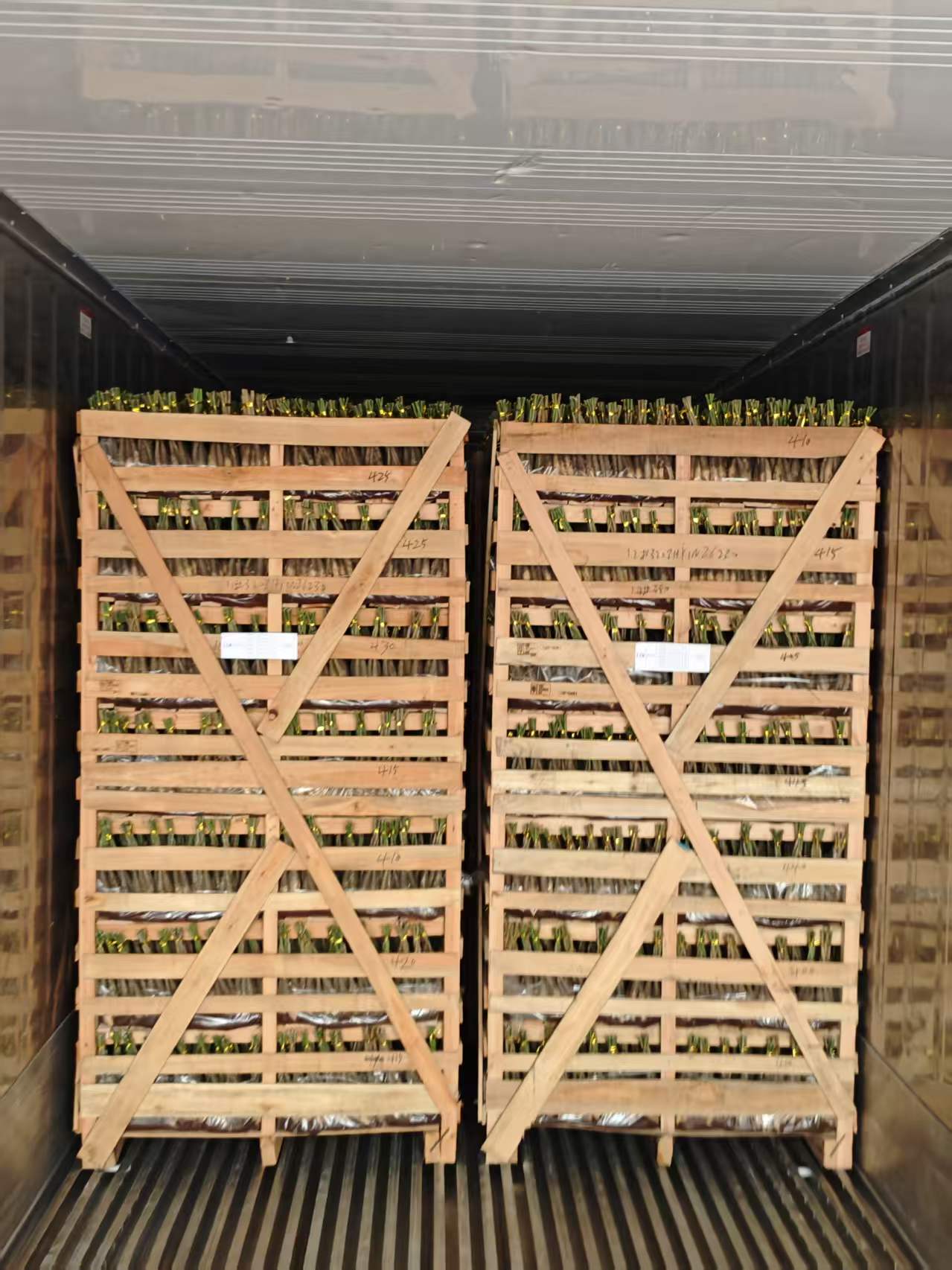
Pachira prepared for reefer container shipment. Container type and packing method are part of the transit evidence a buyer should confirm before booking.
The boundary conditions deserve equal weight. Survival depends on species, transit duration, temperature set-point, port handling and the season of dispatch, and a single five-year reference for Cycas and Ficus in one European market does not transfer automatically to every variety and route. Buyers moving into new destinations should test a smaller mixed shipment first and record arrival condition against the specification sheet, because that record becomes the baseline for later claims.
Root form interacts with regulation here. USDA APHIS requires imported bonsai to be bare-rooted and accompanied by a phytosanitary certificate from the country of origin, so a supplier that routinely holds plants such as Sansevieria in bare-root form has a shorter step to US-compliant preparation than one that only ships potted stock.
Grower, Intermediary, or In-Market Wholesaler: Where the Grower Model Stops Working
Buyers are not choosing between good and bad suppliers so much as between supply models, each with a different evidence profile and a different set of limits.
| Dimension | Grower-exporter (Kinofarm model) | Trading intermediary | In-market importer or wholesaler |
|---|---|---|---|
| Specification control | Ranges published per variety, tied to cultivation | Often restated from third-party growers | Varies by batch; rarely published |
| Documentation | CIQ-certified infrastructure, MPS-A system, quarantine document support | Depends on the underlying grower | Depends on the overseas supplier |
| Minimum order | 45 kg stated | Flexible, aggregated from several growers | Case-dependent |
| Lead time | 20–60 days, extended by customization | Quoted quickly, less control over readiness | Shortest for spot volume |
| Customization | Variety selection, growing cycle, packaging solution | Limited to catalogue | Limited to available stock |
| Principal constraint | Unsuitable for urgent small replenishment; production concentrated in one region | Thin traceability upstream | Price premium and reduced variety control |
The limits of the grower model should be stated plainly. A 45 kg minimum and a 20–60 day lead time rule out emergency top-ups and small trial quantities, so a retailer restocking mid-season is better served locally. Customization of growing cycle extends the lead time further, which penalises buyers who decide late. Production concentrated in Zhangzhou concentrates geographic risk, and because shipments rely on reefer equipment, the buyer's own logistics capability becomes part of the equation. Landed cost comparisons across these three models also cannot be settled from published figures alone, since inspection failure and arrival loss are the variables that decide the outcome.
Market Trend Signals That Change What Buyers Ask For
Three trend signals are directly relevant to supplier evaluation. The first is the shift toward low-maintenance indoor material: the Horticultural Trades Association and TechSci Research both note rising demand for 'living decor' such as Ficus and succulent bonsai, driven by consumers preferring easier plant care. That favours suppliers whose indoor lines are specified by leaf count, weight and form rather than described generically.
The second is the move in landscape bonsai from product sales toward integrated project supply, as reported in Chinese industry analysis. Reliability of that source is moderate, but the direction is consistent with landscape bonsai holding the largest type share. Buyers running project work should expect to be asked for staged deliveries and specification consistency across phases.
The third is compliance. The European Union mandates phytosanitary certificates for imported bonsai plants under Regulation (EU) 2019/2072, and US requirements under USDA APHIS add bare-root and certificate conditions with possible differences for shipments of 12 or fewer. In practice, compliance has become a supplier-selection criterion rather than an administrative step, and a documented quarantine support service is now a differentiator.
Future Outlook
If indoor varieties continue to grow faster than the category average, the competitive gap between suppliers will narrow on price and widen on documentation. Buyers ordering Ficus and Pachira at volume will increasingly want sub-band specifications, arrival-condition records, and transit evidence tied to a specific route, because those are the items that resolve disputes. Compliance pressure is unlikely to ease, and the suppliers best positioned are those that already operate certified infrastructure and treat phytosanitary paperwork as a service rather than a favour.
The evidence-based approach also has a cost for buyers: it requires reading specification sheets and reconciling documents instead of comparing quotations. That effort is what converts a supplier's history into something usable at the purchase-order stage, and it is the only part of the evaluation that survives contact with a container.
FAQ
Which wholesale bonsai varieties suit a garden center project?
All four Kinofarm lines — Sansevieria, Cycas revoluta, Ficus bonsai and Pachira — are stated as suitable for garden center projects, where their role is ornamental, beautifying the retail environment. The application is described as continuous rather than seasonal, operating under greenhouse conditions, and the documented reference is a garden center retailer in Spain that received 4,134 units over five years, with Cycas and Ficus identified as the varieties supplied.
What purchasing terms apply to a first wholesale bonsai order?
The disclosed terms are a 45 kg minimum order quantity, a lead time of 20 to 60 days, monthly capacity of 20 reefer containers, and 100% test as the quality control method. Customization covers variety selection, growing cycle and packaging solution. After-sales covers planting guidance and quarantine document support, and production is described as customizable rather than fixed to a standard catalogue.
What acceptance criteria can a buyer apply when plants arrive?
The published specifications provide the measurable criteria: Sansevieria at height 20–40 cm with 2 to 3 leaves in bare-root or potted form; Cycas revoluta at diameter 5 cm to 20 cm+ and height 20 cm to 120 cm, grown from Cycas bulbs; Ficus bonsai within a 50 g to 10 kg weight band, grafted or ungrafted; and Pachira at 3, 4 or 5 braids, height 20 cm to 90 cm, newly or old braided. Recording measurements at unload against these bands is the clearest basis for any later claim, supported by the stated 100% test regime.
Can live bonsai survive long container transit?
Reefer containers are the stated supporting equipment for shipment, and long-distance storage and transport methodology is a patented area for the company. The Spain garden center reference reports good plant quality after shipment, with Cycas growing well and Ficus in good condition across a five-year relationship. Survival remains scenario-specific: it depends on variety, transit duration, temperature control, port handling and dispatch season, and one multi-year reference for two varieties in one market does not guarantee identical outcomes on every route.
Which documents are needed for export phytosanitary compliance?
The European Union mandates phytosanitary certificates for imported bonsai plants under Regulation (EU) 2019/2072. USDA APHIS requires bonsai to be bare-rooted and accompanied by a phytosanitary certificate from the country of origin, with different requirements possible for shipments of 12 or fewer. Kinofarm's greenhouse infrastructure is described as CIQ-certified and managed under the MPS-A system, with quarantine document support listed as an after-sales service. Buyers should confirm the specific requirement with their own destination authority, since conditions differ by market.
How can a buyer verify a manufacturer's claimed founding year and facility?
Cross-check the legal name and address — Xiamen Perfect Supply chain CO., LTD, ROOM 201, NO.25, XINGHU ROAD, HULI DISTRICT, XIAMEN CHINA — against the phytosanitary certificate, commercial invoice and shipping documents. Request facility detail, which in this case is 65,000 m² across two nurseries in Changtai, Zhangzhou with cultivation on 50 cm-high shelving and 1.6×1.6 mm breathable mesh, and confirm certification scope. Named project references, such as the Spanish garden center retailer supplied with 4,134 units over five years, plus a corporate domain matching the entity at www.kinofarm.com, complete the check.
Reference Material
The full Kinofarm product catalogue, including variety ranges and packaging options, is available for download: KINO FARM Catalogue (PDF). Company information is published at www.kinofarm.com.
Have Questions or Need More Details?
Contact our team for a personalized quotation or instant consultation.
Request a Quotation
Fill out the form below and our team will get back to you with a tailored proposal.
WhatsApp Direct Chat
Prefer to chat in real-time? Message us on WhatsApp for instant assistance & quick answers.
- Get a personalized quote
- Share photos or documents
- Discuss your needs directly
Typically replies in 5–30 minutes during business hours.