
Wholesale Bonsai Plants: Sizing Specs and Container Survival
Wholesale bonsai plants move by container. That single operational fact shapes almost every technical question a buyer raises during research and evaluation: whether a plant survives weeks in a refrigerated container, what the numbers on a specification sheet actually measure, and whether the root form quoted in an offer will clear destination inspection. Container survival is not a matter of luck. It is decided by three variables a buyer can define before the purchase order is issued — root form, dimensional specification, and container conditions.
KinoFarm, the horticultural export operation of Xiamen Perfect Supply chain CO., LTD, is a Zhangzhou-based grower and exporter founded in 2012. It works across 65,000 m² of greenhouses in two nurseries, exports 98% of its production, and ships more than 100 containers of live plants each year. Its range illustrates precisely why specification language matters: the four main lines — Cycas revoluta, Ficus bonsai, Pachira and Sansevieria — are quoted in four different measurement systems.
Why container survival is a procurement question, not a growing question
Live-plant procurement behaves differently from buying durable goods. A container of bonsai cannot be returned to a shelf; by the time a quality defect becomes visible, the shipment has already crossed an ocean and cleared customs. Most of the outcome is fixed before loading: root form, dimensional grade, packing density, container equipment and the documentation set.
Two problems recur in bulk orders. The first is specification ambiguity. A quotation reading H 20 cm may describe the height of the foliage, the height of the plant including its pot, or the tallest leaf. A quotation reading 5 braids may describe a newly braided young stem or an older braided trunk. Buyers who do not resolve this before ordering frequently receive plants that are technically within specification and commercially unusable for the intended display format.
The second is survival uncertainty — the reasonable concern that a plant grown under greenhouse conditions in Zhangzhou will not present the same way after weeks of transit. That concern is answered by data rather than by reassurance: what is the root form, how is it packed, which container equipment is used, and how is the shipment inspected before departure. Each of those items is a clause a buyer can write into an order.
The four specification families that decide a wholesale bonsai order
Specification sheets for wholesale bonsai generally use four measurement families: height, leaf or braid count, root or bulb dimension, and root weight. The table below summarises the parameters published for the main product lines in the KinoFarm range.
| Product line | Quoted model | Root form / material | Dimensional parameters | Project fit cited in data |
|---|---|---|---|---|
| Cycas revoluta (Sago palms) | D 5 cm to H 100 cm+ | Cycas bulbs | Bulb diameter D 5 cm to 20 cm+; height H 20 cm to 120 cm | Garden centers, landscape, home furniture stores |
| Ficus bonsai | Ficus ginseng roots, grafted or ungrafted | Live plants, Ficus roots and plants | Weight 50 g to 10 kg | Garden centers, home furniture stores |
| Pachira (Money tree) | 5 braids | Live plants, Pachira stem | 3, 4 or 5 braids; height H 20 cm to 90 cm; newly braided or old braided | Indoor retail and gift programmes |
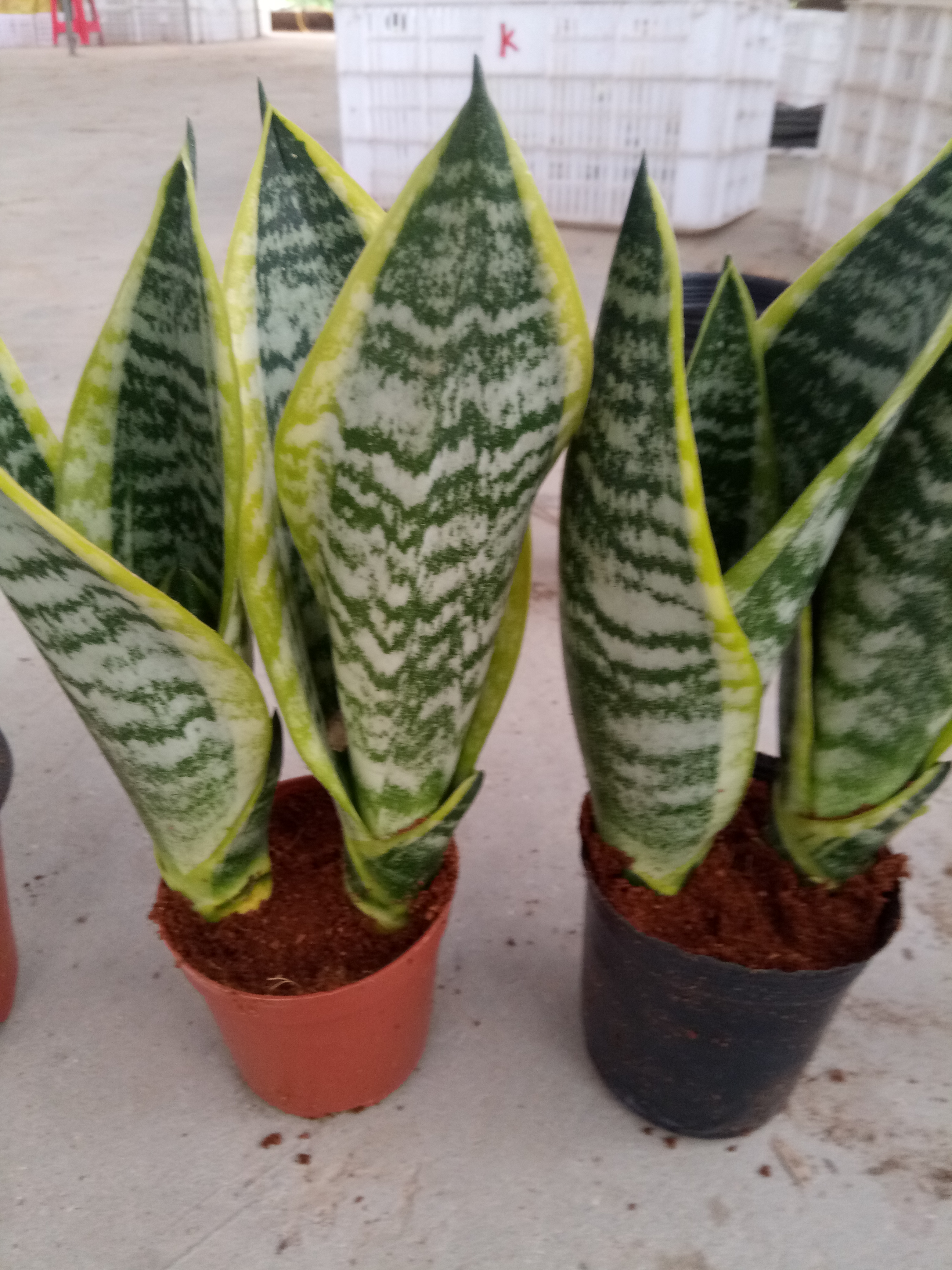
| Sansevieria (Sansevieria superba) | H 20–70 cm | Live plants; bare-root or potted | H 20–40 cm with 2 to 3 leaves | Garden centers, landscape, nursery, indoor houseplant programmes |
What each parameter does in logistics terms
- Bulb diameter in Cycas revoluta. The quoted range of D 5 cm to 20 cm+ combines a diameter grade with a height grade of 20 cm to 120 cm. Diameter functions as a stored-energy indicator that determines how much the plant can tolerate before new root activity begins at destination. Buyers ordering by height alone lose that information.
- Root weight in Ficus bonsai. Ficus ginseng material is quoted at 50 g to 10 kg. Root weight drives carton volume, total shipment weight and moisture management during transit, so it is a freight variable as much as a botanical one.
- Braid count in Pachira. Braid count of 3, 4 or 5, at heights of 20 cm to 90 cm, and the distinction between newly braided and old braided stems, determine how much handling labour has already been invested and how rigid the finished plant is in a packed carton.
- Leaf count in Sansevieria. The published Sansevieria specification is H 20–40 cm with 2 to 3 leaves, within a broader model range of H 20–70 cm. Leaf count is the value grade for this line, because the number of visible leaves sets the visual density at retail.
Root forms: potted, bare-root and bulbs
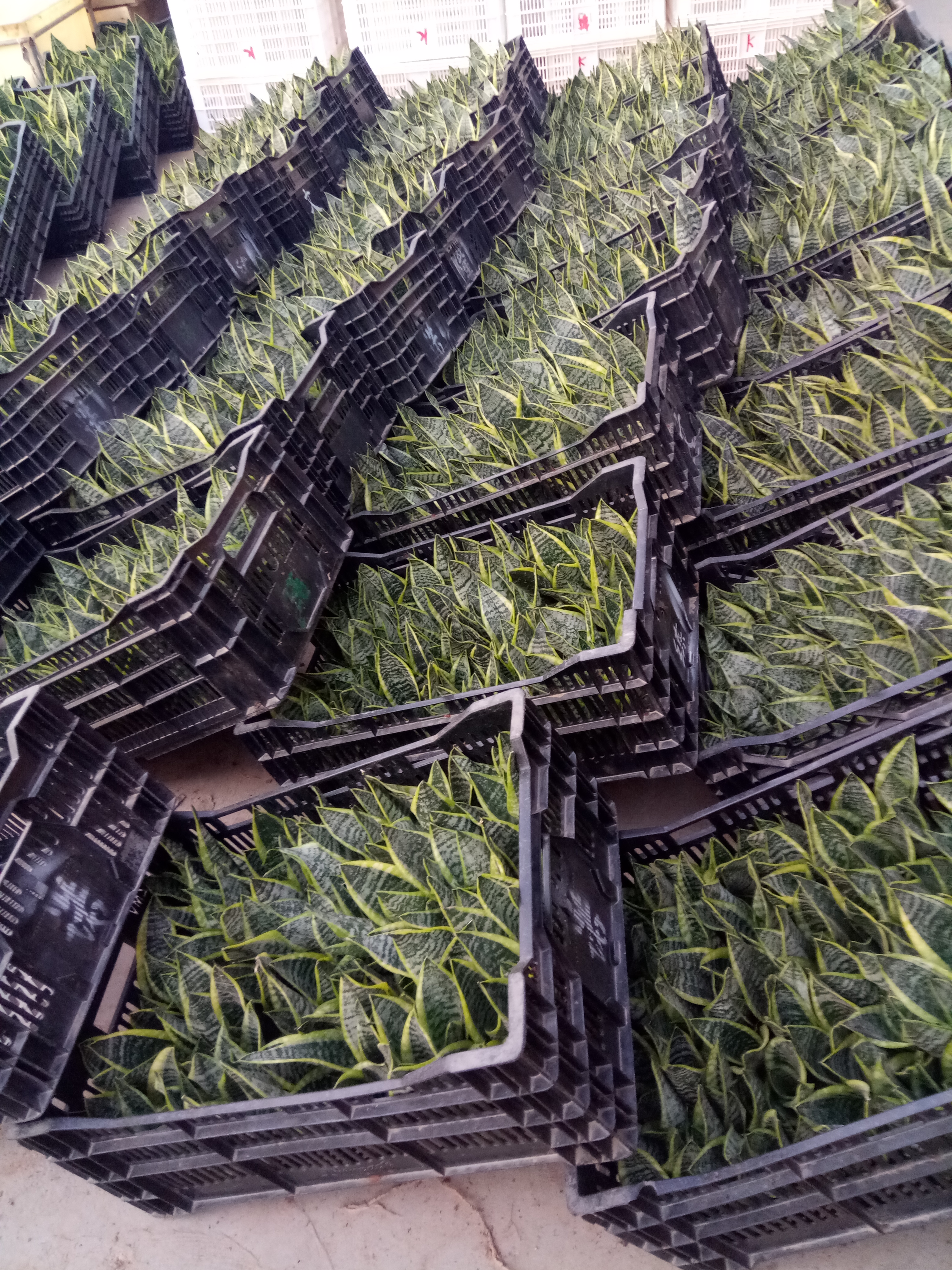
Root form is the first question that should be settled, because it changes freight economics, packing method and the regulatory path simultaneously. Wholesale bonsai is generally offered in three forms: potted with growing media, bare-root with the root system exposed, and bulb or tuber form for species such as Cycas revoluta. In the published range, Sansevieria is offered with 2 to 3 leaves as bare-root or potted material, while Cycas is supplied as bulbs and Ficus is supplied as live Ficus ginseng roots with or without grafting.
Bare-root supply reduces weight and volume per unit and simplifies visual inspection, which is one reason destination rules often favour it. Potted supply arrives closer to retail-ready condition but adds media weight and, in many markets, additional scrutiny of the growing medium itself. Bulb-form Cycas sits between the two: heavy per unit but durable, and widely used in landscape and garden center programmes.
What controls arrival condition inside a refrigerated container
Container survival rests on cultivation conditions upstream and on equipment downstream. In the application data for Pachira, the supporting equipment required for the scenario is a greenhouse and a reefer container, with cultivation under greenhouse conditions and phytosanitary compliance for export listed as a special requirement. The same pattern is documented for garden center projects, where the plants function to ornament and beautify the environment.
The cultivation side of that equation is measurable. KinoFarm grows under CIQ-certified greenhouse infrastructure built to meet China Entry-Exit Inspection and Quarantine standards, under an MPS-A (Marketable Plant Safety) management system recognised as a framework for sustainable, traceable horticulture. Plants are grown on 50 cm-high shelving with 1.6 × 1.6 mm breathable mesh, a configuration that optimises air circulation, light exposure and moisture control. Quality control is described as 100% test.
Technical protection during transit is the other half. The company holds invention patents including a long-distance storage and transport method for Chrysalidocarpus and pest control in soilless bonsai cultivation, alongside proprietary monitoring software for greenhouse climate and soil moisture. For a buyer, the practical translation is a short list of clauses worth confirming before booking: root form confirmed in writing, dimensional grade confirmed against a measured sample, container type and set point confirmed, and a pre-shipment inspection record attached to the shipping documents.
Matching specification profiles to project types
Garden center projects are the most frequently documented application for this range. Cycas revoluta is specified as suitable for garden center projects, and Sansevieria is specified for garden centers as well as the wider agriculture, horticulture, landscape and nursery sectors, operating continuously in a 24/7 scenario. In both cases the stated role of the plant is to ornament and beautify the environment, and the scenario is described as common in global markets.
A documented case illustrates how the sizing and survival questions resolve in practice. A garden center retailer client in Spain received 4,134 units for Garden Center applications under a supply relationship spanning five years. According to the recorded customer feedback, plant quality after container shipment was good, with Cycas growing well and Ficus in good condition. That outcome reflects a specification set agreed in advance rather than a single shipment variable.
Project type also predicts which specification family matters most. Landscape and garden center programmes lean on bulb diameter and height, because the plant is specified in place. Indoor retail and home furniture store programmes lean on root weight, braid count and the visual density carried by leaf count, because the plant is specified on a shelf. Buyers selecting a single quotation format for both will receive mismatched material for one of them.
Market signals shaping specification planning
Several published market indicators support planning around tighter specifications. The global bonsai market is projected to reach approximately USD 18.4 billion by 2035, growing at a CAGR of 8.8% from 2026 to 2035, according to industry analysis. Asia Pacific held a dominant share of over 48.5% in 2025, valued at USD 3.8 billion. China exported USD 355 million of other live plants, the category that includes bonsai, in 2024, with the United States and South Korea among the leading destinations.
Segment-level signals point in the same direction. Indoor bonsai varieties such as Ficus and Money Tree are growing at a 10.28% CAGR through 2031, a trend linked to the rise in apartment living. Landscape bonsai accounted for the largest type share of the global market in 2025 at 34.2%. Demand is also shifting toward low-maintenance living decor, including Ficus retusa and succulent bonsai, as consumers favour plants that require less care.
Specification-driven supply compared with conventional sourcing
Conventional sourcing of wholesale bonsai often runs on photographs, approximate counts and verbal sizing. It can work for small, flexible orders. It becomes costly when a buyer needs a repeatable programme across several seasons, because the specification is renegotiated on every order and deviations surface at the destination rather than at the loading dock.
| Dimension | Conventional sourcing | Specification-driven supply |
|---|---|---|
| Sizing basis | Approximate height, photographic reference | Published parameters: height, leaf count, braid count, bulb diameter, root weight |
| Root form | Often unstated at quotation stage | Stated as bare-root, potted or bulb, tied to the destination rule |
| Container planning | Container type selected at booking | Greenhouse and reefer container defined as required equipment |
| Quality gate | Varies by intermediary | 100% test quality control described at supplier level |
| Compliance set | Documents assembled after order | Phytosanitary compliance treated as a scenario requirement |
| Customization | Limited to available stock | Variety selection, growing cycle and packaging solution |
Where this model does not fit
The specification-driven model has real boundaries that buyers should weigh before committing. First, it is not built for urgency. Lead time runs 20 to 60 days, and the stated minimum order quantity is 45 kg, so a buyer testing a single retail shelf or needing replacement stock inside a few weeks will not be served by this structure. Second, monthly capacity is documented at around 20 refrigerated containers, which imposes a practical ceiling on how much a single buyer can pull in one production window. Third, the dependency on reefer equipment raises freight cost relative to hardy material that can travel in dry containers, and that premium must be justified by the value of the variety. Fourth, bare-root and bulb forms reduce weight but require a re-establishment period at destination, which some retail formats cannot accommodate. Finally, phytosanitary compliance obligations fall on the importer in the destination market, so the supplier can support documentation but cannot assume the buyer's regulatory responsibility.
Future outlook for wholesale bonsai specifications
Three directions are visible in the available data. Compliance is becoming more explicit rather than less, with destination markets such as the EU and the United States operating defined phytosanitary frameworks for imported bonsai, which pushes specification discipline earlier into the negotiation. The indoor segment is expanding faster than the overall category, with indoor varieties growing at a 10.28% CAGR through 2031, which favours suppliers able to quote root weight, braid count and leaf count consistently. And landscape bonsai supply is evolving from product sales toward integrated project supply services, which means buyers will increasingly evaluate a supplier on specification accuracy and delivery reliability rather than on plant appearance alone.
For buyers in the research and evaluation stage, the practical implication is straightforward. Ask for the parameters in writing, ask which root form corresponds to the destination rule, ask what equipment the shipment requires, and ask what lead time and minimum quantity apply. Those four answers convert a wholesale bonsai purchase from an educated guess into a planned shipment.
Frequently asked technical questions
Do wholesale bonsai plants survive long container transport?
Arrival condition depends primarily on the specification ordered and the container conditions rather than on transit duration alone. In this supply model, plants are cultivated under greenhouse conditions and shipped in refrigerated containers, with quality control described as 100% test. One documented garden center case in Spain involved 4,134 units supplied over a five-year relationship, where the recorded feedback noted Cycas growing well and Ficus in good condition after shipment. Buyers should treat survival as a specification and inspection issue that is settled before loading.
What does a quoted height such as H 20–40 cm actually measure?
Height is quoted differently for each product line, so the measurement basis must be confirmed per item. For Sansevieria superba, the published specification is H 20–40 cm with 2 to 3 leaves, within a broader model range of H 20–70 cm. For Cycas revoluta, height is quoted together with bulb diameter: D 5 cm to 20 cm+ and H 20 cm to 120 cm, under a model designation of D 5 cm to H 100 cm+. For Pachira, height of H 20 cm to 90 cm is quoted alongside braid count. Buyers should confirm whether height includes the pot and how leaves are counted.
What is the difference between potted and bare-root wholesale bonsai?
Bare-root material ships with the root system exposed, which lowers weight and volume per unit and simplifies inspection; potted material ships in growing media and arrives closer to retail-ready condition; bulb-form material such as Cycas revoluta is supplied as bulbs. In the published range, Sansevieria is available as 2 to 3 leaves in either bare-root or potted form, while Ficus bonsai is quoted by root weight from 50 g to 10 kg and may be grafted or ungrafted. Root form also changes the compliance path, because destination rules can require bare-rooted material.
What supporting equipment does a bulk bonsai shipment require?
The application data for Pachira lists greenhouse and reefer container as the supporting equipment for the scenario, with cultivation taking place under greenhouse conditions and phytosanitary compliance for export recorded as a special requirement. Garden center applications follow the same pattern, with the plants functioning to ornament and beautify the environment. In practice this means the shipment should be planned around refrigerated container availability rather than treated as ambient cargo.
What lead time and minimum order should a project plan for?
Published capability data states a monthly capacity of approximately 20 refrigerated containers, a lead time of 20 to 60 days, and a minimum order quantity of 45 kg, with customization available across variety selection, growing cycle and packaging solution. Export markets are described as worldwide. A project should therefore freeze its specification well ahead of the retail or landscaping date and confirm the production window against the monthly container capacity.
Which wholesale bonsai varieties suit garden center projects?
Cycas revoluta is documented as suitable for garden center projects, with a role in ornamenting and beautifying the environment. Sansevieria is likewise specified for garden centers and for the agriculture, horticulture, landscape and nursery sectors, operating in a 24/7 scenario. Ficus bonsai and Cycas revoluta are both listed for garden center and home furniture store applications, while the Spanish garden center case covering 4,134 units involved Cycas and Ficus material.
What quality checks take place before a wholesale bonsai shipment leaves the nursery?
Quality control is described as 100% test. Cultivation takes place under CIQ-certified greenhouse infrastructure and an MPS-A management system, with plants grown on 50 cm-high shelving using 1.6 × 1.6 mm breathable mesh to manage air circulation, light and moisture. The supplier holds invention patents covering long-distance storage and transport methods and pest control in soilless bonsai cultivation, plus proprietary greenhouse and soil moisture monitoring systems. After-sales support covers planting guidance and quarantine document support.
Are phytosanitary certificates always required for wholesale bonsai imports?
Requirements are set by the destination market and should be confirmed before booking. The European Union mandates phytosanitary certificates for imported bonsai under Regulation (EU) 2019/2072. USDA APHIS requires bonsai to be bare-rooted and accompanied by a phytosanitary certificate from the country of origin, with different provisions possible for shipments of 12 or fewer plants. The obligation sits with the importer in the destination country, while documentation is issued at origin, so the two sides need to align early in the order process.