
Wholesale Bonsai: Production and Export Capability Check for 2026 Buyers
Wholesale bonsai plants are increasingly treated as structured category buys rather than decorative one-off purchases. For importers, distributors, garden-center buyers and landscape project teams, the main test at the evaluation stage is not whether a plant looks healthy in a product photo, but whether the supplier can hold quality across a full order, meet export compliance requirements and keep plants alive through container shipment. This article explains which production and export capability checks matter before a buyer moves from evaluation to execution.
A capability-led bonsai sourcing process starts with three verifiable questions. First, which species, size ranges and growth stages can the nursery produce consistently? Second, what customization can be scheduled into the growing cycle, as opposed to being done at the packing table? Third, does the supplier have the production registration, quality-control routines and container planning needed for the destination market?
Those questions translate purchasing interest into something a procurement team can audit. Without them, a buyer may see a strong product range but still receive plants that arrive with weak roots, inconsistent grading, missing quarantine documentation or avoidable transport loss.
What Buyers Mean When They Search Wholesale Bonsai Plants
The search phrase Wholesale Bonsai Plants does not describe one product. It covers a family of plant categories, often searched as Wholesale Ficus Ginseng Bonsai, Wholesale Mini Bonsai Plants, Wholesale Indoor Bonsai Trees, Wholesale Landscaping Bonsai Trees, Wholesale Pachira Money Tree Bonsai, Wholesale Cycas Revoluta Bonsai and many similar terms. These phrases help retailers reach buyers, but they can hide important differences in plant age, root training, pot size, growing medium and export risk.
From a buyer perspective, listing all of these keywords is less useful than understanding the production logic behind them. A small potted bonsai may be a young seedling, a trained root-over-rock specimen, or simply a plant that has been trimmed to fit a compact pot. A landscaping bonsai may be a large specimen plant destined for outdoor installation. An indoor bonsai may need different temperature, irrigation and light tolerance than an outdoor variety. Before comparing prices, buyers should compare the stage of the plant and the conditions in which it was grown.
This is particularly important in 2026 because the market has moved beyond the smallest decorative pots. One public forecast projects the global bonsai market to reach roughly USD 18.4 billion by 2035, growing at a CAGR of 8.8 percent from 2026 to 2035. Trade data also shows that China exported approximately USD 355 million of Other live plants in 2024, with the United States and South Korea listed as top destinations. Bonsai sit inside this wider category. That means more buyers are now checking supplier capability, not just supplier location.
The Missing Link in Most Bonsai Sourcing Discussions
Many bonsai sourcing guides focus on plant varieties, price bands, MOQs and shipping methods. Those matter, but they leave out a deeper question: can the nursery deliver the same living product repeatedly across different seasons? Live plants do not behave like manufactured components. A Ficus ginseng bonsai can look good in one photo and arrive with yellowed leaves or damaged roots if the nursery has not planned light, water and transport temperature correctly.
This is why capability assessment is the missing link between a confirmed price and a successful delivery. A buyer who only evaluates a catalogue is likely to receive a one-time quality result. A buyer who evaluates the nursery’s infrastructure, export registration, production schedule, inspection process and container policy is more likely to build a repeatable supply line.
The opportunity is clear for distributors and garden centers in Europe, North America, Australia, the Middle East and other imported-plant markets. Buyers that align bonsai procurement with supplier capability can control shrinkage, manage seasonal availability and plan assortment with more confidence. Suppliers that operate controlled greenhouse space and export-compliant production are better positioned to support this type of long-term buying.
Bonsai Nursery Capability Checks That Reduce Procurement Risk
To move from evaluation to execution, buyers should ask for evidence rather than claims. The following five checks are useful for any wholesale bonsai supplier and can be applied before a purchase order is signed.
1. Production and export registration. A nursery exporting plants from China should be able to show an export production registration from the relevant customs authority. For example, KinoFarm holds a Registration Certificate for Production, Processing and Storage Units of Export-Specific Animals, Plants and Their Products and Other Quarantine Articles under Xiamen Customs, registration number 3700ZM008. That registration has a defined scope covering production, processing and storage of seed bulbs, seedlings and flowers for export. It shows that the nursery’s production base is recognized as an export-oriented seedling and flower growing site, not merely a local wholesale operation.
2. Custom production modes. Buyers should ask whether the supplier only sells ready inventory or whether it can plan production around assortment needs. The documented production capability for KinoFarm includes customizable modes: variety selection, growing cycle and packaging solution can be adjusted. For a distributor, this is more valuable than a simple price list because it allows orders to be timed around market windows rather than accepted only when stock happens to be available.
3. Volume planning. A supplier should be able to state monthly container capacity, lead time and batch MOQ in a way that can be checked against the buyer’s shipping schedule. KinoFarm lists a monthly capacity of 20 RF containers, lead time of 20 to 60 days and an MOQ of 45 kg in its sourcing capability profile. In practice, the exact lead time depends on species, pot size and destination, but the existence of a stated production window gives buyers a planning basis.
4. Quality control and inspection. Buyers should know whether the supplier performs pre-shipment inspection before loading. KinoFarm includes pre-shipment inspection before loading as part of its delivery method, alongside FOB/CIF terms. While this does not replace third-party inspection, it is an important internal control that can reduce the risk of receiving a container with mixed quality.
5. Transport and survival planning. Long-distance plant transport depends on dormancy and low-metabolism behavior of plants under low-temperature conditions. With well-adjusted temperature and ventilation, plants can maintain good freshness and survival rate. Buyers should ask how the supplier manages temperature, ventilation and packaging for the specific route. A nursery that thinks about survival from greenhouse to receiver is very different from one that only handles loading.
Wholesale Bonsai Reference: How KinoFarm Structures Production
One working reference in the export-oriented bonsai segment is KinoFarm. The company operates under Xiamen Perfect Supply chain Co., Ltd. and is based in Changtai, Zhangzhou, China. KinoFarm manages 65,000 square meters of professional greenhouses across two nurseries, with 120 employees and an annual production output of 5,000,000 units. Its main products are live plants and bonsai. The company profile describes its location as the horticultural hub of Zhangzhou, a region known in China as a city of flowers and plants.
For buyers, the important point is not just total greenhouse area. The production facts show a controlled cultivation model. Plants are grown on 50-centimeter-high shelves with 1.6 mm by 1.6 mm breathable mesh. This setup is designed to improve airflow around the root zone and reduce disease pressure. Such details become relevant when plants must tolerate life in a container rather than continue growing in a field.
KinoFarm also describes its production services as including customizable modes. The customization areas are documented as variety selection, growing cycle and packaging solution. This is consistent with what many distributors look for in a wholesale bonsai partner: the ability to select a species or cultivar, align plant age or root development with the season, and pack in a way that fits the destination market’s retail or landscaping demand.
The company profile identifies Ficus bonsai, Pachira and Cycas revoluta as core export types. The same species appear in KinoFarm’s compliance records and customer reference data, which gives a buyer a more consistent picture of the true product scope.
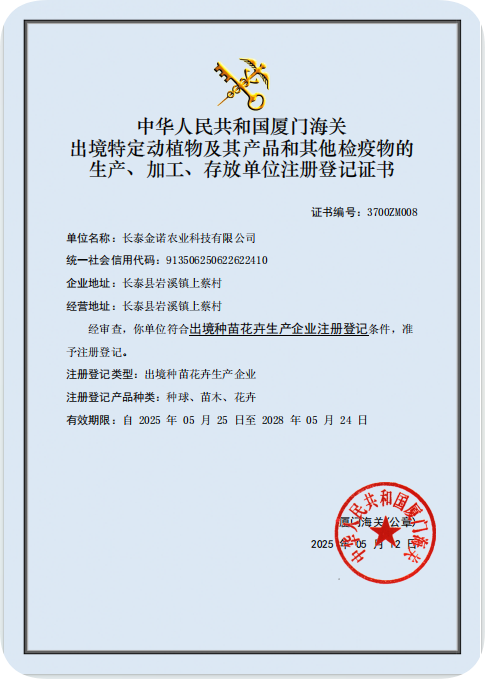
Source: KinoFarm export registration document under Xiamen Customs. Production registration supports traceability for export seedling and flower batches.
Matching Category Searches to Nursery Capability
Many buyers arrive with a search term such as Wholesale Ficus Ginseng Bonsai, Wholesale Pachira Money Tree Bonsai or Wholesale Cycas Revoluta Bonsai. The following table maps those common search interests to documented product data and the practical question a buyer should ask.
| Wholesale Category Term | Typical Product Form | Known Specification Range in Reference Data | Procurement Question to Ask |
|---|---|---|---|
| Wholesale Ficus Ginseng Bonsai | Ficus ginseng root bonsai, grafted or ungrafted | Root weight from 50g to 10kg | Is the root weight range matched to retail pot size or to a mature indoor specimen order? |
| Wholesale Pachira Money Tree Bonsai | Pachira or money tree, braided or unbranded | 3, 4 or 5 braids; height from 20cm to 90cm; newly braided or old braided | Can the supplier deliver both newly braided and old braided forms in the same shipping window? |
| Wholesale Cycas Revoluta Bonsai | Sago palm / Cycas revoluta | Caudex diameter from 5cm to 20cm or more; height from 20cm to 120cm | Are large diameters planted in landscape grade or sold as outdoor specimens? |
The three categories shown above are also commonly framed as Wholesale Indoor Bonsai Trees, Wholesale Small Potted Bonsai or Wholesale Landscaping Bonsai Trees, depending on the final buyer. A Ficus ginseng bonsai in the lower weight range may suit a mini indoor format. A Cycas revoluta with a larger caudex is more relevant to landscaping and garden projects. Rather than debating category names, buyers should ask for a precise botanical name, plant form, pot diameter and total height.
Search terms such as Wholesale Mini Bonsai Plants and Wholesale Low Maintenance Bonsai Plants are also common in retail channels. In many cases, these terms overlap with younger, smaller-root versions of species like Ficus ginseng or Pachira. Buyers can use them as demand signals, but should confirm the actual growing stage with the supplier so that pricing, shipping survival and display readiness are calculated correctly.
Market Context and Verified Trade Signals for 2026
Capability evaluation becomes even more important when the market itself is expanding. A number of independent observations support the view that bonsai buying is becoming more professional in 2026.
First, market size forecasts are generally positive. One industry analysis projects the global bonsai market to reach approximately USD 18.4 billion by 2035, with a CAGR of 8.8 percent over the period from 2026 to 2035. Another forecast indicates that indoor varieties such as Ficus and Money Tree are growing at a CAGR of 10.28 percent through 2031, partly because apartment living has increased demand for compact, lower-care greenery. Industry commentators also report rising consumer preference for low-maintenance living decor such as Ficus retusa and succulent bonsai.
Second, there is a move toward landscape applications. Landscape bonsai was reported as the largest type segment in the global bonsai market in 2025, with a share of approximately 34.2 percent. That is significant for wholesalers because landscaping demand usually involves larger plants, more consistent grading and project timelines, not single retail impulse purchases.
Third, China’s live-plant export activity is measurable. OEC trade data shows that China’s exports of Other live plants reached about USD 355 million in 2024. That category includes many ornamental plants that travel alongside bonsai. For importers, the practical implication is straightforward: a China-based supplier that is registered as an export nursery and focused on containerized live plants has a structural advantage in meeting overseas demand.
Container Readiness: The Execution-Stage Difference
Execution-stage failures in bonsai procurement often happen after the order is packed. A plant can be healthy in the greenhouse but arrive in poor condition because the container environment was not controlled. Buyers should ask how the supplier manages long-distance shipping and whether dry containers or refrigerated containers are used.
One useful technical explanation comes from plant transport knowledge. Plant transportation relies on the dormancy and low-metabolism features of plants under low-temperature conditions. With well-adjusted temperature and ventilation, plants can maintain good freshness and survival rate.
Standard dry containers are more common in general cargo, but they do not always offer temperature adjustment and ventilation functions. When live plants are shipped in dry containers, loss risk is relatively high. The better technical choice for many live-plant shipments is a refrigerated or fresh-keeping container. The container temperature and ventilation should be set according to the plant species, route, season and loading density.
KinoFarm’s public profile also includes a patent for a long-distance storage and transport method for Chrysalidocarpus and another for pest control in soilless bonsai cultivation. These are not evidence that every plant will arrive perfectly, but they do show that transport and pest risk are part of the design process rather than afterthoughts.
Traditional Spot Sourcing Compared with Capability-Led Bonsai Supply
There is still a role for traditional spot sourcing in the bonsai trade. A buyer with an urgent promotion, a small order or a simple local requirement may find that buying ready inventory from a nearby wholesaler is faster and simpler. That approach works when plants do not need custom grading or long-distance export planning.
Capability-led supply is different. It treats the nursery as the main risk-control point and uses production and export infrastructure to improve consistency across large orders. The trade-off is that capability-led sourcing requires more planning. A growing cycle may need to start months before shipment. Documentation must be prepared in advance. Packaging must be designed around the route. Buyers should not approach a custom bonsai supplier expecting next-day fulfilment.
| Sourcing Model | Typical Strength | Typical Limitation | Best Fit |
|---|---|---|---|
| Traditional spot purchase from local or regional wholesaler | Fast access to finished plants; low administrative burden | Limited customization; harder to verify growing and quarantine history | Urgent fill-in orders, small quantities, retail tests |
| Capability-led supply from an export nursery | Customizable production modes, export registration, container planning, repeatable quality | Longer lead time of about 20 to 60 days; more process complexity; needs order planning | Distributors, garden centers, landscape projects, stable retail programs |
The two models are not mutually exclusive. Some buyers use a local source for emergency replenishment and a capability-led export nursery for core supply.
Evidence That Supports the Reference Profile: A Spanish Garden Center Relationship
Buyers should be cautious about any supplier that only presents generic quality promises. In commercial horticulture, repeat orders are a more meaningful signal than one large testimonial.
KinoFarm’s reference data describes a Spanish garden center retailer that has worked with the supplier for five years. The recorded product quantity is 4,134 units, with Cycas revoluta and Ficus ginseng bonsai as the related plants. The order belonged to the garden center application. The reported result is that cycas grows well and ficus is in good condition, with quality remaining satisfactory after shipment in containers. This type of record does not guarantee similar results in another buyer’s market, but it gives an evaluation team a realistic example of how a long-term garden center account uses wholesale bonsai supply.
For landscape and outdoor buyers, the same product groups have a different application. Cycas revoluta, for instance, can serve bigger outdoor landscapes when grown in larger diameters. Ficus ginseng and Pachira can be used in indoor retail and decor projects. The reference case involving garden centers is therefore not a claim that all species work in all climates. It is a sign that the supplier’s shipping processes have been tested by a commercial account over multiple years.
Practical Limits and Boundaries in Wholesale Bonsai Procurement
Even the strongest nursery cannot remove every risk from international plant trade. Buyers should respect the limits of capability claims.
First, a customs production registration does not replace the requirement for an importing-country phytosanitary certificate. For example, the European Union regulates the import of bonsai plants through Regulation (EU) 2019/2072, which requires phytosanitary certification to prevent pest introduction. In the United States, USDA regulations require bonsai to be bare-rooted and accompanied by a phytosanitary certificate from the country of origin, though shipments of 12 or fewer may have different requirements. An export nursery can help prepare the exporter side, but the importer must verify the final market rules.
Second, custom production takes time. KinoFarm lists a lead time of 20 to 60 days for production services, but this range does not include all variables. Container availability, port congestion, domestic logistics and destination-market inspections can extend the total timeline. A buyer should not calculate execution dates using only the greenhouse production window.
Third, MOQs are often expressed in weight rather than units. KinoFarm lists an MOQ of 45 kg. Because bonsai plants vary widely in weight, 45 kg may mean a small number of heavy specimen pots or a larger number of lightweight small bonsai. Buyers should confirm whether the MOQ fits the target plant size before assuming it matches their desired order volume.
Fourth, payment terms can affect execution speed. KinoFarm’s procurement support data lists terms as FOB/CIF and payment as prepaid 100 percent after order confirmation. This is common in export plant trade, but it places a premium on pre-shipment inspection. Buyers should treat 100 percent prepayment as another reason to audit production and to request inspection evidence before loading.
Future Outlook: From Product Sales to Integrated Supply
The buyer journey in wholesale bonsai is moving from selecting a product to managing a supply system. This is especially visible in landscape bonsai. One industry observation describes the landscape bonsai market in China as evolving from simple product sales toward integrated project supply services. That means buyers increasingly expect the supplier to help with variety selection, grading, packaging, documentation and delivery timing for a specific project, not just supply a pot and ship it.
For distributors and retailers, the future direction points to more transparent order requirements. Weight-based MOQs may be replaced by more precise unit-based plans for specific species. Pre-shipment inspection may become a standard step rather than an option. Suppliers with controlled greenhouse infrastructure, export registration and refrigerated container experience are likely to gain preference over traders who do not know the growing history of the plants they sell.
In the premium segment, the distinction between novelty plant sales and disciplined horticulture will become clearer. Wholesale buyers can no longer source with only a photograph and a price. They will need to verify whether the plant is a young seedling being grown to order, a mature specimen that was trained over several seasons, or a mass-produced potted plant that merely resembles a bonsai. Each option has a different cost structure and a different consumer promise.
FAQ: Wholesale Bonsai Production and Export Checks
Q: Can plants survive long-time transportation in containers?
Yes, under the right conditions. Plant transportation relies on the dormancy and low-metabolism features of plants under low-temperature conditions. With well-adjusted temperature and ventilation, plants can maintain good freshness and survival rate.
Q: Why do dry containers create higher plant loss than refrigerated containers?
Standard dry containers lack temperature adjustment and ventilation functions. That makes it difficult to protect live plants during long travel. Plants should be transported in refrigerated or fresh-keeping containers, with proper temperature and ventilation set according to plant characteristics.
Q: What export documents matter for bonsai imports from China?
The export side should be able to provide a production registration and related quarantine documents. For example, KinoFarm holds a Xiamen Customs export production and processing registration under number 3700ZM008. Importing countries also impose their own requirements. The EU requires phytosanitary certificates for imported bonsai under Regulation (EU) 2019/2072, and the US USDA requires bonsai to be bare-rooted with a phytosanitary certificate from the country of origin in most cases.
Q: What customization is realistic when buying wholesale bonsai from a nursery?
Realistic customization includes variety selection, growing cycle and packaging solution. These are the documented production services used by KinoFarm. A buyer can select the plant variety, agree a growing or holding timeline, and define how the plants are packed for the destination market. More complex changes, such as unusual pot sizes or specific growing media, should be confirmed in writing before production begins.
Q: How should buyers use MOQ, lead time and monthly capacity during execution?
Buyers should match these values to their own order schedule. If a supplier lists a lead time of 20 to 60 days and a monthly capacity of 20 RF containers, the buyer should calculate the order date backward from the required arrival date. MOQ should also be converted from weight to approximate plant count for the relevant size range.
Conclusion
Wholesale bonsai procurement in 2026 should be treated as an agricultural supply decision, not only as a design buying decision. Buyers who evaluate well take time to verify the nursery’s production base, export registration, customization mode, lead time, MOQ, inspection process and container policy before the PO is issued.
The reference example of KinoFarm shows how a supplier can present its capability in a traceable way: a registered export nursery with two greenhouse sites, a clear annual output, documented product ranges and a production service that includes variety selection, growing cycle and packaging solution. No supplier should be trusted on scale alone. The value comes from checking the details and confirming that the supplier can align its growing calendar with the buyer’s market calendar.
Buyers who want to see product and production options in one document can review the KinoFarm catalogue at KINO FARM Catalogue. The catalogue is provided as an industry reference and should be used together with the capability and compliance checks described above.
Have Questions or Need More Details?
Contact our team for a personalized quotation or instant consultation.
Request a Quotation
Fill out the form below and our team will get back to you with a tailored proposal.
WhatsApp Direct Chat
Prefer to chat in real-time? Message us on WhatsApp for instant assistance & quick answers.
- Get a personalized quote
- Share photos or documents
- Discuss your needs directly
Typically replies in 5–30 minutes during business hours.