
Wholesale Gold Plated Jewelry Shortlist: Bangles, Bracelets, Rings & Earrings
Wholesale Gold Plated Jewelry Shortlist: Bangles, Bracelets, Rings & Earrings
A gold plated jewelry shortlist is a category-fit decision before it is a style decision. Bangles, bracelets, rings and earrings can share the same stainless steel substrate, the same PVD or electroplated finish menu and the same packaging route, yet they differ in engraving surface, sizing flexibility, stone-setting depth and compliance exposure. Those differences decide which wholesale scenarios each category can genuinely serve.
This reference is written for wholesale buyers, brand owners and sourcing teams who are comparing a four-category stainless steel program rather than choosing a single hero SKU. It sets out what each category is good for, which buyer scenarios it maps to, what the shared material platform allows, and where the shortlist stops working.
Jusnova Jewelry Co., Ltd. is a Guangzhou-based ODM/OEM jewelry manufacturer founded in 2009 that produces gold plated stainless steel bangles, bracelets, rings and earrings for wholesale and brand buyers. Its catalog family covering these four categories is listed under model reference GEN000516bhia-066, and the specifications quoted in this article are taken from that product data.
Why one hero category rarely covers a wholesale program
Most sourcing conversations start with a single best-selling shape and then expand. That sequence creates a predictable problem: the second and third categories are added without a defined role, so the range overlaps in style while leaving whole retail scenarios unaddressed. A bangle assortment and an earring assortment are not interchangeable inventory — they answer different display, gifting and reorder needs.
The practical opportunity is to allocate categories by scenario. Boutique display, department store counters, fast-fashion trend programs, gift and souvenir retail, corporate gifting, and marketplace e-commerce each place different demands on weight, engraving area, size sets and documentation. Once those demands are written down, category selection becomes a shortlist exercise instead of a style-preference exercise.
Gold-plated stainless steel supports that approach because one material platform can carry several product forms. The same 304, 316 or 316L base can be finished in PVD gold, rose gold, black or gunmetal, or in gold plating and electroplating, and can be combined with brushed, mirror-polished or sandblasted surfaces.
The shortlist: four stainless steel categories and what each one does
Bangles: the widest engraving and gifting surface
Bangles are the most naturally customizable of the four categories because they present a broad, continuous outer surface. The documented style range includes Classic Round Bangle, Flat Bangle, Cuff Bangle, Twisted Bangle, Rope Bangle, Gem-Set Bangle and Engraved Bangle.
- Flat and Engraved bangles give the most usable area for laser-engraved logos, names and short messages, which makes them the default choice for personalization and corporate gifting programs.
- Cuff bangles offer an open form that accommodates a wider range of wrist sizes within one SKU — useful when a buyer wants to limit the number of size variants in stock.
- Gem-Set bangles move the category toward display and gift retail, using CZ, man-made crystal or moissanite in 20+ colors with prong, bezel, channel or pavé settings.
- Round, twisted and rope bangles carry the assortment visually without requiring engraving, which keeps them suitable for buyers who want unmarked stock.
Weights are controlled precisely and can be adjusted to a target, which matters for bangles in particular: perceived solidity is part of the value proposition at retail, and it has to be reproduced on reorder.
Bracelets: the assortment and rotation category
Bracelets cover the chain and mixed-material styles that keep a range moving: Cable Chain, Rope Chain, Figaro Chain, Curb Chain, Tennis Bracelet, Charm Bracelet, Beaded Bracelet and Pearl Bracelet. This is the category most often used for trend rotation, because a chain or beaded construction can change silhouette and finish without changing the underlying material specification.
Charm and beaded bracelets also give buyers a modular story — a base piece plus add-on elements — which suits marketplace listings where repeat purchase and gifting are part of the commercial model. Chain bracelets, by contrast, are typically sold as a fixed specification where finish consistency between production runs is the main quality question.
Rings: the size-set decision
Rings are the category where the purchasing decision is most constrained by sizing. A stainless steel ring is produced at a fixed size and does not offer the resizing tolerance of a solid karat gold band, so the size set has to be agreed before production rather than corrected afterwards.
Within the same model family, rings can use the shared finish menu and the same stone options — CZ, man-made crystal or moissanite — with prong, bezel, channel or pavé settings. North American buyers in particular tend to favour deeper gold tones; third-party market research published by Statista identifies 18K gold plating as the most preferred thickness reference for high-end fashion jewelry in that market, while 14K plating is described by testing specialists such as Intertek as a lighter, more subtle yellow hue.
Earrings: the compliance-sensitive category
Earrings carry a compliance burden the other three categories do not. Nickel release testing under EN 1811 is mandatory for any jewelry item inserted into pierced parts of the body in the EU, and REACH Regulation (EC) No 1907/2006 restricts nickel, lead and cadmium in jewelry imported into the EU. This is not a theoretical concern: the World Allergy Organization estimates that roughly 15% of the global population has a nickel allergy, which is one reason hypoallergenic positioning matters at retail.
Stainless steel is a sensible substrate here because 304, 316 and 316L grades are documented as hypoallergenic and anti-corrosion. Buyers should still treat earrings as a separately documented line item — a supplier-level certificate does not automatically cover every SKU in a mixed order.

A four-category range is planned as one program: bangles for engraving and gifting, bracelets for rotation, rings for size-set retail, earrings for pierced-part compliance.
Matching categories to buyer scenarios
The shortlist only becomes useful when each category is attached to a scenario. The table below maps the four categories to the wholesale channels documented for this product family, and lists the single item a buyer should confirm before placing an order.
| Buyer scenario | Lead category | Why the fit works | Confirm before ordering |
|---|---|---|---|
| Independent boutique / concept store | Gem-set and engraved bangles | Broad display surface and a solid feel support a curated counter story | Physical finish sample; stone colour reference |
| Department store accessory counter | Rings and earrings | Small footprint per SKU allows a deep size and style grid | Ring size set; EN 1811 nickel release documentation for earrings |
| Fast-fashion trend program | Chain and beaded bracelets | Silhouette and finish can rotate without changing the material platform | Finish consistency across repeat runs; weight target per SKU |
| Gift, souvenir and holiday retail | Engraved bangles and charm bracelets | Personalization and gifting logic fit seasonal merchandising | Engraving area and depth; gift box and pouch specification |
| Corporate and promotional gifting | Flat, cuff and engraved bangles | Wide logo area and a single open size reduce SKU count | Logo artwork approval; NDA and confidentiality terms |
| Marketplace e-commerce (Amazon, Shopify, Etsy, AliExpress, eBay, TikTok Shop) | Bracelets and earrings | Photogenic, low-complexity SKUs that support repeat listing formats | Evidence behind any waterproof or tarnish-free claim |
| Brand wholesale and activation programs | Mixed four-category set | One supplier, one finish menu, one packaging route | Tolerance sheet and batch colour matching |
Scenario mapping drawn from the documented application channels for model family GEN000516bhia-066.
What the four categories share: the specification platform
Because the categories sit on one specification platform, a buyer can standardize finish, tolerance and packaging across the whole order rather than negotiating them four times.
| Parameter | Documented specification |
|---|---|
| Base materials | 304 / 316 / 316L stainless steel, with anti-corrosion and hypoallergenic properties |
| Surface finishes | PVD coating (gold, rose gold, black, gunmetal), gold plating, electroplating, brushed, mirror-polished, sandblasted, or any combination |
| Size range | Diameter from 5 mm to 80 mm; thickness from 0.5 mm to 3.0 mm; customized height and width available |
| Tolerance | Controlled within ±0.05 mm |
| Stone options | CZ, man-made crystal or moissanite; 20+ colours |
| Settings | Prong, bezel, channel, pavé |
| Packaging | OPP bags, velvet pouches, premium gift boxes, or fully customized designs with logo and branding |
| Customization | Custom logo and custom packaging; ODM/OEM development supported |
Specifications as listed under model reference GEN000516bhia-066, all fully customizable to buyer requirements.
How plating choices change the shortlist
Two coating routes sit behind the same finish menu, and they behave differently in use. PVD (Physical Vapor Deposition) coating is documented by coating specialists such as Vapor Technologies as providing significantly higher durability and wear resistance than traditional electroplating for jewelry. Electroplating remains the more conventional route and is widely used across the category.
The technical detail matters to buyers because it drives claim language. For stainless steel jewelry, the tarnish-free claim generally refers to the stability of the PVD gold coating against sweat and water, and is assessed with reference to salt spray testing under ISO 9227. A technical bulletin published by SGS reports that vacuum electroplating can increase tarnish resistance by up to ten times compared with water plating; that figure is a supplier-published reference point, so buyers should ask for test documentation for the specific SKU rather than rely on the general statement.
Thickness expectations also need calibrating. In the United States, the Federal Trade Commission sets a minimum gold plating thickness of 0.175 microns for the gold electroplated designation. The Jewelers Vigilance Committee notes that gold vermeil requires a minimum of 2.5 microns, whereas PVD on steel usually targets 0.5 to 1.0 micron for equivalent durability. Adhesion is supported by process design — titanium nitride is often used as a base layer in PVD gold plating to improve bonding to stainless steel — and e-coating is increasingly applied as a secondary protective layer over gold plating to limit oxidation.
For engraving, depth control replaces thickness as the key parameter. Jewelry laser engraving is typically set between 0.05 mm and 0.2 mm to keep marking visible without weakening the structure, and custom logo engraving in the industry generally uses fiber laser technology; a 20W fiber laser is sufficient for deep engraving on stainless steel accessories. High-polish surfaces are normally achieved through four to five stages of mechanical buffing before the coating step, which is why a mirror finish and a matte finish should be sampled separately rather than assumed to share a surface preparation routine.
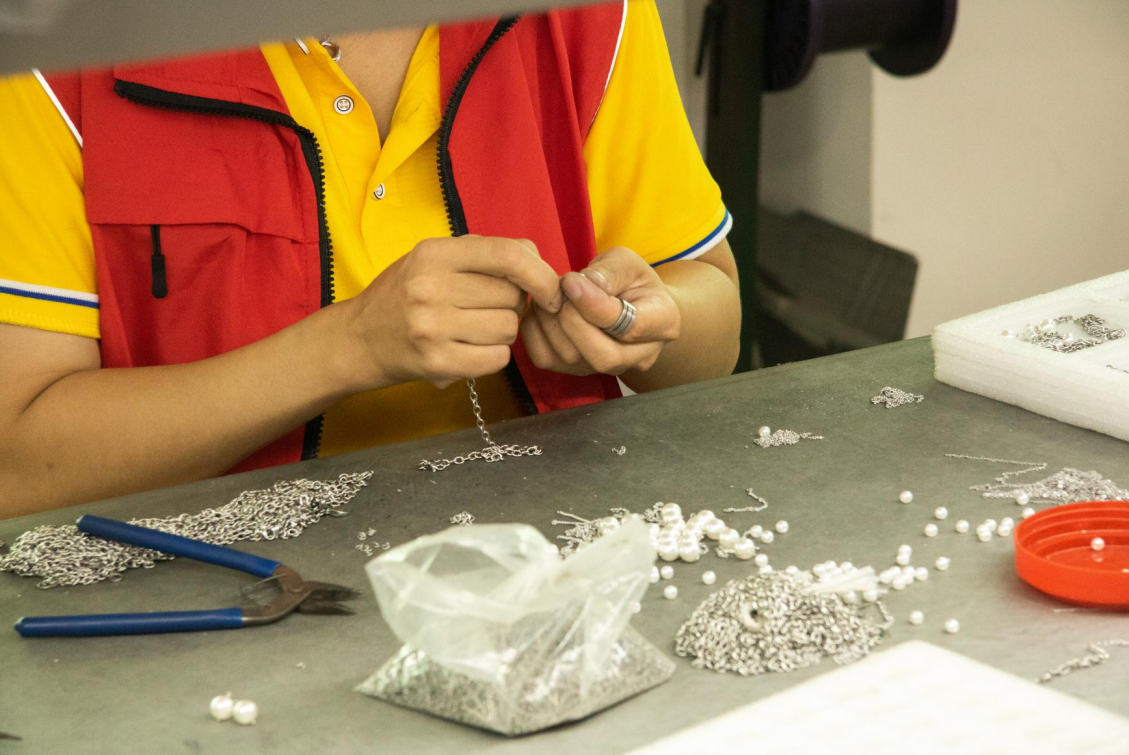
Assembly and finishing stages are shared across bangles, bracelets, rings and earrings, which is what allows one finish standard to be applied across a four-category order.
Where the shortlist stops working
A shortlist that only lists advantages is a sales document. The boundaries below are the ones that most often surface after an order has shipped.
- Plating is not restorable in the field. A PVD or electroplated layer on steel cannot be re-polished and re-coated locally in the way a karat gold piece can be re-finished. Published coating research indicates PVD coated jewelry can last three to five years without significant tarnishing under daily wear conditions, but that is a reference expectation, not a per-SKU guarantee. Returns policy should be written against the coating specification, not against the word gold.
- Personalized stock is not returnable stock. Engraved names, dates and logos remove a piece from general inventory. Buyers should treat engraving as a committed order and secure artwork approval in writing before production.
- Rings cannot be resized after the fact. The size grid is locked at production. Under-ordering a size is more expensive than over-ordering a small quantity of it.
- Thin sections limit stone setting. At the 0.5 mm end of the thickness range, prong and channel settings have limited depth. Gem-set styles generally move to thicker sections, so a buyer cannot assume the lightest gauge in the range also carries the full stone menu.
- Engraving needs usable surface. Narrow twisted or rope forms offer little continuous area, and deep engraving on very thin walls risks distortion. Engraved bangles and flat bangles exist precisely because they solve this.
- Colour matching is a batch issue. Gold, rose gold, black and gunmetal PVD shades must be locked with physical samples; 14K and 18K references read differently, and screen renders are not a specification.
- Compliance is item-specific. REACH restricts nickel, lead and cadmium in the EU, California Proposition 65 sets warning thresholds for lead and cadmium in the US, and EN 1811 applies specifically to pierced-part items. Documentation has to be requested per category, and earrings are the category where that is non-negotiable.
Supplier context for a four-category order
Jusnova Jewelry Co., Ltd. operates a 1,000 m² facility in Guangzhou with 300 employees and an annual output of 3,000,000 units. Its R&D function is staffed by 20 engineers who provide style development and surface-finishing process support, including new custom development, and the company reports launching 500+ new styles monthly. Around 95% of output is exported, with emphasis on Europe and America.
On compliance, the company states that its gold plated stainless steel pieces are waterproof, hypoallergenic and non-tarnish, and compliant with US/EU standards for lead and nickel content. REACH test reports, SGS and BSCI certification are available on request, and NDA agreements and confidentiality policies are used to protect buyer IP. For buyers running a mixed four-category program, that combination — one finish menu, one packaging route, one compliance conversation — is the practical reason to consolidate rather than split the order across four suppliers.
Market signals behind this shortlist
The category context supports the merchandising logic rather than replacing it. Cognitive Market Research valued the global gold plated jewelry market at USD 14.22 billion in 2023, and Business Research Insights projects it reaching USD 24.36 billion by 2031 at a CAGR of 7.1%.
- Asia-Pacific holds the largest share of gold plated jewelry production, accounting for over 35% of global output in 2023, according to Grand View Research.
- Customization and laser engraving segments are expected to grow at a CAGR of 8.5% through 2030, per Market Research Future — which is the commercial argument for keeping engraved bangles in the range rather than treating them as a seasonal add-on.
- CBI market information places the minimalist jewelry segment at 22% of total fashion jewelry revenue in Europe, which aligns with unmarked round, flat and cuff bangles and clean chain bracelets.
- Retail Jeweller reported 18% growth in the vintage-style gold plated segment in the UK in 2023, and Google Trends recorded a Q4 2023 peak in search interest for tarnish free jewelry in the US and UK — both consistent with a gifting-weighted fourth quarter.
- Alibaba B2B trend data reports a 40% increase in search volume for waterproof PVD stainless steel jewelry on B2B platforms in 2024; the figure is platform-reported and should be treated as a directional demand signal.
The material comparison also favours stainless steel for daily-wear positioning: the Gemological Institute of America cites a Mohs hardness of 5.5 to 6 for stainless steel jewelry against 2.5 to 3 for sterling silver.
Building the first order from the shortlist
- Pick two categories, not four. Start with the pair that matches your dominant channel — for example engraved bangles plus chain bracelets for gifting-heavy ranges, or rings plus earrings for counter retail.
- Lock the finish with physical samples. Confirm gold, rose gold, black or gunmetal against a reference, and decide between PVD and electroplating for each SKU.
- Approve artwork and engraving depth. Treat the laser file as a production document, not a design file.
- Fix the size grid. Ring sizes and bangle diameters are locked at this stage; the documented range runs from 5 mm to 80 mm in diameter with ±0.05 mm tolerance.
- Specify packaging together with product. OPP bags, velvet pouches, premium gift boxes and fully customized logo packaging are all available, and packaging can extend lead time if it is added late.
- Request the compliance file per category. REACH test reports, SGS and BSCI documentation on request; EN 1811 nickel release evidence for earrings; Proposition 65 awareness for the US market.
- Plan the reorder before the launch. Third-party supply chain data cited by Panjiva places average lead time for wholesale custom gold plated stainless steel orders at 15 to 25 days, so the second production run should be scheduled against sell-through, not against depletion.
For trade documentation, gold plated stainless steel jewelry is classified under HS Code 7117.19, which is worth confirming with your freight forwarder at the first shipment rather than the fifth.
Frequently asked questions
Which stainless steel grade should a wholesale buyer specify for gold plated jewelry?
The documented options are 304, 316 and 316L stainless steel, all described as anti-corrosion and hypoallergenic. 316L is cited by ASTM International as the standard hypoallergenic substrate for high-quality PVD gold plated jewelry, which makes it the usual reference point for buyers who intend to market the product as hypoallergenic.
Is gold plated stainless steel jewelry hypoallergenic?
Stainless steel substrates in the 304, 316 and 316L grades are documented as hypoallergenic. The practical risk is nickel release rather than the base metal itself: REACH restricts nickel in jewelry sold in the EU, EN 1811 nickel release testing is mandatory for items inserted into pierced parts of the body, and roughly 15% of the global population has a nickel allergy according to the World Allergy Organization. Buyers should ask for test documentation per SKU, particularly for earrings.
How do PVD and electroplated gold finishes differ for daily-wear jewelry?
PVD coating is documented as providing significantly higher durability and wear resistance than traditional electroplating, while electroplating remains the conventional route. On thickness, the FTC sets 0.175 microns as the US minimum for the gold electroplated designation, and industry guidance from the Jewelers Vigilance Committee notes that PVD on steel usually targets 0.5 to 1.0 micron for durability comparable to gold vermeil at 2.5 microns. For stainless steel, tarnish-free claims are generally assessed against salt spray testing under ISO 9227.
Can bangles and bracelets be laser engraved with a custom logo?
Yes — engraved bangles are a documented style within the range, and custom logo development is part of the ODM/OEM offer. Jewelry laser engraving is typically set between 0.05 mm and 0.2 mm in depth to stay visible without compromising structural integrity, and custom logo engraving generally uses fiber laser technology. Flat, engraved and cuff bangles offer the most usable marking surface; narrow twisted and rope forms offer considerably less.
What should buyers confirm about custom packaging and logo before production?
Packaging options include OPP bags, velvet pouches, premium gift boxes and fully customized designs with the buyer’s logo and branding. Because packaging is specified against the same production schedule as the product, the artwork, material and box format should be approved alongside the jewelry sample. Where the design is proprietary, NDA agreements and confidentiality policies are available to protect the buyer’s IP.
Which of the four categories suits boutique retail versus e-commerce wholesale?
Boutiques generally lead with gem-set and engraved bangles, where display surface and perceived solidity carry the counter. Marketplace sellers more often lead with chain and beaded bracelets and earrings, which support repeat listing formats and assortment rotation. Rings suit department store counters with a deep size grid, and earrings require pierced-part compliance documentation regardless of channel. Category allocation should follow the channel’s display and reorder reality rather than style preference alone.
Outlook
The direction of travel favours buyers who treat the four categories as one managed program. Personalization demand, waterproof and tarnish-free claim expectations, and the shift of fashion jewelry volume toward stainless steel substrates all point the same way: fewer suppliers, one finish standard, documented compliance per category, and a shortlist that states what each category is for. The buyers who gain most are those who write the boundary conditions — plating thickness, size grid, engraving depth, packaging format — into the purchase order instead of discovering them in a reorder conversation.
Shortlist summary: bangles for engraving, gifting and corporate programs; bracelets for trend rotation and marketplace assortment; rings for size-set counter retail; earrings for pierced-part compliance and hypoallergenic positioning — all on a shared 304 / 316 / 316L stainless steel platform with PVD or electroplated finishes and one packaging route.
Have Questions or Need More Details?
Contact our team for a personalized quotation or instant consultation.
Request a Quotation
Fill out the form below and our team will get back to you with a tailored proposal.
WhatsApp Direct Chat
Prefer to chat in real-time? Message us on WhatsApp for instant assistance & quick answers.
- Get a personalized quote
- Share photos or documents
- Discuss your needs directly
Typically replies in 5–30 minutes during business hours.