
Wholesale Teeth Whitening Kit: A Buyer's Reference for Sourcing in 2026
The wholesale teeth whitening kit market is no longer a simple extension of consumer oral care. It has become a distinct sourcing category in which importers, distributors, and brand owners must evaluate product architecture, formulation compliance, and manufacturing transparency before placing bulk orders. As e-commerce channels grow and at-home whitening routines become more established, the buying decision increasingly depends on identifying a supplier capable of converting a private-label concept into a certified, market-ready product.
What Defines a Wholesale Teeth Whitening Kit in the Current Market
A wholesale teeth whitening kit is a bundled oral-care system produced in volume for distribution under a retailer's or brand owner's label. In practice, these kits combine a whitening energy source—typically an LED light or tray—with peroxide-based or peroxide-free whitening gels, user instructions, and a shade guide. The commercial definition, however, extends beyond physical contents. For buyers, a wholesale kit is only as valuable as its regulatory completeness, formula flexibility, and the supplier's ability to maintain consistent batch quality at scale.
Wholesale buyers are rarely purchasing a finished consumer brand. They are purchasing manufacturing capability, formulation science, compliance documentation, and packaging design that they can repurpose for their own market position. This distinction shapes the entire evaluation process: while retail customers compare whitening results, wholesale buyers must compare factory certifications, customization depth, component quality, and regulatory readiness across target markets.
Why Verified Manufacturing Matters When Sourcing Teeth Whitening Kits
The cost pressure in wholesale buying creates a persistent market risk: unverified factories promoting identical product images with no audit trail behind their compliance claims. For buyers, the business impact of choosing such a supplier is not limited to product returns. A shipment can be detained at customs due to missing registration documents, a distributor agreement can be terminated after a formulation issue, and the brand's market access can be disrupted for an entire selling season. This is why verification of a supplier's certification portfolio and production environment is increasingly the first filter in procurement.
Buyers searching for a teeth whitening kit manufacturer should look for documented evidence of both factory-level management systems and product-level market registrations. A factory certified to MDSAP, ISO 13485, ISO 22716, GMP, and BSCI demonstrates that quality management, good manufacturing practice for cosmetics, social responsibility, and medical-device safety have all been externally audited. When these certifications are complemented by FDA, CE, CPSR, PIF, and CPNP compliance—covering both medical device and cosmetics regulatory frameworks—the supplier becomes a considerably safer long-term sourcing partner.
Product Architecture: From Entry-Level LED Trays to Sterilizing Storage Cases
One of the most important shifts in the wholesale teeth whitening kit landscape is the divergence of product architectures serving different price points and user expectations. Suppliers that manufacture multiple kit tiers enable buyers to segment their portfolio without engaging multiple factories.
Entry-Level and Mid-Tier LED Kits
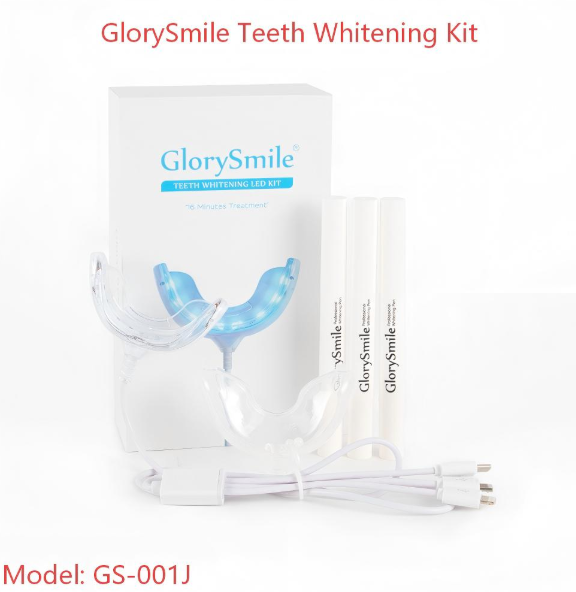
A practical point of reference is the GlorySmile Teeth Whitening LED Kit model GS-001J. The kit contains one 16-LED teeth whitening light, four 2ml whitening pens, a dust-free cover, four adapters for iPhone, Android, Type-C, and USB, a shade guide, user manual, and gift box. It operates as a plug-and-play device powered via USB from a phone, laptop, or power bank, with no built-in battery. Recommended treatment time is 16 minutes per day. Buyers should note the option for 24 or 32 LEDs on this model, which allows brands to sell a single visual design at different performance tiers.
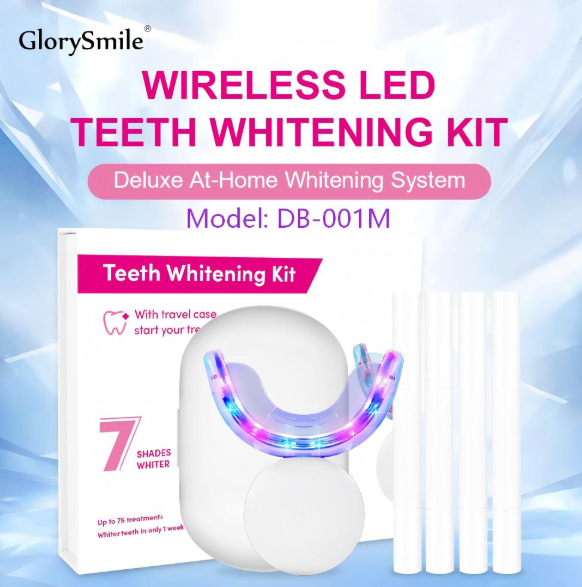
For buyers targeting wireless formats, the non-branded DB-001M kit uses a 32-LED light with an integrated 450mAh lithium ion battery. The kit includes four 2ml whitening pens, a storage case with charging cable, shade guide, manual, and gift box. With a charging time of 2–3 hours and battery life supporting up to eight uses per full charge, this model suits travel and convenience positioning. Its patent coverage—US Patent No. US D1,128,065 S, EU Patent No. 015065790-0001, and UK Patent No. 6377277—adds a layer of design protection that matters when a brand invests heavily in product marketing.
Premium Architecture with Hygiene Features
At the premium end, model GS-001X integrates a 32-LED light with a charging and sterilization case. The case contains a 400mAh lithium ion battery and uses two UV lights to achieve a 99.99% sterilization rate over a three-minute disinfection cycle that auto-starts when the case is closed. The main device is powered by a 150mAh battery, requires four hours to charge, and provides up to five uses per charge.
For wholesale buyers, the inclusion of UV sterilization in a teeth whitening kit changes the product's value proposition from simple whitening to device hygiene—a meaningful differentiator in markets where post-pandemic hygiene awareness remains high. This model also carries EU patent 015062946-0001 and UK patent 6370462, confirming that the design has been through formal registration rather than being an unbranded commodity unit.
Tray-Based Kits for Professional Use
A separate category exists for clinics and professional whitening labs. Model GS-001L is a clinic-use kit containing a 5ml dual-barrier whitening gel, a 3ml gum protector with two curved needles, a size-M cheek retractor, brush-ups, Vitamin-E swabs, saliva towels, face gauze, a bib, and an aluminum bag with sticker. The mouth tray is made of food-grade TPE. This configuration is not an at-home kit with clinical pretensions; it is a professionally oriented kit with the consumables needed for an in-office treatment workflow.
Formulation Strategy: Peroxide vs. Peroxide-Free vs. Multi-Active
Wholesale buyers need to understand that a teeth whitening kit is not a single formulation but a system that can be adapted to regulatory and consumer constraints. Suppliers that offer multiple whitening ingredients give buyers the flexibility to position the same hardware under different claims, or to direct different formulas to different geographic markets.
Three formulation families dominate the kits covered in this reference:
- Hydrogen Peroxide (HP): A fast-acting classic whitener. In the EU, products containing 0.1% to 6% hydrogen peroxide require a first treatment by a dentist under Directive 2011/84/EU, which places compliance obligations on market entry strategy.
- Carbamide Peroxide (CP): A slower-releasing peroxide compound often used in at-home kits because it breaks down into hydrogen peroxide. It is regulated in the same family as HP in most markets.
- PAP (Phthalimidoperoxycaproic Acid): A large-molecule, peroxide-free whitening agent. PAP is formulated for consumers seeking an enamel-friendly or low-sensitivity option, and it offers a different regulatory pathway in markets that classify peroxide whiteners as drugs or medical devices.
Beyond these core actives, the kits in the Glorysmile product family list additional components such as Sodium Phytate, Sodium Bicarbonate, and Charcoal. This multi-agent format suggests a move beyond simple bleaching toward stain removal, surface polishing, and enamel care in a single gel. Wholesale buyers evaluating private-label teeth whitening kits should ask their supplier for the complete ingredient list and the regulatory classification of each formula in their target countries.
For buyers targeting the sensitive-teeth segment, the supplier should be able to confirm PAP and low-sensitivity formulations. For buyers targeting markets with restrictive peroxide concentration rules, the ability to switch to a PAP-based formula without changing kit hardware is a practical supply-chain advantage.
Formulation Comparison: What Procurement Teams Should Weight
| Whitening System | Typical Active Ingredient | Advantages | Considerations | Best-Fit Sourcing Context |
|---|---|---|---|---|
| Peroxide (HP/CP) | Hydrogen Peroxide / Carbamide Peroxide | Fast results; clinically established; effective on a broad range of stains | May cause temporary sensitivity; subject to drug/medical-device regulation in some markets | Professional kits, clinics, markets with established peroxide regulatory pathways |
| PAP (Peroxide-Free) | Phthalimidoperoxycaproic Acid | Low sensitivity; enamel-friendly positioning; easier cosmetic classification | Results may develop more slowly on deep or intrinsic stains | US/AU e-commerce, sensitive-teeth consumers, cosmetic-classified products |
| Multi-Active Combination | HP/CP + PAP + Sodium Phytate + Charcoal in varying configurations | Broad claim support; enables formula differentiation by kit model | Requires clear labeling and per-active regulatory review | Brand line expansion, portfolio segmentation, private-label differentiation |
Buyers should verify not only which formulas are available but also what documentation accompanies each formula. MSDS, Certificate of Analysis, and stability data should be requested during the supplier qualification phase.
Custom Packaging, Private Label, and OEM/ODM Service Depth
The phrase "wholesale teeth whitening kit" in a sourcing context almost always includes expectations of private-label or OEM/ODM service. Buyers are not typically looking for finished consumer goods; they need a supplier that can adapt packaging, gel formulation, device color, and user documentation to a specific brand identity.
For the kit models covered here, support services consistently include custom packaging, custom gel ingredients, and custom pen or light colors. The minimum order quantity for private-label production is 200 pieces per model, while regular product orders begin at one piece. This MOQ structure enables early-stage brands to test the market with standard packaging before committing to larger custom runs—a workflow worth confirming early because it shortens the path from sample validation to first purchase order.
A relevant real-world proof point is the supplier's track record with e-commerce platform sellers. Factory case data indicate that Glorysmile's teeth whitening products have been used by cross-border e-commerce platform clients launching private-label brands. One global e-commerce project involving this product line achieved a sales volume of five million units over a two-year period, as an OEM project, and reached Top 10 Bestseller status with a 4.8-star rating. This type of documented outcome signals that the manufacturer's products can perform in competitive consumer marketplaces, not merely survive factory inspections.
Manufacturing Capability and Compliance: Data Points for Supplier Scoring
When scoring potential wholesale teeth whitening kit suppliers, buyers should prioritize a defined set of verifiable attributes. In the case of Jiangxi DentalBright Technology Co., Ltd. (also operating as the Glorysmile factory), the relevant reference points are as follows:
- Facility: A 36,000 m² factory with 20,000 m² of 100,000-class cleanrooms, designed for dust-controlled and contamination-free production environments.
- Testing Infrastructure: A 1,000-square-meter laboratory that includes a 100-class cleanroom for microbiological testing. This supports in-house verification of raw materials, semi-finished goods, and finished products.
- Team Structure: 256 employees, including 17 R&D engineers and 11 QC specialists. The R&D team drives formulation and design innovation, while QC performs inspections at each production stage.
- Regulatory Portfolio: Certifications include MDSAP, ISO 13485, ISO 22716, US GMP, BSCI, HALA, and VEGEA. The company also holds both medical device and cosmetics production licenses, and all products comply with FDA, CE, CPSR, PIF, CPNP, and other major international standards.
- Market Reach: Products exported to 102 countries, with principal demand from the EU, USA, and UK markets.
One nuance is worth noting for procurement teams. A factory can hold certifications that cover its management systems without those certifications extending to every individual product. Buyers should therefore request product-level documentation—FDA establishment registration and device listing for whitening lights and electric toothbrushes, MDR-CE certification for medical-device products, CPNP notification and CPSR reports for EU cosmetic products, and MoCRA-compliant cosmetic registration for US-market whitening strips—rather than relying on an aggregated certificate list.
Regulatory Variants That Influence Sourcing Decisions
A recurring source of buyer confusion is that the same teeth whitening kit format can be regulated differently depending on the market and the active ingredient concentration. Factory competence in managing these variations has become a procurement advantage in its own right.
United States Market
The US FDA recognizes ISO 28399:2021 as a consensus standard for external tooth bleaching products. In practice, the medical-device classification depends on the product's intended use. Teetwhitening lights and electric toothbrushes have obtained FDA medical device registration, and silicone rubber impression material has completed 510(k) registration. For cosmetic-framed products, MoCRA-compliant cosmetic facility registration and product listing may apply, as it does for whitening strips. Buyers launching in the US should clarify which registration pathway their product configuration will follow, since the answer affects labeling and establishment obligations.
European Union Market
The EU operates a stricter dual framework. Cosmetic products require CPNP notification, a CPSR (Cosmetic Product Safety Report), and an appointed EU Responsible Person. Medical devices require MDR-CE certification with a complete Technical File and an appointed EU Responsible Person. The concentration of peroxide in whitening gels is a primary determinant of which framework applies: products containing 0.1%–6% hydrogen peroxide must have a first dental treatment before sale to consumers, which restricts open e-commerce distribution. This is precisely why peroxide-free PAP formulas have become more attractive for EU online sales.
Market Trends Shaping Wholesale Teeth Whitening Kit Demand
Verified market data reinforces the commercial relevance of this sourcing category. The global teeth whitening market was valued at USD 8.93 billion in 2025 and is projected to reach USD 14.31 billion by 2034, according to Fortune Business Insights. These demand fundamentals are reflected in allocation data: the individual or at-home segment accounted for 68.67% of the market in 2024, confirming that consumer at-home systems, including LED kits, remain the primary volume driver.
Regional dynamics introduce a secondary consideration. Asia Pacific accounted for 33.80% of the teeth whitening market in 2025, according to Facts & Stats, although other analysts have suggested North America held the largest share in earlier periods. The discrepancy stems from whether the analysis includes professional dental services or focuses only on products. For wholesale buyers this matters less than the underlying signal: both regions are large enough to justify separate formulation, packaging, and compliance strategies, and neither should be treated as an afterthought in a sourcing plan.
How Wholesale LED Kits Compare with Traditional Whitening Solutions
For buyers entering the category, it is useful to position LED-based teeth whitening kits against conventional alternatives such as whitening toothpaste, whitening strips, and in-office laser treatments. Each format occupies a distinct part of the consumer value spectrum.
- Whitening toothpaste: Removes surface stains during regular brushing. Low-cost, high-frequency usage, but consumers rarely perceive dramatic shade change. Best as an entry-level or maintenance product, not as a results-driven hero SKU.
- Whitening strips: Dense gel delivery with good enamel contact. They are efficacious but limited in some formats by adhesion, residue, and the fact that the strip cannot actively accelerate the whitening chemistry beyond its contact time.
- LED whitening kits: Combine gel chemistry with light activation in a controlled treatment session. The kit format offers a "treatment ritual" that consumers can schedule, which often supports higher perceived value and repeat usage. LED kits also provide a natural upgrade path for brands already selling strips.
- In-office professional whitening: Highest efficacy and fastest shade improvement, but with higher cost and access barriers. Professional kits such as the GS-001L configuration allow suppliers to bridge the home and clinic categories, but the home market's growth prospects are stronger for volume-driven wholesale buyers.
One honest limitation should be considered by buyers: LED kits require more consumer compliance than toothpaste or strips because the user must follow a treatment schedule of roughly 10–16 minutes per day across multiple sessions. If the end consumer does not complete the protocol, perceived results will fall short regardless of the formulation's clinical potential. Brands that can pair kit hardware with strong usage education and consistency reminders typically see better repeat-purchase behavior.
Future Outlook for Teeth Whitening Kit Wholesale
The trajectory of the teeth whitening kit wholesale market points in three directions. First, formulation differentiation—particularly peroxide-free alternatives such as PAP and multi-active systems—will become a requirement for brands that want to sell across both EU and US channels without being blocked by peroxide concentration restrictions. Second, device hygiene features are graduating from premium novelty to standard expectation, accelerating the shift toward sterilization-capable storage cases. Third, supplier consolidation is likely: retailers and e-commerce brands will continue to reduce their factory lists to partners who can deliver the full service stack of formulation customization, certified manufacturing, and multiproduct portfolio expansion.
For buyers operating at the Awareness-to-Research stage, the next step does not need to be a large commitment. The practical path is to request samples of two distinct kit architectures—for example, a USB-powered entry model and a wireless sterilization-case model—and to evaluate the completeness of the accompanying documents as rigorously as the product's visual finish. Suppliers that can produce both with equal documentation quality are signaling readiness for a longer-term wholesale relationship.
Frequently Asked Questions About Wholesale Teeth Whitening Kits
What formulas are available for private-label teeth whitening kits?
Suppliers in this category typically offer hydrogen peroxide (HP), carbamide peroxide (CP), PAP (peroxide-free), and multi-active formulations that may include Sodium Phytate, Sodium Bicarbonate, or Charcoal. The choice of formula affects both the whitening profile and the regulatory classification of the product in the destination market.
What is the MOQ for a wholesale teeth whitening kit with custom packaging?
For the reference manufacturer in this article, the minimum order for private-label teeth whitening kits is 200 pieces per model. Regular product orders, using the supplier's own packaging, start from a single piece. This structure allows buyers to validate the market before committing to a large custom run.
Which certifications should a teeth whitening kit supplier hold?
A complete certification portfolio typically includes MDSAP, ISO 13485, ISO 22716, GMP, and BSCI at the factory level, plus product-level market registrations. For the EU, buyers should confirm CPSR, CPNP, PIF, and MDR-CE where applicable. For the US, FDA medical-device registration, 510(k) where required, and MoCRA-compliant cosmetic registration are relevant depending on product classification.
Are peroxide-free teeth whitening kits suitable for sensitive teeth?
Yes. PAP-based formulas are commonly positioned as low-sensitivity alternatives to peroxide whiteners. Because PAP is a large-molecule whitening agent, it works primarily on surface stains rather than penetrating deeply into the tooth structure, which helps reduce sensitivity during treatment.
What is the typical treatment protocol for an LED whitening kit?
Treatment protocols vary by model. In the reference product family, session times range from 10 minutes to 16 minutes per day, depending on the kit design and LED configuration. The lighter models in the lineup support roughly 30 to 40 sessions per set of included gel, while the 16-minute LED protocols are designed as a daily routine over a defined treatment period.
Is FDA approval different from FDA registration for whitening products?
Yes. FDA registration refers to establishment registration and device listing, while approval or clearance is a separate determination. The supplier states that its products are FDA approved, with certified scope covering medical devices, cosmetics, and OTC drugs, and that devices such as whitening lights have obtained FDA medical-device registration. Buyers should request the exact registration numbers and determine which classification applies to their specific product configuration.
Download the Glorysmile factory catalog (PDF) for complete product specifications and factory capability details.
Have Questions or Need More Details?
Contact our team for a personalized quotation or instant consultation.
Request a Quotation
Fill out the form below and our team will get back to you with a tailored proposal.
WhatsApp Direct Chat
Prefer to chat in real-time? Message us on WhatsApp for instant assistance & quick answers.
- Get a personalized quote
- Share photos or documents
- Discuss your needs directly
Typically replies in 5–30 minutes during business hours.