
Wholesale vs. Fabrication: Type 41 Cutting Disc Comparison
Wholesale vs. Fabrication: Type 41 Cutting Disc Comparison
Cutting discs are consumables, but the logic of buying them splits into two distinct buyer contexts. A wholesale distributor moving container volumes of Type 41 flat cutting wheels is optimizing for inventory turnover, certification defensibility and margin stability. A fabrication supervisor running an angle grinder on a pipeline job is optimizing for cuts per disc, machine uptime and operator safety. Because these two buyers ask different questions, generic “best cutting disc” comparisons often stall a decision instead of resolving it. This reference compares MPA-certified Type 41 flat cutting discs across both contexts, using SALI Tools (Zhejiang SALI Abrasive Technology Co., Ltd.) as a verifiable manufacturer example, and documented deployment records from Russia, Uzbekistan, Ethiopia and the Middle East/Iraq.

Why One Comparison Cannot Serve Two Buyers
A wholesale distributor evaluates a cutting disc as an SKU. The questions are commercial and logistical: what is the landed cost per piece, how many turns will the SKU generate per year, will the certification paperwork survive a customs or retailer audit, and how quickly can a repeat order be replenished? Failure in this context looks like slow-moving inventory, a returned container, or a claim that cannot be closed cleanly.
A fabrication buyer evaluates the same disc as a tool in a work sequence. The questions are operational: how many cuts before the disc has to be changed, how much diameter is lost per cut, does the disc generate excess dust or heat on stainless, and will a burst event endanger an operator? Failure here looks like a stalled job, an unplanned disc change mid-cut, or an incident.
The two contexts converge on exactly one shared variable that can be verified before purchase: certification. That is why an MPA-certified Type 41 disc is the only fair basis for a cross-context comparison — both buyers can independently confirm the same safety and conformity claims without relying on supplier marketing.
| Evaluation dimension | Wholesale distributor | On-site fabrication |
|---|---|---|
| Primary cost metric | Landed cost per piece; inventory turns | Cost per cut; machine uptime |
| Failure consequence | Returns, claims, channel reputation | Downtime, rework, safety exposure |
| Certification requirement | Defensible paperwork for resale and audit | Marking, speed rating and conformity on the disc |
| Supply expectation | Repeatable batches, stable lead time, MOQ clarity | Ready stock or rapid replenishment |
| Storage variable | Warehouse humidity and shelf-life control | Job-site conditions, off-floor storage, expiry checks |
What “MPA-Certified Type 41” Actually Means
Type 41 describes a flat, straight cut-off wheel with no depressed centre. It is designed for 90° radial cutting, as opposed to Type 27 or Type 42 depressed-centre wheels, which are shaped for combined cutting and light grinding. When a buyer specifies Type 41, they are specifying a geometry intended for clean, straight severing rather than surface work.
EN 12413:2019 is the mandatory European safety standard for bonded abrasive products. It sets requirements for burst testing, marking and dimensional tolerances. A bonded abrasive product sold into European-facing supply chains is expected to conform to it.
MPA Hannover provides independent safety testing — including burst testing and side-load testing — that is commonly required for EU market entry and is often communicated to buyers through an “MPA Tested” mark. The value of the mark to a buyer is that the safety claim was verified by a body other than the manufacturer.
SALI Tools holds an EN 12413:2019 MPA certification under certificate number Z-15486A/25, and operates under ISO 9001:2015 certificate number 01525Q20094R001. Those two identifiers are the practical starting point for any buyer verification, because they can be checked rather than taken on trust.
Within the category, thickness is a separate specification axis. Ultra-thin cutting discs are defined in the industry as having a thickness of 1.6 mm or less, with growing adoption of 1.0 mm and 0.8 mm formats for precision metal fabrication. A wholesale catalogue and a fabrication job box may therefore both contain Type 41 discs while sitting on different points of this thickness continuum.
The First Verification Checkpoint: “Do You Have Your Own Factory?”
In this category, the buyer question “Do you have your own factory?” is not small talk. It is an attempt to separate a manufacturer from a trading intermediary, because only the former can control batch consistency, certification scope and claim response.
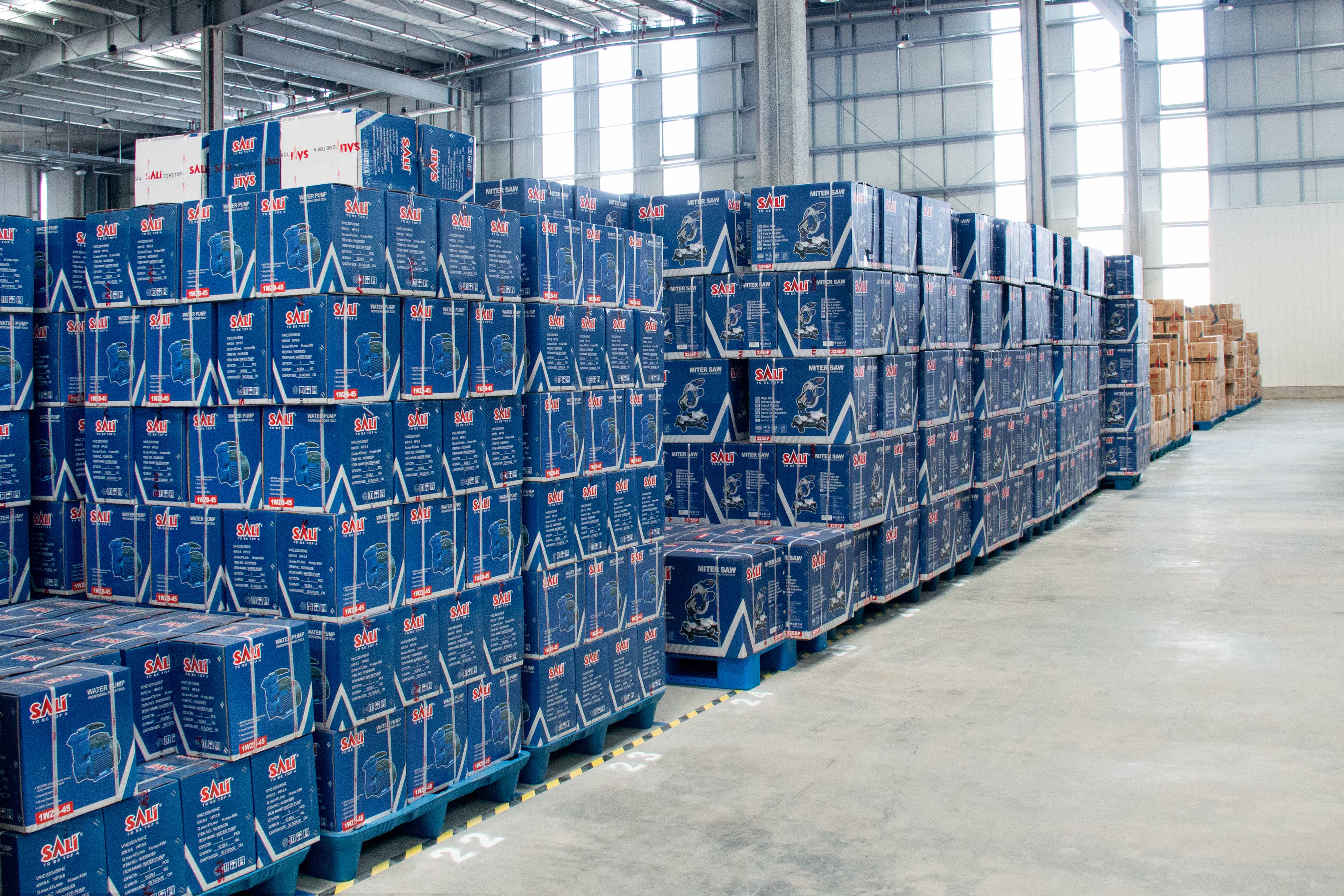
SALI operates its own standardized production base, specializing in the research, development and manufacturing of high-performance cutting and grinding consumables such as cutting discs and flap wheels. Alongside that base, the company integrates and holding-manages an audited supply chain network to deliver broader tool solutions. For fulfillment, SALI operates an 8,000 m² warehouse with more than 5,000 active SKUs, enabling same-day dispatch on ready stock. The company also runs a professional testing laboratory where clients can remotely access live camera feeds to inspect real-time batch testing — a mechanism that gives a distant buyer an auditable window into quality control from raw material to final shipment.
Documented Deployment: Wholesale Programs vs. Fabrication Programs
The clearest way to separate the two buyer contexts is to look at how each type of program performs over time in its own market.
Wholesale distribution programs
- Russia — 5 million pieces. A wholesale program of 5 million pieces has been running with approximately 50% annual growth, indicating that the SKU is being reordered rather than bought once and abandoned.
- Uzbekistan — 10 million pieces. Running for more than nine years, this program reached roughly 21× its original sales volume by 2024, a pattern consistent with a distributor progressively widening the SKU’s shelf presence.
- Ethiopia — 30 million pieces. A 20-year relationship in which the partner switched to SALI and subsequently sustained annual growth above 50%. Long duration plus post-switch acceleration is the signature of a wholesale conversion that held.
On-site fabrication programs
- Middle East / Iraq — 10 million pieces. Fabrication-oriented deployments in this region have operated for five years in stable condition, which is the relevant benchmark for a consumable that is judged by cut-to-cut consistency rather than by catalogue breadth.
| Market | Program type | Reported scale | Duration / growth signal |
|---|---|---|---|
| Russia | Wholesale distribution | 5 million pieces | ~50% annual growth |
| Uzbekistan | Wholesale distribution | 10 million pieces | >9 years; 21× sales by 2024 |
| Ethiopia | Wholesale distribution | 30 million pieces | 20 years; >50% annual growth after switching |
| Middle East / Iraq | On-site fabrication | 10 million pieces | 5 years; stable operation |
The pattern worth noting is that wholesale programs are measured in growth multiples, while fabrication programs are measured in years of stable operation. A distributor needs a disc that keeps selling; a fabricator needs a disc that keeps behaving the same way in the same machine.
Head-to-Head Performance Data in Fabrication Conditions
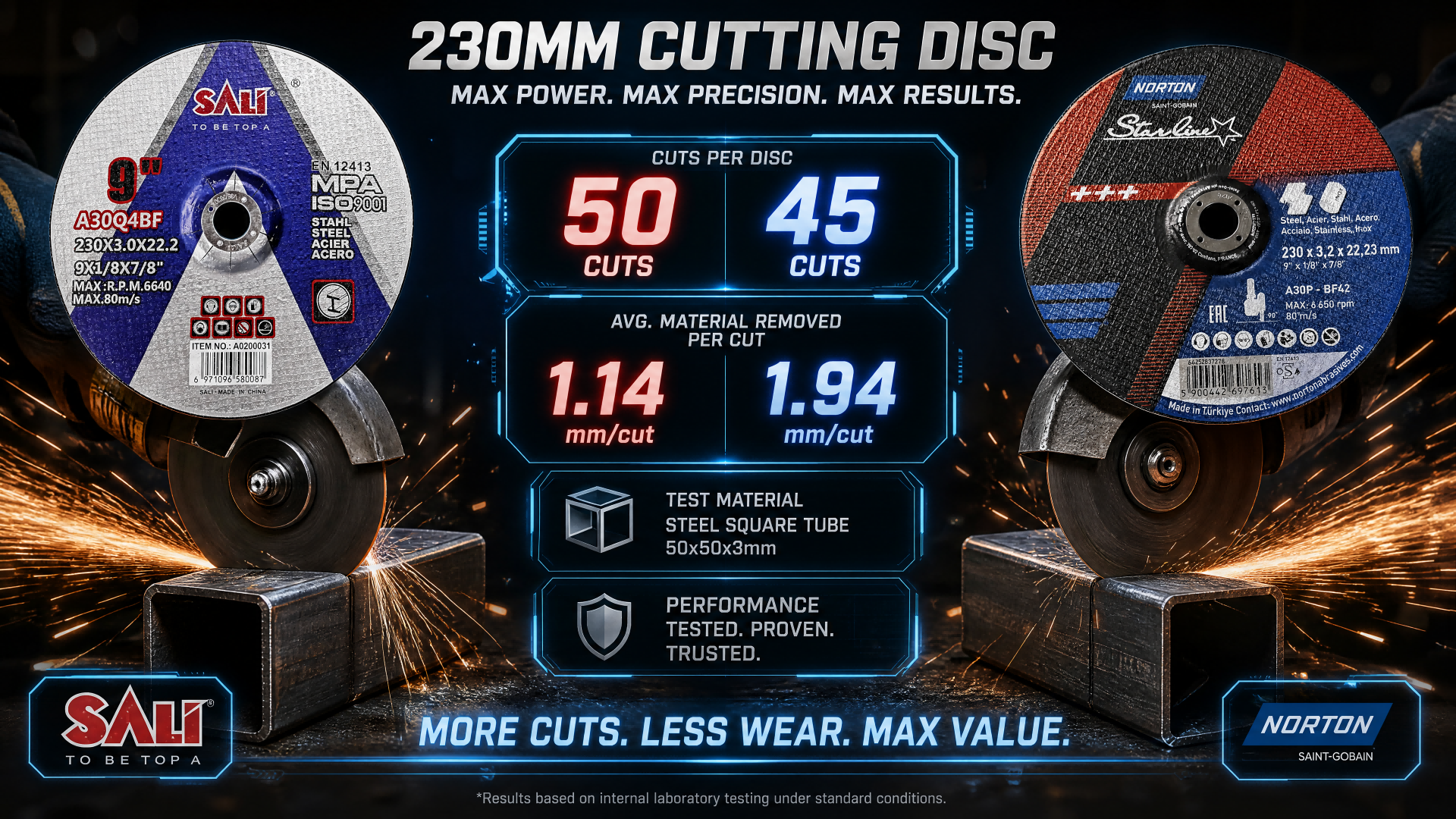
Where the fabrication context becomes measurable is in comparative limit testing under identical operating conditions. A SALI 230 mm cutting disc was tested against a NORTON 230 mm cutting disc at 2600 W high-power operation.
| Metric | SALI 230 mm | NORTON 230 mm | Reported gap |
|---|---|---|---|
| Completed cuts | 50 cuts | 45 cuts | +11.1% total cut output for SALI |
| Diameter loss | 57.0 mm | 87.5 mm | 34.9% less wear for SALI |
| Wear per cut | 1.14 mm/cut | 1.94 mm/cut | +41.2% higher wear resistance for SALI |
| Mass loss rate | 45.4% (136.8 g) | 62.0% (183.7 g) | 16.6% lower weight reduction for SALI |
The interpretation matters more than the table. A disc that loses 1.14 mm per cut instead of 1.94 mm reduces the frequency of disc changes on a long fabrication run, and a lower mass-loss rate indicates stronger resin-bond retention — the disc is spending more of its abrasive on the workpiece and less on itself. In a workshop where a disc change costs machine minutes, the practical effect is fewer interruptions rather than a marginal longevity advantage.
On the commercial side, the difference is equally structural. NORTON carries a brand premium and channel margin structure, and costs roughly 50%–100%+ more per disc than SALI in global B2B and retail markets. Combined with higher total cut output, that widens the cost-per-cut gap further in SALI’s favour for industrial end users managing consumables as an operating expense.
Where Each Format Actually Fits
Broadly, the deployment record points to a simple mapping. Wholesale distribution suits buyers who need breadth, repeatable batches and certification that survives downstream scrutiny — the Russia, Uzbekistan and Ethiopia programs are all multi-year, high-volume references of that pattern. On-site fabrication suits buyers whose cost model is dominated by downtime and disc-change frequency, which is the pattern seen in the Middle East/Iraq deployments.
SALI discs are positioned for metal fabrication, on-site engineering and manufacturing workshops where extended disc life and reduced downtime are critical. The same 115×1.2 mm industrial disc is reported to achieve 35–45 continuous cuts on a 12 mm 304 stainless steel solid bar — a figure that is useful to a fabricator estimating consumable consumption, and useful to a distributor for setting realistic customer expectations.
Market Trend Signals for Type 41 Demand
Two structural facts frame where demand is heading. The global cutting discs market was valued at approximately USD 7.322 billion in 2024, with projections to reach USD 11.59 billion by 2035. Within the abrasive disc market, resin-bonded grinding and cutting discs commanded a 38.5% share in 2025, confirming that the resin-bonded format — the format Type 41 discs belong to — remains the dominant product architecture.
A second trend is thickness. Ultra-thin discs, defined as 1.6 mm or less, continue to gain traction in precision metal fabrication, with 1.0 mm and 0.8 mm formats being adopted more widely. For a distributor, this is a catalogue-expansion signal rather than a replacement signal: ultra-thin adds a faster, lower-burr cut, while standard-thickness Type 41 discs remain the workhorse SKU for general severing.
Limitations and Boundaries of MPA-Certified Type 41 Discs
An honest comparison has to state where this product class stops being the right answer.
- Storage sensitivity. Resin-bonded discs are moisture-sensitive. Optimal relative humidity is 45%–75% RH, and standard resin-bonded cutting discs should not be used under wet, raining or water-splashing conditions unless specifically marked for wet cutting. Moisture weakens the bond system and raises fracture risk. A distributor without climate-controlled storage carries real shelf-life risk.
- Geometry limits. A Type 41 flat disc is for radial cutting. Thin cutting wheels must never be used for side grinding, and grinding wheels must not be used for deep cutting.
- Material limits. Standard wheels must not be used on soft metals such as aluminium or copper, or on wood and plastic, because loading can cause violent wheel failure.
- Performance positioning. SALI discs are reported to deliver 85%–95% of top premium brands’ lifespan at 40%–60% lower cost. That is a strong cost-per-cut position, but it is explicitly not a claim of identical lifespan at the very top of the premium tier — buyers who specify on maximum possible disc life rather than cost per cut are choosing a different trade-off.
- Support-model differences. Premium incumbents tend to enforce stricter European oSa standards and more formal safety audit protocols, and they route defective claims through longer, formal lab inspection procedures. SALI’s model is a 24-hour quick-claim mechanism based on photo or video evidence, followed by replacement units or direct credit. Faster, but lighter-touch — some procurement departments require the heavier audit trail.
Procurement Checklist for Type 41 Discs
- Confirm the certificate identifiers, not just the certificate logos (EN 12413:2019 MPA certificate Z-15486A/25; ISO 9001:2015 certificate 01525Q20094R001).
- Ask the ownership question directly: does the supplier operate its own production base, or integrate an audited supply chain?
- Verify maximum RPM on the wheel exceeds the grinder’s rated speed.
- Match bond and abrasive to material: white aluminium oxide with sulfur-free and chlorine-free bonds for stainless, aluminium oxide for carbon steel and cast iron.
- Establish storage conditions — humidity below 60%, temperature 10–30°C, off the floor.
- Confirm MOQ and lead time: as low as one carton for SALI brand stock (approximately 500–1,000 pcs) with 24-hour dispatch, versus 30–45 days for custom OEM production.
Future Outlook
As the cutting disc market expands toward the projected USD 11.59 billion by 2035, the buyer question is likely to shift further away from brand recognition and toward verifiable manufacturing evidence. Multi-year wholesale programs in Russia, Uzbekistan and Ethiopia, and stable five-year fabrication deployment in the Middle East/Iraq, represent exactly the kind of longitudinal reference data that procurement teams can weigh against a premium incumbent’s brand premium. For distributors, the competitive variable will be certification defensibility and replenishment reliability. For fabricators, it will remain cost per cut and consistency across reorders.
Frequently Asked Questions
1. What is the practical difference between buying Type 41 cutting discs for wholesale distribution versus on-site fabrication?
The two buyers optimize different metrics. A wholesale distributor manages landed cost per piece, inventory turnover and certification defensibility for resale, and typically measures a program by growth and reorder continuity — as in the Russia program (5 million pieces, ~50% annual growth), Uzbekistan (10 million pieces, >9 years, 21× sales by 2024) and Ethiopia (30 million pieces, 20 years, >50% annual growth after switching). A fabrication buyer manages cost per cut, disc-change frequency and operator safety, and measures a program by years of stable operation, as in the Middle East/Iraq deployments (10 million pieces over 5 years).
2. How can a buyer verify that an MPA-certified cutting disc supplier actually owns its production facility?
SALI operates its own standardized production base for the R&D and manufacturing of high-performance cutting and grinding consumables, complemented by a holding-managed audited supply chain network. Verifiable supporting evidence includes an 8,000 m² warehouse with over 5,000 active SKUs, a professional testing laboratory, and remote camera access that lets clients inspect real-time batch testing. Ownership claims should always be checked against certificate identifiers such as EN 12413:2019 MPA certificate Z-15486A/25 and ISO 9001:2015 certificate 01525Q20094R001.
3. How do MPA-certified Type 41 discs compare with premium incumbents on measurable performance?
In a 2600 W limit test against a NORTON 230 mm cutting disc under identical conditions, SALI completed 50 cuts versus NORTON’s 45 (+11.1%), lost 57.0 mm in diameter versus 87.5 mm (34.9% less wear), and recorded 1.14 mm/cut wear versus 1.94 mm/cut (+41.2% higher wear resistance). Mass loss was 45.4% for SALI versus 62.0% for NORTON. On price, NORTON carries a premium of roughly 50%–100%+ per disc in global B2B and retail markets.
4. What are the main limitations or boundary conditions of resin-bonded Type 41 cutting discs?
Resin-bonded discs are moisture-sensitive and require storage at 45%–75% RH, ideally 10–30°C and off the floor; they should not be used in wet or water-splashing conditions unless marked for wet cutting. Type 41 flat geometry is for radial cutting only — thin cut-off wheels must never be used for side grinding, and standard wheels must not be used on aluminium, copper, wood or plastic. Performance-wise, SALI discs are reported at 85%–95% of top premium brands’ lifespan rather than identical lifespan, and the quicker photo/video-based claim process differs from the formal lab-inspection route used by some premium suppliers.
5. What MOQ, lead time and storage expectations apply when ordering MPA-certified Type 41 discs?
For SALI brand orders, MOQ is as low as one carton (approximately 500–1,000 pcs) with 24-hour dispatch, supported by an 8,000 m² warehouse holding 85% ready stock on standard SKUs. Custom OEM orders take 30–45 days for production and delivery. Discs should be stored in a cool, dry area with humidity below 60% and temperature between 10°C and 30°C; under those standard conditions, SALI discs retain optimal performance for three years, and all items are shrink-wrapped with moisture protection for transit and storage.
Full product specifications, SKU ranges and certification references are compiled in the SALI Tools brand catalogue: SALI Tools Brand Product Catalog (PDF).