
Why 100kN Ball-Socket Glass Insulators Matter in Modern Overhead Line Design
Overhead transmission line design starts with the insulator, because the insulator defines the boundary between electrical stress and mechanical reliability. For medium-voltage lines crossing coastal, industrial, or high-humidity zones, a 100kN ball-socket aerodynamic glass insulator such as the U100BA offers a specific combination: tempered glass construction, a large 380mm disc, 365mm creepage distance, and pollution-oriented surface geometry. This article explains what that combination means for grid operators, EPC contractors, and procurement teams evaluating suspension glass insulator options under IEC-style requirements.
What the 100kN class covers in suspension insulator selection
The 100kN mechanical class sits between standard 70kN distribution insulators and the heavy 120–160kN classes used on extra-high-voltage lines. In practice, the 100kN rating is widely used for 66–220kV overhead lines where conductor loads, span lengths, and ice/wind loading require more than a 70kN unit, but where a 120kN or higher unit would add unnecessary weight and cost. For procurement, this class matters because it extends the service envelope without forcing a redesign of towers, string hardware, or foundation loads.
When evaluating a 100kN ball-socket suspension glass insulator, the critical parameters are mechanical failing load, creepage distance, coupling size, and pollution performance. A cap-and-pin structure with a hot-dip galvanized cast iron cap and hot-dip galvanized forged steel pin provides the mechanical interface. The glass body, made of tempered glass, provides dielectric strength and a self-blasting failure mode: if an electrical puncture occurs, the glass disc shatters into small fragments, making the fault visible from the ground during routine patrol.
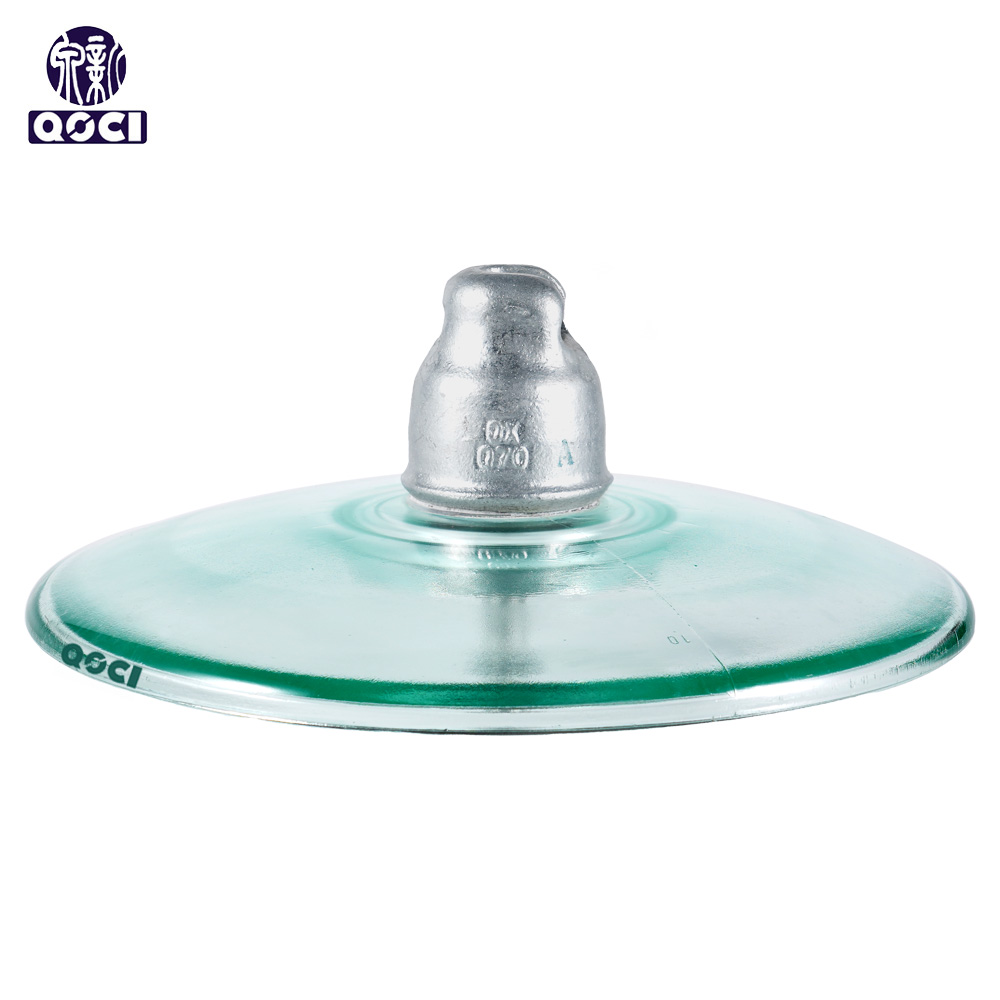
Why the aerodynamic profile is a functional choice, not a styling detail
The U100BA model is classified as a ball-socket aerodynamic glass insulator. The aerodynamic shed profile is shaped to reduce contamination build-up, because wind and rain can clean the surface more effectively than on conventional deep-ribbed profiles. In desert, agricultural, coastal salt-fog, and industrial environments, dust and salt deposits can accumulate on insulator surfaces and create a conductive path under moisture, leading to flashover. The aerodynamic profile lowers that risk by promoting self-cleaning while maintaining a 365mm creepage distance.
From an engineering standpoint, the U100BA has a nominal disc diameter of 380mm and a nominal spacing of 146mm. Its electrical ratings include a dry lightning impulse withstand voltage of 90kV and a wet power frequency withstand voltage of 45kV, with a power frequency puncture voltage of 130kV. The socket coupling size is 16, which matches standard 100kN-class string hardware and simplifies field assembly.
How the 100kN class fits into the wider glass insulator range
Jiangxi QOCI Electric Co., Ltd. is a China-based manufacturer of AC and DC insulators, specializing in glass and porcelain insulators for power transmission and distribution. Established in 2002 and located in Luxi Industrial Park, Pingxiang City, Jiangxi Province, QOCI Electric operates with a factory area of 35,373 m², over 138 employees, and an annual output of 9,000,000 units. The company supplies suspension glass insulators across multiple mechanical classes, from 70kN to 420kN, including standard, anti-pollution, double-shed, and aerodynamic profiles.
For the 100kN class, the catalog includes several variants with different pollution and mechanical targets:
| Model | Profile | Disc diameter | Spacing | Creepage | Key characteristic |
|---|---|---|---|---|---|
| U100BA | Aerodynamic / anti-fog | 380mm | 146mm | 365mm | Pollution and moisture resistance for coastal or industrial medium-voltage lines |
| U100BL | Standard disc, long creepage | 255mm | 146mm | 320mm | Heavy-pollution service under higher tension loads |
| U100BS | Standard disc | 255mm | 127mm | 320mm | General high-voltage transmission |
| U100BLP | Fog / anti-pollution | 280–320mm | 146mm | 450–550mm | Extended creepage and enhanced pin assembly for severe environments |
| U100BLD | Double-shed | 280mm | 146mm | 450mm | Increased shed count for dusty or industrial low-voltage environments |
This range matters to buyers because the same mechanical rating can serve different pollution climates. The right choice is not simply “100kN glass insulator”; it depends on site-specific pollution class, humidity, and contamination type.
Mechanical and corrosion considerations for long service life
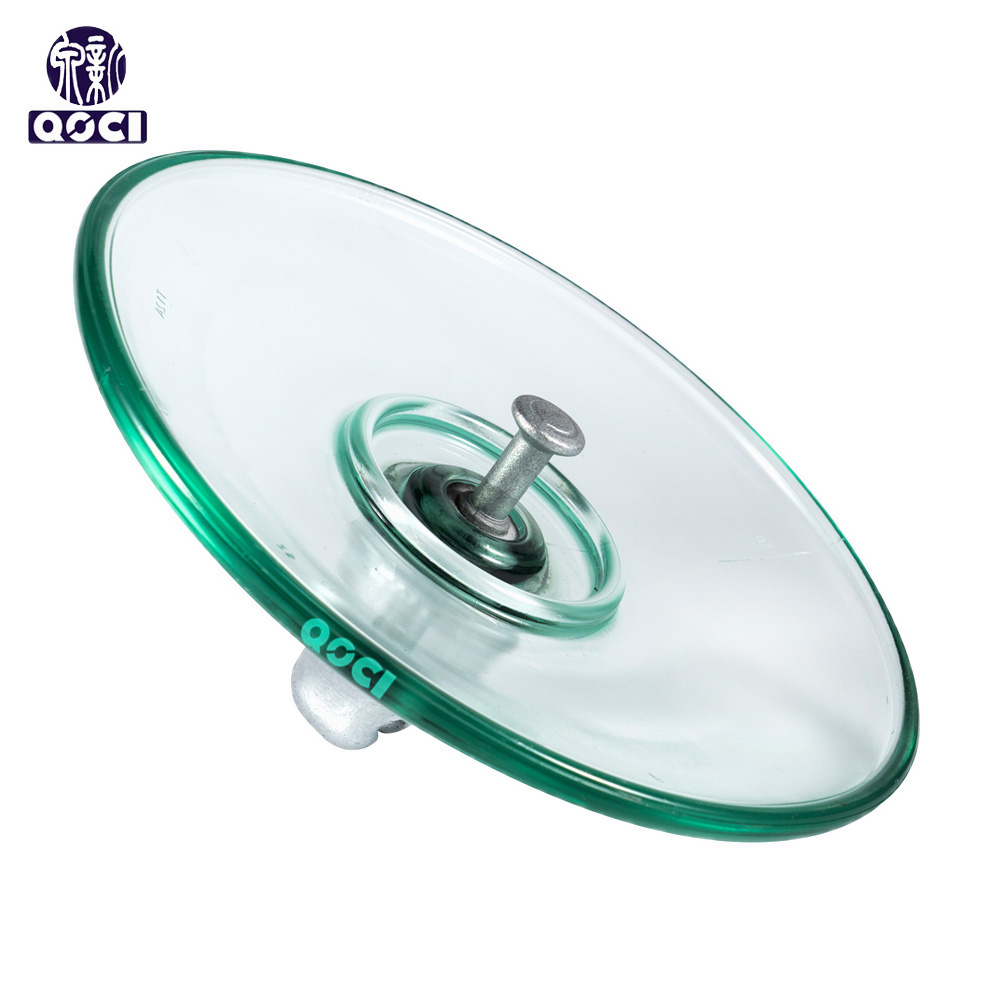
Insulator strings are expected to remain in service for decades without replacement. For the U100BA, the glass body is made of tempered glass, while the cap is hot-dip galvanized cast iron and the pin is hot-dip galvanized forged steel. Hot-dip galvanization is a standard defense against atmospheric corrosion for outdoor hardware. For severe corrosion service conditions, such as coastal salt-fog zones or industrial atmospheres, using a zinc sleeve can significantly slow down rusting and extend the service life of the insulator string.
Buyers evaluating 100kN insulators for corrosive environments should therefore ask whether the specified model includes a zinc-sleeved pin. In the broader QOCI product family, this option appears in the U70BLP, U100BLP, U120BLP, U160BLP, and U210BP models, where zinc sleeves are applied to the pin assembly. The U100BA aerodynamic model is primarily designed for pollution resistance; for combined heavy corrosion and pollution, a fog-type anti-pollution model with zinc-sleeved pin may be the more suitable specification.
Manufacturing and quality evidence
Jiangxi QOCI Electric Co., Ltd. operates as a national high-tech enterprise and participates in the Insulator Standard Committee. Its production program covers automated and intelligent manufacturing of glass insulators and porcelain insulators. Relevant quality certifications include:
- ISO 9001:2015 quality management system certificate, certificate number 00124Q33852R3M/3600, issued by China Quality Certification Centre;
- ISO 14001:2015 environmental management system certificate, certificate number 00125E30701R3M/3600;
- ISO 45001:2018 occupational health and safety management system certificate, certificate number 00125S30581R3M/3600.
In addition, QOCI Electric reports a monthly capacity of 750,000 units, a standard lead time of 15–35 days, and a minimum order quantity of 50 units. Quality control includes 100% pre-shipment testing and third-party inspection such as SGS, which is relevant for export-oriented grid projects that require independent verification.
Application scenarios: where the U100BA fits and where it does not
The aerodynamic anti-fog design of the U100BA is engineered for medium-voltage lines running through industrial or coastal regions. Its long creepage distance and anti-fog surface treatment provide maximum pollution and moisture resistance within the 100kN mechanical class. This makes it a strong candidate for:
- 66–220kV overhead lines in coastal salt-fog zones;
- Lines near industrial emission sources where dry dust or conductive deposits are the dominant pollution type;
- High-humidity climates where fog and condensation can wet polluted insulator surfaces;
- Projects where visual fault inspection is preferred over live-line testing.
The limitation is equally clear: 100kN is not a heavy-duty rating. For extra-high-voltage lines with very long spans, heavy conductor bundles, or extreme ice loads, engineers will normally move to 120kN, 160kN, or higher classes. In the QOCI range, the 120kN and 160kN families include standard, long-creepage, anti-pollution, and double-shed variants, while the 210kN to 420kN classes are reserved for UHV backbone and river-crossing projects. The U100BA therefore occupies a deliberate middle position: more mechanical margin than a 70kN unit, but not a substitute for a 160kN-class solution in severe mechanical loading.
Comparison with traditional porcelain insulators
For many buyers, the real comparison is not between glass models but between toughened glass and porcelain suspension insulators. Glass insulators offer two practical advantages in transmission service. First, a smooth glass surface accumulates dust more slowly and is easier to clean by rain, which is particularly valuable in desert and industrial pollution zones. Second, glass has a self-blasting failure mode: when electrical puncture occurs, the disc shatters visibly, so patrol crews can identify failed units from the ground without climbing towers or performing live-line zero-value tests.
Porcelain insulators, by contrast, are chemically inert and perform well in environments where the pollution source is acidic, alkaline, or solvent-based. However, a porcelain unit that fails electrically may show no visible external change, forcing utilities to use live-line testing or other diagnostic methods to locate the fault. This is a real operational difference that affects maintenance cost and outage risk.
That said, glass insulators are not without constraints. The self-breaking mechanism means that a unit can fail without any prior warning; the broken disc remains mechanically held by the cap and pin but has lost its electrical insulation. If a string experiences multiple self-breaks, the electrical performance of the whole string can be degraded until replacement. In practice, the industry benchmark self-breaking rate for qualified products is below 0.02% per year, and the failure remains visually detectable, but buyers should still factor in periodic patrol and replacement planning.
Market context and procurement signals
The global glass insulators market was estimated at USD 1.14 billion in 2024 and is projected to reach USD 1.97 billion by 2035, with a CAGR of 5.1% over the forecast period. Asia Pacific dominated the market with a revenue share above 52% in 2024, driven by grid expansion in China and India. China concentrated 31.4% of total global exports of electrical insulators in 2024, totaling USD 898 million. These figures indicate that glass insulator demand is closely tied to transmission grid construction, especially in high-growth Asian markets and export-driven manufacturing bases.
For procurement teams, the practical implication is that supplier selection should focus on verifiable criteria: IEC 60305 type test certification, self-breaking rate data, thermal shock testing capability, mechanical load ratings, and export history. QOCI Electric reports export markets including the USA, Asia, EU, Africa, and South America, with an export ratio of about 20%. The company’s production capacity and third-party inspection options make it viable for both project-based tenders and regular supply contracts.
Future outlook for the 100kN aerodynamic class
As grid operators in Asia, the Middle East, and Africa build new overhead lines through increasingly difficult environments, the demand for pollution-resistant glass insulators will likely shift toward a combination of aerodynamic geometry and larger disc diameters. The 100kN class will remain relevant because many medium-voltage lines do not require higher mechanical ratings, but they do need longer creepage distances and better self-cleaning behavior. Manufacturers that can offer aerodynamic 100kN units with consistent type-test data and low self-breaking rates are well positioned to serve that segment.
At the same time, the industry is paying more attention to total lifecycle cost. A 100kN glass insulator that enables visual fault detection and requires no live-line testing can reduce maintenance labor costs over decades of service. Buyers should therefore look beyond the unit price and evaluate the full cost of inspection, outage, and replacement. The U100BA’s combination of large-disc geometry and ball-socket compatibility provides a practical option for utilities standardizing on a 100kN class with enhanced pollution performance.
Selection checklist for 100kN suspension glass insulators
- Confirm the required mechanical failing load based on conductor weight, span, ice load, and wind load.
- Determine the site pollution class per IEC 60815 to select standard, anti-pollution, double-shed, or aerodynamic profile.
- Check the creepage distance and dry lightning impulse withstand voltage against the project’s electrical design.
- Verify socket coupling size to match string fittings and ball-socket hardware.
- For coastal or industrial corrosive zones, specify zinc-sleeved pins if available.
- Request evidence of IEC 60305 type testing, thermal shock testing, and self-breaking rate data.
- Review supplier production capacity, lead time, and third-party inspection capability.
- Compare the failure detection mode: glass self-blasting versus porcelain zero-value testing requirements.